Global Personal computers Market Highlights
| Market Size (2025) | USD 272 Billion |
| Forecast Size (2032) | USD 360.5 Billion |
| CAGR | 4.10% |
| Base Year | 2025 |
| Forecast Period | 2026-2032 |
| Largest Region | North America |
| Fastest Growing Region | Asia |
| Largest Segment | Commercial Notebook |
| Fastest Growing Segment | Consumer Notebook |
| Leading Companies | HP, Dell, Lenovo, Apple, Acer |
Global Personal computers Market Size & Growth Rate (2026-2032)
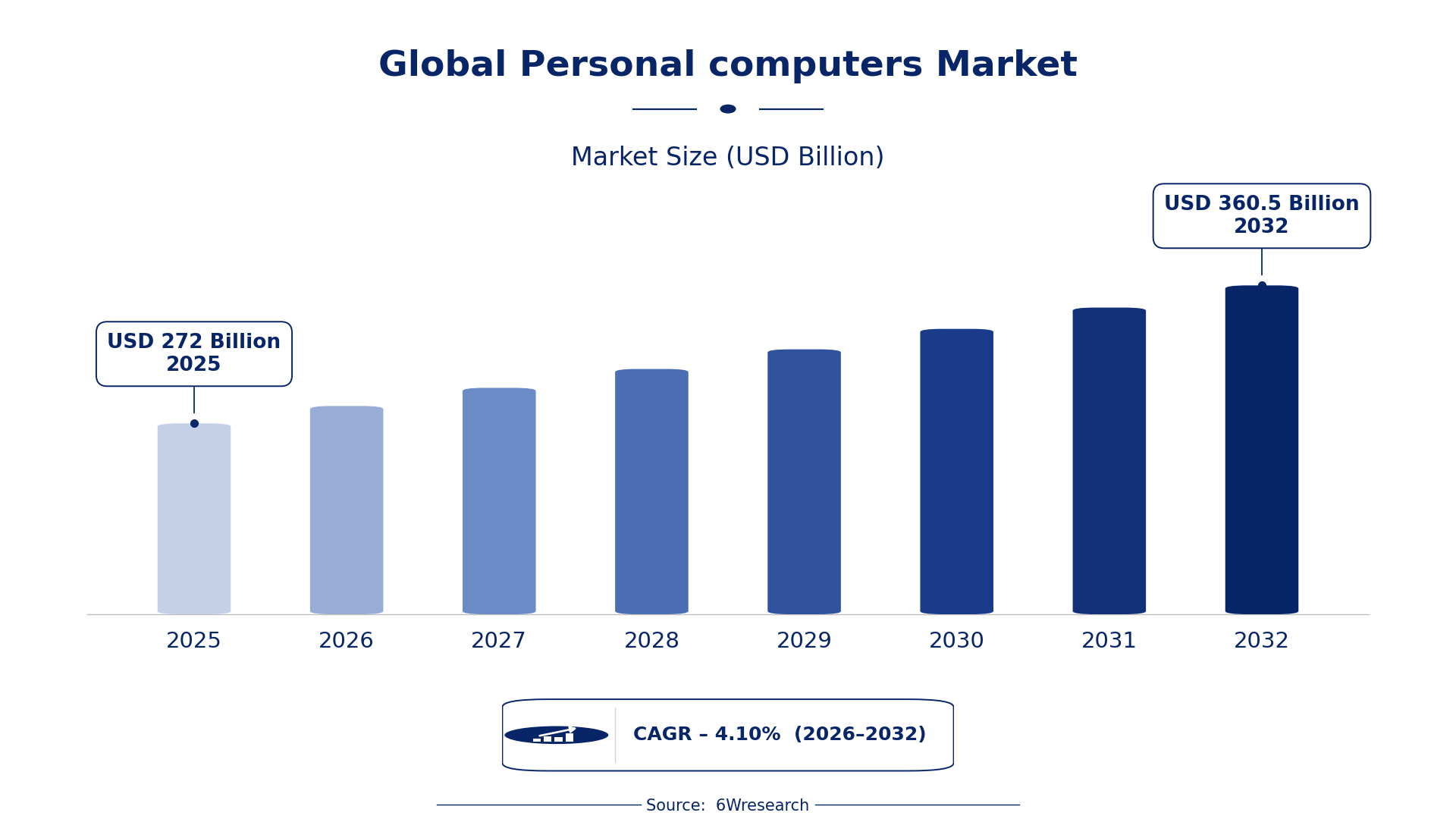
The Global Personal computers Market was estimated at USD 272 Billion in 2025 and is projected to reach USD 360.5 Billion by 2032, growing at a CAGR of 4.10% from 2026 to 2032.
Global Personal computers Market Synopsis
The ongoing transformation within the Global Personal computers Market signals an era marked by increased innovation and heightened user expectations. Factors such as remote work proliferation and the shift towards online learning are reshaping market dynamics, pushing manufacturers to focus on higher performance and greater versatility in their offerings. Companies are increasingly integrating advanced technologies that bridge the gap between portability and productivity.
Recent shifts in consumer behavior showcase a growing preference for mobile and ultra-portable devices such as laptops and tablets. This trend is evident among different demographics, including students and professionals alike, who demand machines that cater to both high performance and enhanced connectivity. Such changes underscore the critical importance of this market within the broader technological landscape.
Global Personal computers Market Year-wise Growth Rate and Key Drivers
This graph illustrates the annual growth rates of the Global Personal computers Market from 2022 to 2032, highlighting a steady upward trajectory and projected expansion over the forecast period.
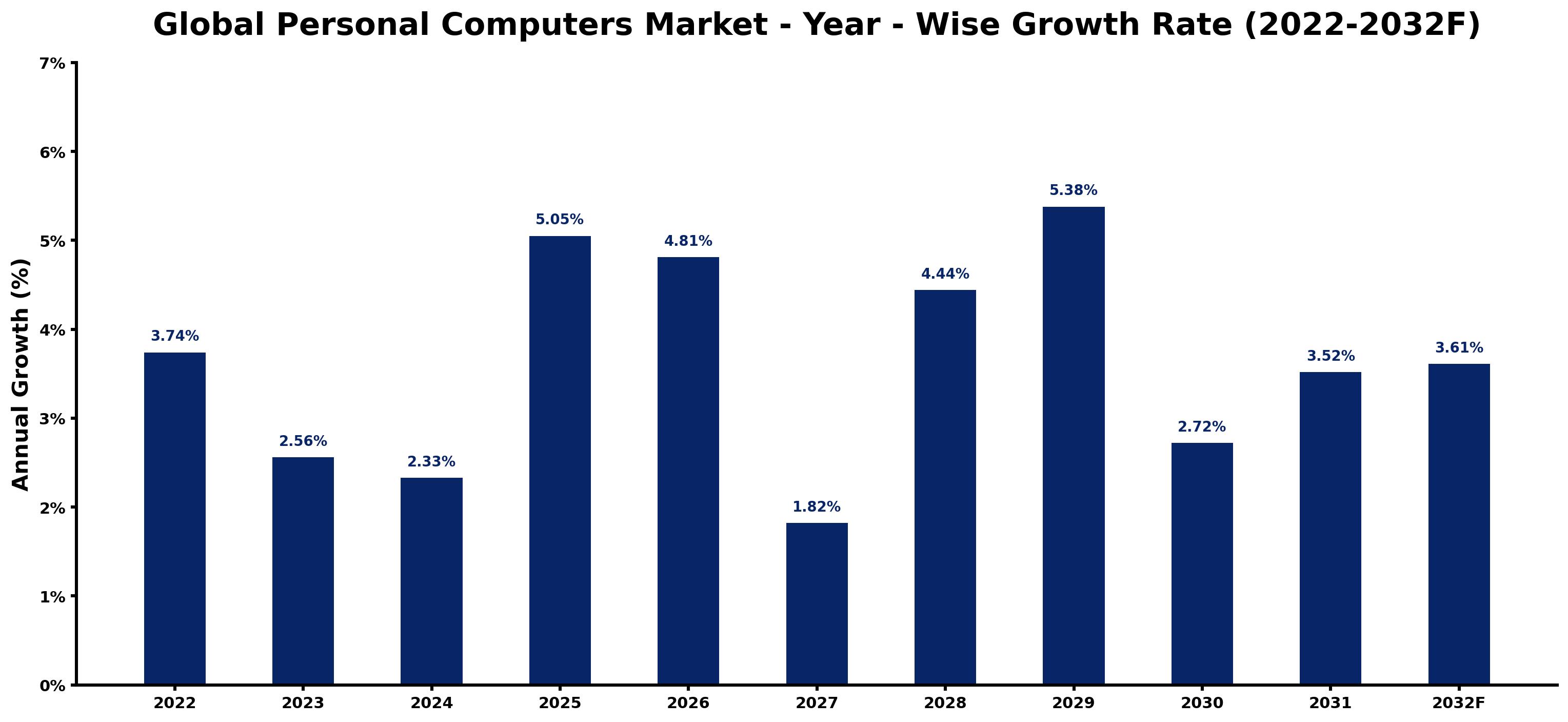
The table below presents the year‑wise growth rates along with the key drivers influencing the market
| Year | Growth Rate (%) | Major Drivers |
| 2022 | 3.71 | Rising raw material costs for semiconductors create challenges in personal computers production. |
| 2023 | 4.81 | Manufacturers increasingly seek skilled labor to meet personal computers demand. |
| 2024 | 2.04 | Advancements in chipset architecture are driving innovation in personal computers technology. |
| 2025 | 6.35 | Node shrinking methods allow manufacturers to enhance personal computers performance significantly. |
| 2026 | 3.03 | EUV lithography equipment supports sustainable practices in personal computers manufacturing. |
| 2027 | 4.02 | Consumers are actively seeking personal computers with enhanced GPU and memory features. |
| 2028 | 4.61 | A shift toward stricter environmental regulations changes production strategies for personal computers. |
| 2029 | 4.78 | In North America, consumers are prioritizing energy-efficient personal computers in their purchasing decisions. |
| 2030 | 5.42 | Retail channels are adapting to shifting demand for high-performance personal computers. |
| 2031 | 2.79 | As major tech firms pursue M&A activities, the personal computers sector experiences consolidation. |
| 2032 | 4.13 | Expanding geographic markets enables greater accessibility to advanced personal computers technology. |
Note - Market size estimations and growth projections presented in this report are based on 6Wresearch's proprietary research methodology, combining internal industry data, secondary research, and primary validation, updated periodically to reflect current market conditions. As markets evolve rapidly, figures for certain industries may vary slightly and are intended as informed estimates rather than absolute figures. For the most current market sizing, we recommend validating figures with a 6Wresearch analyst.
Global Personal computers Market Key Takeaways
Below are some of the specific key takeaways from the market, including:
- In 2025, Commercial Notebooks will hold the largest market share at approximately 38%.
- The Consumer Notebook segment is anticipated to grow at a remarkable CAGR of 6.5% from 2026 to 2032, signifying a shift in consumer priorities.
- North America is expected to maintain its position as the largest region, capturing around 45% of the market in 2025, due to its established technological infrastructure.
- HP and Dell remain key players in the market, focusing on high-performance devices that cater to gaming and professional segments.
- The rising demand for telecommuting solutions has been pivotal in driving awareness of the essential features needed in personal computers.
Evaluation of Restraints in Global Personal computers Market
The market for personal computers faces noteworthy constraints that significantly influence growth forecasts. A primary restraint is the escalating cost of semiconductor materials, which has surged by approximately 15% over the past two years. This cost escalation threatens to squeeze profit margins for manufacturers who are already grappling with the price-sensitive consumer base. For example, Dell has reported challenges in maintaining competitive pricing amidst these rising material costs, forcing them to explore alternative supply chains and materials to mitigate impacts on pricing structures.
Global Personal computers Market Trends
Several distinct trends are shaping the current operational landscape of the Global Personal computers Market. A significant shift towards artificial intelligence (AI) integration is revolutionizing user experience, with companies like Lenovo embedding AI-driven features in their latest line of laptops released in 2023. This integration enhances productivity and automates processes, appealing to both consumers and business clients. Additionally, the growing interest in gaming PCs has led to an increased focus on performance specifications, exemplified by HP's launch of its Omen series targeted at serious gamers.
Moreover, the educational sector is experiencing a paradigm shift, with institutions increasingly adopting digital learning platforms that require versatile devices, prompting significant investments in laptops and tablets. Consequently, manufacturers are focusing on developing more robust and durable products capable of accommodating rigorous daily use while ensuring a seamless learning experience.
Global Personal computers Market Opportunities
The future of the Global Personal computers Market presents a myriad of revenue opportunities linked to evolving consumer needs. A notable opportunity lies in the growing demand for hybrid work solutions, with companies such as Microsoft investing in education-focused devices designed to cater to students engaged in remote learning. This sector is projected to open a market potentially worth USD 2 billion by 2030. Furthermore, sustainability initiatives are gaining traction; manufacturers are beginning to use recycled materials, as seen with Dell's commitment to incorporate 100% recycled plastic into their devices by 2030, appealing to eco-conscious consumers and enhancing brand loyalty.
Additionally, advancements in cloud technologies offer manufacturers the chance to innovate and provide devices equipped for cloud-based functionalities, which are becoming increasingly essential in corporate environments. This transition could expand market reach significantly, particularly in sectors reliant on agile, collaborative workflows.
Global Personal computers Market by Product
In the Global Personal computers Market, the largest segment is the Commercial Notebook, commanding a market share of approximately 38% in 2025. This dominance can be attributed to increasing uptake in enterprise solutions, where portability and functionality are paramount. Conversely, the fastest-growing segment is the Consumer Notebook, projected to have a CAGR of 6.5% from 2026 to 2032, driven primarily by changing consumer lifestyles and the heightened demand for devices suited for personal and educational use.
Global Personal computers Market by Distribution Channel
Within the Global Personal computers Market, the Online distribution channel is experiencing significant growth, capturing a market share of around 60% as of 2025. This trend is propelled by the proliferation of e-commerce platforms and the convenience they offer consumers. The Offline distribution channel is also expanding, with a projected CAGR of 5% from 2026 to 2032, facilitated by strategic partnerships between retailers and manufacturers seeking to enhance in-store experiences.
Global Personal computers Market by Region
North America remains the largest region in the Global Personal computers Market, expected to achieve a share of about 45% in 2025 due to its advanced technological infrastructure and high consumer spending. In contrast, Asia is positioned as the fastest-growing region, driven by increasing urbanization and a burgeoning middle class, projected to grow at a CAGR of 5.8% from 2026 to 2032, reflecting high demand for personal computing devices in emerging markets.
Government Initiatives in the Global Personal computers Market
A recently evolving regulatory environment has resulted in several initiatives aimed at bolstering the Global Personal computers Market. Governments are increasingly recognizing the need to enhance digital infrastructure, which can significantly benefit market participants in the sector.
- U.S. Department of Education, "Education Transformation Initiative," launched in 2022, aims to provide funding for technological upgrades in schools to foster digital learning environments.
- European Commission, "Digital Europe Programme," ongoing since 2021, promotes digital transformation across Europe, including grants to accelerate personal computer usage in educational institutions.
- Ministry of Electronics and Information Technology (India), "Digital India Initiative," aimed at expanding digital access, set for implementation in phases through 2025, focusing on facilitating widespread access to affordable computing devices.
- Australian Government, "Business Recovery Fund," announced in 2023, seeks to support small businesses in acquiring personal computers and related technologies, reinforcing digital agility across sectors.
Future Insights of the Global Personal computers Market
As the Global Personal computers Market approaches 2032, we anticipate a pivotal transformation driven by advancements in AI and cloud computing. Companies like HP are expected to enhance integration with cloud services, allowing users seamless access to applications and storage. Moreover, the arrival of 5G technology will likely expedite connectivity and processing capabilities, reshaping devices to better accommodate remote working habits and on-demand services. This trajectory underlines the necessity for manufacturers to evolve their offerings in response to the complex demands of both corporate and consumer environments.
Global Personal computers Market Latest Developments
Recent initiatives in the Global Personal computers Market reflect strategic responses to shifting user needs and technological advancements. The following developments showcase key efforts made by leading companies:
- Dell recently announced a partnership with Qualcomm in September 2023, focusing on the development of laptops equipped with 5G technology, enhancing connectivity for remote work and urban professionals.
- In July 2023, Apple launched new models of its MacBook Pro, integrating M2 chips that significantly boost performance, positioning itself as a leader in processing power among consumer and professional devices.
- Lenovo is set to introduce a line of eco-friendly laptops made from sustainable materials by early 2024, aligning with market trends towards environmental responsibility and appealing to eco-conscious consumers.
- HP launched its Omen gaming series in March 2023, featuring cutting-edge graphics and cooling systems, targeting the expanding gaming community and reinforcing its competitive edge in performance laptops.
Global Personal computers Market Key Players and Industry Positioning
The competitive environment within the Global Personal computers Market is relatively consolidated, dominated by a handful of key players who control a significant market share. These companies leverage their technological prowess and strong brand recognition to maintain their leading positions while addressing evolving consumer needs.
| Leading Company | Core Strength | Strategic Focus |
|---|---|---|
| HP | Diversified product offerings across consumer and commercial PCs | Innovation in gaming and performance laptops |
| Dell | Strong enterprise solutions and customer service | Focus on 5G technology and cloud integration |
| Lenovo | Global reach and extensive R&D | Sustainability and AI-driven features |
| Apple | High-quality build and innovative chip technology | Premium laptops with cutting-edge processing power |
| Acer | Competitive pricing and strong market presence | Targeting educational and budget-conscious consumers |
These industry leaders continue to shape the Global Personal computers Market by strategically diversifying their portfolios and focusing on emerging technologies that align with consumer demands.
Key Attractiveness of the Report
- 10 Years of Market Numbers
- Historical Data Starting from 2022 to 2025
- Base Year: 2025
- Forecast Data until 2032
- Key Performance Indicators Impacting the Market
- Major Upcoming Developments and Projects
Key Highlights of the Report:
- Global Personal computers (PC) Market Outlook
- Market Size of Global Personal computers (PC) Market, 2025
- Forecast of Global Personal computers (PC) Market, 2032
- Historical Data and Forecast of Global Personal computers (PC) Revenues & Volume for the Period 2022-2032
- Global Personal computers (PC) Market Trend Evolution
- Global Personal computers (PC) Market Drivers and Challenges
- Global Personal computers (PC) Price Trends
- Global Personal computers (PC) Porter's Five Forces
- Global Personal computers (PC) Industry Life Cycle
- Historical Data and Forecast of Global Personal computers (PC) Market Revenues & Volume
- Historical Data and Forecast of Global Personal computers (PC) Market Revenues & Volume By Product for the Period 2022-2032
- Historical Data and Forecast of Global Personal computers (PC) Market Revenues & Volume By Commercial Desktop for the Period 2022-2032
- Historical Data and Forecast of Global Personal computers (PC) Market Revenues & Volume By Commercial Notebook for the Period 2022-2032
- Historical Data and Forecast of Global Personal computers (PC) Market Revenues & Volume By Consumer Desktop for the Period 2022-2032
- Historical Data and Forecast of Global Personal computers (PC) Market Revenues & Volume By Consumer Notebook and Workstation for the Period 2022-2032
- Historical Data and Forecast of Global Personal computers (PC) Market Revenues & Volume By Distribution Channel for the Period 2022-2032
- Historical Data and Forecast of Global Personal computers (PC) Market Revenues & Volume By Online for the Period 2022-2032
- Historical Data and Forecast of Global Personal computers (PC) Market Revenues & Volume By Offline for the Period 2022-2032
- Historical Data and Forecast of North America Personal computers (PC) Market Revenues & Volume By Product for the Period 2022-2032
- Historical Data and Forecast of North America Personal computers (PC) Market Revenues & Volume By Commercial Desktop for the Period 2022-2032
- Historical Data and Forecast of North America Personal computers (PC) Market Revenues & Volume By Commercial Notebook for the Period 2022-2032
- Historical Data and Forecast of North America Personal computers (PC) Market Revenues & Volume By Consumer Desktop for the Period 2022-2032
- Historical Data and Forecast of North America Personal computers (PC) Market Revenues & Volume By Consumer Notebook and Workstation for the Period 2022-2032
- Historical Data and Forecast of North America Personal computers (PC) Market Revenues & Volume By Distribution Channel for the Period 2022-2032
- Historical Data and Forecast of North America Personal computers (PC) Market Revenues & Volume By Online for the Period 2022-2032
- Historical Data and Forecast of North America Personal computers (PC) Market Revenues & Volume By Offline for the Period 2022-2032
- Historical Data and Forecast of United States of America Personal computers (PC) Market Revenues & Volume for the Period 2022-2032
- Historical Data and Forecast of Canada Personal computers (PC) Market Revenues & Volume for the Period 2022-2032
- Historical Data and Forecast of Rest of North America Personal computers (PC) Market Revenues & Volume for the Period 2022-2032
- Historical Data and Forecast of Latin America (LATAM) Personal computers (PC) Market Revenues & Volume By Product for the Period 2022-2032
- Historical Data and Forecast of Latin America (LATAM) Personal computers (PC) Market Revenues & Volume By Commercial Desktop for the Period 2022-2032
- Historical Data and Forecast of Latin America (LATAM) Personal computers (PC) Market Revenues & Volume By Commercial Notebook for the Period 2022-2032
- Historical Data and Forecast of Latin America (LATAM) Personal computers (PC) Market Revenues & Volume By Consumer Desktop for the Period 2022-2032
- Historical Data and Forecast of Latin America (LATAM) Personal computers (PC) Market Revenues & Volume By Consumer Notebook and Workstation for the Period 2022-2032
- Historical Data and Forecast of Latin America (LATAM) Personal computers (PC) Market Revenues & Volume By Distribution Channel for the Period 2022-2032
- Historical Data and Forecast of Latin America (LATAM) Personal computers (PC) Market Revenues & Volume By Online for the Period 2022-2032
- Historical Data and Forecast of Latin America (LATAM) Personal computers (PC) Market Revenues & Volume By Offline for the Period 2022-2032
- Historical Data and Forecast of Brazil Personal computers (PC) Market Revenues & Volume for the Period 2022-2032
- Historical Data and Forecast of Mexico Personal computers (PC) Market Revenues & Volume for the Period 2022-2032
- Historical Data and Forecast of Argentina Personal computers (PC) Market Revenues & Volume for the Period 2022-2032
- Historical Data and Forecast of Rest of LATAM Personal computers (PC) Market Revenues & Volume for the Period 2022-2032
- Historical Data and Forecast of Asia Personal computers (PC) Market Revenues & Volume By Product for the Period 2022-2032
- Historical Data and Forecast of Asia Personal computers (PC) Market Revenues & Volume By Commercial Desktop for the Period 2022-2032
- Historical Data and Forecast of Asia Personal computers (PC) Market Revenues & Volume By Commercial Notebook for the Period 2022-2032
- Historical Data and Forecast of Asia Personal computers (PC) Market Revenues & Volume By Consumer Desktop for the Period 2022-2032
- Historical Data and Forecast of Asia Personal computers (PC) Market Revenues & Volume By Consumer Notebook and Workstation for the Period 2022-2032
- Historical Data and Forecast of Asia Personal computers (PC) Market Revenues & Volume By Distribution Channel for the Period 2022-2032
- Historical Data and Forecast of Asia Personal computers (PC) Market Revenues & Volume By Online for the Period 2022-2032
- Historical Data and Forecast of Asia Personal computers (PC) Market Revenues & Volume By Offline for the Period 2022-2032
- Historical Data and Forecast of China Personal computers (PC) Market Revenues & Volume for the Period 2022-2032
- Historical Data and Forecast of India Personal computers (PC) Market Revenues & Volume for the Period 2022-2032
- Historical Data and Forecast of Japan Personal computers (PC) Market Revenues & Volume for the Period 2022-2032
- Historical Data and Forecast of Rest of Asia Personal computers (PC) Market Revenues & Volume for the Period 2022-2032
- Historical Data and Forecast of Africa Personal computers (PC) Market Revenues & Volume By Product for the Period 2022-2032
- Historical Data and Forecast of Africa Personal computers (PC) Market Revenues & Volume By Commercial Desktop for the Period 2022-2032
- Historical Data and Forecast of Africa Personal computers (PC) Market Revenues & Volume By Commercial Notebook for the Period 2022-2032
- Historical Data and Forecast of Africa Personal computers (PC) Market Revenues & Volume By Consumer Desktop for the Period 2022-2032
- Historical Data and Forecast of Africa Personal computers (PC) Market Revenues & Volume By Consumer Notebook and Workstation for the Period 2022-2032
- Historical Data and Forecast of Africa Personal computers (PC) Market Revenues & Volume By Distribution Channel for the Period 2022-2032
- Historical Data and Forecast of Africa Personal computers (PC) Market Revenues & Volume By Online for the Period 2022-2032
- Historical Data and Forecast of Africa Personal computers (PC) Market Revenues & Volume By Offline for the Period 2022-2032
- Historical Data and Forecast of South Africa Personal computers (PC) Market Revenues & Volume for the Period 2022-2032
- Historical Data and Forecast of Nigeria Personal computers (PC) Market Revenues & Volume for the Period 2022-2032
- Historical Data and Forecast of Egypt Personal computers (PC) Market Revenues & Volume for the Period 2022-2032
- Historical Data and Forecast of Rest of Africa Personal computers (PC) Market Revenues & Volume for the Period 2022-2032
- Historical Data and Forecast of Europe Personal computers (PC) Market Revenues & Volume By Product for the Period 2022-2032
- Historical Data and Forecast of Europe Personal computers (PC) Market Revenues & Volume By Commercial Desktop for the Period 2022-2032
- Historical Data and Forecast of Europe Personal computers (PC) Market Revenues & Volume By Commercial Notebook for the Period 2022-2032
- Historical Data and Forecast of Europe Personal computers (PC) Market Revenues & Volume By Consumer Desktop for the Period 2022-2032
- Historical Data and Forecast of Europe Personal computers (PC) Market Revenues & Volume By Consumer Notebook and Workstation for the Period 2022-2032
- Historical Data and Forecast of Europe Personal computers (PC) Market Revenues & Volume By Distribution Channel for the Period 2022-2032
- Historical Data and Forecast of Europe Personal computers (PC) Market Revenues & Volume By Online for the Period 2022-2032
- Historical Data and Forecast of Europe Personal computers (PC) Market Revenues & Volume By Offline for the Period 2022-2032
- Historical Data and Forecast of United Kingdom Personal computers (PC) Market Revenues & Volume for the Period 2022-2032
- Historical Data and Forecast of France Personal computers (PC) Market Revenues & Volume for the Period 2022-2032
- Historical Data and Forecast of Germany Personal computers (PC) Market Revenues & Volume for the Period 2022-2032
- Historical Data and Forecast of Rest of Europe Personal computers (PC) Market Revenues & Volume for the Period 2022-2032
- Historical Data and Forecast of Middle East Personal computers (PC) Market Revenues & Volume By Product for the Period 2022-2032
- Historical Data and Forecast of Middle East Personal computers (PC) Market Revenues & Volume By Commercial Desktop for the Period 2022-2032
- Historical Data and Forecast of Middle East Personal computers (PC) Market Revenues & Volume By Commercial Notebook for the Period 2022-2032
- Historical Data and Forecast of Middle East Personal computers (PC) Market Revenues & Volume By Consumer Desktop for the Period 2022-2032
- Historical Data and Forecast of Middle East Personal computers (PC) Market Revenues & Volume By Consumer Notebook and Workstation for the Period 2022-2032
- Historical Data and Forecast of Middle East Personal computers (PC) Market Revenues & Volume By Distribution Channel for the Period 2022-2032
- Historical Data and Forecast of Middle East Personal computers (PC) Market Revenues & Volume By Online for the Period 2022-2032
- Historical Data and Forecast of Middle East Personal computers (PC) Market Revenues & Volume By Offline for the Period 2022-2032
- Historical Data and Forecast of Saudi Arabia Personal computers (PC) Market Revenues & Volume for the Period 2022-2032
- Historical Data and Forecast of UAE Personal computers (PC) Market Revenues & Volume for the Period 2022-2032
- Historical Data and Forecast of Turkey Personal computers (PC) Market Revenues & Volume for the Period 2022-2032
- Historical Data and Forecast of Rest of Middle East Personal computers (PC) Market Revenues & Volume for the Period 2022-2032
- Global Personal computers (PC) Market - Key Performance Indicators
- Global Personal computers (PC) Market - Import Export Trade Statistics
- Global Personal computers (PC) Market - Opportunity Assessment By Countries
- Global Personal computers (PC) Market - Opportunity Assessment By Product
- Global Personal computers (PC) Market - Opportunity Assessment By Distribution Channel
- Global Personal computers (PC) Market - Top Companies Market Share
- Global Personal computers (PC) Market - Top Companies Profiles
- Global Personal computers (PC) Market - Comparison of Players in Technical and Operating Parameters
- Global Personal computers (PC) Market - Strategic Recommendations
Markets Covered
The Global Personal computers (PC) Market report provides a detailed analysis of the following market segments:
By Regions and Countries:
- North America
- Europe
- LATAM
- Middle East
- Asia
- Africa
By Product:
- Commercial Desktop
- Commercial Notebook
- Consumer Desktop
- Consumer Notebook
- Workstation
By Distribution Channel:
- Online
- Offline






































