Global Propylene Glycol Market Highlights
| Market Size (2025) | USD 33 Billion |
| Forecast Size (2032) | USD 56 Billion |
| CAGR | 7.20% |
| Base Year | 2025 |
| Forecast Period | 2026-2032 |
| Largest Region | North America |
| Fastest Growing Region | Asia |
| Largest Segment | Food, Drug, and Cosmetics |
| Fastest Growing Segment | Functional Fluids |
| Leading Companies | Dow Chemical Company, BASF SE, Archer Daniels Midland Company, LyondellBasell Industries, and Ineos Group |
Global Propylene Glycol Market Size & Growth Rate (2026-2032)
The Global Propylene Glycol Market was estimated at USD 33 Billion in 2025 and is projected to reach USD 56 Billion by 2032, growing at a CAGR of 7.20% from 2026 to 2032.
Global Propylene Glycol Market Synopsis
The Global Propylene Glycol Market is in a transformative phase characterized by increasing demand from diverse sectors such as pharmaceuticals, food and beverage, and automotive. Notably, propylene glycol’s role in enhancing product stability and shelf life is reshaping consumer expectations and usage patterns. As manufacturers seek to optimize formulations with non-toxic ingredients, the drive for higher-grade propylene glycol is becoming pronounced.
Competition is intensifying as companies invest in innovative production techniques to meet sustainability goals. The shift towards bio-based alternatives is also gaining traction, challenging traditional methodologies and impacting pricing structures. This dynamic, multifaceted environment positions the Global Propylene Glycol Market at the center of industrial evolution.
Global Propylene Glycol Market Year-wise Growth Rate and Key Drivers
This graph illustrates the annual growth rates of the Global Propylene Glycol Market from 2022 to 2032, highlighting a steady upward trajectory and projected expansion over the forecast period.
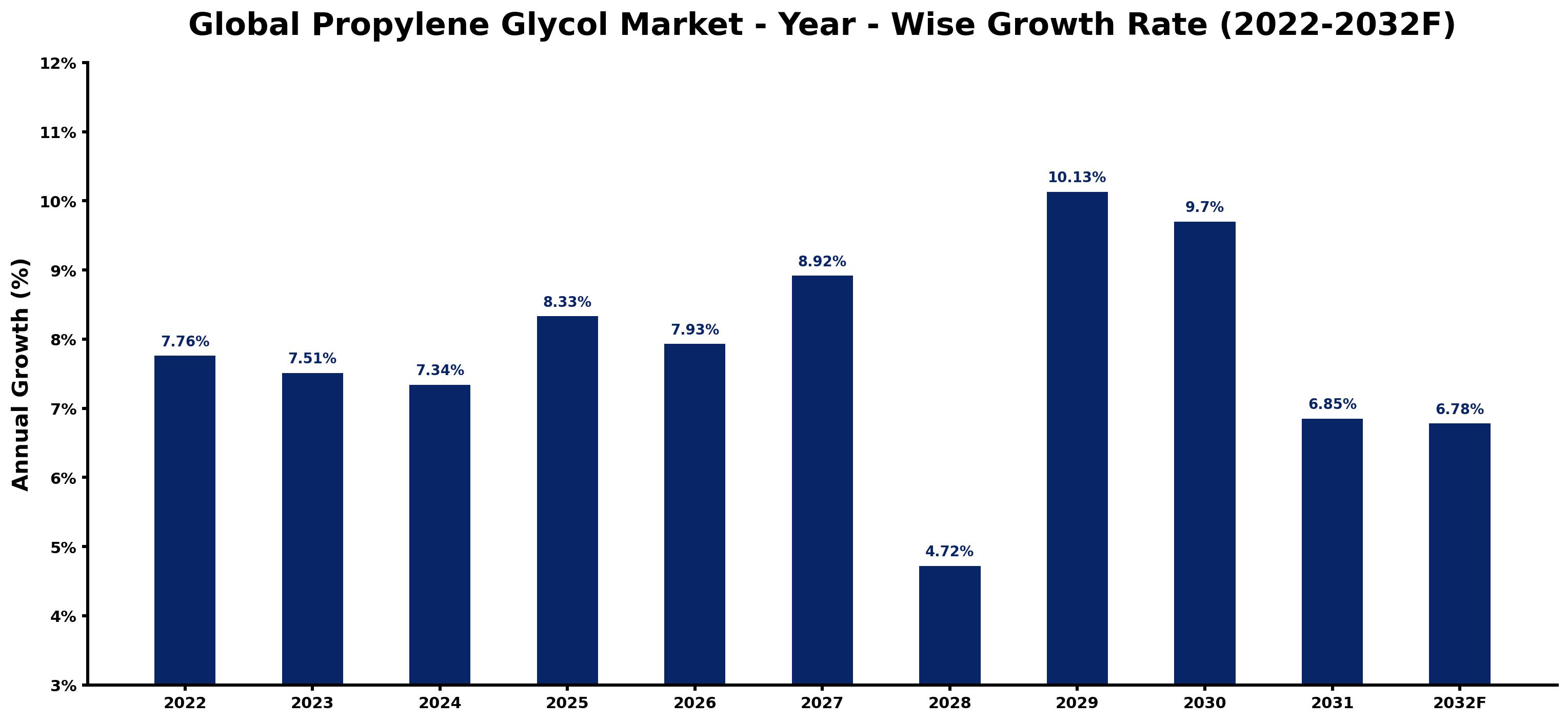
The table below presents the year‑wise growth rates along with the key drivers influencing the market
| Year | Growth Rate (%) | Major Drivers |
| 2022 | 7.76 | A competitive landscape shift encourages the adoption of propylene glycol as a key ingredient. |
| 2023 | 7.51 | In North America, increased M&A activity stimulates innovation within propylene glycol production. |
| 2024 | 7.34 | Supply chain bottlenecks in raw materials constrain propylene glycol availability in the market. |
| 2025 | 8.33 | Manufacturers prioritize propylene glycol due to new regulatory compliance requirements for sustainability. |
| 2026 | 7.93 | A shift toward bio-based propylene glycol expands production capabilities across various regions. |
| 2027 | 8.92 | Petrochemical cracking technology reduces the raw material costs associated with propylene glycol synthesis. |
| 2028 | 4.72 | Embracing green chemistry principles drives the adoption of sustainable propylene glycol solutions. |
| 2029 | 10.13 | Manufacturers are investing in performance coatings that utilize advanced propylene glycol formulations. |
| 2030 | 9.7 | As consumer preferences shift toward eco-friendly products, propylene glycol demand accelerates. |
| 2031 | 6.85 | Additive manufacturing materials increasingly require specialized propylene glycol to enhance their properties. |
| 2032 | 6.78 | Chemical distributors recognize the demand for propylene glycol from food and beverage companies. |
Note - Market size estimations and growth projections presented in this report are based on 6Wresearch's proprietary research methodology, combining internal industry data, secondary research, and primary validation, updated periodically to reflect current market conditions. As markets evolve rapidly, figures for certain industries may vary slightly and are intended as informed estimates rather than absolute figures. For the most current market sizing, we recommend validating figures with a 6Wresearch analyst.
Global Propylene Glycol Market Key Takeaways
Below are some of the specific key takeaways from the market, including:
- In pharmaceutical applications, propylene glycol accounts for approximately 40% of the segment's total usage.
- Asia is projected to be the fastest-growing region, anticipated to expand at a CAGR of 9.5% from 2026 to 2032.
- Dow Chemical Company recently expanded its propylene glycol production capacity by 20% in response to growing market demands.
- The functional fluids segment is estimated to grow at a CAGR of 8.2% between 2026 and 2032, due to increasing applications in automotive and industrial sectors.
- Regulatory compliance is tightening, with new environmental guidelines effective from 2025 impacting production methods.
Evaluation of Restraints in Global Propylene Glycol Market
The Global Propylene Glycol Market faces challenges largely driven by fluctuating raw material costs, such as a documented 15% increase in prices over the last two years. This volatility complicates forecasting and pricing strategies for manufacturers. In addition, competitive pressure from bio-based alternatives poses a substantial threat, as organizations like BASF are increasingly pivoting towards greener product lines. For example, BASF's bio-based product range has captured approximately 25% market share within its segment, indicating shifting consumer preferences towards eco-friendly alternatives.
Global Propylene Glycol Market Trends
There are significant shifts shaping the Global Propylene Glycol Market, influenced by changing production methodologies and consumer preferences. One notable trend is the increasing adoption of bio-based pathways for production. Companies like Archer Daniels Midland are investing heavily in sustainable practices, with projections indicating that bio-based propylene glycol will constitute around 30% of their production by 2028. Additionally, technological advancements in manufacturing processes enhance the efficiency and reduce the carbon footprint of propylene glycol production. For example, a recent upgrade at a production facility by LyondellBasell has led to a 20% reduction in energy consumption. These operational changes demonstrate the industry's shift toward more responsible manufacturing.
Global Propylene Glycol Market Opportunities
The future landscape of the Global Propylene Glycol Market presents significant revenue potential, particularly in sectors tapping into sustainability initiatives. The increasing emphasis on renewable energy solutions gives rise to applications in battery manufacturing and energy storage systems, where propylene glycol serves as an effective coolant and solvent. For instance, a recent project by Ineos Group, highlighted in 2023, is set to enter the energy market, leveraging propylene glycol’s properties for improved battery performance. This move is expected to open new revenue channels, driving growth in this segment.
Global Propylene Glycol Market by Application
In the Global Propylene Glycol Market, the Food, Drug, and Cosmetics segment leads with an impressive share of approximately 45% in 2025. This dominance stems from the essential role of propylene glycol as a solvent and stabilizer in various consumer products. Meanwhile, the Functional Fluids segment is the fastest-growing, projected to develop at a CAGR of 8.7% from 2026 to 2032. This growth is attributed to increasing demand in sectors focused on enhancing product safety and efficacy, particularly in automotive applications such as antifreeze and engine coolants.
Global Propylene Glycol Market by Region
North America holds the largest share of the Global Propylene Glycol Market, commanding approximately 50% in 2025. The region’s robust industrial manufacturing ecosystem and consistent demand from the pharmaceuticals and food processing sectors underpin this leadership. Conversely, Asia is emerging as the fastest-growing region, expected to witness a CAGR of 9.1% from 2026 to 2032, driven by expanding industrial applications and rising consumption of cosmetics and personal care products.
Government Initiatives in the Global Propylene Glycol Market
Government policies are pivotal in shaping the operational landscape of the Global Propylene Glycol Market, focusing on sustainability and safety. These initiatives impact production methods, regulatory compliance, and market dynamics. Various government bodies are implementing programs to foster growth while adhering to stringent environmental regulations.
- U.S. Environmental Protection Agency (EPA) - New Chemical Notifications under the Toxic Substances Control Act, effective 2023: This initiative aims to evaluate the environmental impact of new propylene glycol formulations, encouraging cleaner production methods.
- European Commission - REACH Regulation, updated in 2022: This regulation mandates safety assessments and registrations of chemical substances, including propylene glycol, to ensure sustainability and consumer safety in the European market.
- National Renewable Energy Laboratory (NREL) - Bio-based Product Initiative, launched in 2021: This program supports research and development for bio-based propylene glycol, aligning with renewable energy goals.
- Ministry of Environment, Government of India - Draft National Chemical Policy, 2024 (planned): Aims to enhance the circular economy in chemical manufacturing by promoting sustainable practices in propylene glycol production.
Future Insights of the Global Propylene Glycol Market
The trajectory of the Global Propylene Glycol Market is increasingly being influenced by sustainability initiatives and technological advancements. As seen recently, Archer Daniels Midland's commitment to bio-based production could lead to around 30% of its output being derived from sustainable sources by 2028, reflecting a broader industry shift. This movement towards eco-friendly solutions is likely to reshape production strategies, encouraging more companies to follow suit, thus enhancing the market’s resilience against price volatility and regulatory challenges, especially in regions with stringent environmental standards.
Global Propylene Glycol Market Latest Developments
Recent developments in the Global Propylene Glycol Market demonstrate a proactive approach among key players to meet evolving market demands and regulatory requirements. The initiatives taken reflect both adaptation to consumer preferences and strategies for enhancing competitive advantages.
- Dow Chemical Company is actively working on expanding its propylene glycol production capacity, which is expected to be completed by mid-2024. This expansion will strengthen its market presence amid rising demand.
- BASF SE is anticipated to launch a new line of bio-based formulations by late 2023, aiming to capture a growing segment focused on sustainable ingredients in food and cosmetics.
- Ineos Group recently initiated a pilot program for propylene glycol applications in energy storage systems, set to commence in early 2024, targeting the renewable energy market.
- LyondellBasell has implemented upgraded manufacturing technologies at its plants, achieving notable efficiency improvements that are projected to be fully operational by 2025.
Global Propylene Glycol Market Key Players and Industry Positioning
The competitive landscape in the Global Propylene Glycol Market is moderately consolidated, with a few key players holding a substantial share while various other firms contribute to niche segments. The leaders are characterized by their advanced manufacturing capabilities, strong R&D investments, and strategic partnerships that enhance their market adaptability and product offerings.
| Leading Company | Core Strength | Strategic Focus |
|---|---|---|
| Dow Chemical Company | Extensive production capabilities with advanced processing technology | Expansion into high-demand applications like pharmaceuticals |
| BASF SE | Strong commitment to sustainability and bio-based innovations | Focus on delivering eco-friendly product lines |
| Archer Daniels Midland Company | Robust supply chain with emphasis on renewable resources | Investments in bio-based production technologies |
| LyondellBasell Industries | Innovative manufacturing and material efficiency | Technological upgrades for energy savings and sustainability |
| Ineos Group | Diverse applications across various sectors | Market entry into energy-related segments |
In conclusion, the strong positioning of these companies signifies a robust competitive framework, addressing both the demand for propylene glycol and the pressing need for sustainable solutions.
Key Attractiveness of the Report
- 10 Years of Market Numbers
- Historical Data Starting from 2022 to 2025
- Base Year: 2025
- Forecast Data until 2032
- Key Performance Indicators Impacting the Market
- Major Upcoming Developments and Projects
Key Highlights of the Report:
- Global Propylene Glycol Market Outlook
- Market Size of Global Propylene Glycol Market, 2025
- Forecast of Global Propylene Glycol Market, 2032
- Historical Data and Forecast of Global Propylene Glycol Revenues & Volume for the Period 2022-2032
- Global Propylene Glycol Market Trend Evolution
- Global Propylene Glycol Market Drivers and Challenges
- Global Propylene Glycol Price Trends
- Global Propylene Glycol Porter's Five Forces
- Global Propylene Glycol Industry Life Cycle
- Historical Data and Forecast of Global Propylene Glycol Market Revenues & Volume
- Historical Data and Forecast of Global Propylene Glycol Market Revenues & Volume By Application for the Period 2022-2032
- Historical Data and Forecast of Global Propylene Glycol Market Revenues & Volume By Unsaturated Polyester Resins, Functional Fluids, Food, Drug, and Cosmetics, Liquid Detergent, Paints and Coating, Others for the Period 2022-2032
- Historical Data and Forecast of North America Propylene Glycol Market Revenues & Volume By Application for the Period 2022-2032
- Historical Data and Forecast of North America Propylene Glycol Market Revenues & Volume By Unsaturated Polyester Resins, Functional Fluids, Food, Drug, and Cosmetics, Liquid Detergent, Paints and Coating, Others for the Period 2022-2032
- Historical Data and Forecast of United States of America Propylene Glycol Market Revenues & Volume for the Period 2022-2032
- Historical Data and Forecast of Canada Propylene Glycol Market Revenues & Volume for the Period 2022-2032
- Historical Data and Forecast of Rest of North America Propylene Glycol Market Revenues & Volume for the Period 2022-2032
- Historical Data and Forecast of Latin America (LATAM) Propylene Glycol Market Revenues & Volume By Application for the Period 2022-2032
- Historical Data and Forecast of Latin America (LATAM) Propylene Glycol Market Revenues & Volume By Unsaturated Polyester Resins, Functional Fluids, Food, Drug, and Cosmetics, Liquid Detergent, Paints and Coating, Others for the Period 2022-2032
- Historical Data and Forecast of Brazil Propylene Glycol Market Revenues & Volume for the Period 2022-2032
- Historical Data and Forecast of Mexico Propylene Glycol Market Revenues & Volume for the Period 2022-2032
- Historical Data and Forecast of Argentina Propylene Glycol Market Revenues & Volume for the Period 2022-2032
- Historical Data and Forecast of Rest of LATAM Propylene Glycol Market Revenues & Volume for the Period 2022-2032
- Historical Data and Forecast of Asia Propylene Glycol Market Revenues & Volume By Application for the Period 2022-2032
- Historical Data and Forecast of Asia Propylene Glycol Market Revenues & Volume By Unsaturated Polyester Resins, Functional Fluids, Food, Drug, and Cosmetics, Liquid Detergent, Paints and Coating, Others for the Period 2022-2032
- Historical Data and Forecast of China Propylene Glycol Market Revenues & Volume for the Period 2022-2032
- Historical Data and Forecast of India Propylene Glycol Market Revenues & Volume for the Period 2022-2032
- Historical Data and Forecast of Japan Propylene Glycol Market Revenues & Volume for the Period 2022-2032
- Historical Data and Forecast of Rest of Asia Propylene Glycol Market Revenues & Volume for the Period 2022-2032
- Historical Data and Forecast of Africa Propylene Glycol Market Revenues & Volume By Application for the Period 2022-2032
- Historical Data and Forecast of Africa Propylene Glycol Market Revenues & Volume By Unsaturated Polyester Resins, Functional Fluids, Food, Drug, and Cosmetics, Liquid Detergent, Paints and Coating, Others for the Period 2022-2032
- Historical Data and Forecast of South Africa Propylene Glycol Market Revenues & Volume for the Period 2022-2032
- Historical Data and Forecast of Nigeria Propylene Glycol Market Revenues & Volume for the Period 2022-2032
- Historical Data and Forecast of Egypt Propylene Glycol Market Revenues & Volume for the Period 2022-2032
- Historical Data and Forecast of Rest of Africa Propylene Glycol Market Revenues & Volume for the Period 2022-2032
- Historical Data and Forecast of Europe Propylene Glycol Market Revenues & Volume By Application for the Period 2022-2032
- Historical Data and Forecast of Europe Propylene Glycol Market Revenues & Volume By Unsaturated Polyester Resins, Functional Fluids, Food, Drug, and Cosmetics, Liquid Detergent, Paints and Coating, Others for the Period 2022-2032
- Historical Data and Forecast of United Kingdom Propylene Glycol Market Revenues & Volume for the Period 2022-2032
- Historical Data and Forecast of France Propylene Glycol Market Revenues & Volume for the Period 2022-2032
- Historical Data and Forecast of Germany Propylene Glycol Market Revenues & Volume for the Period 2022-2032
- Historical Data and Forecast of Rest of Europe Propylene Glycol Market Revenues & Volume for the Period 2022-2032
- Historical Data and Forecast of Middle East Propylene Glycol Market Revenues & Volume By Application for the Period 2022-2032
- Historical Data and Forecast of Middle East Propylene Glycol Market Revenues & Volume By Unsaturated Polyester Resins, Functional Fluids, Food, Drug, and Cosmetics, Liquid Detergent, Paints and Coating, Others for the Period 2022-2032
- Historical Data and Forecast of Saudi Arabia Propylene Glycol Market Revenues & Volume for the Period 2022-2032
- Historical Data and Forecast of UAE Propylene Glycol Market Revenues & Volume for the Period 2022-2032
- Historical Data and Forecast of Turkey Propylene Glycol Market Revenues & Volume for the Period 2022-2032
- Historical Data and Forecast of Rest of Middle East Propylene Glycol Market Revenues & Volume for the Period 2022-2032
- Global Propylene Glycol Market - Key Performance Indicators
- Global Propylene Glycol Market - Import Export Trade Statistics
- Global Propylene Glycol Market - Opportunity Assessment By Countries
- Global Propylene Glycol Market - Opportunity Assessment By Application
- 0
- Global Propylene Glycol Market - Top Companies Market Share
- Global Propylene Glycol Market - Top Companies Profiles
- Global Propylene Glycol Market - Comparison of Players in Technical and Operating Parameters
- Global Propylene Glycol Market - Strategic Recommendations
Markets Covered
The Global Propylene Glycol Market report provides a detailed analysis of the following market segments:
By Regions and Countries:
- North America
- Europe
- LATAM
- Middle East
- Asia
- Africa
By Application:
- Unsaturated Polyester Resins,Functional Fluids,Food
- Drug
- Cosmetics,Liquid Detergent,Paints
- Coating,Others






































