Global Robotic Vision Market Highlights
| Market Size (2025) | USD 2.3 Billion |
| Forecast Size (2032) | USD 3.4 Billion |
| CAGR | 5.60% |
| Base Year | 2025 |
| Forecast Period | 2026-2032 |
| Largest Region | Asia Pacific |
| Fastest Growing Region | Asia Pacific |
| Largest Segment | 3D Vision Systems |
| Fastest Growing Segment | 3D Vision Systems |
| Leading Companies | Cognex Corporation, Basler AG, Omron Corporation, Keyence Corporation, Teledyne Technologies Incorporated |
Global Robotic Vision Market Size & Growth Rate (2026-2032)
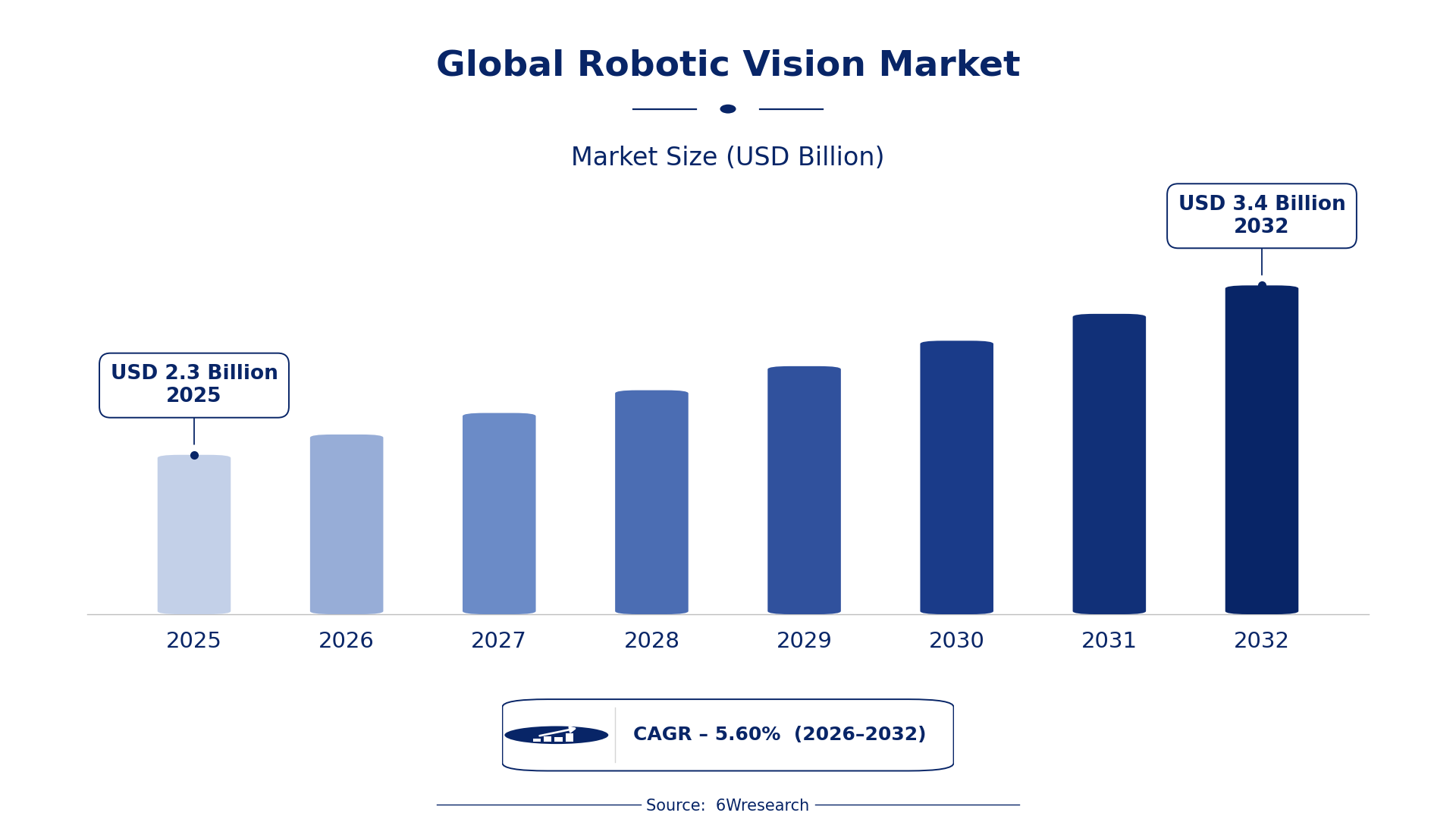
The Global Robotic Vision Market was estimated at USD 2.3 Billion in 2025 and is projected to reach USD 3.4 Billion by 2032, growing at a CAGR of 5.60% from 2026 to 2032.
Global Robotic Vision Market Synopsis
The Global Robotic Vision Market is undergoing a significant transformation, driven by the escalating demand for automation across various industries. This shift is particularly evident in sectors such as manufacturing, automotive, healthcare, and agriculture, where robotic vision systems are enhancing operational efficiency and precision. The integration of advanced technologies like machine learning and artificial intelligence is further propelling the capabilities of these systems, enabling robots to perform complex tasks with greater accuracy. As industries strive for higher productivity and quality standards, the adoption of robotic vision solutions is becoming increasingly critical.
The market's growth trajectory is also influenced by the evolving competitive landscape, with key players continually innovating to offer more sophisticated and cost-effective solutions. This competitive environment is fostering rapid advancements in robotic vision technologies, leading to broader applications and increased market penetration. The convergence of robotics and vision technologies is not only transforming traditional manufacturing processes but also opening new avenues in sectors like logistics and healthcare, where precision and efficiency are paramount.
Global Robotic Vision Market Year-wise Growth Rate and Key Drivers
This graph illustrates the annual growth rates of the Global Robotic Vision Market from 2022 to 2032, highlighting a steady upward trajectory and projected expansion over the forecast period.
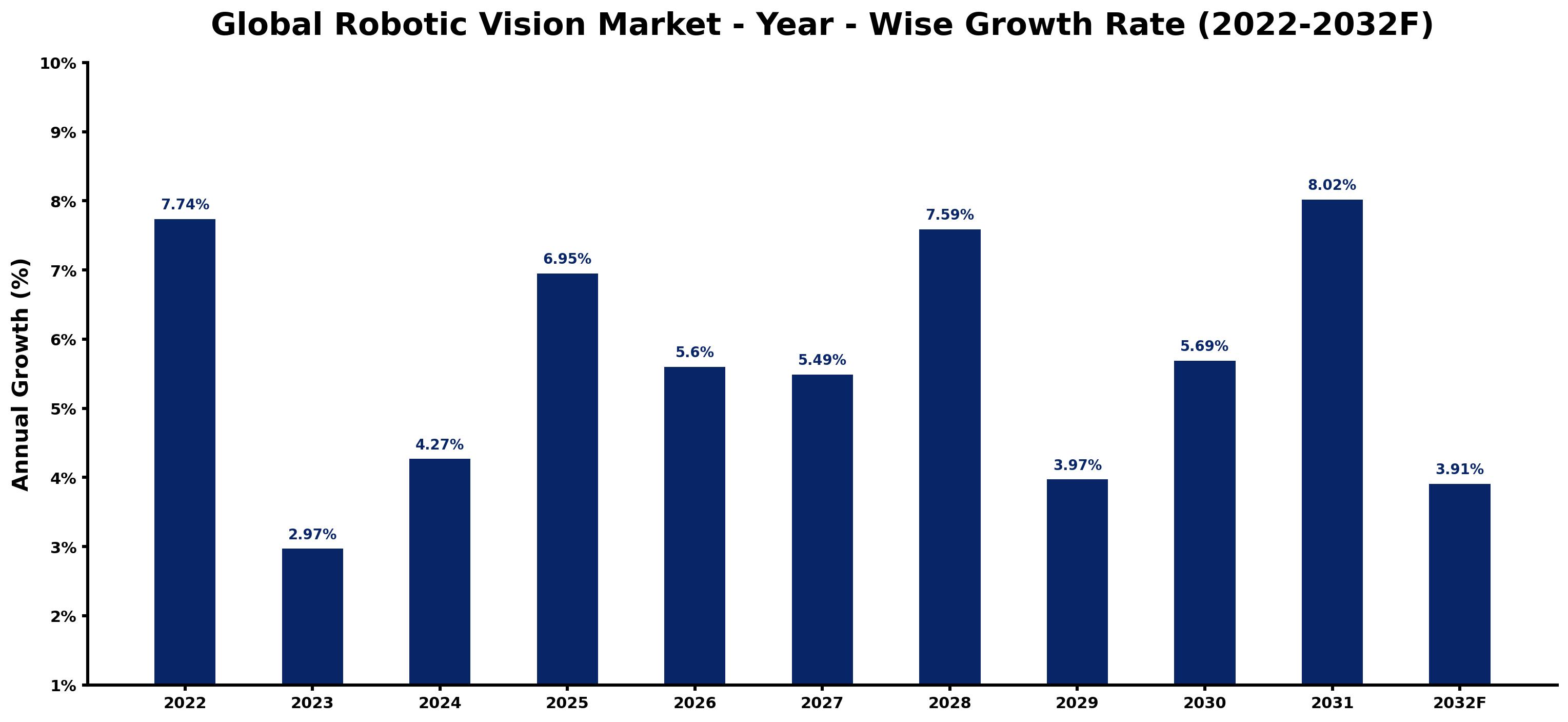
The table below presents the year‑wise growth rates along with the key drivers influencing the market
| Year | Growth Rate (%) | Major Drivers |
| 2022 | 7.74 | Manufacturers in logistics must comply with evolving regulations on robotic vision systems. |
| 2023 | 2.97 | Camera technology advancements in robotic vision attract increased investment from major players. |
| 2024 | 4.27 | Rising raw material costs are inhibiting the growth of robotic vision solutions. |
| 2025 | 6.95 | As customers shift toward automation, demand for robotic vision applications surges. |
| 2026 | 5.6 | A shift toward efficient supply chains enhances the integration of robotic vision technologies. |
| 2027 | 5.49 | Adoption of eco-friendly materials in robotic vision products aligns with sustainability goals. |
| 2028 | 7.59 | In North America, competitive pressures are driving innovation in robotic vision solutions. |
| 2029 | 3.97 | Manufacturers are responding to market maturity with next-generation robotic vision products. |
| 2030 | 5.69 | Expanding global distribution networks facilitates wider access to robotic vision technologies. |
| 2031 | 8.02 | The increasing availability of skilled labor enhances the deployment of robotic vision systems. |
| 2032 | 3.91 | Retailers are prioritizing robotic vision technologies to meet evolving consumer expectations. |
Note - Market size estimations and growth projections presented in this report are based on 6Wresearch's proprietary research methodology, combining internal industry data, secondary research, and primary validation, updated periodically to reflect current market conditions. As markets evolve rapidly, figures for certain industries may vary slightly and are intended as informed estimates rather than absolute figures. For the most current market sizing, we recommend validating figures with a 6Wresearch analyst.
Global Robotic Vision Market Key Takeaways
Below are some of the specific key takeaways from the market, including:
- The Asia Pacific region is projected to dominate the market, accounting for approximately 43.7% of the global revenue share in 2025, driven by robust industrial automation initiatives in countries like China and Japan.
- The 3D Vision Systems segment is expected to lead the market, holding a significant share due to their superior depth perception capabilities, which are crucial for complex manufacturing tasks.
- The hardware component, particularly cameras and sensors, is anticipated to represent the largest market share, estimated at 62.0% in 2025, reflecting the foundational role of these components in robotic vision systems.
- The automotive industry is projected to be the largest end-user segment, capturing a significant portion of the market share, as automotive manufacturers increasingly integrate robotic vision for quality control and assembly processes.
Evaluation of Restraints in Global Robotic Vision Market
Despite the promising growth prospects, the Global Robotic Vision Market faces several challenges that could impede its expansion. One significant restraint is the high cost associated with the implementation and maintenance of advanced robotic vision systems. For instance, the initial setup costs for integrating 3D vision systems can be substantial, often requiring significant capital investment. This financial burden can be particularly challenging for small and medium-sized enterprises (SMEs) that may lack the necessary resources to adopt such technologies. Additionally, the complexity involved in integrating robotic vision systems with existing manufacturing processes poses a technical challenge. Ensuring compatibility and seamless operation between new robotic vision systems and legacy equipment requires specialized expertise and can lead to increased downtime during the transition period. Moreover, the need for continuous software updates and hardware maintenance to keep the systems operating at optimal performance levels adds to the ongoing operational costs, further deterring potential adopters.
Global Robotic Vision Market Trends
The Global Robotic Vision Market is witnessing several notable trends that are shaping its future direction. One prominent trend is the integration of artificial intelligence (AI) and deep learning algorithms into robotic vision systems. This integration enhances the systems' ability to interpret complex visual data, enabling robots to perform tasks with higher accuracy and adaptability. For example, companies like Cognex Corporation have developed vision systems that utilize AI to improve defect detection in manufacturing processes. Another significant trend is the adoption of 3D vision systems, which provide depth perception and spatial awareness, essential for tasks such as assembly and material handling. The automotive industry, in particular, is leveraging 3D vision systems to enhance precision in assembly lines and improve quality control measures. Additionally, the rise of collaborative robots, or cobots, is influencing the market. These robots work alongside human operators and rely on advanced vision systems to ensure safe and efficient interactions. The development of user-friendly interfaces and intuitive programming tools is making it easier for operators to deploy and manage these collaborative robots, thereby expanding their adoption across various industries.
Global Robotic Vision Market Opportunities
The Global Robotic Vision Market presents several lucrative opportunities for growth and innovation. One such opportunity lies in the development of cost-effective and user-friendly vision solutions. As the technology matures, there is a growing potential to create more affordable systems that can be adopted by a broader range of businesses, including SMEs. This democratization of technology could lead to widespread adoption and market expansion. Another opportunity is the expansion of applications in emerging sectors like agriculture and retail. In agriculture, robotic vision systems can be utilized for tasks such as crop monitoring and harvesting, while in retail, they can enhance inventory management and customer service. For instance, companies are exploring the use of robotic vision for automated shelf scanning to monitor stock levels and product placement. Additionally, the potential for market growth in regions with a strong focus on industrial automation, such as the Asia-Pacific region, presents a significant opportunity. The increasing investments in smart manufacturing and Industry 4.0 initiatives in countries like China and Japan are driving the demand for advanced robotic vision systems, creating a favorable environment for market players to expand their presence in these regions.
Global Robotic Vision Market by Application
In 2025, the Global Robotic Vision Market's application landscape was dominated by the Material Handling segment, which accounted for approximately 42% of the market share. This dominance is attributed to the widespread use of robotic vision systems in tasks such as automated storage and retrieval, sorting, and packaging, where precision and efficiency are critical. The Assembling & Disassembling segment is the fastest-growing application, with a projected CAGR of 8.5% from 2026 to 2032. This growth is driven by the increasing complexity of assembly processes and the need for high precision, which robotic vision systems can provide. The ability to handle intricate assembly tasks with minimal human intervention is making robotic vision systems indispensable in modern manufacturing environments.
Global Robotic Vision Market by End User
As of 2025, the Industrial sector was the largest end-user of robotic vision systems, holding a market share of approximately 60%. This dominance is due to the extensive adoption of robotic vision in manufacturing processes, quality control, and material handling. The Commercial sector is the fastest-growing end-user segment, with a projected CAGR of 7.2% from 2026 to 2032. This growth is fueled by the increasing demand for automation in sectors such as retail, logistics, and healthcare, where robotic vision systems are enhancing operational efficiency and service quality. The scalability and adaptability of robotic vision solutions are enabling their integration into a wide range of commercial applications, contributing to the sector's rapid expansion.
Global Robotic Vision Market by Region
In 2025, the Asia Pacific region emerged as the largest market for robotic vision systems, accounting for approximately 43.7% of the global revenue share. This dominance is driven by the region's strong manufacturing base, particularly in countries like China and Japan, which are at the forefront of adopting advanced automation technologies. The region is also the fastest-growing, with a projected CAGR of 6.5% from 2026 to 2032. This rapid growth is attributed to the increasing investments in smart manufacturing and Industry 4.0 initiatives, as well as the rising demand for high-quality products that robotic vision systems can help achieve. The concentration of industrial hubs and the supportive government policies in the region further bolster the market's expansion prospects.
Government Initiatives in the Global Robotic Vision Market
The regulatory and policy environment plays a pivotal role in shaping the trajectory of the Global Robotic Vision Market. Governments worldwide are implementing initiatives to foster innovation, support research and development, and promote the adoption of advanced manufacturing technologies, including robotic vision systems. These initiatives aim to enhance industrial competitiveness, improve product quality, and drive economic growth. By providing funding, incentives, and creating favorable regulatory frameworks, governments are facilitating the integration of robotic vision technologies across various industries, thereby accelerating the market's expansion.
- In November 2023, the U.S. Department of Commerce announced the CHIPS for America program, allocating approximately $3 billion for the National Advanced Packaging Manufacturing Program. This initiative aims to bolster U.S. capabilities in advanced semiconductor packaging, indirectly benefiting the robotic vision market by enhancing the performance and integration of vision systems in semiconductor manufacturing processes.
- In December 2023, the U.S. Department of Transportation launched the Rural Autonomous Vehicle (RAV) Research Program, offering $25 million in funding. This program focuses on integrating automated vehicle technologies, including robotic vision systems, into rural and Tribal communities, promoting the adoption of advanced vision technologies in underserved areas.
- In June 2023, the U.S. Department of Transportation's Federal Transit Administration announced $11.6 million in grants to support six transit bus automation research projects. These projects aim to improve bus safety and efficiency through the integration of automated technologies, including robotic vision systems, in public transportation.
- In October 2023, the State of Maryland launched the Build Our Future Innovation Infrastructure Pilot Program, a $10 million initiative providing matching grants of up to $2 million for projects that demonstrate transformative impacts in accelerating growth and innovation in strategic industry sectors, including robotics and advanced manufacturing.
Future Insights of the Global Robotic Vision Market
The trajectory of the Global Robotic Vision Market is set to shift towards increased integration of AI technologies and innovative imaging techniques by 2032. Companies like Cognex Corporation are pioneering advancements in deep learning algorithms that enhance real-time data processing, making robotic vision systems more adaptable in dynamic environments. Additionally, heightened investments in smart manufacturing technologies in the Asia-Pacific region are expected to redefine industrial workflows, where robotic vision will play a critical role in maintaining efficiency and quality. Demand for tailored solutions will likely spur new applications across sectors, particularly in logistics and healthcare automation.
Global Robotic Vision Market Latest Developments
Recent developments in the Global Robotic Vision Market highlight significant advancements and strategic moves aimed at enhancing capabilities and expanding market presence. Key updates include:
- In early 2023, Cognex Corporation introduced a new range of AI-enabled camera systems, which incorporate advanced image processing algorithms, allowing for faster and more accurate defect detection in manufacturing processes.
- In mid-2023, Basler AG unveiled a line of 3D vision cameras designed for industrial applications, enhancing depth perception and spatial awareness, crucial for automating complex assembly tasks.
- In late 2023, Omron Corporation announced a strategic partnership with a leading AI firm to develop next-gen robotic vision solutions aimed at improving human-robot collaboration in warehouse settings.
- In January 2024, Keyence Corporation launched an innovative robotic vision suite that integrates with existing automation systems, simplifying deployment and improving operational efficiency across various sectors.
Global Robotic Vision Market Key Players and Industry Positioning
The Global Robotic Vision Market exhibits a consolidated competitive structure, dominated by leading firms that focus on technological advancements and comprehensive solutions. These companies leverage their robust technological capabilities and partnerships to increase their market footprint.
| Leading Company | Core Strength | Strategic Focus |
|---|---|---|
| Cognex Corporation | Expertise in AI-driven image processing | Expanding market reach through innovations in quality control |
| Basler AG | Strong portfolio of 3D vision technology | Targeting industrial automation with high-performance cameras |
| Omron Corporation | Integration of robotics and AI solutions | Enhancing collaborative robot applications in logistics |
| Keyence Corporation | Focus on user-friendly automation solutions | Building comprehensive automation ecosystems for various industries |
| Teledyne Technologies Incorporated | Advanced imaging solutions for diverse applications | Leveraging technological advancements for various market demands |
The competitive landscape is characterized by the ongoing quest for technological leadership, where each key player strives to develop distinct offerings that meet the evolving needs of industries utilizing robotic vision systems.
Key Attractiveness of the Report
- 10 Years of Market Numbers
- Historical Data Starting from 2022 to 2025
- Base Year: 2025
- Forecast Data until 2032
- Key Performance Indicators Impacting the Market
- Major Upcoming Developments and Projects
Key Highlights of the Report:
- Global Robotic Vision Market Outlook
- Market Size of Global Robotic Vision Market, 2025
- Forecast of Global Robotic Vision Market, 2032
- Historical Data and Forecast of Global Robotic Vision Revenues & Volume for the Period 2022-2032
- Global Robotic Vision Market Trend Evolution
- Global Robotic Vision Market Drivers and Challenges
- Global Robotic Vision Price Trends
- Global Robotic Vision Porter's Five Forces
- Global Robotic Vision Industry Life Cycle
- Historical Data and Forecast of Global Robotic Vision Market Revenues & Volume
- Historical Data and Forecast of Global Robotic Vision Market Revenues & Volume By Application for the Period 2022-2032
- Historical Data and Forecast of Global Robotic Vision Market Revenues & Volume By Welding & Soldering for the Period 2022-2032
- Historical Data and Forecast of Global Robotic Vision Market Revenues & Volume By Assembling & Disassembling for the Period 2022-2032
- Historical Data and Forecast of Global Robotic Vision Market Revenues & Volume By Material Handling for the Period 2022-2032
- Historical Data and Forecast of Global Robotic Vision Market Revenues & Volume By Identification & Feature Extraction for the Period 2022-2032
- Historical Data and Forecast of Global Robotic Vision Market Revenues & Volume By End User for the Period 2022-2032
- Historical Data and Forecast of Global Robotic Vision Market Revenues & Volume By Industrial for the Period 2022-2032
- Historical Data and Forecast of Global Robotic Vision Market Revenues & Volume By Commercial for the Period 2022-2032
- Historical Data and Forecast of North America Robotic Vision Market Revenues & Volume By Application for the Period 2022-2032
- Historical Data and Forecast of North America Robotic Vision Market Revenues & Volume By Welding & Soldering for the Period 2022-2032
- Historical Data and Forecast of North America Robotic Vision Market Revenues & Volume By Assembling & Disassembling for the Period 2022-2032
- Historical Data and Forecast of North America Robotic Vision Market Revenues & Volume By Material Handling for the Period 2022-2032
- Historical Data and Forecast of North America Robotic Vision Market Revenues & Volume By Identification & Feature Extraction for the Period 2022-2032
- Historical Data and Forecast of North America Robotic Vision Market Revenues & Volume By End User for the Period 2022-2032
- Historical Data and Forecast of North America Robotic Vision Market Revenues & Volume By Industrial for the Period 2022-2032
- Historical Data and Forecast of North America Robotic Vision Market Revenues & Volume By Commercial for the Period 2022-2032
- Historical Data and Forecast of United States of America Robotic Vision Market Revenues & Volume for the Period 2022-2032
- Historical Data and Forecast of Canada Robotic Vision Market Revenues & Volume for the Period 2022-2032
- Historical Data and Forecast of Rest of North America Robotic Vision Market Revenues & Volume for the Period 2022-2032
- Historical Data and Forecast of Latin America (LATAM) Robotic Vision Market Revenues & Volume By Application for the Period 2022-2032
- Historical Data and Forecast of Latin America (LATAM) Robotic Vision Market Revenues & Volume By Welding & Soldering for the Period 2022-2032
- Historical Data and Forecast of Latin America (LATAM) Robotic Vision Market Revenues & Volume By Assembling & Disassembling for the Period 2022-2032
- Historical Data and Forecast of Latin America (LATAM) Robotic Vision Market Revenues & Volume By Material Handling for the Period 2022-2032
- Historical Data and Forecast of Latin America (LATAM) Robotic Vision Market Revenues & Volume By Identification & Feature Extraction for the Period 2022-2032
- Historical Data and Forecast of Latin America (LATAM) Robotic Vision Market Revenues & Volume By End User for the Period 2022-2032
- Historical Data and Forecast of Latin America (LATAM) Robotic Vision Market Revenues & Volume By Industrial for the Period 2022-2032
- Historical Data and Forecast of Latin America (LATAM) Robotic Vision Market Revenues & Volume By Commercial for the Period 2022-2032
- Historical Data and Forecast of Brazil Robotic Vision Market Revenues & Volume for the Period 2022-2032
- Historical Data and Forecast of Mexico Robotic Vision Market Revenues & Volume for the Period 2022-2032
- Historical Data and Forecast of Argentina Robotic Vision Market Revenues & Volume for the Period 2022-2032
- Historical Data and Forecast of Rest of LATAM Robotic Vision Market Revenues & Volume for the Period 2022-2032
- Historical Data and Forecast of Asia Robotic Vision Market Revenues & Volume By Application for the Period 2022-2032
- Historical Data and Forecast of Asia Robotic Vision Market Revenues & Volume By Welding & Soldering for the Period 2022-2032
- Historical Data and Forecast of Asia Robotic Vision Market Revenues & Volume By Assembling & Disassembling for the Period 2022-2032
- Historical Data and Forecast of Asia Robotic Vision Market Revenues & Volume By Material Handling for the Period 2022-2032
- Historical Data and Forecast of Asia Robotic Vision Market Revenues & Volume By Identification & Feature Extraction for the Period 2022-2032
- Historical Data and Forecast of Asia Robotic Vision Market Revenues & Volume By End User for the Period 2022-2032
- Historical Data and Forecast of Asia Robotic Vision Market Revenues & Volume By Industrial for the Period 2022-2032
- Historical Data and Forecast of Asia Robotic Vision Market Revenues & Volume By Commercial for the Period 2022-2032
- Historical Data and Forecast of China Robotic Vision Market Revenues & Volume for the Period 2022-2032
- Historical Data and Forecast of India Robotic Vision Market Revenues & Volume for the Period 2022-2032
- Historical Data and Forecast of Japan Robotic Vision Market Revenues & Volume for the Period 2022-2032
- Historical Data and Forecast of Rest of Asia Robotic Vision Market Revenues & Volume for the Period 2022-2032
- Historical Data and Forecast of Africa Robotic Vision Market Revenues & Volume By Application for the Period 2022-2032
- Historical Data and Forecast of Africa Robotic Vision Market Revenues & Volume By Welding & Soldering for the Period 2022-2032
- Historical Data and Forecast of Africa Robotic Vision Market Revenues & Volume By Assembling & Disassembling for the Period 2022-2032
- Historical Data and Forecast of Africa Robotic Vision Market Revenues & Volume By Material Handling for the Period 2022-2032
- Historical Data and Forecast of Africa Robotic Vision Market Revenues & Volume By Identification & Feature Extraction for the Period 2022-2032
- Historical Data and Forecast of Africa Robotic Vision Market Revenues & Volume By End User for the Period 2022-2032
- Historical Data and Forecast of Africa Robotic Vision Market Revenues & Volume By Industrial for the Period 2022-2032
- Historical Data and Forecast of Africa Robotic Vision Market Revenues & Volume By Commercial for the Period 2022-2032
- Historical Data and Forecast of South Africa Robotic Vision Market Revenues & Volume for the Period 2022-2032
- Historical Data and Forecast of Nigeria Robotic Vision Market Revenues & Volume for the Period 2022-2032
- Historical Data and Forecast of Egypt Robotic Vision Market Revenues & Volume for the Period 2022-2032
- Historical Data and Forecast of Rest of Africa Robotic Vision Market Revenues & Volume for the Period 2022-2032
- Historical Data and Forecast of Europe Robotic Vision Market Revenues & Volume By Application for the Period 2022-2032
- Historical Data and Forecast of Europe Robotic Vision Market Revenues & Volume By Welding & Soldering for the Period 2022-2032
- Historical Data and Forecast of Europe Robotic Vision Market Revenues & Volume By Assembling & Disassembling for the Period 2022-2032
- Historical Data and Forecast of Europe Robotic Vision Market Revenues & Volume By Material Handling for the Period 2022-2032
- Historical Data and Forecast of Europe Robotic Vision Market Revenues & Volume By Identification & Feature Extraction for the Period 2022-2032
- Historical Data and Forecast of Europe Robotic Vision Market Revenues & Volume By End User for the Period 2022-2032
- Historical Data and Forecast of Europe Robotic Vision Market Revenues & Volume By Industrial for the Period 2022-2032
- Historical Data and Forecast of Europe Robotic Vision Market Revenues & Volume By Commercial for the Period 2022-2032
- Historical Data and Forecast of United Kingdom Robotic Vision Market Revenues & Volume for the Period 2022-2032
- Historical Data and Forecast of France Robotic Vision Market Revenues & Volume for the Period 2022-2032
- Historical Data and Forecast of Germany Robotic Vision Market Revenues & Volume for the Period 2022-2032
- Historical Data and Forecast of Rest of Europe Robotic Vision Market Revenues & Volume for the Period 2022-2032
- Historical Data and Forecast of Middle East Robotic Vision Market Revenues & Volume By Application for the Period 2022-2032
- Historical Data and Forecast of Middle East Robotic Vision Market Revenues & Volume By Welding & Soldering for the Period 2022-2032
- Historical Data and Forecast of Middle East Robotic Vision Market Revenues & Volume By Assembling & Disassembling for the Period 2022-2032
- Historical Data and Forecast of Middle East Robotic Vision Market Revenues & Volume By Material Handling for the Period 2022-2032
- Historical Data and Forecast of Middle East Robotic Vision Market Revenues & Volume By Identification & Feature Extraction for the Period 2022-2032
- Historical Data and Forecast of Middle East Robotic Vision Market Revenues & Volume By End User for the Period 2022-2032
- Historical Data and Forecast of Middle East Robotic Vision Market Revenues & Volume By Industrial for the Period 2022-2032
- Historical Data and Forecast of Middle East Robotic Vision Market Revenues & Volume By Commercial for the Period 2022-2032
- Historical Data and Forecast of Saudi Arabia Robotic Vision Market Revenues & Volume for the Period 2022-2032
- Historical Data and Forecast of UAE Robotic Vision Market Revenues & Volume for the Period 2022-2032
- Historical Data and Forecast of Turkey Robotic Vision Market Revenues & Volume for the Period 2022-2032
- Historical Data and Forecast of Rest of Middle East Robotic Vision Market Revenues & Volume for the Period 2022-2032
- Global Robotic Vision Market - Key Performance Indicators
- Global Robotic Vision Market - Import Export Trade Statistics
- Global Robotic Vision Market - Opportunity Assessment By Countries
- Global Robotic Vision Market - Opportunity Assessment By Application
- Global Robotic Vision Market - Opportunity Assessment By End User
- Global Robotic Vision Market - Top Companies Market Share
- Global Robotic Vision Market - Top Companies Profiles
- Global Robotic Vision Market - Comparison of Players in Technical and Operating Parameters
- Global Robotic Vision Market - Strategic Recommendations
Markets Covered
The Global Robotic Vision Market report provides a detailed analysis of the following market segments:
By Regions and Countries:
- North America
- Europe
- LATAM
- Middle East
- Asia
- Africa
By Application:
- Welding & Soldering
- Assembling & Disassembling
- Material Handling
- Identification & Feature Extraction
By End User:
- Industrial
- Commercial






































