Global Sanitary ware Market Highlights
| Market Size (2025) | USD 55 Billion |
| Forecast Size (2032) | USD 75 Billion |
| CAGR | 4.50% |
| Base Year | 2025 |
| Forecast Period | 2026-2032 |
| Largest Region | Asia |
| Fastest Growing Region | Africa |
| Largest Segment | Toilet sink/water closet |
| Fastest Growing Segment | Wash basin |
| Leading Companies | Kohler, Moen, Grohe, Roca, American Standard |
Global Sanitary ware Market Size & Growth Rate (2026-2032)
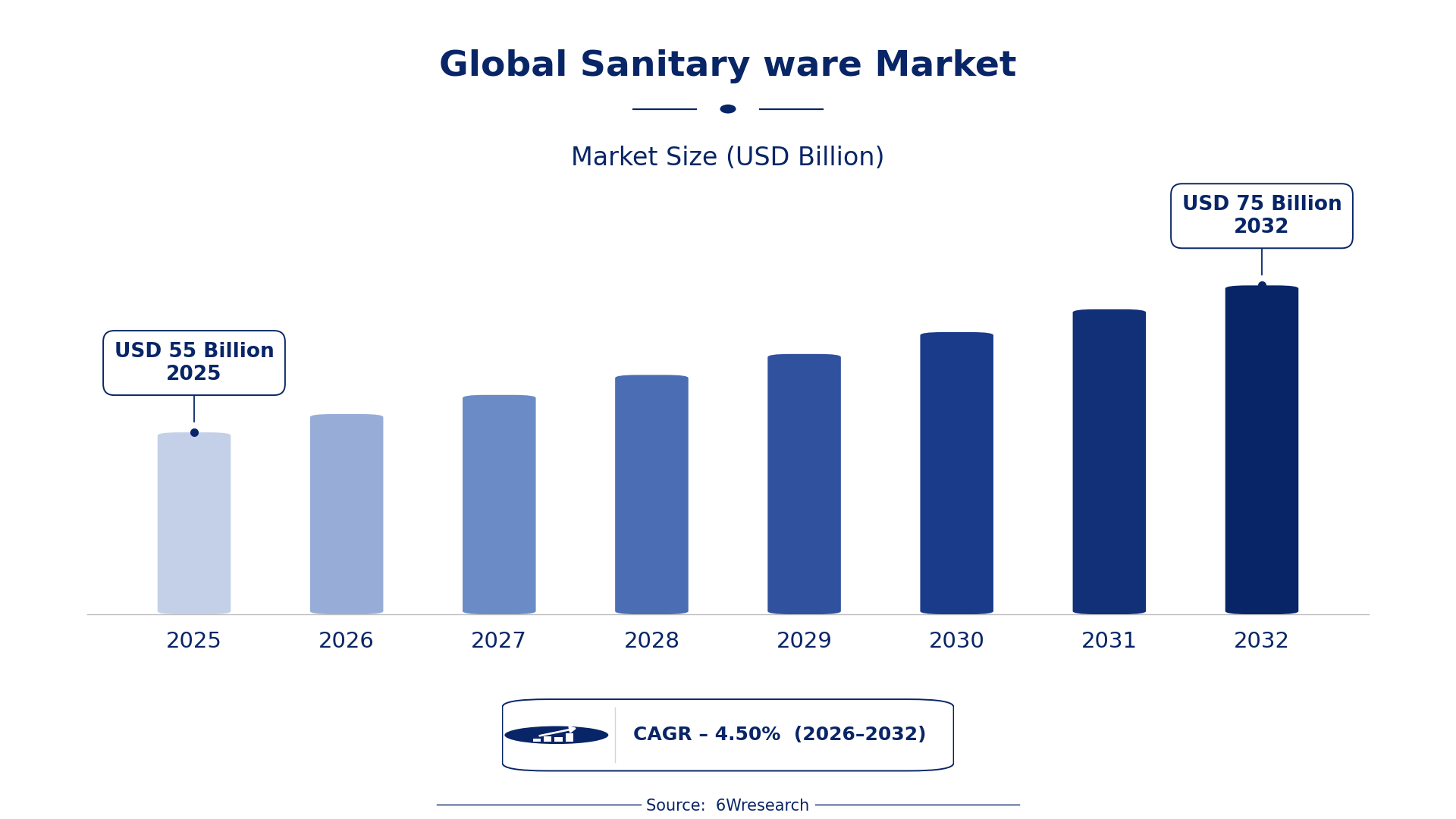
The Global Sanitary ware Market was estimated at USD 55 Billion in 2025 and is projected to reach USD 75 Billion by 2032, growing at a CAGR of 4.50% from 2026 to 2032.
Global Sanitary ware Market Synopsis
The Global Sanitary ware Market is presently undergoing a transformative phase, driven by urbanization and increasing disposable incomes. New residential and commercial projects demand modern sanitary ware that meets aesthetic and functional requirements, significantly reshaping consumer preferences.
With the construction sector embracing green technologies, the market is also leaning towards eco-friendly products that conserve water. This evolution is not only addressing consumer expectations for sustainability but is also enabling manufacturers to innovate more effectively in design and technology.
Global Sanitary ware Market Year-wise Growth Rate and Key Drivers
This graph illustrates the annual growth rates of the Global Sanitary ware Market from 2022 to 2032, highlighting a steady upward trajectory and projected expansion over the forecast period.
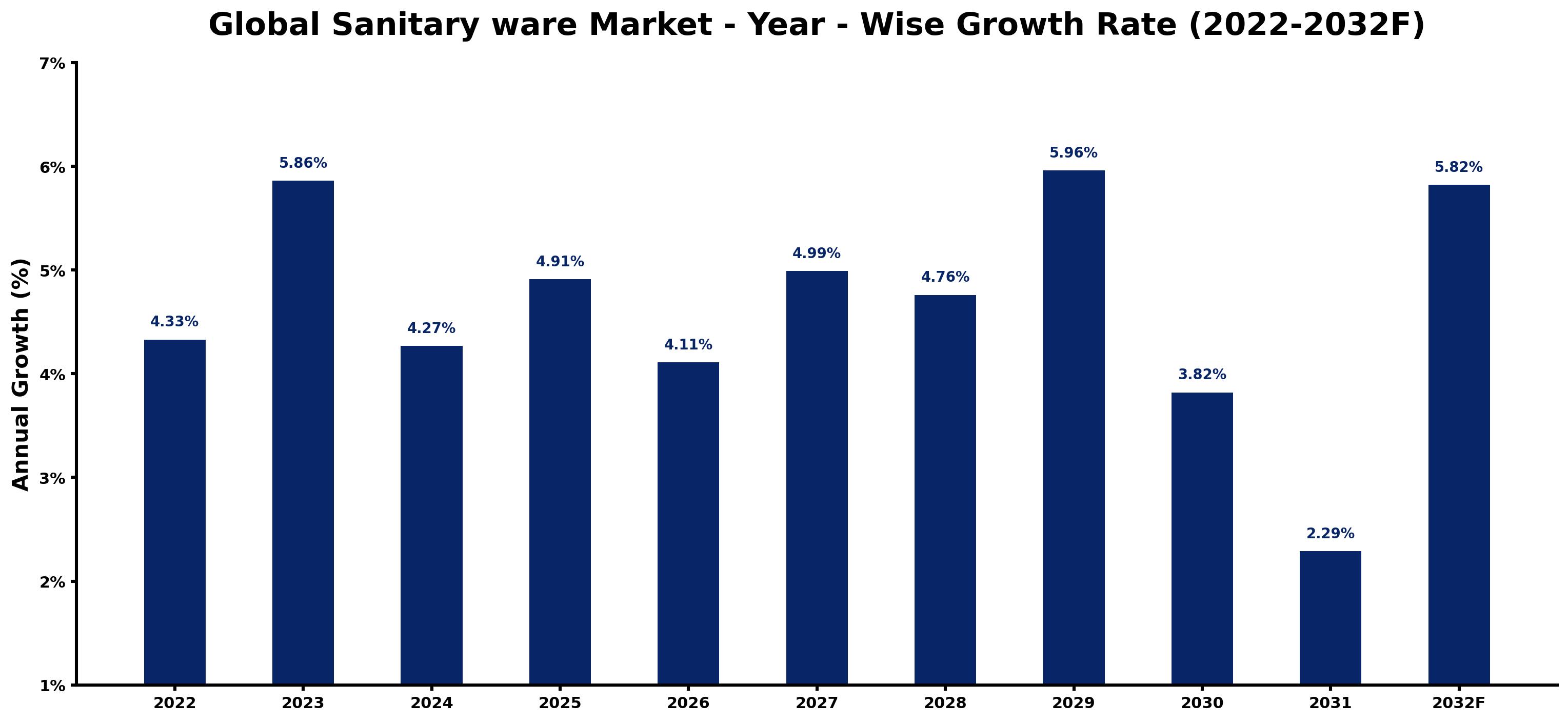
The table below presents the year‑wise growth rates along with the key drivers influencing the market
| Year | Growth Rate (%) | Major Drivers |
| 2022 | 4.33 | Supply chain disruptions caused delays in sanitary ware production and distribution channels. |
| 2023 | 5.86 | Advanced materials in sanitary ware manufacturing are enhancing product durability and appeal. |
| 2024 | 4.27 | Residential consumers are increasingly seeking diverse sanitary ware options for home renovations. |
| 2025 | 4.91 | As raw material prices stabilize, sanitary ware manufacturers are expanding production capacities. |
| 2026 | 4.11 | In emerging markets, end-users are prioritizing high-quality sanitary ware for new constructions. |
| 2027 | 4.99 | A shift toward eco-friendly materials in sanitary ware production enhances market attractiveness. |
| 2028 | 4.76 | Implementing stricter regulations on sanitary ware manufacturing drives innovation in compliance strategies. |
| 2029 | 5.96 | Manufacturers are hiring specialized talent to improve sanitary ware design and functionality. |
| 2030 | 3.82 | Fluctuating investment trends are reshaping the competitive environment across the sanitary ware sector. |
| 2031 | 2.29 | Ceramic sanitary ware technology is evolving to meet the increasing consumer expectations for style. |
| 2032 | 5.82 | Retailers are adapting to consumer preferences by offering customizable sanitary ware solutions. |
Note - Market size estimations and growth projections presented in this report are based on 6Wresearch's proprietary research methodology, combining internal industry data, secondary research, and primary validation, updated periodically to reflect current market conditions. As markets evolve rapidly, figures for certain industries may vary slightly and are intended as informed estimates rather than absolute figures. For the most current market sizing, we recommend validating figures with a 6Wresearch analyst.
Global Sanitary ware Market Key Takeaways
Below are some of the specific key takeaways from the market, including:
- Asia is expected to dominate the overall market, holding around 48% share in 2025.
- The wash basin segment is anticipated to grow at a CAGR of 5.8% from 2026 to 2032.
- Kohler invests approximately $1.5 billion over the next five years to enhance its manufacturing capabilities.
- Rapid urbanization in Africa will drive a CAGR of 7% in the region from 2026 to 2032.
Evaluation of Restraints in Global Sanitary ware Market
A primary restraint in the Global Sanitary ware Market is the significant volatility in raw material prices, which can increase production costs unpredictably. For instance, prices for ceramic, a key material, can fluctuate by as much as 20% within a year due to supply chain constraints. This inconsistency may deter manufacturers from investing in new technologies, unsettling their competitive edge. Additionally, stringent environmental regulations regarding waste management present a challenge, requiring investments in recycling systems that may not provide immediate returns.
Global Sanitary ware Market Trends
A key trend reshaping the Global Sanitary ware Market is the rise of smart bathroom technologies, with firms like Moen incorporating advanced sensor-based systems to enhance user experience. Data shows that smart system integration is expected to grow by over 30% annually until 2030. For example, Moen's U by Moen system enables water control through smartphone apps, catering to the tech-savvy consumer demographic.
Another trend is the increased focus on sustainable materials, with many manufacturers adopting recycled materials in their products. Currently, 15% of products in the market are made from recycled content, and this percentage is anticipated to rise as consumer pressure for eco-friendly options strengthens. Companies are expected to transition towards sustainability in practices and products, not only to meet regulatory demands but also to capture the environmentally conscious consumer segment.
Global Sanitary ware Market Opportunities
Emerging opportunities in the Global Sanitary ware Market include developments in water treatment solutions, which can align with both retail and commercial sanitary ware segments. For instance, eco-friendly water efficiency programs are worth an estimated $10 billion globally, creating a demand for water-saving sanitary products. In addition, as more governments push for green building certifications, manufacturers can capitalize by creating products that support these initiatives, such as low-flow toilets or taps.
Additionally, the digitalization trend in construction is poised to create opportunities for sanitary ware manufacturers. The integration of Building Information Modeling (BIM) in design will result in advanced product placements and customizations, further enhancing the consumer experience while contributing to reducing waste during the construction process.
Global Sanitary ware Market by Product Type
As of 2025, the leading product type in the Global Sanitary ware Market is the toilet sink/water closet segment, commanding approximately 40% share. This dominance is driven by ongoing construction in residential and commercial projects, where functional and aesthetic requirements are paramount. Meanwhile, the wash basin segment is anticipated to exhibit the fastest growth, with a CAGR of 5.8% from 2026 to 2032. This growth can be attributed to increasing consumer preferences for stylish designs and upgraded bathroom experiences as home renovations gain traction.
Global Sanitary ware Market by Material
In the Global Sanitary ware Market, ceramic remains the dominant material choice, securing a market share of roughly 55% in 2025. This material's popularity stems from its durability and versatility, making it suitable for various sanitary products. Conversely, acrylic plastics & Perspex are the fastest-growing material category, expected to achieve a CAGR of 6.0% from 2026 to 2032. Rising demand for lightweight and colorful sanitaryware is driving this trend, particularly in the hospitality sector.
Global Sanitary ware Market by Region
The Asia region is projected to be the largest market for sanitary ware, accounting for approximately 48% share in 2025. This dominance is largely due to rapid urbanization and ongoing infrastructure projects across various countries, including India and China. On the other hand, Africa is set to be the fastest-growing region, with a CAGR of 7.0% from 2026 to 2032, as increasing investments in sanitation and clean water initiatives propel demand for sanitary ware solutions.
Government Initiatives in the Global Sanitary ware Market
The regulatory landscape surrounding the Global Sanitary ware Market is evolving, with governments taking initiatives to enhance sanitation and promote eco-friendly practices. Policies focusing on public health and environmental sustainability are increasingly influencing market dynamics, facilitating both growth and competition. Various nation-specific projects are underway that aim to improve sanitation infrastructures.
- Ministry of Housing & Urban Affairs, Swachh Bharat Mission, 2014 - Aimed at eliminating open defecation and promoting sanitation facilities for all.
- UN Habitat, Clean Cities Initiative, 2020 - Focused on enhancing urban sanitation in cities across Africa, ensuring clean water and sanitation for residents.
- European Commission, Green Deal, 2021 - Includes regulations on the use of water-saving appliances that align with the EU's sustainability goals.
- Ministry of Infrastructure Development, National Sanitation Policy, Planned for 2025 - Aims to improve sanitation and hygiene in rural areas through funding and infrastructure development.
Future Insights of the Global Sanitary ware Market
The Global Sanitary ware Market is expected to see profound shifts with advancements in smart technologies and sustainable practices. Companies like Kohler, which is investing in enhanced manufacturing capabilities, signify a broader trend of integrating IoT technology that not only streamlines production but enhances user interaction. These developments suggest a future where consumer experience is prioritized, paving the way for innovative designs and eco-friendly materials, reshaping traditional approaches in product development.
Global Sanitary ware Market Latest Developments
Recent activities in the Global Sanitary ware Market highlight the strategic moves by leading companies to bolster their positions. The following are key developments:
- Kohler is currently enhancing its manufacturing facilities, which is expected to increase production capacity by 25% by early 2025, thus improving supply chain efficiency.
- Moen has launched a new line of water-saving faucets and showerheads earlier in 2023, showcasing its commitment to sustainability and attracting eco-conscious consumers.
- Grohe is investing in research for smart bathroom technology, aiming for product release by late 2024, illustrating its push towards incorporating IoT in sanitary ware.
- Roca has initiated a multi-country expansion plan in Asia, which is due to be completed by mid-2025, further tapping into rapidly developing markets.
Global Sanitary ware Market Key Players and Industry Positioning
The Global Sanitary ware Market consists of a blend of established and emerging players, with major companies focusing on distinguishing themselves through technological advancements and sustainable products. Competitive dynamics show a mix of consolidation among a few large firms while also presenting opportunities for regional players to grow rapidly with innovative solutions.
| Leading Company | Core Strength | Strategic Focus |
|---|---|---|
| Kohler | Diverse product range with strong R&D capabilities | Enhancing manufacturing capabilities and smart technology integration |
| Moen | Leadership in kitchen and bathroom fixtures | Sustainability and eco-friendly product lines |
| Grohe | Innovative designs with premium materials | Smart technology and IoT developments |
| Roca | Strong presence in ceramic products | Market expansion in developing regions |
| American Standard | Broad market reach and brand recognition | Focus on water-efficient solutions |
As companies innovate and expand globally, maintaining competitive advantage will require continuous investment in technology and sustainability efforts, forging a path towards a more modern sanitary ware ecosystem.
Key Attractiveness of the Report
- 10 Years of Market Numbers
- Historical Data Starting from 2022 to 2025
- Base Year: 2025
- Forecast Data until 2032
- Key Performance Indicators Impacting the Market
- Major Upcoming Developments and Projects
Key Highlights of the Report:
- Global Sanitary Ware Market Outlook
- Global Sanitary Ware Market Overview
- Global Sanitary Ware Market Forecast
- Historical Data for the period 2022-2032 and Market Forecast of Global Sanitary Ware Market Revenues until 2032
- Historical Data for the period 2022-2032 and Market Forecast of the market until 2032, By Product Type
- Historical Data for the period 2022-2032 and Market Forecast of the market until 2032, By Application
- Historical Data for the period 2022-2032 and Market Forecast of the market until 2032, By Regions
- Historical Data for the period 2022-2032 and Market Forecast until 2032 for Latin America Sanitary Ware Market
- Historical Data for the period 2022-2032 and Market Forecast until 2032 for North America Sanitary Ware Market
- Historical Data for the period 2022-2032 and Market Forecast until 2032 for Europe Sanitary Ware Market
- Historical Data for the period 2022-2032 and Market Forecast until 2032 for Asia Pacific Sanitary Ware Market
- Historical Data for the period 2022-2032 and Market Forecast until 2032 for Middle East Sanitary Ware Market
- Historical Data for the period 2022-2032 and Market Forecast until 2032 for Africa Sanitary Ware Market
- Market Drivers and Restraints
- Global Sanitary Ware Market Trends
- Industry Life Cycle
- Porter’s Five Force Analysis
- Market Opportunity Assessment
- Global Sanitary Ware Market Share, By Players
- Competitive Benchmarking
Markets Covered
The Global Sanitary ware Market report provides a detailed analysis of the following market segments:
By Regions and Countries:
- North America
- Europe
- LATAM
- Middle East
- Asia
- Africa
By Product Type:
- Toilet sink/water closet
- Wash basin
- Pedestal
- Cistern
By Material:
- Ceramic
- Pressed metal
- Acrylic plastics & Perspex
- Others






































