Global Smartphones Market Highlights
| Market Size (2025) | USD 520 Billion |
| Forecast Size (2032) | USD 720 Billion |
| CAGR | 8.00% |
| Base Year | 2025 |
| Forecast Period | 2026-2032 |
| Largest Region | Asia-Pacific |
| Fastest Growing Region | Africa |
| Largest Segment | Android |
| Fastest Growing Segment | iOS |
| Leading Companies | Apple, Samsung, Xiaomi, Huawei, Google |
Global Smartphones Market Size & Growth Rate (2026-2032)
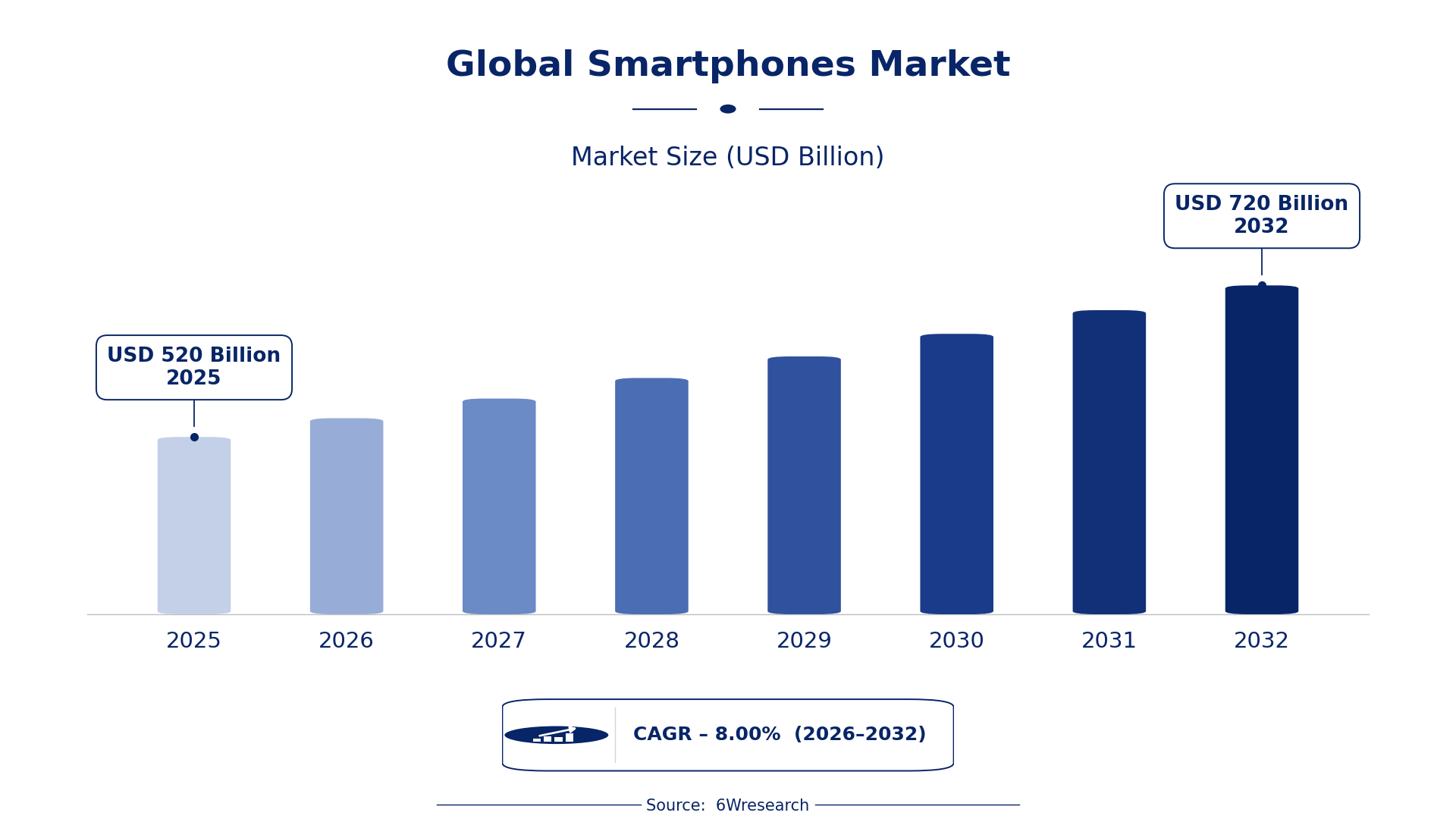
The Global Smartphones Market was estimated at USD 520 Billion in 2025 and is projected to reach USD 720 Billion by 2032, growing at a CAGR of 8.00% from 2026 to 2032.
Global Smartphones Market Synopsis
The Global Smartphones Market is currently navigating a transformative phase. Factors like the shift towards 5G connectivity and increasing consumer demand for AI-driven features are reshaping industry strategies. Brands that focus on innovation and sustainability are likely to capture the evolving preferences of tech-savvy consumers.
The rising integration of smartphones in sectors such as healthcare and education highlights their growing significance. The push for enhanced data privacy and security is setting new standards in regulatory compliance, forcing manufacturers to adapt quickly to meet updated consumer expectations and legal requirements.
Global Smartphones Market Year-wise Growth Rate and Key Drivers
This graph illustrates the annual growth rates of the Global Smartphones Market from 2022 to 2032, highlighting a steady upward trajectory and projected expansion over the forecast period.
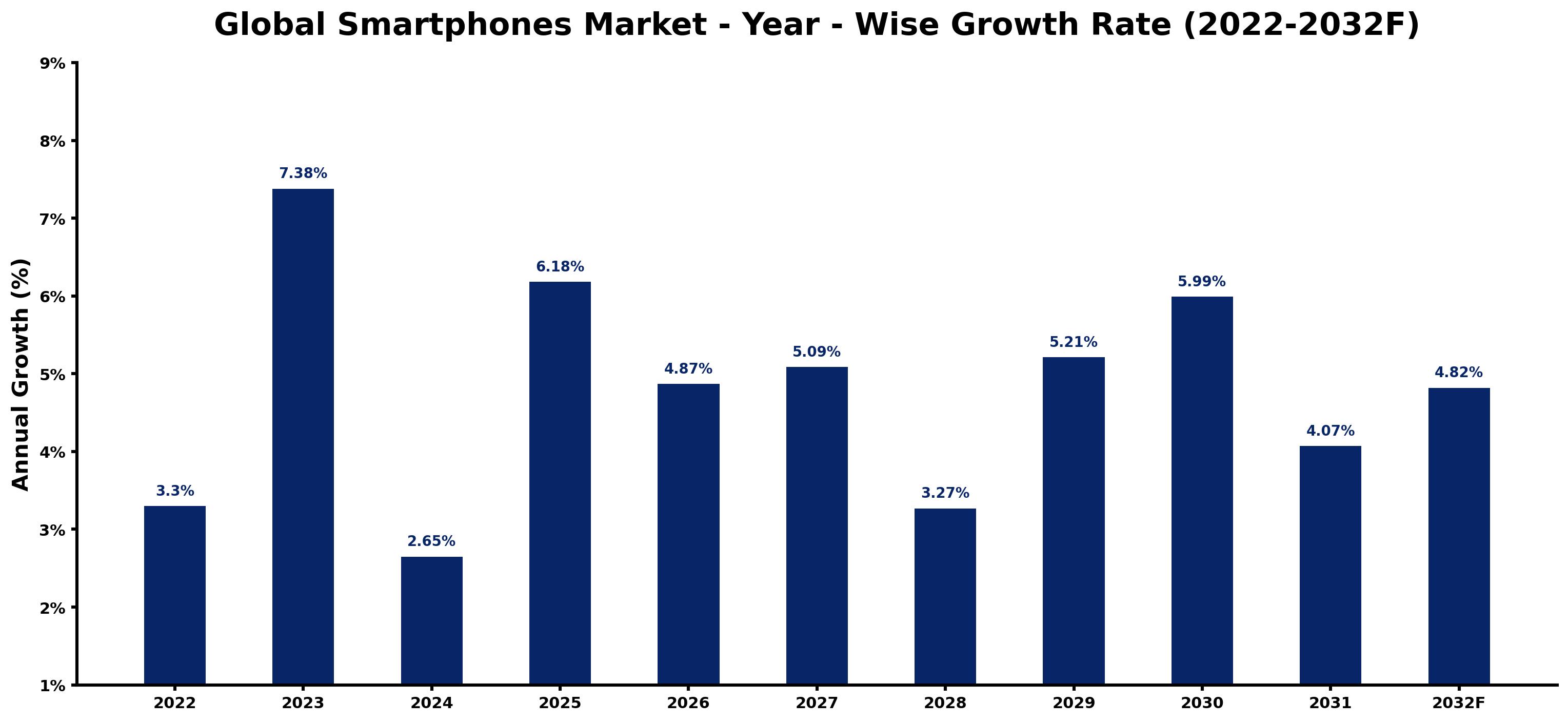
The table below presents the year‑wise growth rates along with the key drivers influencing the market
| Year | Growth Rate (%) | Major Drivers |
| 2022 | 3.3 | A shift toward more reliable supply chains stabilizes smartphone production capabilities. |
| 2023 | 7.38 | Manufacturers are introducing advanced 5G smartphones to meet evolving consumer expectations. |
| 2024 | 2.65 | Expansion into emerging markets facilitates wider smartphone accessibility and usage. |
| 2025 | 6.18 | New competitive strategies emphasize enhanced network infrastructure for smartphone connectivity. |
| 2026 | 4.87 | Tech companies are prioritizing eco-friendly smartphone designs in response to sustainability demands. |
| 2027 | 5.09 | A skilled workforce in software development accelerates mobile app integration in smartphones. |
| 2028 | 3.27 | Smartphones are increasingly utilizing innovative materials that minimize production costs and enhance durability. |
| 2029 | 5.21 | Tech-savvy consumers are driving demand for multifunctional smartphones with advanced features. |
| 2030 | 5.99 | Regulatory changes promoting data security compel smartphone manufacturers to enhance cybersecurity features. |
| 2031 | 4.07 | While users increasingly seek personalized smartphone functionalities, manufacturers are adapting to preferences. |
| 2032 | 4.82 | In North America, significant investments in smartphone technology aim to boost market competition. |
Note - Market size estimations and growth projections presented in this report are based on 6Wresearch's proprietary research methodology, combining internal industry data, secondary research, and primary validation, updated periodically to reflect current market conditions. As markets evolve rapidly, figures for certain industries may vary slightly and are intended as informed estimates rather than absolute figures. For the most current market sizing, we recommend validating figures with a 6Wresearch analyst.
Global Smartphones Market Key Takeaways
Below are some of the specific key takeaways from the market, including:
- Asia-Pacific accounts for approximately ~48% share in the Global Smartphones Market as of 2025, driven by high population density and urbanization.
- iOS is projected to have a CAGR of 10.5% from 2026 to 2032, fueled by Apple's continued focus on premium devices and ecosystem integration.
- Samsung launched the Galaxy S22 in February 2022, which has since gained significant traction for its advanced camera capabilities, enhancing its market position.
- The budget smartphone segment is growing rapidly, estimated to comprise around 45% of sales by 2032, catering to emerging markets' price-sensitive consumers.
- Samsung and Apple collectively command over 50% market share in the high-end segment as of 2025.
Evaluation of Restraints in Global Smartphones Market
The Global Smartphones Market faces multiple restraints pertaining to supply chain and regulatory challenges. Component shortages, particularly in semiconductors, have led to production delays and inflated costs, with estimated losses reaching nearly $1 billion in 2022. For example, the ongoing global semiconductor shortage has disrupted multiple manufacturers' production lines, leading to a slowdown in product releases and decreased market competitiveness. Additionally, regulatory changes concerning data privacy, such as the EU's General Data Protection Regulation (GDPR), impose significant compliance costs, further hindering market growth.
Global Smartphones Market Trends
Recent trends indicate a pronounced shift towards energy efficiency and sustainability in smartphone manufacturing. Companies like Apple and Samsung are investing heavily in recycled materials and eco-friendly practices to attract environmentally conscious consumers. Apple's commitment to using 100% recycled aluminum in its products by 2025 exemplifies this trend. Furthermore, the integration of AI features into smartphones, such as voice recognition and camera enhancements, is elevating user experiences. Google’s Pixel lineup, for instance, leverages machine learning algorithms to optimize photography, setting new standards in user interaction.
Global Smartphones Market Opportunities
Emerging opportunities in the Global Smartphones Market are notably linked to advancements in mobile technology and expansive consumer demographics. For instance, the increasing adoption of 5G technology is expected to stimulate demand for high-performance devices, opening avenues for brands that can enhance their connectivity features. Companies like Xiaomi are capitalizing on this shift by providing affordable 5G models, targeting budget-conscious markets. Furthermore, the mobile gaming industry presents significant revenue potential; research indicates that mobile gaming revenue will reach $100 billion by 2025, driving demand for high-spec devices tailored for gaming applications. Brands that effectively cater to these trends are well-positioned for success.
Global Smartphones Market by Operating System
Android leads the Global Smartphones Market with a ~70% share in 2025, primarily due to its wide array of devices across multiple price points. By contrast, iOS, while holding a smaller share, is projected to experience a CAGR of 10.5% from 2026 to 2032, given its strong brand loyalty and premium positioning. The flexibility and adaptability of Android allow it to dominate the lower to mid-range segment of the market, whereas iOS's exclusivity in high-end devices differentiates it in terms of brand perception and consumer preference.
Global Smartphones Market by Region
Asia-Pacific is the largest region in the Global Smartphones Market, with a share of ~48% in 2025, supported by substantial consumer bases in countries like China and India. Conversely, Africa is expected to be the fastest-growing region, with a CAGR of approximately 12.5% from 2026 to 2032. This surge is driven by rising smartphone penetration rates and decreasing device prices, coupled with improving infrastructure. The concentration of manufacturing activities in Asia amplifies that region’s significance, making it a dominant player in both supply and demand aspects of the market.
Government Initiatives in the Global Smartphones Market
Government initiatives play a pivotal role in shaping the regulatory and operational environment for the Global Smartphones Market. A focus on advancing technology through policy support is evident as various countries enhance their digital frameworks and promote telecommunications development.
- Ministry of Electronics and Information Technology (MeitY), India - Production-Linked Incentive (PLI) Scheme, 2020. This initiative incentivizes local manufacturing of smartphones, aiming to reduce import reliance and enhance domestic capabilities.
- Federal Communications Commission (FCC), United States - 5G Action Plan, 2019. By expediting spectrum allocation and infrastructure deployment, this plan enhances the country’s 5G readiness, positively impacting smartphone adoption rates.
- European Commission - Digital Decade Policy Program, 2021. This initiative supports the development of digital ecosystems, improving mobile connectivity and thereby driving smartphone usage across the EU.
- Telecommunications Regulatory Authority of India (TRAI) - National Telecom Policy, 2022. This policy outlines objectives for enhancing telecom services, aiming to expand smartphone penetration in rural areas.
- Department of Telecommunications, India - National Broadband Mission, 2019. This initiative aims to improve broadband connectivity and infrastructure, indirectly spurring smartphone growth by augmenting user access to mobile internet.
Future Insights of the Global Smartphones Market
The landscape of the Global Smartphones Market is anticipated to experience transformative shifts fueled by technological advancements, particularly in AI and machine learning. For instance, a recent project by Google aims to implement advanced AI functionalities in their upcoming Pixel devices, allowing for enhanced user interactions and personalized experiences. Furthermore, as manufacturers pivot towards adopting 5G capabilities, we can expect a marked acceleration in smart device integration across various sectors, including healthcare and smart cities, fundamentally reshaping consumer behaviors and preferences by 2032.
Global Smartphones Market Latest Developments
The competitive arena of the Global Smartphones Market is dynamic, with key players continually introducing groundbreaking initiatives to enhance their market positioning. Recent developments include:
- Apple has unveiled plans for a new series of iPhones featuring satellite connectivity options, expected to launch in late 2023. This enhancement positions Apple ahead in user safety and connectivity on remote terrains.
- Samsung is expanding its semiconductor manufacturing facilities in Vietnam, aiming for completion by mid-2024. This move is crucial for bolstering its production capacity amid ongoing global component shortages.
- Xiaomi recently announced the rollout of its MIUI 14 operating system, which integrates AI-driven features, enhancing efficiency and user satisfaction. This update is set to be available for its devices starting in early 2024.
- Huawei has outlined a new initiative to develop its HarmonyOS as a competitive alternative to Android, with a focus on seamless device ecosystem integration, targeted for release in late 2023.
Global Smartphones Market Key Players and Industry Positioning
The Global Smartphones Market is characterized by a consolidated structure, dominated by a few key players who command substantial market shares and influence consumer preferences. The competitive landscape is marked by ongoing innovations and strategic partnerships designed to enhance technological capabilities and improve consumer experiences.
| Leading Company | Core Strength | Strategic Focus |
|---|---|---|
| Apple | Strong brand loyalty and premium product lineup | Integration of hardware and software for premium customer experience |
| Samsung | Diverse product range across various price points | Investment in semiconductor manufacturing to secure supply chain |
| Xiaomi | Cost-effective devices with cutting-edge features | Expansion into emerging markets with affordable 5G solutions |
| Huawei | Advanced capabilities in telecommunications technology | Development of proprietary operating systems to increase ecosystem autonomy |
| Innovative software solutions and AI integration | Enhancement of user interaction through AI-driven features in smartphones |
As competition intensifies, companies will likely enhance their focus on sustainability and technological advancements, leading to more environmentally friendly products and a robust ecosystem of interconnected devices.
Key Attractiveness of the Report
- 10 Years of Market Numbers
- Historical Data Starting from 2022 to 2025
- Base Year: 2025
- Forecast Data until 2032
- Key Performance Indicators Impacting the Market
- Major Upcoming Developments and Projects
Key Highlights of the Report:
- Global Smartphones Market Outlook
- Market Size of Global Smartphones Market, 2025
- Forecast of Global Smartphones Market, 2032
- Historical Data and Forecast of Global Smartphones Revenues & Volume for the Period 2022-2032
- Global Smartphones Market Trend Evolution
- Global Smartphones Market Drivers and Challenges
- Global Smartphones Price Trends
- Global Smartphones Porter's Five Forces
- Global Smartphones Industry Life Cycle
- Historical Data and Forecast of Global Smartphones Market Revenues & Volume
- Historical Data and Forecast of Global Smartphones Market Revenues & Volume By Operating System for the Period 2022-2032
- Historical Data and Forecast of Global Smartphones Market Revenues & Volume By Android for the Period 2022-2032
- Historical Data and Forecast of Global Smartphones Market Revenues & Volume By iOS for the Period 2022-2032
- Historical Data and Forecast of Global Smartphones Market Revenues & Volume By Others for the Period 2022-2032
- Historical Data and Forecast of North America Smartphones Market Revenues & Volume By Operating System for the Period 2022-2032
- Historical Data and Forecast of North America Smartphones Market Revenues & Volume By Android for the Period 2022-2032
- Historical Data and Forecast of North America Smartphones Market Revenues & Volume By iOS for the Period 2022-2032
- Historical Data and Forecast of North America Smartphones Market Revenues & Volume By Others for the Period 2022-2032
- Historical Data and Forecast of United States of America Smartphones Market Revenues & Volume for the Period 2022-2032
- Historical Data and Forecast of Canada Smartphones Market Revenues & Volume for the Period 2022-2032
- Historical Data and Forecast of Rest of North America Smartphones Market Revenues & Volume for the Period 2022-2032
- Historical Data and Forecast of Latin America (LATAM) Smartphones Market Revenues & Volume By Operating System for the Period 2022-2032
- Historical Data and Forecast of Latin America (LATAM) Smartphones Market Revenues & Volume By Android for the Period 2022-2032
- Historical Data and Forecast of Latin America (LATAM) Smartphones Market Revenues & Volume By iOS for the Period 2022-2032
- Historical Data and Forecast of Latin America (LATAM) Smartphones Market Revenues & Volume By Others for the Period 2022-2032
- Historical Data and Forecast of Brazil Smartphones Market Revenues & Volume for the Period 2022-2032
- Historical Data and Forecast of Mexico Smartphones Market Revenues & Volume for the Period 2022-2032
- Historical Data and Forecast of Argentina Smartphones Market Revenues & Volume for the Period 2022-2032
- Historical Data and Forecast of Rest of LATAM Smartphones Market Revenues & Volume for the Period 2022-2032
- Historical Data and Forecast of Asia Smartphones Market Revenues & Volume By Operating System for the Period 2022-2032
- Historical Data and Forecast of Asia Smartphones Market Revenues & Volume By Android for the Period 2022-2032
- Historical Data and Forecast of Asia Smartphones Market Revenues & Volume By iOS for the Period 2022-2032
- Historical Data and Forecast of Asia Smartphones Market Revenues & Volume By Others for the Period 2022-2032
- Historical Data and Forecast of China Smartphones Market Revenues & Volume for the Period 2022-2032
- Historical Data and Forecast of India Smartphones Market Revenues & Volume for the Period 2022-2032
- Historical Data and Forecast of Japan Smartphones Market Revenues & Volume for the Period 2022-2032
- Historical Data and Forecast of Rest of Asia Smartphones Market Revenues & Volume for the Period 2022-2032
- Historical Data and Forecast of Africa Smartphones Market Revenues & Volume By Operating System for the Period 2022-2032
- Historical Data and Forecast of Africa Smartphones Market Revenues & Volume By Android for the Period 2022-2032
- Historical Data and Forecast of Africa Smartphones Market Revenues & Volume By iOS for the Period 2022-2032
- Historical Data and Forecast of Africa Smartphones Market Revenues & Volume By Others for the Period 2022-2032
- Historical Data and Forecast of South Africa Smartphones Market Revenues & Volume for the Period 2022-2032
- Historical Data and Forecast of Nigeria Smartphones Market Revenues & Volume for the Period 2022-2032
- Historical Data and Forecast of Egypt Smartphones Market Revenues & Volume for the Period 2022-2032
- Historical Data and Forecast of Rest of Africa Smartphones Market Revenues & Volume for the Period 2022-2032
- Historical Data and Forecast of Europe Smartphones Market Revenues & Volume By Operating System for the Period 2022-2032
- Historical Data and Forecast of Europe Smartphones Market Revenues & Volume By Android for the Period 2022-2032
- Historical Data and Forecast of Europe Smartphones Market Revenues & Volume By iOS for the Period 2022-2032
- Historical Data and Forecast of Europe Smartphones Market Revenues & Volume By Others for the Period 2022-2032
- Historical Data and Forecast of United Kingdom Smartphones Market Revenues & Volume for the Period 2022-2032
- Historical Data and Forecast of France Smartphones Market Revenues & Volume for the Period 2022-2032
- Historical Data and Forecast of Germany Smartphones Market Revenues & Volume for the Period 2022-2032
- Historical Data and Forecast of Rest of Europe Smartphones Market Revenues & Volume for the Period 2022-2032
- Historical Data and Forecast of Middle East Smartphones Market Revenues & Volume By Operating System for the Period 2022-2032
- Historical Data and Forecast of Middle East Smartphones Market Revenues & Volume By Android for the Period 2022-2032
- Historical Data and Forecast of Middle East Smartphones Market Revenues & Volume By iOS for the Period 2022-2032
- Historical Data and Forecast of Middle East Smartphones Market Revenues & Volume By Others for the Period 2022-2032
- Historical Data and Forecast of Saudi Arabia Smartphones Market Revenues & Volume for the Period 2022-2032
- Historical Data and Forecast of UAE Smartphones Market Revenues & Volume for the Period 2022-2032
- Historical Data and Forecast of Turkey Smartphones Market Revenues & Volume for the Period 2022-2032
- Historical Data and Forecast of Rest of Middle East Smartphones Market Revenues & Volume for the Period 2022-2032
- Global Smartphones Market - Key Performance Indicators
- Global Smartphones Market - Import Export Trade Statistics
- Global Smartphones Market - Opportunity Assessment By Countries
- Global Smartphones Market - Opportunity Assessment By Operating System
- 0
- Global Smartphones Market - Top Companies Market Share
- Global Smartphones Market - Top Companies Profiles
- Global Smartphones Market - Comparison of Players in Technical and Operating Parameters
- Global Smartphones Market - Strategic Recommendations
Markets Covered
The Global Smartphones Market report provides a detailed analysis of the following market segments:
By Regions and Countries:
- North America
- Europe
- LATAM
- Middle East
- Asia
- Africa
By Operating System:
- Android
- iOS
- Others






































