Global Therapeutic Products Market Highlights
| Market Size (2025) | USD 12 Billion |
| Forecast Size (2032) | USD 21.5 Billion |
| CAGR | 8.20% |
| Base Year | 2025 |
| Forecast Period | 2026-2032 |
| Largest Region | North America |
| Fastest Growing Region | Asia-Pacific |
| Largest Segment | Pharmaceuticals |
| Fastest Growing Segment | Biopharmaceuticals |
| Leading Companies | Pfizer, Roche, Merck KGaA, Novartis, Johnson & Johnson |
Global Therapeutic Products Market Size & Growth Rate (2026-2032)
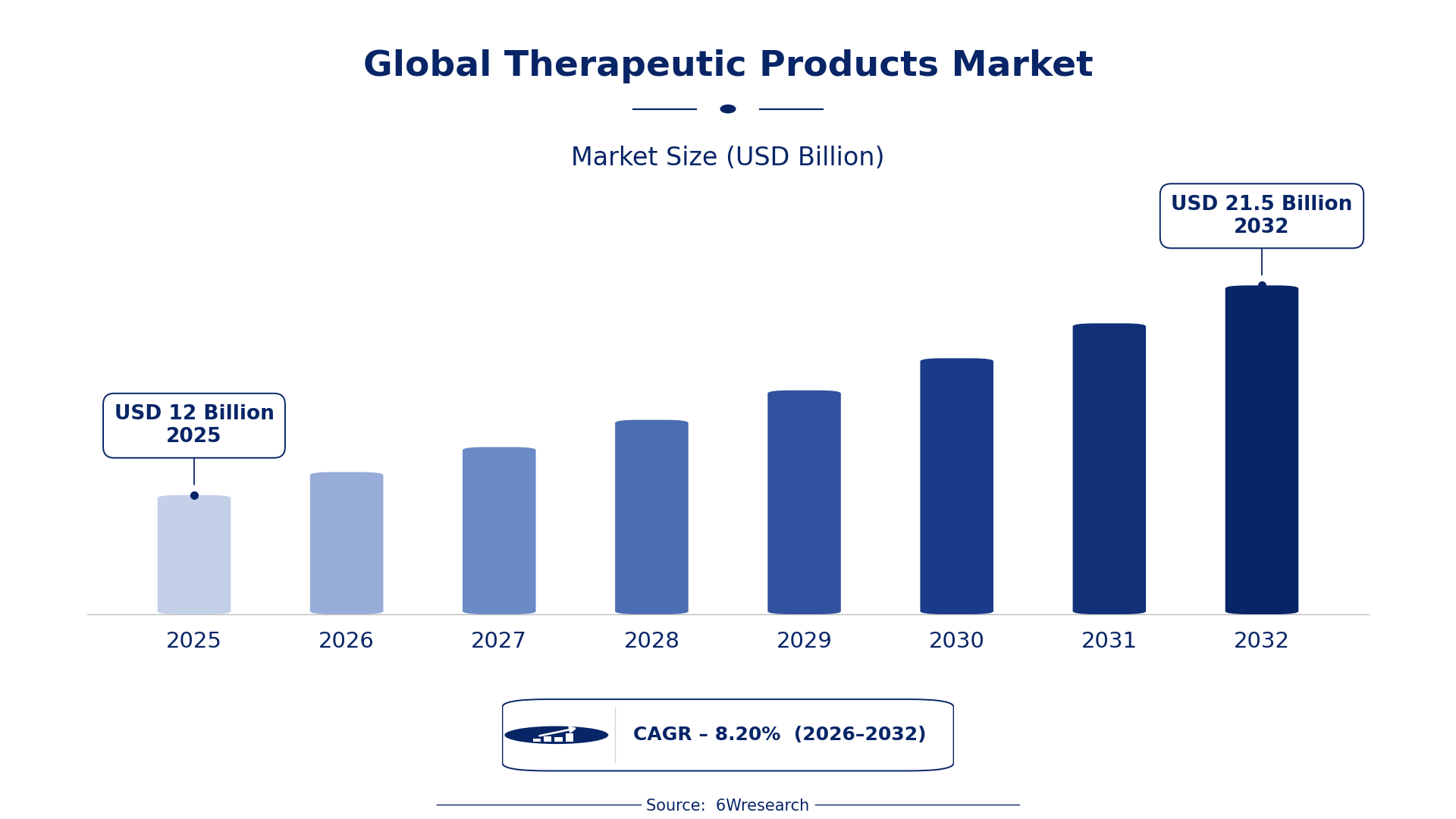
The Global Therapeutic Products Market was estimated at USD 12 Billion in 2025 and is projected to reach USD 21.5 Billion by 2032, growing at a CAGR of 8.20% from 2026 to 2032.
Global Therapeutic Products Market Synopsis
The Global Therapeutic Products Market is experiencing transformational shifts, primarily driven by the increasing prevalence of chronic diseases and the growing demand for personalized healthcare solutions. This market serves critical industries such as pharmaceuticals, biotechnology, and healthcare, making its dynamics crucial to overall public health management.
Rising healthcare expenditures and advancements in therapeutic modalities, particularly in gene therapy and immunotherapy, are reshaping the landscape. The market is distinct from adjacent sectors due to its stringent regulatory environment and the necessity for high levels of research and development investment, which challenges new entrants while rewarding established players with innovation.
Global Therapeutic Products Market Year-wise Growth Rate and Key Drivers
This graph illustrates the annual growth rates of the Global Therapeutic Products Market from 2022 to 2032, highlighting a steady upward trajectory and projected expansion over the forecast period.
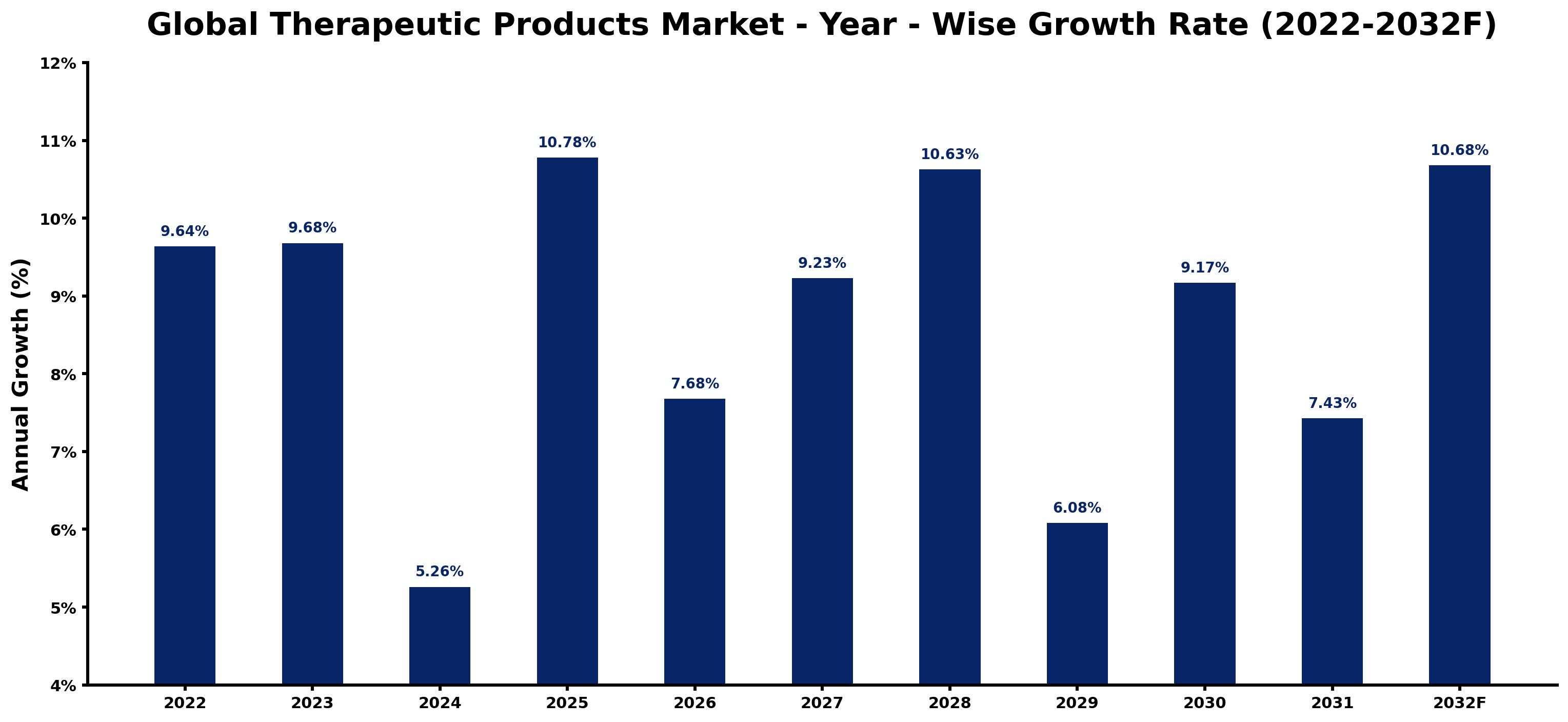
The table below presents the year‑wise growth rates along with the key drivers influencing the market
| Year | Growth Rate (%) | Major Drivers |
| 2022 | 9.64 | Wearable monitoring devices enhance therapeutic engagement through improved patient adherence to treatments. |
| 2023 | 9.68 | A shift toward telehealth platforms changes patient access to therapeutic product consultations. |
| 2024 | 5.26 | Increasing emphasis on sustainability in healthcare fosters growth in eco-friendly therapeutic products. |
| 2025 | 10.78 | Expanding drug delivery systems enables more efficient administration of therapeutic medications. |
| 2026 | 7.68 | Emerging markets in Asia are boosting the demand for innovative therapeutic products. |
| 2027 | 9.23 | Manufacturers are investing in supply chain improvements to enhance therapeutic product availability. |
| 2028 | 10.63 | Regulatory agencies like the FDA are expediting approvals for vital therapeutic innovations. |
| 2029 | 6.08 | Rising raw material costs for therapeutic products are pressuring companies to innovate and optimize. |
| 2030 | 9.17 | As investment activities surge, companies are expanding their therapeutic product development pipelines. |
| 2031 | 7.43 | Healthcare providers are increasingly prioritizing chronic disease management solutions among end-users. |
| 2032 | 10.68 | Intense competition among therapeutic product manufacturers is driving innovation and market differentiation. |
Note - Market size estimations and growth projections presented in this report are based on 6Wresearch's proprietary research methodology, combining internal industry data, secondary research, and primary validation, updated periodically to reflect current market conditions. As markets evolve rapidly, figures for certain industries may vary slightly and are intended as informed estimates rather than absolute figures. For the most current market sizing, we recommend validating figures with a 6Wresearch analyst.
Global Therapeutic Products Market Key Takeaways
Below are some of the specific key takeaways from the market, including:
- Projected growth in the biopharmaceuticals segment, expected to expand at a CAGR of 10% from 2026 to 2032.
- North America accounts for approximately 48% of the market share in 2025, driven by advanced healthcare infrastructure.
- Roche, a market leader, is heavily investing in oncology therapeutics, allocating over $10 billion in R&D annually.
- Emerging markets, particularly in Asia-Pacific, are experiencing a surge in demand, with growth rates expected to exceed 9% during the forecast period.
Evaluation of Restraints in Global Therapeutic Products Market
The Global Therapeutic Products Market faces significant challenges stemming from stringent regulatory requirements and rising costs associated with research and development. For instance, the cost of bringing a new drug to market can exceed $2.6 billion, which includes costs associated with lengthy clinical trials and regulatory approvals. Regulatory hurdles delay product launches, thereby impacting competitive advantage. For example, the FDA's extended review process for new drug applications can lead to delays of 12 months or more, adversely affecting profitability for developers.
Global Therapeutic Products Market Trends
Several key trends are currently shaping the Global Therapeutic Products Market. One prominent shift is the move towards personalized medicine, enabled by advancements in genomic technologies and data analytics. Companies like Novartis are leveraging big data to tailor therapies to specific patient profiles, enhancing treatment efficacy. For example, Novartis initiated a specialized program last year focusing on targeted therapies for rare diseases, showcasing this strategic shift.
Another trend is the rise of digital health solutions, especially telemedicine platforms that integrate therapeutic product delivery. With an estimated 50% increase in telehealth consultations, healthcare providers are adapting to optimize patient engagement and product accessibility. Moreover, the growing focus on immunotherapy, particularly against rare cancers, signifies innovation. According to recent studies, the global revenue from immunotherapy products is expected to reach $45 billion by 2030, further underscoring its significance.
Global Therapeutic Products Market Opportunities
Future revenue opportunities in the Global Therapeutic Products Market are abundant, particularly in emerging technologies like gene editing and regenerative medicine. For instance, CRISPR technology is projected to capture a market share worth $8 billion by 2025 as its applications widen across therapeutic products. This allows traditional pharmaceutical companies to diversify their portfolios and stay competitive.
Additionally, partnerships between technology firms and biopharmaceutical companies will foster innovation. For example, a recent agreement between IBM and Pfizer aims to enhance drug discovery through AI, expected to generate $2 billion in collaborative revenues by 2027. These collaborations signify pathways to not only advanced product development but also improved patient outcomes.
Global Therapeutic Products Market by Type
Within the Global Therapeutic Products Market, the largest segment is Pharmaceuticals, holding an approximate share of 60% in 2025. This significant share is attributed to the extensive variety of medications available for chronic diseases and their widespread adoption in healthcare settings. Meanwhile, the fastest-growing segment is Biopharmaceuticals, projected to grow at a robust CAGR of 12% from 2026 to 2032, largely due to increasing research activities and advancements in biologics, which are gaining traction in both oncology and autoimmune disease treatments.
Global Therapeutic Products Market by Application
In terms of applications, Pharmaceuticals & Biopharmaceutical Companies dominate the Global Therapeutic Products Market, accounting for about 45% share in 2025. This leading position is driven by the consistent need for innovative treatments and high investment in R&D. Conversely, the fastest growing application is Research & Academic Institutions, which are expected to achieve a CAGR of 10.5% from 2026 to 2032. This growth is propelled by increased funding for clinical studies and collaborations with pharmaceutical companies, reflecting a growing emphasis on translating research into viable therapeutic products.
Global Therapeutic Products Market by Region
North America retains its status as the largest region in the Global Therapeutic Products Market, with approximately 48% share in 2025, largely due to its robust healthcare infrastructure and significant investment in pharmaceuticals. However, the fastest-growing region is Asia-Pacific, projected to grow at a CAGR of 9.5% from 2026 to 2032. This growth is attributed to increasing healthcare investments, expanding middle-class populations, and a focus on improving healthcare access across the region, elevating demand for therapeutic products.
Government Initiatives in the Global Therapeutic Products Market
The regulatory environment surrounding the Global Therapeutic Products Market is continuously evolving, influenced by governmental policies aimed at enhancing product safety and efficacy while promoting innovation. As a result, several initiatives are underway to support research, development, and accessibility to therapeutic products across various regions.
- U.S. Food & Drug Administration (FDA) - 21st Century Cures Act, enacted in December 2016, promotes expedited review of new therapies, enabling faster delivery of innovative treatments to patients.
- European Medicines Agency (EMA) - PRIME scheme, started in March 2016, assists developers of promising medicines in meeting regulatory requirements, effectively reducing time to market.
- Department of Health and Human Services (HHS) - National Institutes of Health (NIH) Precision Medicine Initiative, launched in January 2015, aims to accelerate patient-centered research and precision therapeutic applications.
- India's Department of Pharmaceuticals - Production-Linked Incentive Scheme, introduced in 2020, provides financial incentives to boost domestic manufacturing of pharmaceutical products.
Future Insights of the Global Therapeutic Products Market
The trajectory of the Global Therapeutic Products Market suggests a transformative shift toward technology-driven solutions. By 2032, we can anticipate a significant rise in the integration of artificial intelligence for drug discovery and patient management, particularly through collaborations like the one between IBM and Pfizer. Alongside this, the personal medicine approach will become more entrenched, impacting therapeutic strategies across various diseases. The accelerating interest in gene therapies and their commercial viability, with worldwide investments predicted to reach billions by 2030, will further redefine industry standards and treatment modalities.
Global Therapeutic Products Market Latest Developments
Recent advancements in the Global Therapeutic Products Market highlight strategic initiatives and partnerships aimed at enhancing product offerings and market reach. Below are key developments that underscore this trend:
- Pfizer recently completed the acquisition of a biotech firm focusing on mRNA technology in early 2023, positioning itself as a leader in innovative vaccine development.
- Roche is currently expanding its production capacity for targeted therapies, with plans to increase output by 30% by late 2024, ensuring faster access to essential treatments.
- Merck KGaA has ongoing clinical trials aiming to expand its immunotherapy portfolio, with preliminary results expected by mid-2024 that indicate promising efficacy for specific cancer types.
- Novartis is set to launch a next-generation CAR T-cell therapy in Q3 2025, engineered to improve patient outcomes through enhanced targeting mechanisms.
Global Therapeutic Products Market Key Players and Industry Positioning
The competitive landscape of the Global Therapeutic Products Market is characterized by a mix of consolidated leaders and emerging players. While the top companies dominate through extensive R&D capabilities, partnerships, and established market presence, niche players are increasingly contributing innovative solutions, particularly in the biopharmaceutical segment.
| Leading Company | Core Strength | Strategic Focus |
|---|---|---|
| Pfizer | Strong pipeline in mRNA technology | Expanding vaccine and targeted therapy offerings |
| Roche | Leadership in oncology treatments | Investing heavily in targeted treatment R&D |
| Merck KGaA | Expertise in immunotherapy | Broadening immunotherapy initiatives |
| Novartis | Advancements in CAR T-cell therapies | Focused on precision medicine |
| Johnson & Johnson | Diverse product portfolio across therapeutic areas | Investment in innovation and access strategies |
As competition intensifies, the market's future will see a rising emphasis on collaborative efforts for drug development, ensuring a steady influx of novel therapies that address unmet medical needs.
Key Attractiveness of the Report
- 10 Years of Market Numbers
- Historical Data Starting from 2022 to 2025
- Base Year: 2025
- Forecast Data until 2032
- Key Performance Indicators Impacting the Market
- Major Upcoming Developments and Projects
Key Highlights of the Report:
- Global Therapeutic Products Market Outlook
- Market Size of Global Therapeutic Products Market, 2025
- Forecast of Global Therapeutic Products Market, 2032
- Historical Data and Forecast of Global Therapeutic Products Revenues & Volume for the Period 2022-2032
- Global Therapeutic Products Market Trend Evolution
- Global Therapeutic Products Market Drivers and Challenges
- Global Therapeutic Products Price Trends
- Global Therapeutic Products Porter's Five Forces
- Global Therapeutic Products Industry Life Cycle
- Historical Data and Forecast of Global Therapeutic Products Market Revenues & Volume
- Historical Data and Forecast of Global Therapeutic Products Market Revenues & Volume By Type for the Period 2022-2032
- Historical Data and Forecast of Global Therapeutic Products Market Revenues & Volume By Bacteria for the Period 2022-2032
- Historical Data and Forecast of Global Therapeutic Products Market Revenues & Volume By Fungi for the Period 2022-2032
- Historical Data and Forecast of Global Therapeutic Products Market Revenues & Volume By Others for the Period 2022-2032
- Historical Data and Forecast of Global Therapeutic Products Market Revenues & Volume By Application for the Period 2022-2032
- Historical Data and Forecast of Global Therapeutic Products Market Revenues & Volume By Hospitals for the Period 2022-2032
- Historical Data and Forecast of Global Therapeutic Products Market Revenues & Volume By Pharmaceuticals & Biopharmaceutical Companies for the Period 2022-2032
- Historical Data and Forecast of Global Therapeutic Products Market Revenues & Volume By Research & academic institutions for the Period 2022-2032
- Historical Data and Forecast of North America Therapeutic Products Market Revenues & Volume By Type for the Period 2022-2032
- Historical Data and Forecast of North America Therapeutic Products Market Revenues & Volume By Bacteria for the Period 2022-2032
- Historical Data and Forecast of North America Therapeutic Products Market Revenues & Volume By Fungi for the Period 2022-2032
- Historical Data and Forecast of North America Therapeutic Products Market Revenues & Volume By Others for the Period 2022-2032
- Historical Data and Forecast of North America Therapeutic Products Market Revenues & Volume By Application for the Period 2022-2032
- Historical Data and Forecast of North America Therapeutic Products Market Revenues & Volume By Hospitals for the Period 2022-2032
- Historical Data and Forecast of North America Therapeutic Products Market Revenues & Volume By Pharmaceuticals & Biopharmaceutical Companies for the Period 2022-2032
- Historical Data and Forecast of North America Therapeutic Products Market Revenues & Volume By Research & academic institutions for the Period 2022-2032
- Historical Data and Forecast of United States of America Therapeutic Products Market Revenues & Volume for the Period 2022-2032
- Historical Data and Forecast of Canada Therapeutic Products Market Revenues & Volume for the Period 2022-2032
- Historical Data and Forecast of Rest of North America Therapeutic Products Market Revenues & Volume for the Period 2022-2032
- Historical Data and Forecast of Latin America (LATAM) Therapeutic Products Market Revenues & Volume By Type for the Period 2022-2032
- Historical Data and Forecast of Latin America (LATAM) Therapeutic Products Market Revenues & Volume By Bacteria for the Period 2022-2032
- Historical Data and Forecast of Latin America (LATAM) Therapeutic Products Market Revenues & Volume By Fungi for the Period 2022-2032
- Historical Data and Forecast of Latin America (LATAM) Therapeutic Products Market Revenues & Volume By Others for the Period 2022-2032
- Historical Data and Forecast of Latin America (LATAM) Therapeutic Products Market Revenues & Volume By Application for the Period 2022-2032
- Historical Data and Forecast of Latin America (LATAM) Therapeutic Products Market Revenues & Volume By Hospitals for the Period 2022-2032
- Historical Data and Forecast of Latin America (LATAM) Therapeutic Products Market Revenues & Volume By Pharmaceuticals & Biopharmaceutical Companies for the Period 2022-2032
- Historical Data and Forecast of Latin America (LATAM) Therapeutic Products Market Revenues & Volume By Research & academic institutions for the Period 2022-2032
- Historical Data and Forecast of Brazil Therapeutic Products Market Revenues & Volume for the Period 2022-2032
- Historical Data and Forecast of Mexico Therapeutic Products Market Revenues & Volume for the Period 2022-2032
- Historical Data and Forecast of Argentina Therapeutic Products Market Revenues & Volume for the Period 2022-2032
- Historical Data and Forecast of Rest of LATAM Therapeutic Products Market Revenues & Volume for the Period 2022-2032
- Historical Data and Forecast of Asia Therapeutic Products Market Revenues & Volume By Type for the Period 2022-2032
- Historical Data and Forecast of Asia Therapeutic Products Market Revenues & Volume By Bacteria for the Period 2022-2032
- Historical Data and Forecast of Asia Therapeutic Products Market Revenues & Volume By Fungi for the Period 2022-2032
- Historical Data and Forecast of Asia Therapeutic Products Market Revenues & Volume By Others for the Period 2022-2032
- Historical Data and Forecast of Asia Therapeutic Products Market Revenues & Volume By Application for the Period 2022-2032
- Historical Data and Forecast of Asia Therapeutic Products Market Revenues & Volume By Hospitals for the Period 2022-2032
- Historical Data and Forecast of Asia Therapeutic Products Market Revenues & Volume By Pharmaceuticals & Biopharmaceutical Companies for the Period 2022-2032
- Historical Data and Forecast of Asia Therapeutic Products Market Revenues & Volume By Research & academic institutions for the Period 2022-2032
- Historical Data and Forecast of China Therapeutic Products Market Revenues & Volume for the Period 2022-2032
- Historical Data and Forecast of India Therapeutic Products Market Revenues & Volume for the Period 2022-2032
- Historical Data and Forecast of Japan Therapeutic Products Market Revenues & Volume for the Period 2022-2032
- Historical Data and Forecast of Rest of Asia Therapeutic Products Market Revenues & Volume for the Period 2022-2032
- Historical Data and Forecast of Africa Therapeutic Products Market Revenues & Volume By Type for the Period 2022-2032
- Historical Data and Forecast of Africa Therapeutic Products Market Revenues & Volume By Bacteria for the Period 2022-2032
- Historical Data and Forecast of Africa Therapeutic Products Market Revenues & Volume By Fungi for the Period 2022-2032
- Historical Data and Forecast of Africa Therapeutic Products Market Revenues & Volume By Others for the Period 2022-2032
- Historical Data and Forecast of Africa Therapeutic Products Market Revenues & Volume By Application for the Period 2022-2032
- Historical Data and Forecast of Africa Therapeutic Products Market Revenues & Volume By Hospitals for the Period 2022-2032
- Historical Data and Forecast of Africa Therapeutic Products Market Revenues & Volume By Pharmaceuticals & Biopharmaceutical Companies for the Period 2022-2032
- Historical Data and Forecast of Africa Therapeutic Products Market Revenues & Volume By Research & academic institutions for the Period 2022-2032
- Historical Data and Forecast of South Africa Therapeutic Products Market Revenues & Volume for the Period 2022-2032
- Historical Data and Forecast of Nigeria Therapeutic Products Market Revenues & Volume for the Period 2022-2032
- Historical Data and Forecast of Egypt Therapeutic Products Market Revenues & Volume for the Period 2022-2032
- Historical Data and Forecast of Rest of Africa Therapeutic Products Market Revenues & Volume for the Period 2022-2032
- Historical Data and Forecast of Europe Therapeutic Products Market Revenues & Volume By Type for the Period 2022-2032
- Historical Data and Forecast of Europe Therapeutic Products Market Revenues & Volume By Bacteria for the Period 2022-2032
- Historical Data and Forecast of Europe Therapeutic Products Market Revenues & Volume By Fungi for the Period 2022-2032
- Historical Data and Forecast of Europe Therapeutic Products Market Revenues & Volume By Others for the Period 2022-2032
- Historical Data and Forecast of Europe Therapeutic Products Market Revenues & Volume By Application for the Period 2022-2032
- Historical Data and Forecast of Europe Therapeutic Products Market Revenues & Volume By Hospitals for the Period 2022-2032
- Historical Data and Forecast of Europe Therapeutic Products Market Revenues & Volume By Pharmaceuticals & Biopharmaceutical Companies for the Period 2022-2032
- Historical Data and Forecast of Europe Therapeutic Products Market Revenues & Volume By Research & academic institutions for the Period 2022-2032
- Historical Data and Forecast of United Kingdom Therapeutic Products Market Revenues & Volume for the Period 2022-2032
- Historical Data and Forecast of France Therapeutic Products Market Revenues & Volume for the Period 2022-2032
- Historical Data and Forecast of Germany Therapeutic Products Market Revenues & Volume for the Period 2022-2032
- Historical Data and Forecast of Rest of Europe Therapeutic Products Market Revenues & Volume for the Period 2022-2032
- Historical Data and Forecast of Middle East Therapeutic Products Market Revenues & Volume By Type for the Period 2022-2032
- Historical Data and Forecast of Middle East Therapeutic Products Market Revenues & Volume By Bacteria for the Period 2022-2032
- Historical Data and Forecast of Middle East Therapeutic Products Market Revenues & Volume By Fungi for the Period 2022-2032
- Historical Data and Forecast of Middle East Therapeutic Products Market Revenues & Volume By Others for the Period 2022-2032
- Historical Data and Forecast of Middle East Therapeutic Products Market Revenues & Volume By Application for the Period 2022-2032
- Historical Data and Forecast of Middle East Therapeutic Products Market Revenues & Volume By Hospitals for the Period 2022-2032
- Historical Data and Forecast of Middle East Therapeutic Products Market Revenues & Volume By Pharmaceuticals & Biopharmaceutical Companies for the Period 2022-2032
- Historical Data and Forecast of Middle East Therapeutic Products Market Revenues & Volume By Research & academic institutions for the Period 2022-2032
- Historical Data and Forecast of Saudi Arabia Therapeutic Products Market Revenues & Volume for the Period 2022-2032
- Historical Data and Forecast of UAE Therapeutic Products Market Revenues & Volume for the Period 2022-2032
- Historical Data and Forecast of Turkey Therapeutic Products Market Revenues & Volume for the Period 2022-2032
- Historical Data and Forecast of Rest of Middle East Therapeutic Products Market Revenues & Volume for the Period 2022-2032
- Global Therapeutic Products Market - Key Performance Indicators
- Global Therapeutic Products Market - Import Export Trade Statistics
- Global Therapeutic Products Market - Opportunity Assessment By Countries
- Global Therapeutic Products Market - Opportunity Assessment By Type
- Global Therapeutic Products Market - Opportunity Assessment By Application
- Global Therapeutic Products Market - Top Companies Market Share
- Global Therapeutic Products Market - Top Companies Profiles
- Global Therapeutic Products Market - Comparison of Players in Technical and Operating Parameters
- Global Therapeutic Products Market - Strategic Recommendations
Markets Covered
The Global Therapeutic Products Market report provides a detailed analysis of the following market segments:
By Regions and Countries:
- North America
- Europe
- LATAM
- Middle East
- Asia
- Africa
By Type:
- Bacteria
- Fungi
- Others
By Application:
- Hospitals
- Pharmaceuticals & Biopharmaceutical Companies
- Research & academic institutions






































