Global Thermochromic Pigments Market Highlights
| Market Size (2025) | USD 0.6 Billion |
| Forecast Size (2032) | USD 1.1 Billion |
| CAGR | 8.40% |
| Base Year | 2025 |
| Forecast Period | 2026-2032 |
| Largest Region | Asia-Pacific |
| Fastest Growing Region | Europe |
| Largest Segment | Reversible Thermochromic Pigment |
| Fastest Growing Segment | Irreversible Thermochromic Pigment |
| Leading Companies | Chromaflo Technologies, Matsui Shikiso Chemical, EMD Performance Materials, The Shepherd Color Company, Pidilite Industries |
Global Thermochromic Pigments Market Size & Growth Rate (2026-2032)
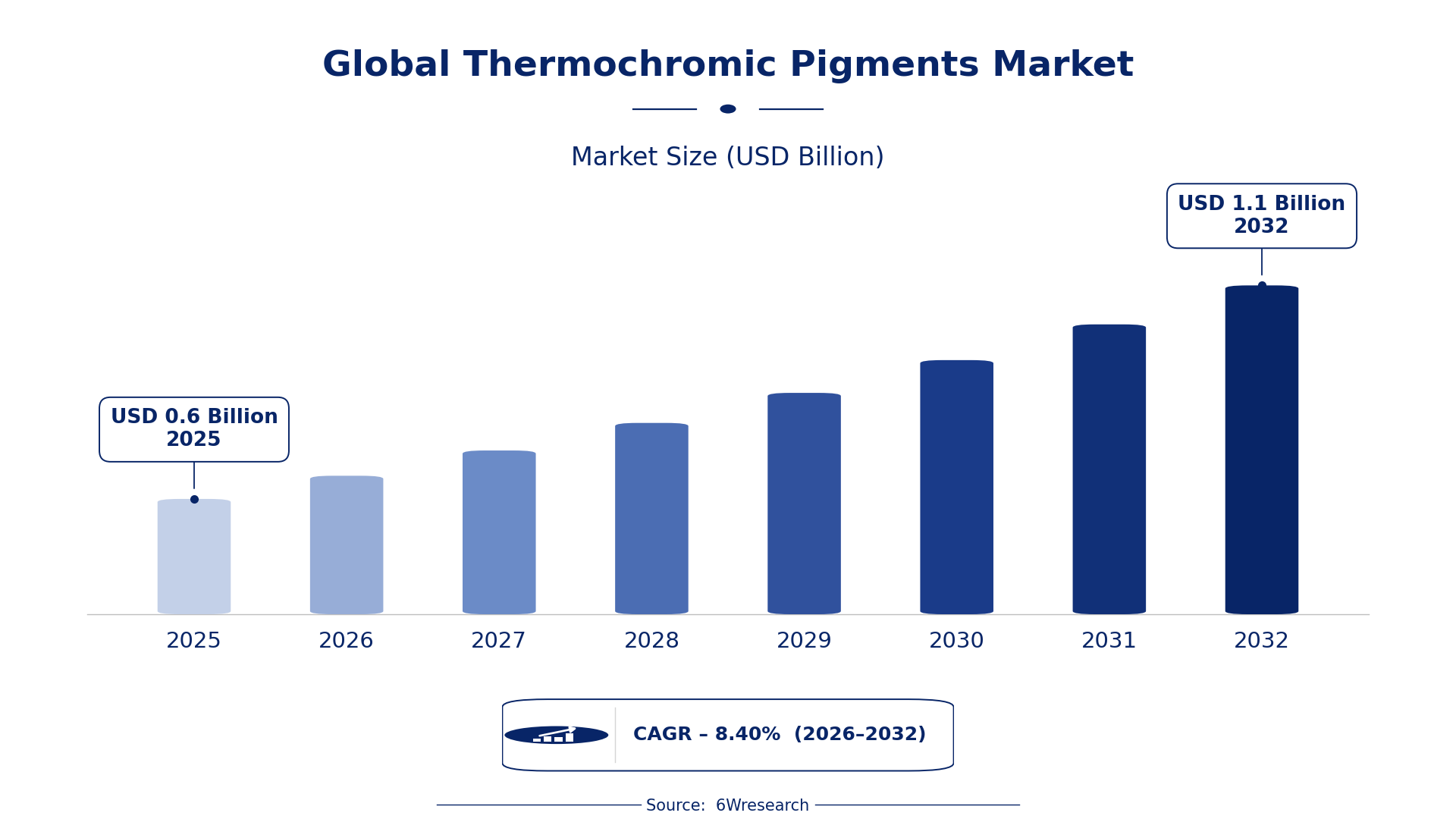
The Global Thermochromic Pigments Market was estimated at USD 0.6 Billion in 2025 and is projected to reach USD 1.1 Billion by 2032, growing at a CAGR of 8.40% from 2026 to 2032.
Global Thermochromic Pigments Market Synopsis
The Global Thermochromic Pigments Market exhibits structural shifts driven by increasing applications in packaging and consumer goods. As industries seek innovative solutions for temperature-sensitive products, thermochromic pigments are becoming essential for enhancing product functionality.
The market differentiates itself from adjacent segments through its unique color-changing properties and a focus on sustainability. Major industries are now exploring advanced formulations that not only meet aesthetic requirements but also align with regulatory standards related to consumer safety and environmental impact.
Global Thermochromic Pigments Market Year-wise Growth Rate and Key Drivers
This graph illustrates the annual growth rates of the Global Thermochromic Pigments Market from 2022 to 2032, highlighting a steady upward trajectory and projected expansion over the forecast period.
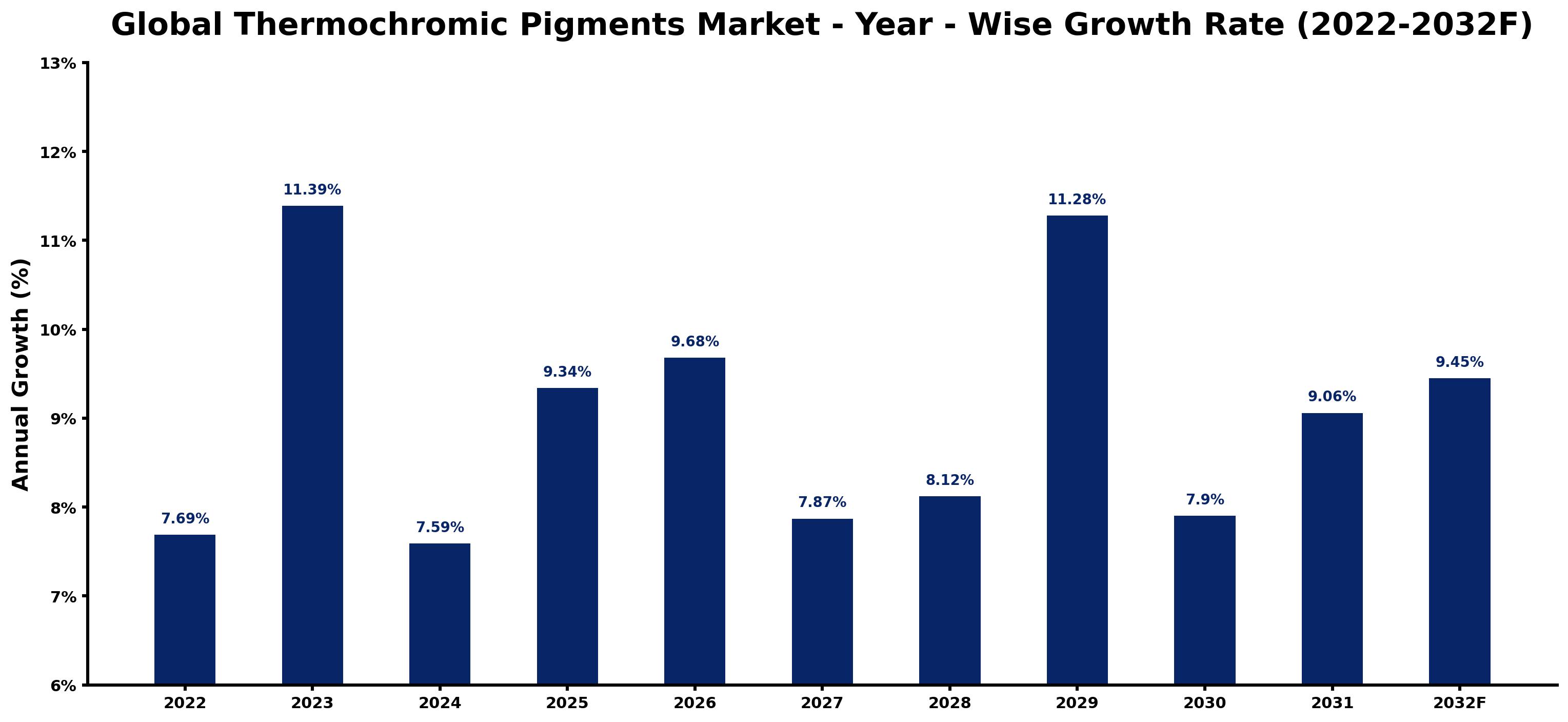
The table below presents the year‑wise growth rates along with the key drivers influencing the market
| Year | Growth Rate (%) | Major Drivers |
| 2022 | 7.69 | Manufacturers in the thermochromic pigments market are pursuing significant investment opportunities. |
| 2023 | 11.39 | As major players consolidate, competition in the thermochromic pigments sector intensifies. |
| 2024 | 7.59 | End-users increasingly prioritize sustainability, reshaping demand for thermochromic pigments. |
| 2025 | 9.34 | Innovative resin formulation processes are enhancing the performance of thermochromic pigments. |
| 2026 | 9.68 | Expanding applications in performance coatings are driving thermochromic pigments adoption among industries. |
| 2027 | 7.87 | New regulatory guidelines are motivating shifts towards compliant thermochromic pigment formulations. |
| 2028 | 8.12 | A shift toward Asian markets opens new avenues for thermochromic pigment distribution. |
| 2029 | 11.28 | In Europe, rising feedstock pricing pressures thermochromic pigment manufacturers to optimize costs. |
| 2030 | 7.9 | The petrochemical cracking process significantly influences thermochromic pigments' supply chain dynamics. |
| 2031 | 9.06 | Coating companies are altering their strategies to incorporate thermochromic pigments into products. |
| 2032 | 9.45 | A skilled workforce is crucial for advancing technologies in thermochromic pigments production. |
Note - Market size estimations and growth projections presented in this report are based on 6Wresearch's proprietary research methodology, combining internal industry data, secondary research, and primary validation, updated periodically to reflect current market conditions. As markets evolve rapidly, figures for certain industries may vary slightly and are intended as informed estimates rather than absolute figures. For the most current market sizing, we recommend validating figures with a 6Wresearch analyst.
Global Thermochromic Pigments Market Key Takeaways
Below are some of the specific key takeaways from the market, including:
- Asia-Pacific is anticipated to dominate the market, accounting for approximately 45% share by 2025, attributed to its robust manufacturing ecosystem.
- Chromaflo Technologies has invested over $10 million in R&D efforts focused on enhancing pigment efficacy and expanding application areas.
- The irreversible thermochromic pigment segment is projected to grow at a CAGR of 10.5% from 2026 to 2032, driven by rising demand in the automotive sector.
- Sustainable product lines are becoming a priority, with consumer preference leaning towards non-toxic thermochromic options, influencing supplier developments.
Evaluation of Restraints in Global Thermochromic Pigments Market
Several factors hinder the growth of the Global Thermochromic Pigments Market. High production costs, which can reach upwards of 20% more than traditional pigments, continue to be a significant barrier for entry. Complex manufacturing processes combined with the necessity for continual R&D investment raises these costs. For example, suppliers focusing on non-toxic formulations often incur higher costs that impact final retail prices, thus limiting affordability in competitive markets.
Global Thermochromic Pigments Market Trends
The market is witnessing several operative trends. One prominent shift is toward eco-friendly product offerings. Companies like Matsui Shikiso Chemical have embraced this shift, promoting their non-toxic thermochromic pigments, which contribute to a lower environmental footprint. Additionally, automation in manufacturing processes is optimizing production efficiency. For instance, advanced blending technologies have improved the consistency and performance of pigments, which is crucial for applications needing precise color changes.
Furthermore, the rise in digital printing technologies is altering pigment formulations, with brands seeking adaptations to meet the flexibility demands of digital applications.
Global Thermochromic Pigments Market Opportunities
Future revenue opportunities abound in the Global Thermochromic Pigments Market. The food and beverage industry presents significant potential, as companies innovate around temperature-sensitive packaging. For example, the collaboration between EMD Performance Materials and leading food brands aims to develop packaging that informs consumers when products are safe to consume or when they require refrigeration.
Moreover, the automotive sector is embracing thermochromic pigments for safety indicators and aesthetic enhancements, predicted to boost demand substantially. Projects that integrate smart materials into wearables and health-monitoring devices also offer a compelling market avenue for upcoming innovators.
Global Thermochromic Pigments Market by Type
Reversible Thermochromic Pigment commands a significant share, estimated at ~60% in 2025, while the Irreversible Thermochromic Pigment segment is the fastest-growing, projected to grow at a CAGR of 10.5% from 2026 to 2032. The reversible variant is favored for its diverse applications across various sectors, including consumer products and decor, due to its cost-effectiveness and versatility. In contrast, the irreversible segment's accelerated growth can be attributed to specialized uses in temperature-sensitive materials, where permanent color change is advantageous.
Global Thermochromic Pigments Market by Application
The Paint & Coating application leads the segment with a share of ~50% in 2025, while the Cosmetics segment is the fastest-growing, with a CAGR of 9.5% from 2026 to 2032. The paint and coating sector utilizes thermochromic pigments increasingly for both aesthetic and functional properties, such as in automotive bodies and household products. The Cosmetics sector, however, is innovating rapidly, pushing boundaries with products like temperature-adaptive makeup that respond to environmental changes, thereby carving a niche with significant consumer interest.
Global Thermochromic Pigments Market by Region
Asia-Pacific is the largest region, capturing a share of ~45% in 2025, while Europe is the fastest-growing region with a projected CAGR of 9.0% from 2026 to 2032. The significant manufacturing capabilities in Asia-Pacific, complemented by robust infrastructure and competitive pricing, contribute to its market dominance. Conversely, Europe’s commitment to sustainability and innovation is fueling rapid growth, as regulations increasingly favor eco-friendly product options that leverage thermochromic technologies for both environmental and consumer benefits.
Government Initiatives in the Global Thermochromic Pigments Market
The regulatory environment related to the Global Thermochromic Pigments Market is shaped by various government initiatives aimed at promoting product safety and environmental sustainability. These initiatives catalyze innovation while ensuring compliance within the industry.
- U.S. Environmental Protection Agency (EPA) - "Safer Choice Program" - Launched in 2020. This initiative encourages manufacturers to create safer and sustainable chemical products, which supports the development of thermochromic pigments that comply with health and environmental standards.
- European Commission - REACH Regulation - Enforced since 2007 and continues. This regulation ensures that all chemicals manufactured or imported into the EU meet safety standards, benefiting suppliers of compliant thermochromic pigments.
- Ministry of the Environment (Japan) - "Green Product Certification" - Announced in 2021, focusing on promoting environmentally friendly products. This certification supports domestic companies developing thermochromic pigments using eco-friendly materials and processes.
- Government of India - "Make in India" initiative - Initiated in 2014, this effort promotes local manufacturing, allowing companies in India to boost production of thermochromic pigments, reducing import dependency.
Future Insights of the Global Thermochromic Pigments Market
The Global Thermochromic Pigments Market is on the cusp of structural changes driven by advancements in digital technologies and evolving consumer preferences. Investment in R&D is anticipated to rise, particularly in non-toxic formulations as the demand for sustainable products grows. Companies such as Chromaflo Technologies are expected to lead this transformation, with a focus on enhancing product performance and application versatility. New applications are emerging in the smart packaging and automotive sectors, reinforcing the trend towards innovative solutions that align with environmental standards.
Global Thermochromic Pigments Market Latest Developments
The recent strategic activities in the Global Thermochromic Pigments Market indicate an active pursuit of innovation and market expansion. These developments reflect the industry's efforts to enhance capacity and meet changing consumer demands.
- In September 2023, EMD Performance Materials announced the launch of a new line of eco-friendly thermochromic pigments, designed specifically for packaging applications, emphasizing sustainability while catering to current market needs.
- Matsui Shikiso Chemical is currently enhancing its production processes through automation upgrades, slated for completion by mid-2024. This initiative aims to improve efficiency and reduce costs, thereby bolstering competitive positioning.
- Beginning in early 2024, The Shepherd Color Company plans to expand its R&D facilities in the United States to focus on thermochromic solutions for the automotive industry, aiming to capitalize on the increasing demand for innovative safety features.
- Recently, in August 2023, Pidilite Industries secured a partnership with prominent electronics companies to explore the use of thermochromic pigments in smart gadget design, potentially transforming consumer interaction with their devices.
Global Thermochromic Pigments Market Key Players and Industry Positioning
The competitive landscape of the Global Thermochromic Pigments Market is moderately consolidated, with a few key players significantly influencing market dynamics. These companies leverage their technological expertise, established market presence, and strategic initiatives to assert leadership in the industry.
| Leading Company | Core Strength | Strategic Focus |
|---|---|---|
| Chromaflo Technologies | Extensive R&D capabilities, focusing on advanced pigment solutions. | Innovation in non-toxic thermochromic formulations. |
| Matsui Shikiso Chemical | Strong manufacturing base in Asia, with improved automation processes. | Sustainability and product efficiency enhancements. |
| EMD Performance Materials | Diverse application know-how across industries. | Expansion into eco-friendly product lines for packaging. |
| The Shepherd Color Company | Technical leadership in color stability and performance. | Automotive safety applications and innovative designs. |
| Pidilite Industries | Strong brand presence in adhesives and specialty chemicals. | Exploring new applications in consumer electronics. |
Ongoing strategic initiatives by these key players are expected to further define industry standards while fostering a competitive environment aimed at technological advancements and sustainability efforts.
Key Attractiveness of the Report
- 10 Years of Market Numbers
- Historical Data Starting from 2022 to 2025
- Base Year: 2025
- Forecast Data until 2032
- Key Performance Indicators Impacting the Market
- Major Upcoming Developments and Projects
Key Highlights of the Report:
- Global Thermochromic Pigments Market Outlook
- Market Size of Global Thermochromic Pigments Market, 2025
- Forecast of Global Thermochromic Pigments Market, 2032
- Historical Data and Forecast of Global Thermochromic Pigments Revenues & Volume for the Period 2022-2032
- Global Thermochromic Pigments Market Trend Evolution
- Global Thermochromic Pigments Market Drivers and Challenges
- Global Thermochromic Pigments Price Trends
- Global Thermochromic Pigments Porter's Five Forces
- Global Thermochromic Pigments Industry Life Cycle
- Historical Data and Forecast of Global Thermochromic Pigments Market Revenues & Volume
- Historical Data and Forecast of Global Thermochromic Pigments Market Revenues & Volume By Type for the Period 2022-2032
- Historical Data and Forecast of Global Thermochromic Pigments Market Revenues & Volume By Reversible Thermochromic Pigment for the Period 2022-2032
- Historical Data and Forecast of Global Thermochromic Pigments Market Revenues & Volume By Irreversible Thermochromic Pigment for the Period 2022-2032
- Historical Data and Forecast of Global Thermochromic Pigments Market Revenues & Volume By Application for the Period 2022-2032
- Historical Data and Forecast of Global Thermochromic Pigments Market Revenues & Volume By Paint & Coating for the Period 2022-2032
- Historical Data and Forecast of Global Thermochromic Pigments Market Revenues & Volume By Ink printing for the Period 2022-2032
- Historical Data and Forecast of Global Thermochromic Pigments Market Revenues & Volume By Plastic for the Period 2022-2032
- Historical Data and Forecast of Global Thermochromic Pigments Market Revenues & Volume By Cosmetics for the Period 2022-2032
- Historical Data and Forecast of North America Thermochromic Pigments Market Revenues & Volume By Type for the Period 2022-2032
- Historical Data and Forecast of North America Thermochromic Pigments Market Revenues & Volume By Reversible Thermochromic Pigment for the Period 2022-2032
- Historical Data and Forecast of North America Thermochromic Pigments Market Revenues & Volume By Irreversible Thermochromic Pigment for the Period 2022-2032
- Historical Data and Forecast of North America Thermochromic Pigments Market Revenues & Volume By Application for the Period 2022-2032
- Historical Data and Forecast of North America Thermochromic Pigments Market Revenues & Volume By Paint & Coating for the Period 2022-2032
- Historical Data and Forecast of North America Thermochromic Pigments Market Revenues & Volume By Ink printing for the Period 2022-2032
- Historical Data and Forecast of North America Thermochromic Pigments Market Revenues & Volume By Plastic for the Period 2022-2032
- Historical Data and Forecast of North America Thermochromic Pigments Market Revenues & Volume By Cosmetics for the Period 2022-2032
- Historical Data and Forecast of United States of America Thermochromic Pigments Market Revenues & Volume for the Period 2022-2032
- Historical Data and Forecast of Canada Thermochromic Pigments Market Revenues & Volume for the Period 2022-2032
- Historical Data and Forecast of Rest of North America Thermochromic Pigments Market Revenues & Volume for the Period 2022-2032
- Historical Data and Forecast of Latin America (LATAM) Thermochromic Pigments Market Revenues & Volume By Type for the Period 2022-2032
- Historical Data and Forecast of Latin America (LATAM) Thermochromic Pigments Market Revenues & Volume By Reversible Thermochromic Pigment for the Period 2022-2032
- Historical Data and Forecast of Latin America (LATAM) Thermochromic Pigments Market Revenues & Volume By Irreversible Thermochromic Pigment for the Period 2022-2032
- Historical Data and Forecast of Latin America (LATAM) Thermochromic Pigments Market Revenues & Volume By Application for the Period 2022-2032
- Historical Data and Forecast of Latin America (LATAM) Thermochromic Pigments Market Revenues & Volume By Paint & Coating for the Period 2022-2032
- Historical Data and Forecast of Latin America (LATAM) Thermochromic Pigments Market Revenues & Volume By Ink printing for the Period 2022-2032
- Historical Data and Forecast of Latin America (LATAM) Thermochromic Pigments Market Revenues & Volume By Plastic for the Period 2022-2032
- Historical Data and Forecast of Latin America (LATAM) Thermochromic Pigments Market Revenues & Volume By Cosmetics for the Period 2022-2032
- Historical Data and Forecast of Brazil Thermochromic Pigments Market Revenues & Volume for the Period 2022-2032
- Historical Data and Forecast of Mexico Thermochromic Pigments Market Revenues & Volume for the Period 2022-2032
- Historical Data and Forecast of Argentina Thermochromic Pigments Market Revenues & Volume for the Period 2022-2032
- Historical Data and Forecast of Rest of LATAM Thermochromic Pigments Market Revenues & Volume for the Period 2022-2032
- Historical Data and Forecast of Asia Thermochromic Pigments Market Revenues & Volume By Type for the Period 2022-2032
- Historical Data and Forecast of Asia Thermochromic Pigments Market Revenues & Volume By Reversible Thermochromic Pigment for the Period 2022-2032
- Historical Data and Forecast of Asia Thermochromic Pigments Market Revenues & Volume By Irreversible Thermochromic Pigment for the Period 2022-2032
- Historical Data and Forecast of Asia Thermochromic Pigments Market Revenues & Volume By Application for the Period 2022-2032
- Historical Data and Forecast of Asia Thermochromic Pigments Market Revenues & Volume By Paint & Coating for the Period 2022-2032
- Historical Data and Forecast of Asia Thermochromic Pigments Market Revenues & Volume By Ink printing for the Period 2022-2032
- Historical Data and Forecast of Asia Thermochromic Pigments Market Revenues & Volume By Plastic for the Period 2022-2032
- Historical Data and Forecast of Asia Thermochromic Pigments Market Revenues & Volume By Cosmetics for the Period 2022-2032
- Historical Data and Forecast of China Thermochromic Pigments Market Revenues & Volume for the Period 2022-2032
- Historical Data and Forecast of India Thermochromic Pigments Market Revenues & Volume for the Period 2022-2032
- Historical Data and Forecast of Japan Thermochromic Pigments Market Revenues & Volume for the Period 2022-2032
- Historical Data and Forecast of Rest of Asia Thermochromic Pigments Market Revenues & Volume for the Period 2022-2032
- Historical Data and Forecast of Africa Thermochromic Pigments Market Revenues & Volume By Type for the Period 2022-2032
- Historical Data and Forecast of Africa Thermochromic Pigments Market Revenues & Volume By Reversible Thermochromic Pigment for the Period 2022-2032
- Historical Data and Forecast of Africa Thermochromic Pigments Market Revenues & Volume By Irreversible Thermochromic Pigment for the Period 2022-2032
- Historical Data and Forecast of Africa Thermochromic Pigments Market Revenues & Volume By Application for the Period 2022-2032
- Historical Data and Forecast of Africa Thermochromic Pigments Market Revenues & Volume By Paint & Coating for the Period 2022-2032
- Historical Data and Forecast of Africa Thermochromic Pigments Market Revenues & Volume By Ink printing for the Period 2022-2032
- Historical Data and Forecast of Africa Thermochromic Pigments Market Revenues & Volume By Plastic for the Period 2022-2032
- Historical Data and Forecast of Africa Thermochromic Pigments Market Revenues & Volume By Cosmetics for the Period 2022-2032
- Historical Data and Forecast of South Africa Thermochromic Pigments Market Revenues & Volume for the Period 2022-2032
- Historical Data and Forecast of Nigeria Thermochromic Pigments Market Revenues & Volume for the Period 2022-2032
- Historical Data and Forecast of Egypt Thermochromic Pigments Market Revenues & Volume for the Period 2022-2032
- Historical Data and Forecast of Rest of Africa Thermochromic Pigments Market Revenues & Volume for the Period 2022-2032
- Historical Data and Forecast of Europe Thermochromic Pigments Market Revenues & Volume By Type for the Period 2022-2032
- Historical Data and Forecast of Europe Thermochromic Pigments Market Revenues & Volume By Reversible Thermochromic Pigment for the Period 2022-2032
- Historical Data and Forecast of Europe Thermochromic Pigments Market Revenues & Volume By Irreversible Thermochromic Pigment for the Period 2022-2032
- Historical Data and Forecast of Europe Thermochromic Pigments Market Revenues & Volume By Application for the Period 2022-2032
- Historical Data and Forecast of Europe Thermochromic Pigments Market Revenues & Volume By Paint & Coating for the Period 2022-2032
- Historical Data and Forecast of Europe Thermochromic Pigments Market Revenues & Volume By Ink printing for the Period 2022-2032
- Historical Data and Forecast of Europe Thermochromic Pigments Market Revenues & Volume By Plastic for the Period 2022-2032
- Historical Data and Forecast of Europe Thermochromic Pigments Market Revenues & Volume By Cosmetics for the Period 2022-2032
- Historical Data and Forecast of United Kingdom Thermochromic Pigments Market Revenues & Volume for the Period 2022-2032
- Historical Data and Forecast of France Thermochromic Pigments Market Revenues & Volume for the Period 2022-2032
- Historical Data and Forecast of Germany Thermochromic Pigments Market Revenues & Volume for the Period 2022-2032
- Historical Data and Forecast of Rest of Europe Thermochromic Pigments Market Revenues & Volume for the Period 2022-2032
- Historical Data and Forecast of Middle East Thermochromic Pigments Market Revenues & Volume By Type for the Period 2022-2032
- Historical Data and Forecast of Middle East Thermochromic Pigments Market Revenues & Volume By Reversible Thermochromic Pigment for the Period 2022-2032
- Historical Data and Forecast of Middle East Thermochromic Pigments Market Revenues & Volume By Irreversible Thermochromic Pigment for the Period 2022-2032
- Historical Data and Forecast of Middle East Thermochromic Pigments Market Revenues & Volume By Application for the Period 2022-2032
- Historical Data and Forecast of Middle East Thermochromic Pigments Market Revenues & Volume By Paint & Coating for the Period 2022-2032
- Historical Data and Forecast of Middle East Thermochromic Pigments Market Revenues & Volume By Ink printing for the Period 2022-2032
- Historical Data and Forecast of Middle East Thermochromic Pigments Market Revenues & Volume By Plastic for the Period 2022-2032
- Historical Data and Forecast of Middle East Thermochromic Pigments Market Revenues & Volume By Cosmetics for the Period 2022-2032
- Historical Data and Forecast of Saudi Arabia Thermochromic Pigments Market Revenues & Volume for the Period 2022-2032
- Historical Data and Forecast of UAE Thermochromic Pigments Market Revenues & Volume for the Period 2022-2032
- Historical Data and Forecast of Turkey Thermochromic Pigments Market Revenues & Volume for the Period 2022-2032
- Historical Data and Forecast of Rest of Middle East Thermochromic Pigments Market Revenues & Volume for the Period 2022-2032
- Global Thermochromic Pigments Market - Key Performance Indicators
- Global Thermochromic Pigments Market - Import Export Trade Statistics
- Global Thermochromic Pigments Market - Opportunity Assessment By Countries
- Global Thermochromic Pigments Market - Opportunity Assessment By Type
- Global Thermochromic Pigments Market - Opportunity Assessment By Application
- Global Thermochromic Pigments Market - Top Companies Market Share
- Global Thermochromic Pigments Market - Top Companies Profiles
- Global Thermochromic Pigments Market - Comparison of Players in Technical and Operating Parameters
- Global Thermochromic Pigments Market - Strategic Recommendations
Markets Covered
The Global Thermochromic Pigments Market report provides a detailed analysis of the following market segments:
By Regions and Countries:
- North America
- Europe
- LATAM
- Middle East
- Asia
- Africa
By Type:
- Reversible Thermochromic Pigment
- Irreversible Thermochromic Pigment
By Application:
- Paint & Coating
- Ink printing
- Plastic
- Cosmetics






































