Global Tourism and Hotel Market Highlights
| Market Size (2025) | USD 1230 Billion |
| Forecast Size (2032) | USD 1740 Billion |
| CAGR | 6.80% |
| Base Year | 2025 |
| Forecast Period | 2026-2032 |
| Largest Region | North America |
| Fastest Growing Region | Asia |
| Largest Segment | Travel Services |
| Fastest Growing Segment | Accommodation Services |
| Leading Companies | Marriott International, Hilton Worldwide, Accor, IHG, Airbnb |
Global Tourism and Hotel Market Size & Growth Rate (2026-2032)
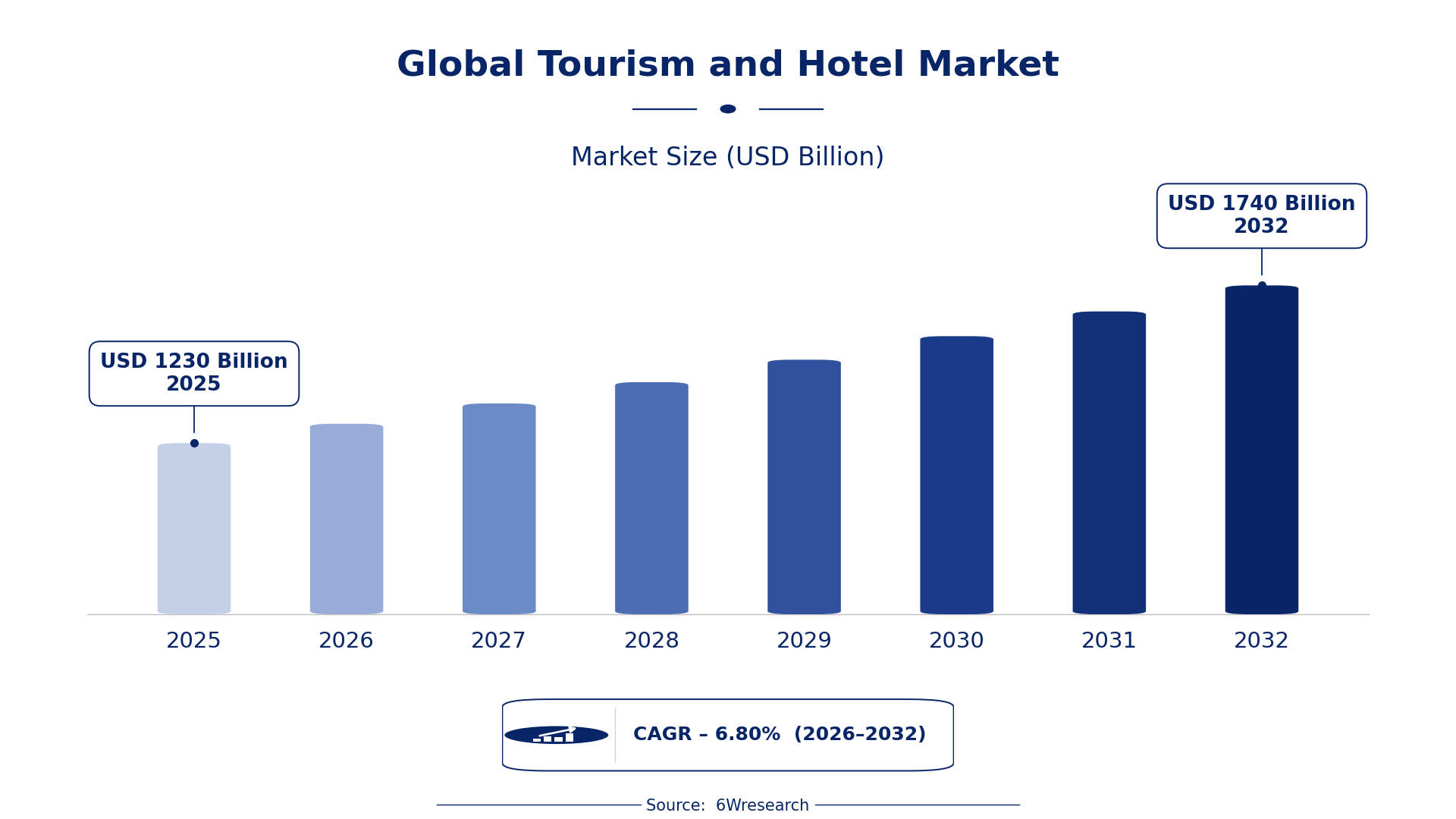
The Global Tourism and Hotel Market was estimated at USD 1230 Billion in 2025 and is projected to reach USD 1740 Billion by 2032, growing at a CAGR of 6.80% from 2026 to 2032.
Global Tourism and Hotel Market Synopsis
The Global Tourism and Hotel Market is undergoing pivotal transformations, influenced by consumer preferences favoring sustainability and experiential travel. This shift is not only changing the demographics of travelers but also reshaping service offerings across the market. Industry leaders are harnessing advanced technologies to streamline operations, enhance customer engagement, and optimize supply chains.
Demand for tailor-made travel experiences is growing, prompting hotels and travel operators to adapt their services to meet specific consumer desires. As digital platforms enable seamless booking and increased transparency, businesses must leverage data analytics to craft personalized journeys. This dynamic environment presents numerous opportunities amid challenges posed by geopolitical climates and economic fluctuations.
Global Tourism and Hotel Market Year-wise Growth Rate and Key Drivers
This graph illustrates the annual growth rates of the Global Tourism and Hotel Market from 2022 to 2032, highlighting a steady upward trajectory and projected expansion over the forecast period.
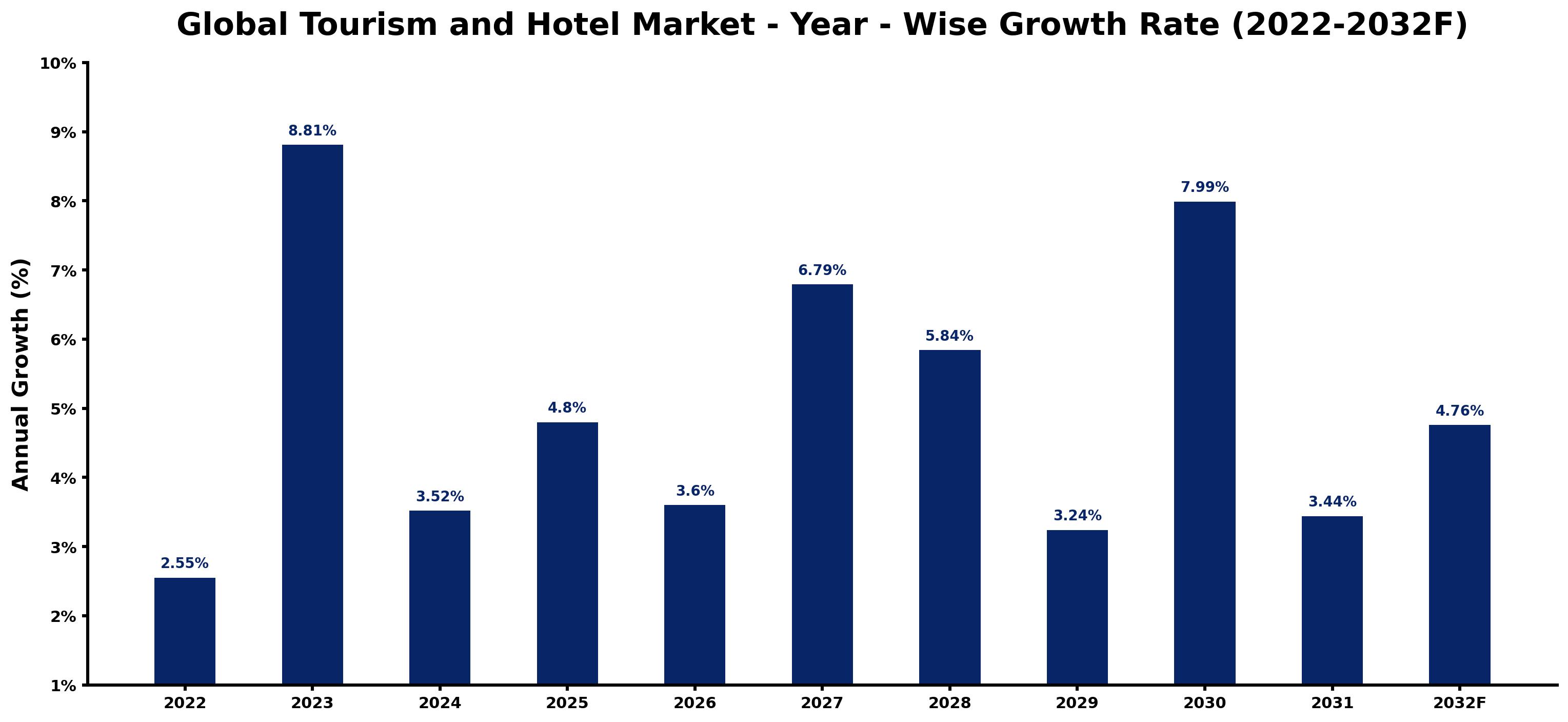
The table below presents the year‑wise growth rates along with the key drivers influencing the market
| Year | Growth Rate (%) | Major Drivers |
| 2022 | 2.55 | As regulatory changes begin to stabilize, the global tourism and hotel market shows modest recovery. |
| 2023 | 8.81 | Growing preferences for unique travel experiences drive increased visitation to hotels and tourist attractions. |
| 2024 | 3.52 | Major hotel chains enhance recruitment strategies to address skilled labor shortages effectively. |
| 2025 | 4.8 | In North America, rising raw material costs prompt hotels to adjust pricing strategies for sustainability. |
| 2026 | 3.6 | Hotel operators are consolidating their competitive strategies to capture diverse tourism segments more effectively. |
| 2027 | 6.79 | A shift toward eco-friendly practices influences consumer choices in the hotel and tourism sectors. |
| 2028 | 5.84 | Digital marketing technologies enable hotels to align offerings with changing consumer preferences for personalization. |
| 2029 | 3.24 | Increasing merger activities among hotel chains pave the way for strategic resource consolidation and market positioning. |
| 2030 | 7.99 | International tourist segments are expanding, leading to larger hotel developments in emerging markets. |
| 2031 | 3.44 | Improving supply chain logistics facilitates more efficient hotel operations and enhances guest experiences. |
| 2032 | 4.76 | Technological advancements in hospitality management software transform how hotels optimize service delivery. |
Note - Market size estimations and growth projections presented in this report are based on 6Wresearch's proprietary research methodology, combining internal industry data, secondary research, and primary validation, updated periodically to reflect current market conditions. As markets evolve rapidly, figures for certain industries may vary slightly and are intended as informed estimates rather than absolute figures. For the most current market sizing, we recommend validating figures with a 6Wresearch analyst.
Global Tourism and Hotel Market Key Takeaways
Below are some of the specific key takeaways from the market, including:
- As of 2025, travel services command approximately 58% of the market share.
- The accommodation services segment is projected to grow at a CAGR of 8.5% from 2026 to 2032.
- Airbnb reported a 30% increase in bookings in 2022, capitalizing on the trend towards alternative stays.
- Government tourism initiatives are expected to mobilize over $500 million in investment by 2026.
Evaluation of Restraints in Global Tourism and Hotel Market
The Global Tourism and Hotel Market is hindered by issues such as increasing labor costs, with average wages rising by 10% in many regions post-pandemic. Regulatory challenges also impact operational efficiency, exemplified by stringent health and safety regulations in response to global health crises. For example, the European Union's General Data Protection Regulation (GDPR) imposes fines of up to €20 million or 4% of global revenue for non-compliance, putting pressure on companies to ensure stringent data protection practices.
Global Tourism and Hotel Market Trends
Several key trends are reshaping the Global Tourism and Hotel Market as operators respond to evolving consumer expectations. First, there’s a notable shift toward sustainable and eco-friendly practices. Companies like Marriott are investing in green technologies, aiming for a 50% reduction in carbon emissions by 2025. Additionally, the integration of travel technology platforms is revolutionizing the booking process, improving the customer experience. For instance, Expedia reported that nearly 40% of travelers utilize mobile apps for bookings, indicating a move towards digital-first interactions. This trend is also reflected in the rise of personalized travel itineraries, allowing customers to tailor their travel experiences more intricately than before.
Global Tourism and Hotel Market Opportunities
Future revenue opportunities in the Global Tourism and Hotel Market are vast. The growing wellness tourism segment, which is projected to exceed $800 billion globally by 2027, presents a significant avenue for hotels. Initiatives like Accor's investment in wellness-focused resorts highlight this trend. Furthermore, there’s growing demand for smart hospitality solutions with integrated technologies. For example, Hilton’s initiative to incorporate IoT devices in rooms aims to enhance guest comfort. This trend is projected to contribute to approximately $100 billion in revenue by 2025, reflecting a robust diversification strategy.
Global Tourism and Hotel Market by Type
The Global Tourism and Hotel Market is currently led by Travel Services, which holds an estimated market share of ~58% in 2025. Conversely, Accommodation Services is the fastest-growing segment, with a projected CAGR of 8.5% from 2026 to 2032. The consumer preference for diverse lodging options, including boutique hotels and homestays, is driving this growth. Additionally, the increased desire for flexibility in travel arrangements strengthens the performance of this segment as travelers seek more customized experiences.
Global Tourism and Hotel Market by Application
In the Global Tourism and Hotel Market, Accommodation Services currently lead with a market share of ~45% as of 2025. Travel Services is identified as the fastest-growing segment, yielding a CAGR of 7.2% from 2026 to 2032. The strong consumer inclination for flexible travel arrangements and experiences tailored to individual preferences fuels the momentum in this area, especially with the rise of platforms that facilitate personalized travel itineraries.
Global Tourism and Hotel Market by Region
North America emerges as the largest region, accounting for approximately ~48% share in 2025. However, Asia is anticipated to be the fastest-growing region, with a CAGR of 8.7% from 2026 to 2032. This growth can be attributed to increasing disposable incomes, rising middle-class populations, and heightened interest in travel experiences among consumers. Moreover, governments in the region are investing in infrastructure to enhance travel and tourism services, which further stimulates market expansion.
Government Initiatives in the Global Tourism and Hotel Market
Government initiatives play a critical role in shaping the regulatory landscape of the Global Tourism and Hotel Market. Various ministries and agencies have launched programs aimed at boosting tourism, enhancing infrastructure, and supporting businesses within this sector. These initiatives often provide financial support or regulatory adjustments that can positively affect market growth.
- Ministry of Tourism, Government of India: "Incredible India 2.0" Scheme, launched in 2021, aims to boost domestic as well as international tourism through marketing and promotional activities.
- European Commission: "EU Open Skies Policy," updated in 2022, facilitates free air transport within EU countries, enhancing travel accessibility.
- U.S. Travel Association: "Travel Promotion Act," renewed in 2023, allocates $50 million to promote tourism in the United States, particularly for underserved markets.
- Ministry of Culture and Tourism, Turkey: "Turkey Tourism Strategy 2023," launched in 2023, emphasizes investment in sustainable tourism practices to attract eco-conscious travelers.
Future Insights of the Global Tourism and Hotel Market
The Global Tourism and Hotel Market is expected to undergo structural shifts as technology integration becomes more prevalent. By 2032, smart hospitality solutions, including AI-powered chatbots and data analytics for personalized services, will redefine customer interactions. Current initiatives, such as Hilton’s rollout of IoT devices in guest rooms, exemplify the push towards enhanced automation and improved guest satisfaction. As these technologies increase operational efficiency and reshape competitive dynamics, companies that prioritize tech adoption will be better positioned to capture market share.
Global Tourism and Hotel Market Latest Developments
Recent trends indicate robust activity within the Global Tourism and Hotel Market, highlighting significant transformations aimed at enhancing operational efficiency and guest experiences.
- Marriott International is enhancing its personalized guest experiences with advanced AI technologies, projected to roll out in late 2023, aiming for a substantial competitive edge.
- Accor has announced plans to open over 100 eco-friendly hotels across Europe by 2025, aligning with the rising demand for sustainable travel options.
- Airbnb is expanding its offerings to include immersive local experiences, with this initiative slated for full implementation by early 2024, enhancing its differentiation from traditional hotels.
- Hilton recently launched a partnership with a tech firm to implement blockchain solutions aimed at securing transactions and improving data transparency throughout 2023.
Global Tourism and Hotel Market Key Players and Industry Positioning
The competitive structure of the Global Tourism and Hotel Market is characterized by a mix of large, established players and emerging niche brands. Leading companies leverage technology and robust supply chains to enhance service delivery and maintain market share.
| Leading Company | Core Strength | Strategic Focus |
|---|---|---|
| Marriott International | Extensive global presence with premium brand portfolio. | Sustainability initiatives and tech adoption. |
| Hilton Worldwide | Strong loyalty program and innovative guest experiences. | Investment in smart technologies and sustainability. |
| Accor | Diverse brand offerings and commitment to local experiences. | Focus on eco-friendly practices and expansion in emerging markets. |
| IHG | Robust loyalty programs and operational excellence. | Digital transformation and innovative service delivery. |
| Airbnb | Disruptive business model in short-term rentals. | Expansion into experiential travel and partnerships. |
This landscape indicates that companies prioritizing technology and sustainability will likely lead market advancements, enhancing competitive positioning as consumer preferences evolve.
Key Attractiveness of the Report
- 10 Years of Market Numbers
- Historical Data Starting from 2022 to 2025
- Base Year: 2025
- Forecast Data until 2032
- Key Performance Indicators Impacting the Market
- Major Upcoming Developments and Projects
Key Highlights of the Report:
- Global Tourism and Hotel Market Outlook
- Market Size of Global Tourism and Hotel Market, 2025
- Forecast of Global Tourism and Hotel Market, 2032
- Historical Data and Forecast of Global Tourism and Hotel Revenues & Volume for the Period 2022-2032
- Global Tourism and Hotel Market Trend Evolution
- Global Tourism and Hotel Market Drivers and Challenges
- Global Tourism and Hotel Price Trends
- Global Tourism and Hotel Porter's Five Forces
- Global Tourism and Hotel Industry Life Cycle
- Historical Data and Forecast of Global Tourism and Hotel Market Revenues & Volume
- Historical Data and Forecast of Global Tourism and Hotel Market Revenues & Volume By Type for the Period 2022-2032
- Historical Data and Forecast of Global Tourism and Hotel Market Revenues & Volume By Domestic for the Period 2022-2032
- Historical Data and Forecast of Global Tourism and Hotel Market Revenues & Volume By International for the Period 2022-2032
- Historical Data and Forecast of Global Tourism and Hotel Market Revenues & Volume By Application for the Period 2022-2032
- Historical Data and Forecast of Global Tourism and Hotel Market Revenues & Volume By Accommodation Services for the Period 2022-2032
- Historical Data and Forecast of Global Tourism and Hotel Market Revenues & Volume By Travel Services for the Period 2022-2032
- Historical Data and Forecast of North America Tourism and Hotel Market Revenues & Volume By Type for the Period 2022-2032
- Historical Data and Forecast of North America Tourism and Hotel Market Revenues & Volume By Domestic for the Period 2022-2032
- Historical Data and Forecast of North America Tourism and Hotel Market Revenues & Volume By International for the Period 2022-2032
- Historical Data and Forecast of North America Tourism and Hotel Market Revenues & Volume By Application for the Period 2022-2032
- Historical Data and Forecast of North America Tourism and Hotel Market Revenues & Volume By Accommodation Services for the Period 2022-2032
- Historical Data and Forecast of North America Tourism and Hotel Market Revenues & Volume By Travel Services for the Period 2022-2032
- Historical Data and Forecast of United States of America Tourism and Hotel Market Revenues & Volume for the Period 2022-2032
- Historical Data and Forecast of Canada Tourism and Hotel Market Revenues & Volume for the Period 2022-2032
- Historical Data and Forecast of Rest of North America Tourism and Hotel Market Revenues & Volume for the Period 2022-2032
- Historical Data and Forecast of Latin America (LATAM) Tourism and Hotel Market Revenues & Volume By Type for the Period 2022-2032
- Historical Data and Forecast of Latin America (LATAM) Tourism and Hotel Market Revenues & Volume By Domestic for the Period 2022-2032
- Historical Data and Forecast of Latin America (LATAM) Tourism and Hotel Market Revenues & Volume By International for the Period 2022-2032
- Historical Data and Forecast of Latin America (LATAM) Tourism and Hotel Market Revenues & Volume By Application for the Period 2022-2032
- Historical Data and Forecast of Latin America (LATAM) Tourism and Hotel Market Revenues & Volume By Accommodation Services for the Period 2022-2032
- Historical Data and Forecast of Latin America (LATAM) Tourism and Hotel Market Revenues & Volume By Travel Services for the Period 2022-2032
- Historical Data and Forecast of Brazil Tourism and Hotel Market Revenues & Volume for the Period 2022-2032
- Historical Data and Forecast of Mexico Tourism and Hotel Market Revenues & Volume for the Period 2022-2032
- Historical Data and Forecast of Argentina Tourism and Hotel Market Revenues & Volume for the Period 2022-2032
- Historical Data and Forecast of Rest of LATAM Tourism and Hotel Market Revenues & Volume for the Period 2022-2032
- Historical Data and Forecast of Asia Tourism and Hotel Market Revenues & Volume By Type for the Period 2022-2032
- Historical Data and Forecast of Asia Tourism and Hotel Market Revenues & Volume By Domestic for the Period 2022-2032
- Historical Data and Forecast of Asia Tourism and Hotel Market Revenues & Volume By International for the Period 2022-2032
- Historical Data and Forecast of Asia Tourism and Hotel Market Revenues & Volume By Application for the Period 2022-2032
- Historical Data and Forecast of Asia Tourism and Hotel Market Revenues & Volume By Accommodation Services for the Period 2022-2032
- Historical Data and Forecast of Asia Tourism and Hotel Market Revenues & Volume By Travel Services for the Period 2022-2032
- Historical Data and Forecast of China Tourism and Hotel Market Revenues & Volume for the Period 2022-2032
- Historical Data and Forecast of India Tourism and Hotel Market Revenues & Volume for the Period 2022-2032
- Historical Data and Forecast of Japan Tourism and Hotel Market Revenues & Volume for the Period 2022-2032
- Historical Data and Forecast of Rest of Asia Tourism and Hotel Market Revenues & Volume for the Period 2022-2032
- Historical Data and Forecast of Africa Tourism and Hotel Market Revenues & Volume By Type for the Period 2022-2032
- Historical Data and Forecast of Africa Tourism and Hotel Market Revenues & Volume By Domestic for the Period 2022-2032
- Historical Data and Forecast of Africa Tourism and Hotel Market Revenues & Volume By International for the Period 2022-2032
- Historical Data and Forecast of Africa Tourism and Hotel Market Revenues & Volume By Application for the Period 2022-2032
- Historical Data and Forecast of Africa Tourism and Hotel Market Revenues & Volume By Accommodation Services for the Period 2022-2032
- Historical Data and Forecast of Africa Tourism and Hotel Market Revenues & Volume By Travel Services for the Period 2022-2032
- Historical Data and Forecast of South Africa Tourism and Hotel Market Revenues & Volume for the Period 2022-2032
- Historical Data and Forecast of Nigeria Tourism and Hotel Market Revenues & Volume for the Period 2022-2032
- Historical Data and Forecast of Egypt Tourism and Hotel Market Revenues & Volume for the Period 2022-2032
- Historical Data and Forecast of Rest of Africa Tourism and Hotel Market Revenues & Volume for the Period 2022-2032
- Historical Data and Forecast of Europe Tourism and Hotel Market Revenues & Volume By Type for the Period 2022-2032
- Historical Data and Forecast of Europe Tourism and Hotel Market Revenues & Volume By Domestic for the Period 2022-2032
- Historical Data and Forecast of Europe Tourism and Hotel Market Revenues & Volume By International for the Period 2022-2032
- Historical Data and Forecast of Europe Tourism and Hotel Market Revenues & Volume By Application for the Period 2022-2032
- Historical Data and Forecast of Europe Tourism and Hotel Market Revenues & Volume By Accommodation Services for the Period 2022-2032
- Historical Data and Forecast of Europe Tourism and Hotel Market Revenues & Volume By Travel Services for the Period 2022-2032
- Historical Data and Forecast of United Kingdom Tourism and Hotel Market Revenues & Volume for the Period 2022-2032
- Historical Data and Forecast of France Tourism and Hotel Market Revenues & Volume for the Period 2022-2032
- Historical Data and Forecast of Germany Tourism and Hotel Market Revenues & Volume for the Period 2022-2032
- Historical Data and Forecast of Rest of Europe Tourism and Hotel Market Revenues & Volume for the Period 2022-2032
- Historical Data and Forecast of Middle East Tourism and Hotel Market Revenues & Volume By Type for the Period 2022-2032
- Historical Data and Forecast of Middle East Tourism and Hotel Market Revenues & Volume By Domestic for the Period 2022-2032
- Historical Data and Forecast of Middle East Tourism and Hotel Market Revenues & Volume By International for the Period 2022-2032
- Historical Data and Forecast of Middle East Tourism and Hotel Market Revenues & Volume By Application for the Period 2022-2032
- Historical Data and Forecast of Middle East Tourism and Hotel Market Revenues & Volume By Accommodation Services for the Period 2022-2032
- Historical Data and Forecast of Middle East Tourism and Hotel Market Revenues & Volume By Travel Services for the Period 2022-2032
- Historical Data and Forecast of Saudi Arabia Tourism and Hotel Market Revenues & Volume for the Period 2022-2032
- Historical Data and Forecast of UAE Tourism and Hotel Market Revenues & Volume for the Period 2022-2032
- Historical Data and Forecast of Turkey Tourism and Hotel Market Revenues & Volume for the Period 2022-2032
- Historical Data and Forecast of Rest of Middle East Tourism and Hotel Market Revenues & Volume for the Period 2022-2032
- Global Tourism and Hotel Market - Key Performance Indicators
- Global Tourism and Hotel Market - Import Export Trade Statistics
- Global Tourism and Hotel Market - Opportunity Assessment By Countries
- Global Tourism and Hotel Market - Opportunity Assessment By Type
- Global Tourism and Hotel Market - Opportunity Assessment By Application
- Global Tourism and Hotel Market - Top Companies Market Share
- Global Tourism and Hotel Market - Top Companies Profiles
- Global Tourism and Hotel Market - Comparison of Players in Technical and Operating Parameters
- Global Tourism and Hotel Market - Strategic Recommendations
Markets Covered
The Global Tourism and Hotel Market report provides a detailed analysis of the following market segments:
By Regions and Countries:
- North America
- Europe
- LATAM
- Middle East
- Asia
- Africa
By Type:
- Domestic
- International
By Application:
- Accommodation Services
- Travel Services






































