Global Upholstered Furniture Market Highlights
| Market Size (2025) | USD 56.4 Billion |
| Forecast Size (2032) | USD 80.6 Billion |
| CAGR | 8.30% |
| Base Year | 2025 |
| Forecast Period | 2026-2032 |
| Largest Region | Asia Pacific |
| Fastest Growing Region | LATAM |
| Largest Segment | Sofas |
| Fastest Growing Segment | Chairs |
| Leading Companies | IKEA, Ashley Furniture, Steelcase, La-Z-Boy, Flexsteel |
Global Upholstered Furniture Market Size & Growth Rate (2026-2032)
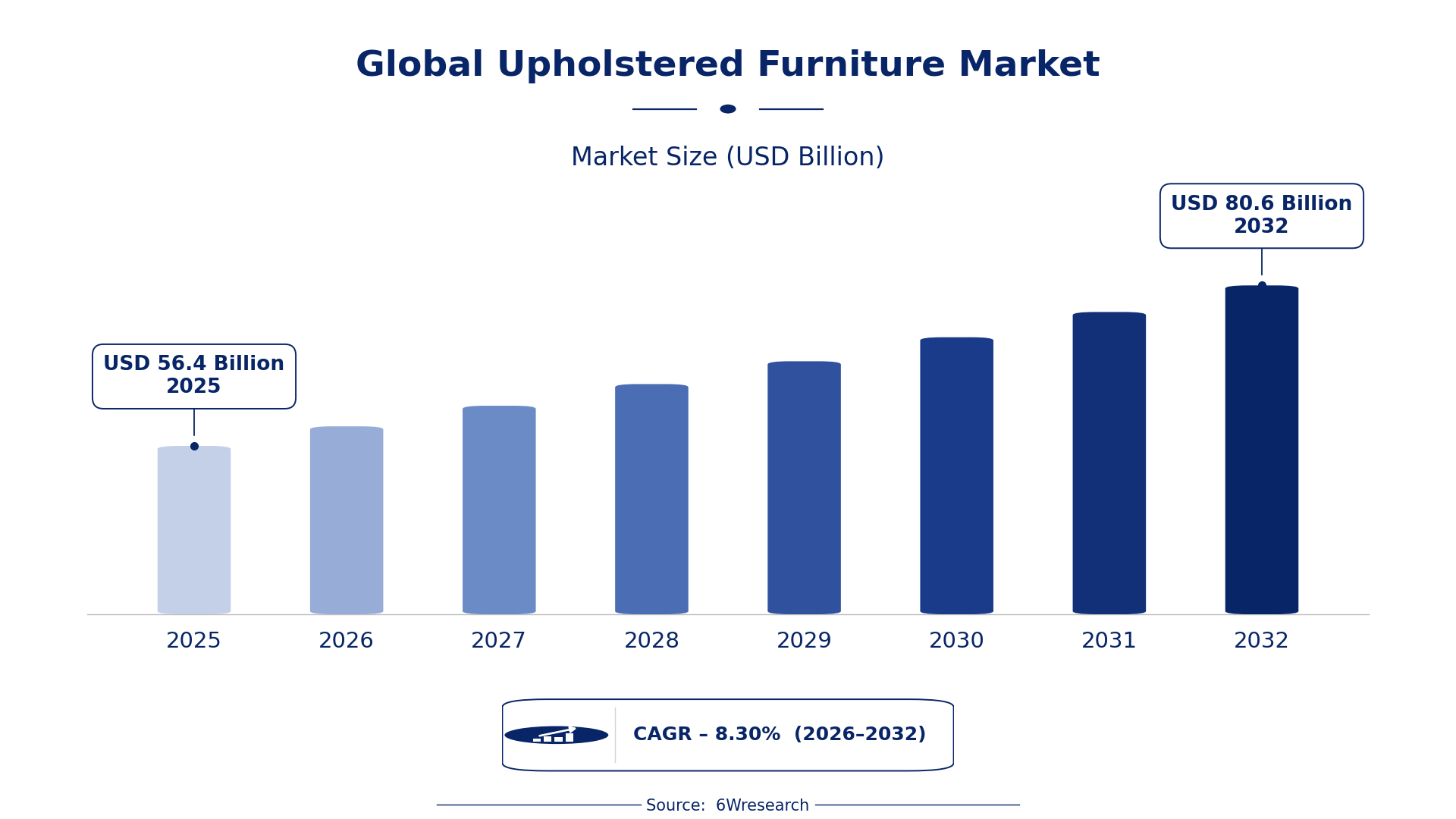
The Global Upholstered Furniture Market was estimated at USD 56.4 Billion in 2025 and is projected to reach USD 80.6 Billion by 2032, growing at a CAGR of 8.30% from 2026 to 2032.
Global Upholstered Furniture Market Synopsis
The Global Upholstered Furniture Market is at a pivotal point, undergoing substantial shifts influenced by evolving consumer preferences for comfort, aesthetics, and sustainability. As residential and commercial spaces become more integrated, the demand for stylish upholstered furniture is expected to increase. Urbanization and rising household incomes are further fueling this market's expansion, making it increasingly relevant across various sectors.
Key players are responding to these transformations by focusing on factors like design innovation and sustainable materials. This market distinguishes itself by not only offering traditional products but also embracing customization and eco-friendly solutions. In this changing consumer landscape, brands that effectively balance style with sustainability are likely to find significant competitive advantages.
Global Upholstered Furniture Market Year-wise Growth Rate and Key Drivers
This graph illustrates the annual growth rates of the Global Upholstered Furniture Market from 2022 to 2032, highlighting a steady upward trajectory and projected expansion over the forecast period.
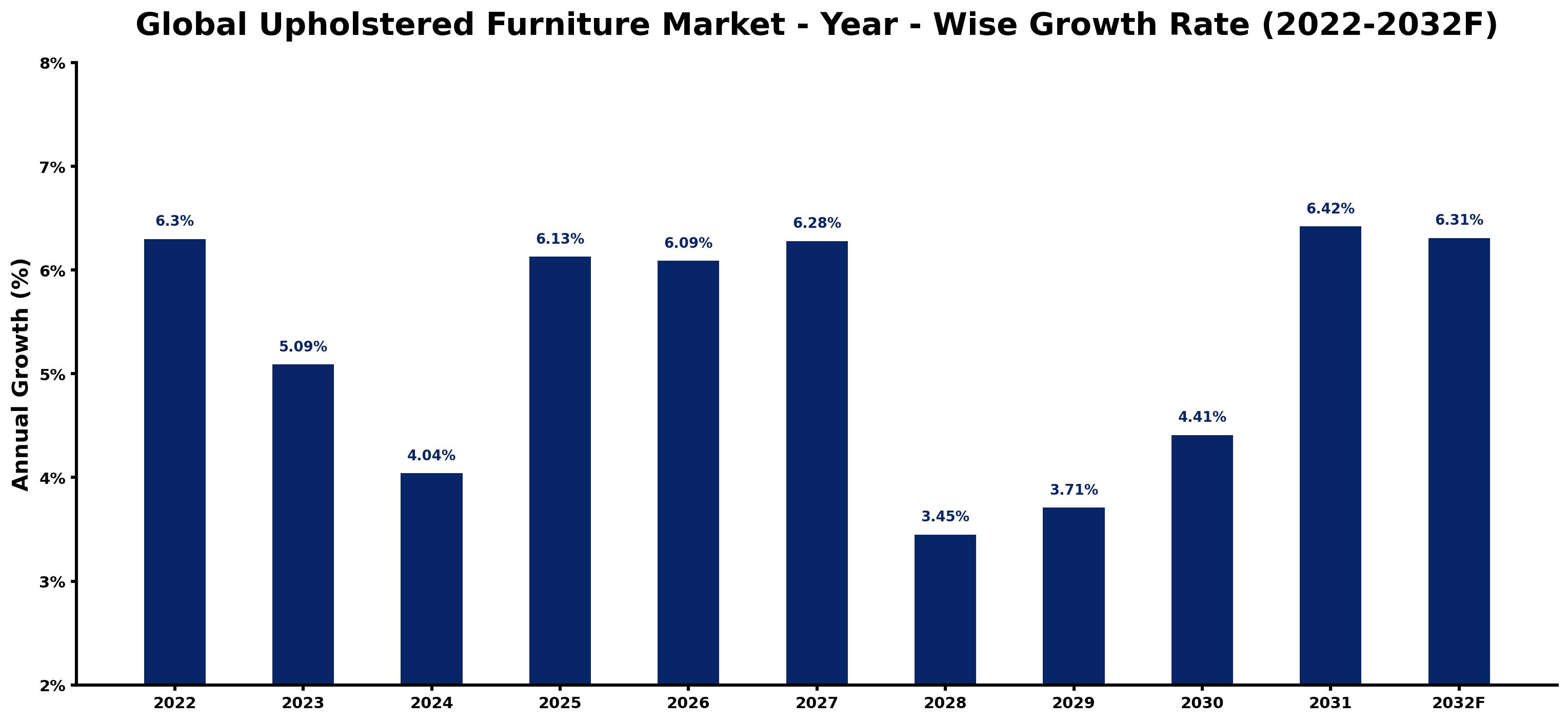
The table below presents the year‑wise growth rates along with the key drivers influencing the market
| Year | Growth Rate (%) | Major Drivers |
| 2022 | 6.3 | A shift toward innovative upholstered furniture technologies changes consumer engagement patterns. |
| 2023 | 5.09 | In the North American region, sustainability initiatives influence upholstered furniture purchasing decisions. |
| 2024 | 4.04 | Manufacturers recognize changing consumer preferences towards upholstered furniture customization options. |
| 2025 | 6.13 | New regulations mandating eco-friendly materials enhance upholstered furniture industry compliance efforts. |
| 2026 | 6.09 | While consumers increasingly prioritize aesthetics, upholstered furniture sales continue to rise. |
| 2027 | 6.28 | Expanding market reach into emerging economies enables greater upholstered furniture availability. |
| 2028 | 3.45 | Strategic mergers and acquisitions within the industry enhance upholstered furniture product offerings. |
| 2029 | 3.71 | Supply chain disruptions and their effects on upholstered furniture production demand operational adjustments. |
| 2030 | 4.41 | Emerging smart upholstered furniture technologies redefine user experiences and market expectations. |
| 2031 | 6.42 | Retailers face rising raw material costs, impacting upholstered furniture pricing strategies. |
| 2032 | 6.31 | Furniture manufacturers invest in skilled labor to innovate in upholstered furniture design. |
Note - Market size estimations and growth projections presented in this report are based on 6Wresearch's proprietary research methodology, combining internal industry data, secondary research, and primary validation, updated periodically to reflect current market conditions. As markets evolve rapidly, figures for certain industries may vary slightly and are intended as informed estimates rather than absolute figures. For the most current market sizing, we recommend validating figures with a 6Wresearch analyst.
Global Upholstered Furniture Market Key Takeaways
Below are some of the specific key takeaways from the market, including:
- Asia Pacific accounts for approximately 45% of the market share in 2025, driven by rapid urbanization.
- Sofas lead the product segment with a market share of about 40% in 2025, highlighting consumer preference for multi-functional living spaces.
- The market for chairs is projected to grow at a CAGR of 8.9% from 2026 to 2032, indicating a strong consumer trend towards diverse seating options.
- IKEA has been a market leader in innovative, affordable designs that appeal to a wide demographic, enhancing their market presence.
Evaluation of Restraints in Global Upholstered Furniture Market
The Global Upholstered Furniture Market faces several significant restraints, notably the volatility in raw material prices, which can impact production costs substantially. For instance, fluctuations in foam prices can vary by as much as 15% annually, affecting overall profitability. Additionally, competitive pressures from alternative materials, like leather and synthetic fabrics, further complicate manufacturer strategies. Manufacturers must navigate these challenges while aligning their offerings with ever-evolving consumer preferences for sustainability.
Global Upholstered Furniture Market Trends
Three distinct trends are shaping the Global Upholstered Furniture Market. First, there’s a technological push towards integration of augmented reality (AR) in shopping experiences, enhanced by companies like IKEA allowing consumers to visualize furniture in their own spaces before purchase. Second, the focus on sustainable sourcing has intensified, with organizations such as La-Z-Boy committing to using 100% sustainably sourced wood by 2025—a move that aligns with growing consumer demand for eco-friendly products. Lastly, customization is becoming more prevalent, with personalized design options leading to higher customer engagement. For example, Steelcase has recently released modular furniture lines that cater specifically to home office setups, addressing the shift in work environment needs.
Global Upholstered Furniture Market Opportunities
Several future revenue opportunities are emerging within the Global Upholstered Furniture Market. The rise of e-commerce platforms presents a significant avenue for expanding consumer reach; companies like Wayfair are capitalizing on this trend, reporting over $2 billion in sales in 2022 alone. Furthermore, innovations in manufacturing techniques, such as the integration of 3D printing, could allow companies to reduce production costs while increasing design versatility. For example, a recent project utilizing 3D technology reported a 30% reduction in material waste while improving design customization. Finally, the increasing interest in smart furniture, integrated with technology for enhanced functionality, offers a lucrative growth path, particularly in urban markets.
Global Upholstered Furniture Market by Types
Sofas emerge as the largest segment of the Global Upholstered Furniture Market, holding a share of approximately 40% in 2025. This dominance can be attributed to their essential role in living spaces and consumer preference for versatile furniture that accommodates social interactions. Conversely, chairs are the fastest-growing segment, expected to exhibit a CAGR of 9.5% from 2026 to 2032, reflecting increasing demand for tailored seating solutions that blend comfort with style.
Global Upholstered Furniture Market by Application
The residential sector dominates the Global Upholstered Furniture Market, with an estimated share of around 70% in 2025. This significant share underscores the importance of home furnishings in new housing developments and renovations. On the other hand, the commercial segment is projected to grow at a CAGR of 8.7% from 2026 to 2032, driven by an increase in office refurbishments and a focus on creating inviting work environments. The rise in remote work trends also contributes to this growth as businesses prioritize employee comfort.
Global Upholstered Furniture Market by Region
Asia Pacific currently holds the largest share of the Global Upholstered Furniture Market, estimated at around 45% in 2025, driven by rapid urbanization and a booming middle class. However, LATAM is the fastest-growing region, with a projected CAGR of 9.2% from 2026 to 2032, fueled by increasing consumer spending and shifting preferences towards modern, stylish furniture. The strong demand in these regions is bolstered by local manufacturing capabilities and favorable economic conditions.
Government Initiatives in the Global Upholstered Furniture Market
The regulatory landscape impacting the Global Upholstered Furniture Market is becoming increasingly dynamic, with various government initiatives playing a pivotal role in shaping industry standards and growth potential. These initiatives range from funding for sustainable practices to regulations aimed at enhancing consumer protection.
- U.S. Department of Energy - Energy Efficiency Improvements for Furniture - 2022: This initiative encourages manufacturers to improve energy efficiency in their production processes.
- European Commission - EU Green Deal - 2020: Aimed at promoting sustainable manufacturing and reducing carbon footprints, thereby benefiting eco-friendly furniture producers.
- Ministry of Housing and Urban Affairs, India - Pradhan Mantri Awas Yojana - 2015: This housing initiative indirectly boosts the demand for upholstered furniture in affordable housing projects.
- Government of Canada - Sustainable Development Strategy - 2021: Funding provided for manufacturers adopting sustainable materials and practices, fostering innovation in the market.
Future Insights of the Global Upholstered Furniture Market
The Global Upholstered Furniture Market is expected to witness substantial structural shifts through 2032. As consumer behavior increasingly favors multifunctional and sustainable products, companies like Flexsteel are investing in advanced manufacturing technologies, including eco-friendly materials, to enhance their appeal. The rising trend of remote work is also reshaping the furniture landscape, as demand for stylish yet functional home office solutions increases. This combination of factors is likely to accelerate diversification in product offerings and market strategies among key players.
Global Upholstered Furniture Market Latest Developments
Several notable developments are currently shaping the Global Upholstered Furniture Market, reflecting the dynamic changes within this sector:
- IKEA is enhancing its product range with a new collection focused on sustainable materials, set to launch in Q2 2023, aligning with consumer preferences for eco-friendly options.
- Ashley Furniture recently completed the acquisition of a regional manufacturing facility, boosting its production capabilities and ensuring quicker turnaround times for new designs, with operations expected to ramp up by late 2023.
- Steelcase is expanding its modular furniture line tailored for home offices, with a series of offerings slated for release in early 2024 to meet growing remote work demand.
- La-Z-Boy is set to implement advanced digital marketing strategies in 2025, targeting online consumers and enhancing engagement through personalized shopping experiences.
Global Upholstered Furniture Market Key Players and Industry Positioning
The competitive landscape of the Global Upholstered Furniture Market is moderately fragmented, with several key players leading in innovation, sustainability, and market reach. Each company has carved a niche that reflects its unique strategic focus and market positioning.
| Leading Company | Core Strength | Strategic Focus |
|---|---|---|
| IKEA | Global sourcing and innovative designs | Sustainability and affordability |
| Ashley Furniture | Diverse product range | Omnichannel distribution strategies |
| Steelcase | Workspace solutions expertise | Home office customization |
| La-Z-Boy | Comfort-driven designs | Luxury and ergonomic furniture |
| Flexsteel | Durability and handcrafted quality | Investing in sustainable materials |
As market dynamics evolve, the distinct strategies adopted by these companies will be pivotal in navigating consumer preferences and competition, particularly in the realms of sustainability and customization.
Key Attractiveness of the Report
- 10 Years of Market Numbers
- Historical Data Starting from 2022 to 2025
- Base Year: 2025
- Forecast Data until 2032
- Key Performance Indicators Impacting the Market
- Major Upcoming Developments and Projects
Key Highlights of the Report:
- Global Upholstered Furniture Market Outlook
- Market Size of Global Upholstered Furniture Market, 2025
- Forecast of Global Upholstered Furniture Market, 2032
- Historical Data and Forecast of Global Upholstered Furniture Revenues & Volume for the Period 2022-2032
- Global Upholstered Furniture Market Trend Evolution
- Global Upholstered Furniture Market Drivers and Challenges
- Global Upholstered Furniture Price Trends
- Global Upholstered Furniture Porter's Five Forces
- Global Upholstered Furniture Industry Life Cycle
- Historical Data and Forecast of Global Upholstered Furniture Market Revenues & Volume
- Historical Data and Forecast of Global Upholstered Furniture Market Revenues & Volume By Types for the Period 2022-2032
- Historical Data and Forecast of Global Upholstered Furniture Market Revenues & Volume By Chair for the Period 2022-2032
- Historical Data and Forecast of Global Upholstered Furniture Market Revenues & Volume By Sofas for the Period 2022-2032
- Historical Data and Forecast of Global Upholstered Furniture Market Revenues & Volume By Tables for the Period 2022-2032
- Historical Data and Forecast of Global Upholstered Furniture Market Revenues & Volume By Beds for the Period 2022-2032
- Historical Data and Forecast of Global Upholstered Furniture Market Revenues & Volume By Other for the Period 2022-2032
- Historical Data and Forecast of Global Upholstered Furniture Market Revenues & Volume By Application for the Period 2022-2032
- Historical Data and Forecast of Global Upholstered Furniture Market Revenues & Volume By Residential for the Period 2022-2032
- Historical Data and Forecast of Global Upholstered Furniture Market Revenues & Volume By Commercial for the Period 2022-2032
- Historical Data and Forecast of North America Upholstered Furniture Market Revenues & Volume By Types for the Period 2022-2032
- Historical Data and Forecast of North America Upholstered Furniture Market Revenues & Volume By Chair for the Period 2022-2032
- Historical Data and Forecast of North America Upholstered Furniture Market Revenues & Volume By Sofas for the Period 2022-2032
- Historical Data and Forecast of North America Upholstered Furniture Market Revenues & Volume By Tables for the Period 2022-2032
- Historical Data and Forecast of North America Upholstered Furniture Market Revenues & Volume By Beds for the Period 2022-2032
- Historical Data and Forecast of North America Upholstered Furniture Market Revenues & Volume By Other for the Period 2022-2032
- Historical Data and Forecast of North America Upholstered Furniture Market Revenues & Volume By Application for the Period 2022-2032
- Historical Data and Forecast of North America Upholstered Furniture Market Revenues & Volume By Residential for the Period 2022-2032
- Historical Data and Forecast of North America Upholstered Furniture Market Revenues & Volume By Commercial for the Period 2022-2032
- Historical Data and Forecast of United States of America Upholstered Furniture Market Revenues & Volume for the Period 2022-2032
- Historical Data and Forecast of Canada Upholstered Furniture Market Revenues & Volume for the Period 2022-2032
- Historical Data and Forecast of Rest of North America Upholstered Furniture Market Revenues & Volume for the Period 2022-2032
- Historical Data and Forecast of Latin America (LATAM) Upholstered Furniture Market Revenues & Volume By Types for the Period 2022-2032
- Historical Data and Forecast of Latin America (LATAM) Upholstered Furniture Market Revenues & Volume By Chair for the Period 2022-2032
- Historical Data and Forecast of Latin America (LATAM) Upholstered Furniture Market Revenues & Volume By Sofas for the Period 2022-2032
- Historical Data and Forecast of Latin America (LATAM) Upholstered Furniture Market Revenues & Volume By Tables for the Period 2022-2032
- Historical Data and Forecast of Latin America (LATAM) Upholstered Furniture Market Revenues & Volume By Beds for the Period 2022-2032
- Historical Data and Forecast of Latin America (LATAM) Upholstered Furniture Market Revenues & Volume By Other for the Period 2022-2032
- Historical Data and Forecast of Latin America (LATAM) Upholstered Furniture Market Revenues & Volume By Application for the Period 2022-2032
- Historical Data and Forecast of Latin America (LATAM) Upholstered Furniture Market Revenues & Volume By Residential for the Period 2022-2032
- Historical Data and Forecast of Latin America (LATAM) Upholstered Furniture Market Revenues & Volume By Commercial for the Period 2022-2032
- Historical Data and Forecast of Brazil Upholstered Furniture Market Revenues & Volume for the Period 2022-2032
- Historical Data and Forecast of Mexico Upholstered Furniture Market Revenues & Volume for the Period 2022-2032
- Historical Data and Forecast of Argentina Upholstered Furniture Market Revenues & Volume for the Period 2022-2032
- Historical Data and Forecast of Rest of LATAM Upholstered Furniture Market Revenues & Volume for the Period 2022-2032
- Historical Data and Forecast of Asia Upholstered Furniture Market Revenues & Volume By Types for the Period 2022-2032
- Historical Data and Forecast of Asia Upholstered Furniture Market Revenues & Volume By Chair for the Period 2022-2032
- Historical Data and Forecast of Asia Upholstered Furniture Market Revenues & Volume By Sofas for the Period 2022-2032
- Historical Data and Forecast of Asia Upholstered Furniture Market Revenues & Volume By Tables for the Period 2022-2032
- Historical Data and Forecast of Asia Upholstered Furniture Market Revenues & Volume By Beds for the Period 2022-2032
- Historical Data and Forecast of Asia Upholstered Furniture Market Revenues & Volume By Other for the Period 2022-2032
- Historical Data and Forecast of Asia Upholstered Furniture Market Revenues & Volume By Application for the Period 2022-2032
- Historical Data and Forecast of Asia Upholstered Furniture Market Revenues & Volume By Residential for the Period 2022-2032
- Historical Data and Forecast of Asia Upholstered Furniture Market Revenues & Volume By Commercial for the Period 2022-2032
- Historical Data and Forecast of China Upholstered Furniture Market Revenues & Volume for the Period 2022-2032
- Historical Data and Forecast of India Upholstered Furniture Market Revenues & Volume for the Period 2022-2032
- Historical Data and Forecast of Japan Upholstered Furniture Market Revenues & Volume for the Period 2022-2032
- Historical Data and Forecast of Rest of Asia Upholstered Furniture Market Revenues & Volume for the Period 2022-2032
- Historical Data and Forecast of Africa Upholstered Furniture Market Revenues & Volume By Types for the Period 2022-2032
- Historical Data and Forecast of Africa Upholstered Furniture Market Revenues & Volume By Chair for the Period 2022-2032
- Historical Data and Forecast of Africa Upholstered Furniture Market Revenues & Volume By Sofas for the Period 2022-2032
- Historical Data and Forecast of Africa Upholstered Furniture Market Revenues & Volume By Tables for the Period 2022-2032
- Historical Data and Forecast of Africa Upholstered Furniture Market Revenues & Volume By Beds for the Period 2022-2032
- Historical Data and Forecast of Africa Upholstered Furniture Market Revenues & Volume By Other for the Period 2022-2032
- Historical Data and Forecast of Africa Upholstered Furniture Market Revenues & Volume By Application for the Period 2022-2032
- Historical Data and Forecast of Africa Upholstered Furniture Market Revenues & Volume By Residential for the Period 2022-2032
- Historical Data and Forecast of Africa Upholstered Furniture Market Revenues & Volume By Commercial for the Period 2022-2032
- Historical Data and Forecast of South Africa Upholstered Furniture Market Revenues & Volume for the Period 2022-2032
- Historical Data and Forecast of Nigeria Upholstered Furniture Market Revenues & Volume for the Period 2022-2032
- Historical Data and Forecast of Egypt Upholstered Furniture Market Revenues & Volume for the Period 2022-2032
- Historical Data and Forecast of Rest of Africa Upholstered Furniture Market Revenues & Volume for the Period 2022-2032
- Historical Data and Forecast of Europe Upholstered Furniture Market Revenues & Volume By Types for the Period 2022-2032
- Historical Data and Forecast of Europe Upholstered Furniture Market Revenues & Volume By Chair for the Period 2022-2032
- Historical Data and Forecast of Europe Upholstered Furniture Market Revenues & Volume By Sofas for the Period 2022-2032
- Historical Data and Forecast of Europe Upholstered Furniture Market Revenues & Volume By Tables for the Period 2022-2032
- Historical Data and Forecast of Europe Upholstered Furniture Market Revenues & Volume By Beds for the Period 2022-2032
- Historical Data and Forecast of Europe Upholstered Furniture Market Revenues & Volume By Other for the Period 2022-2032
- Historical Data and Forecast of Europe Upholstered Furniture Market Revenues & Volume By Application for the Period 2022-2032
- Historical Data and Forecast of Europe Upholstered Furniture Market Revenues & Volume By Residential for the Period 2022-2032
- Historical Data and Forecast of Europe Upholstered Furniture Market Revenues & Volume By Commercial for the Period 2022-2032
- Historical Data and Forecast of United Kingdom Upholstered Furniture Market Revenues & Volume for the Period 2022-2032
- Historical Data and Forecast of France Upholstered Furniture Market Revenues & Volume for the Period 2022-2032
- Historical Data and Forecast of Germany Upholstered Furniture Market Revenues & Volume for the Period 2022-2032
- Historical Data and Forecast of Rest of Europe Upholstered Furniture Market Revenues & Volume for the Period 2022-2032
- Historical Data and Forecast of Middle East Upholstered Furniture Market Revenues & Volume By Types for the Period 2022-2032
- Historical Data and Forecast of Middle East Upholstered Furniture Market Revenues & Volume By Chair for the Period 2022-2032
- Historical Data and Forecast of Middle East Upholstered Furniture Market Revenues & Volume By Sofas for the Period 2022-2032
- Historical Data and Forecast of Middle East Upholstered Furniture Market Revenues & Volume By Tables for the Period 2022-2032
- Historical Data and Forecast of Middle East Upholstered Furniture Market Revenues & Volume By Beds for the Period 2022-2032
- Historical Data and Forecast of Middle East Upholstered Furniture Market Revenues & Volume By Other for the Period 2022-2032
- Historical Data and Forecast of Middle East Upholstered Furniture Market Revenues & Volume By Application for the Period 2022-2032
- Historical Data and Forecast of Middle East Upholstered Furniture Market Revenues & Volume By Residential for the Period 2022-2032
- Historical Data and Forecast of Middle East Upholstered Furniture Market Revenues & Volume By Commercial for the Period 2022-2032
- Historical Data and Forecast of Saudi Arabia Upholstered Furniture Market Revenues & Volume for the Period 2022-2032
- Historical Data and Forecast of UAE Upholstered Furniture Market Revenues & Volume for the Period 2022-2032
- Historical Data and Forecast of Turkey Upholstered Furniture Market Revenues & Volume for the Period 2022-2032
- Historical Data and Forecast of Rest of Middle East Upholstered Furniture Market Revenues & Volume for the Period 2022-2032
- Global Upholstered Furniture Market - Key Performance Indicators
- Global Upholstered Furniture Market - Import Export Trade Statistics
- Global Upholstered Furniture Market - Opportunity Assessment By Countries
- Global Upholstered Furniture Market - Opportunity Assessment By Types
- Global Upholstered Furniture Market - Opportunity Assessment By Application
- Global Upholstered Furniture Market - Top Companies Market Share
- Global Upholstered Furniture Market - Top Companies Profiles
- Global Upholstered Furniture Market - Comparison of Players in Technical and Operating Parameters
- Global Upholstered Furniture Market - Strategic Recommendations
Markets Covered
The Global Upholstered Furniture Market report provides a detailed analysis of the following market segments:
By Regions and Countries:
- North America
- Europe
- LATAM
- Middle East
- Asia
- Africa
By Types:
- Chair
- Sofas
- Tables
- Beds
- Other
By Application:
- Residential
- Commercial






































