Global Veterinary Clinical Services Market Highlights
| Market Size (2025) | USD 2.6 Billion |
| Forecast Size (2032) | USD 4.2 Billion |
| CAGR | 7.00% |
| Base Year | 2025 |
| Forecast Period | 2026-2032 |
| Largest Region | North America |
| Fastest Growing Region | Asia Pacific |
| Largest Segment | Medical Services |
| Fastest Growing Segment | Non-Medical Services |
| Leading Companies | VCA (Mars Inc.), Banfield Pet Hospital (Mars Inc.), Greencross Ltd., Animal Health International, Zoetis |
Global Veterinary Clinical Services Market Size & Growth Rate (2026-2032)
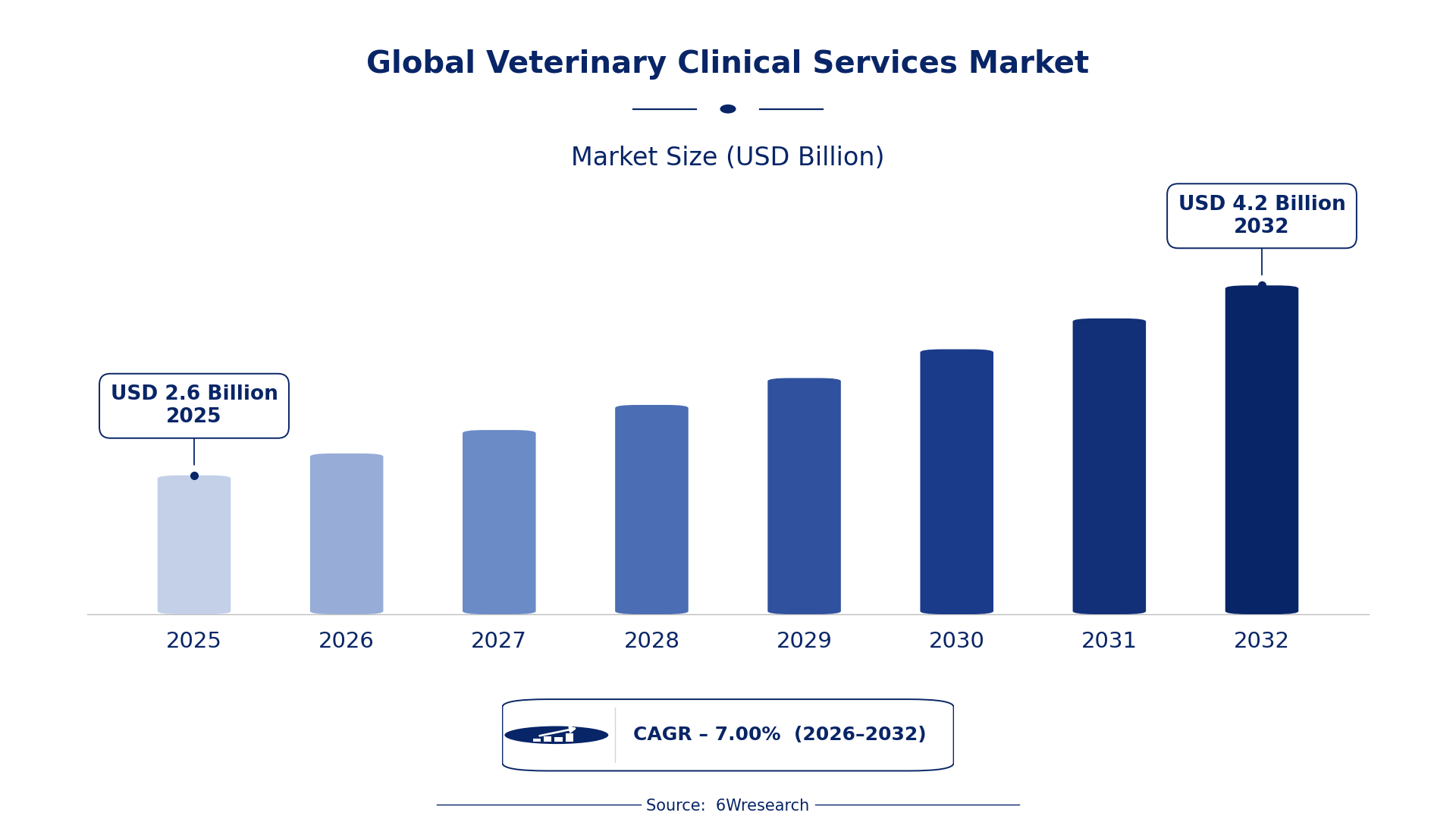
The Global Veterinary Clinical Services Market was estimated at USD 2.6 Billion in 2025 and is projected to reach USD 4.2 Billion by 2032, growing at a CAGR of 7.00% from 2026 to 2032.
Global Veterinary Clinical Services Market Synopsis
Recent trends indicate a notable shift in the Global Veterinary Clinical Services Market, characterized by an increasing focus on preventive care and personalized treatment options for pets. As consumers become more informed about animal health, specialized services such as advanced diagnostics and telehealth consultations are becoming mainstream. This evolution reflects a growing awareness of the importance of comprehensive care in enhancing the quality of life for pets.
The market is increasingly influenced by an expanding base of pet ownership, coupled with a rising prevalence of chronic animal diseases. Additionally, innovations in veterinary technology are facilitating enhancements in clinical service delivery, making them more accessible and efficient for pet owners. This convergence of behavioral shifts and technological advancements is reshaping the veterinary care landscape.
Global Veterinary Clinical Services Market Year-wise Growth Rate and Key Drivers
This graph illustrates the annual growth rates of the Global Veterinary Clinical Services Market from 2022 to 2032, highlighting a steady upward trajectory and projected expansion over the forecast period.
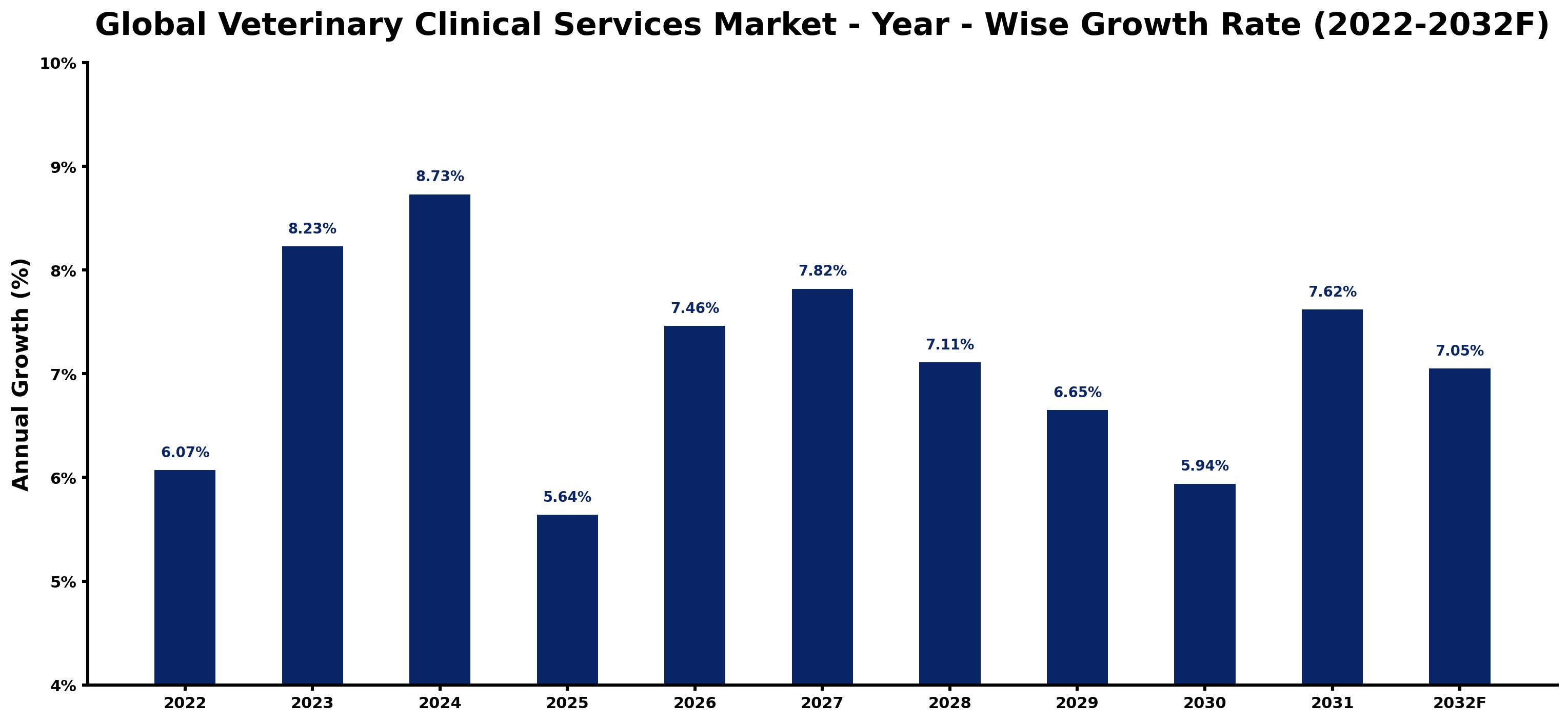
The table below presents the year‑wise growth rates along with the key drivers influencing the market
| Year | Growth Rate (%) | Major Drivers |
| 2022 | 6.07 | Veterinary hospitals are adapting to new reimbursement policies to enhance service offerings. |
| 2023 | 8.23 | A shift toward efficient supply chains facilitates better access to clinical services. |
| 2024 | 8.73 | As demand for telehealth platforms rises, veterinary practices expand their service range. |
| 2025 | 5.64 | Expanding diagnostic imaging capabilities enables clinics to offer more comprehensive care. |
| 2026 | 7.46 | Investment in wearable monitoring devices enhances the effectiveness of chronic disease management. |
| 2027 | 7.82 | Technological advancements in drug delivery systems streamline the administration of treatments. |
| 2028 | 7.11 | Biosensor technology adoption reduces the environmental impact of veterinary clinical services. |
| 2029 | 6.65 | In North America, geographic expansion of veterinary services meets diverse animal healthcare needs. |
| 2030 | 5.94 | A fluctuating raw material cost trend challenges the affordability of veterinary clinical services. |
| 2031 | 7.62 | Veterinary clinics are increasingly responding to changing consumer preferences for telehealth options. |
| 2032 | 7.05 | Digital therapeutics adoption by veterinary companies addresses evolving skill demands in clinical services. |
Note - Market size estimations and growth projections presented in this report are based on 6Wresearch's proprietary research methodology, combining internal industry data, secondary research, and primary validation, updated periodically to reflect current market conditions. As markets evolve rapidly, figures for certain industries may vary slightly and are intended as informed estimates rather than absolute figures. For the most current market sizing, we recommend validating figures with a 6Wresearch analyst.
Global Veterinary Clinical Services Market Key Takeaways
Below are some of the specific key takeaways from the market, including:
- As of 2025, North America captures approximately 48% of the Global Veterinary Clinical Services Market due to high pet ownership and advanced healthcare practices.
- The Non-Medical Services segment is projected to grow at a CAGR of 8.5% from 2026 to 2032, underscoring a shift towards wellness and preventive care.
- The integration of telemedicine solutions is gaining traction, with companies like VCA continuously improving their remote service offerings since 2020.
- Telehealth consultations have been shown to reduce costs by approximately 25%, making veterinary care more accessible to pet owners.
Evaluation of Restraints in Global Veterinary Clinical Services Market
Despite the promising growth trajectory, the Global Veterinary Clinical Services Market faces challenges, particularly in terms of cost and regulatory compliance. For instance, the acquisition cost of advanced veterinary equipment can exceed $200,000, creating a barrier for smaller clinics to adopt new technologies. Furthermore, regulatory complexity surrounding animal healthcare practices often requires significant investments in compliance infrastructure. For example, veterinary facilities must adhere to strict licensing regulations, which can vary widely by jurisdiction, complicating operational scalability and market accessibility.
Global Veterinary Clinical Services Market Trends
The landscape of the Global Veterinary Clinical Services Market is evolving, driven by several key trends. A notable shift towards specialized veterinary services is emerging, particularly in diagnostics and imaging technologies. Companies like Zoetis have invested heavily in developing advanced diagnostic tools, anticipating a surge in demand for tailored veterinary solutions. For example, Zoetis launched its innovative diagnostic platform in 2021, aimed at offering real-time health assessments for pets.
Furthermore, telemedicine is reshaping customer access to veterinary care by providing convenient options for consultations. Studies indicate that telehealth utilization has increased approximately 40% since its initial adaptation during the pandemic. This shift not only improves the customer experience but also enhances practice efficiencies, representing a transformative trend in how veterinary services are delivered.
Global Veterinary Clinical Services Market Opportunities
Future revenue opportunities in the Global Veterinary Clinical Services Market are abundant, particularly in technological integration. The rise of mobile applications offering health management tools for pet owners is one such opportunity. For instance, companies like Banfield Pet Hospital have developed a mobile app to streamline appointment scheduling and provide health tracking features. This service enhancement aims to capture the growing demographic increasingly reliant on digital platforms.
Moreover, the movement toward personalized animal healthcare opens avenues for specialized services, such as genetic testing and dietary consultations. Companies addressing these needs are positioned to gain a competitive advantage in a market increasingly focused on individualized care solutions.
Global Veterinary Clinical Services Market by Veterinary Services
Within the Global Veterinary Clinical Services Market, Medical Services hold the largest share, accounting for approximately 65% as of 2025. This dominance is largely due to the increasing focus on surgical procedures and advanced diagnostics, making it a cornerstone of modern veterinary care. In contrast, the Non-Medical Services segment is the fastest growing, projected to expand at a CAGR of 8.5% between 2026 and 2032. The shift reflects changing consumer preferences for wellness-oriented services, driven by a heightened awareness of preventive care for pets.
Global Veterinary Clinical Services Market by Delivery Channel
Hospitals and Clinics are the predominant delivery channel for veterinary services, capturing roughly 70% of the market share in 2025. This preference is justified by the comprehensive care facilities offered in such environments, making them the first choice for pet owners requiring specialized services. Conversely, the Outdoors/Ambulatory segment is anticipated to see robust growth, with a projected CAGR of 9.0% from 2026 to 2032. This growth can be attributed to the rising trend of mobile veterinary services, which enhance accessibility and cater to pet owners seeking at-home care solutions.
Global Veterinary Clinical Services Market by Region
North America remains the largest region in the Global Veterinary Clinical Services Market, holding approximately 48% share in 2025, driven by its high density of veterinary hospitals and established infrastructure. Meanwhile, the Asia Pacific region is experiencing rapid growth, with a CAGR of 8.0% from 2026 to 2032. This shift is fueled by increasing pet ownership and the adoption of Western veterinary practices, translating into a higher demand for professional veterinary services across urbanized areas.
Government Initiatives in the Global Veterinary Clinical Services Market
The regulatory landscape for the Global Veterinary Clinical Services Market is undergoing significant changes, spearheaded by various government initiatives aimed at improving animal health standards and promoting veterinary care access. Policies are being implemented to support veterinary professionals, enhance pet health outcomes, and streamline veterinary service delivery.
- United States Department of Agriculture (USDA) - Veterinary Medicine Loan Repayment Program, established in 2020, aims to alleviate student loan debt for veterinarians working in underserved areas, facilitating improved access to veterinary services.
- European Commission - Animal Health Law, initiated in 2021, sets out comprehensive guidelines for animal health management, enhancing regulatory standards across EU member states.
- Veterinary Council of India - Scheme for Establishment of Veterinary clinics, launched in February 2022, focuses on supporting the setup of modern veterinary clinics across the country, significantly improving service reach in rural areas.
- Australian Government - National Animal Welfare Framework, announced in 2023, aims to strengthen animal welfare standards and practices, which indirectly boosts the veterinary services market through increased demand for quality veterinary care.
Future Insights of the Global Veterinary Clinical Services Market
The future of the Global Veterinary Clinical Services Market is leaning towards enhanced technological integration and personalized healthcare for pets. As telehealth usage surged by nearly 40% during the pandemic, companies like VCA are expanding their digital service offerings to capitalize on this trend. The demand for specialized services is also expected to significantly rise, supported by innovations in diagnostic methods and preventive care protocols. These shifts are set to redefine service delivery models and dictate future investments through 2032.
Global Veterinary Clinical Services Market Latest Developments
The veterinary clinical services sector is witnessing dynamic changes driven by strategic initiatives from leading players. Companies are actively enhancing their service capabilities to align with emerging trends.
- Recently, Zoetis announced the launch of an enhanced diagnostic platform, aiming to provide real-time health assessments for pets, which positions them as a leader in advanced veterinary diagnostics.
- In early 2023, Banfield Pet Hospital expanded its telehealth services, allowing pet owners to access veterinary consultations remotely, effectively increasing their customer reach in urban areas.
- Ongoing initiatives by Greencross Ltd. focus on integrating innovative mobile apps for pet health management, enhancing user engagement and service transparency.
- Upcoming in 2024, Animal Health International is expected to roll out a new suite of preventive care services specifically designed for chronic conditions in pets, targeting the growing demand for specialized healthcare.
Global Veterinary Clinical Services Market Key Players and Industry Positioning
The competitive structure of the Global Veterinary Clinical Services Market is increasingly consolidated, with leading companies forming strategic alliances and enhancing their service offerings. This consolidation enables them to leverage advanced technologies and expand their geographical presence.
| Leading Company | Core Strength | Strategic Focus |
|---|---|---|
| VCA (Mars Inc.) | Robust network of veterinary hospitals | Expanding telehealth offerings and enhancing patient accessibility |
| Banfield Pet Hospital (Mars Inc.) | Comprehensive wellness programs | Integrating preventive care and mobile health management solutions |
| Greencross Ltd. | Established brand presence in Australia | Innovation in veterinary care through digital platforms |
| Animal Health International | Strong distribution network for veterinary products | Focus on preventive health solutions and expanding service breadth |
| Zoetis | Pioneering advancements in veterinary diagnostics | Investing heavily in research and development for new health solutions |
The competitive landscape reveals a focus on innovative services and technologies, as established companies aim to not only retain market shares but also to meet evolving consumer expectations.
Key Attractiveness of the Report
- 10 Years of Market Numbers
- Historical Data Starting from 2022 to 2025
- Base Year: 2025
- Forecast Data until 2032
- Key Performance Indicators Impacting the Market
- Major Upcoming Developments and Projects
Key Highlights of the Report:
- Global Veterinary Clinical Services Market Outlook
- Market Size of Global Veterinary Clinical Services Market, 2025
- Forecast of Global Veterinary Clinical Services Market, 2032
- Historical Data and Forecast of Global Veterinary Clinical Services Revenues & Volume for the Period 2022-2032
- Global Veterinary Clinical Services Market Trend Evolution
- Global Veterinary Clinical Services Market Drivers and Challenges
- Global Veterinary Clinical Services Price Trends
- Global Veterinary Clinical Services Porter's Five Forces
- Global Veterinary Clinical Services Industry Life Cycle
- Historical Data and Forecast of Global Veterinary Clinical Services Market Revenues & Volume
- Historical Data and Forecast of Global Veterinary Clinical Services Market Revenues & Volume By Veterinary Services for the Period 2022-2032
- Historical Data and Forecast of Global Veterinary Clinical Services Market Revenues & Volume By Medical Services for the Period 2022-2032
- Historical Data and Forecast of Global Veterinary Clinical Services Market Revenues & Volume By Non-Medical Services for the Period 2022-2032
- Historical Data and Forecast of Global Veterinary Clinical Services Market Revenues & Volume By Delivery Channel for the Period 2022-2032
- Historical Data and Forecast of Global Veterinary Clinical Services Market Revenues & Volume By Hospitals and Clinics for the Period 2022-2032
- Historical Data and Forecast of Global Veterinary Clinical Services Market Revenues & Volume By Commercial Facilities for the Period 2022-2032
- Historical Data and Forecast of Global Veterinary Clinical Services Market Revenues & Volume By Outdoors/Ambulatory for the Period 2022-2032
- Historical Data and Forecast of Global Veterinary Clinical Services Market Revenues & Volume By Others for the Period 2022-2032
- Historical Data and Forecast of North America Veterinary Clinical Services Market Revenues & Volume By Veterinary Services for the Period 2022-2032
- Historical Data and Forecast of North America Veterinary Clinical Services Market Revenues & Volume By Medical Services for the Period 2022-2032
- Historical Data and Forecast of North America Veterinary Clinical Services Market Revenues & Volume By Non-Medical Services for the Period 2022-2032
- Historical Data and Forecast of North America Veterinary Clinical Services Market Revenues & Volume By Delivery Channel for the Period 2022-2032
- Historical Data and Forecast of North America Veterinary Clinical Services Market Revenues & Volume By Hospitals and Clinics for the Period 2022-2032
- Historical Data and Forecast of North America Veterinary Clinical Services Market Revenues & Volume By Commercial Facilities for the Period 2022-2032
- Historical Data and Forecast of North America Veterinary Clinical Services Market Revenues & Volume By Outdoors/Ambulatory for the Period 2022-2032
- Historical Data and Forecast of North America Veterinary Clinical Services Market Revenues & Volume By Others for the Period 2022-2032
- Historical Data and Forecast of United States of America Veterinary Clinical Services Market Revenues & Volume for the Period 2022-2032
- Historical Data and Forecast of Canada Veterinary Clinical Services Market Revenues & Volume for the Period 2022-2032
- Historical Data and Forecast of Rest of North America Veterinary Clinical Services Market Revenues & Volume for the Period 2022-2032
- Historical Data and Forecast of Latin America (LATAM) Veterinary Clinical Services Market Revenues & Volume By Veterinary Services for the Period 2022-2032
- Historical Data and Forecast of Latin America (LATAM) Veterinary Clinical Services Market Revenues & Volume By Medical Services for the Period 2022-2032
- Historical Data and Forecast of Latin America (LATAM) Veterinary Clinical Services Market Revenues & Volume By Non-Medical Services for the Period 2022-2032
- Historical Data and Forecast of Latin America (LATAM) Veterinary Clinical Services Market Revenues & Volume By Delivery Channel for the Period 2022-2032
- Historical Data and Forecast of Latin America (LATAM) Veterinary Clinical Services Market Revenues & Volume By Hospitals and Clinics for the Period 2022-2032
- Historical Data and Forecast of Latin America (LATAM) Veterinary Clinical Services Market Revenues & Volume By Commercial Facilities for the Period 2022-2032
- Historical Data and Forecast of Latin America (LATAM) Veterinary Clinical Services Market Revenues & Volume By Outdoors/Ambulatory for the Period 2022-2032
- Historical Data and Forecast of Latin America (LATAM) Veterinary Clinical Services Market Revenues & Volume By Others for the Period 2022-2032
- Historical Data and Forecast of Brazil Veterinary Clinical Services Market Revenues & Volume for the Period 2022-2032
- Historical Data and Forecast of Mexico Veterinary Clinical Services Market Revenues & Volume for the Period 2022-2032
- Historical Data and Forecast of Argentina Veterinary Clinical Services Market Revenues & Volume for the Period 2022-2032
- Historical Data and Forecast of Rest of LATAM Veterinary Clinical Services Market Revenues & Volume for the Period 2022-2032
- Historical Data and Forecast of Asia Veterinary Clinical Services Market Revenues & Volume By Veterinary Services for the Period 2022-2032
- Historical Data and Forecast of Asia Veterinary Clinical Services Market Revenues & Volume By Medical Services for the Period 2022-2032
- Historical Data and Forecast of Asia Veterinary Clinical Services Market Revenues & Volume By Non-Medical Services for the Period 2022-2032
- Historical Data and Forecast of Asia Veterinary Clinical Services Market Revenues & Volume By Delivery Channel for the Period 2022-2032
- Historical Data and Forecast of Asia Veterinary Clinical Services Market Revenues & Volume By Hospitals and Clinics for the Period 2022-2032
- Historical Data and Forecast of Asia Veterinary Clinical Services Market Revenues & Volume By Commercial Facilities for the Period 2022-2032
- Historical Data and Forecast of Asia Veterinary Clinical Services Market Revenues & Volume By Outdoors/Ambulatory for the Period 2022-2032
- Historical Data and Forecast of Asia Veterinary Clinical Services Market Revenues & Volume By Others for the Period 2022-2032
- Historical Data and Forecast of China Veterinary Clinical Services Market Revenues & Volume for the Period 2022-2032
- Historical Data and Forecast of India Veterinary Clinical Services Market Revenues & Volume for the Period 2022-2032
- Historical Data and Forecast of Japan Veterinary Clinical Services Market Revenues & Volume for the Period 2022-2032
- Historical Data and Forecast of Rest of Asia Veterinary Clinical Services Market Revenues & Volume for the Period 2022-2032
- Historical Data and Forecast of Africa Veterinary Clinical Services Market Revenues & Volume By Veterinary Services for the Period 2022-2032
- Historical Data and Forecast of Africa Veterinary Clinical Services Market Revenues & Volume By Medical Services for the Period 2022-2032
- Historical Data and Forecast of Africa Veterinary Clinical Services Market Revenues & Volume By Non-Medical Services for the Period 2022-2032
- Historical Data and Forecast of Africa Veterinary Clinical Services Market Revenues & Volume By Delivery Channel for the Period 2022-2032
- Historical Data and Forecast of Africa Veterinary Clinical Services Market Revenues & Volume By Hospitals and Clinics for the Period 2022-2032
- Historical Data and Forecast of Africa Veterinary Clinical Services Market Revenues & Volume By Commercial Facilities for the Period 2022-2032
- Historical Data and Forecast of Africa Veterinary Clinical Services Market Revenues & Volume By Outdoors/Ambulatory for the Period 2022-2032
- Historical Data and Forecast of Africa Veterinary Clinical Services Market Revenues & Volume By Others for the Period 2022-2032
- Historical Data and Forecast of South Africa Veterinary Clinical Services Market Revenues & Volume for the Period 2022-2032
- Historical Data and Forecast of Nigeria Veterinary Clinical Services Market Revenues & Volume for the Period 2022-2032
- Historical Data and Forecast of Egypt Veterinary Clinical Services Market Revenues & Volume for the Period 2022-2032
- Historical Data and Forecast of Rest of Africa Veterinary Clinical Services Market Revenues & Volume for the Period 2022-2032
- Historical Data and Forecast of Europe Veterinary Clinical Services Market Revenues & Volume By Veterinary Services for the Period 2022-2032
- Historical Data and Forecast of Europe Veterinary Clinical Services Market Revenues & Volume By Medical Services for the Period 2022-2032
- Historical Data and Forecast of Europe Veterinary Clinical Services Market Revenues & Volume By Non-Medical Services for the Period 2022-2032
- Historical Data and Forecast of Europe Veterinary Clinical Services Market Revenues & Volume By Delivery Channel for the Period 2022-2032
- Historical Data and Forecast of Europe Veterinary Clinical Services Market Revenues & Volume By Hospitals and Clinics for the Period 2022-2032
- Historical Data and Forecast of Europe Veterinary Clinical Services Market Revenues & Volume By Commercial Facilities for the Period 2022-2032
- Historical Data and Forecast of Europe Veterinary Clinical Services Market Revenues & Volume By Outdoors/Ambulatory for the Period 2022-2032
- Historical Data and Forecast of Europe Veterinary Clinical Services Market Revenues & Volume By Others for the Period 2022-2032
- Historical Data and Forecast of United Kingdom Veterinary Clinical Services Market Revenues & Volume for the Period 2022-2032
- Historical Data and Forecast of France Veterinary Clinical Services Market Revenues & Volume for the Period 2022-2032
- Historical Data and Forecast of Germany Veterinary Clinical Services Market Revenues & Volume for the Period 2022-2032
- Historical Data and Forecast of Rest of Europe Veterinary Clinical Services Market Revenues & Volume for the Period 2022-2032
- Historical Data and Forecast of Middle East Veterinary Clinical Services Market Revenues & Volume By Veterinary Services for the Period 2022-2032
- Historical Data and Forecast of Middle East Veterinary Clinical Services Market Revenues & Volume By Medical Services for the Period 2022-2032
- Historical Data and Forecast of Middle East Veterinary Clinical Services Market Revenues & Volume By Non-Medical Services for the Period 2022-2032
- Historical Data and Forecast of Middle East Veterinary Clinical Services Market Revenues & Volume By Delivery Channel for the Period 2022-2032
- Historical Data and Forecast of Middle East Veterinary Clinical Services Market Revenues & Volume By Hospitals and Clinics for the Period 2022-2032
- Historical Data and Forecast of Middle East Veterinary Clinical Services Market Revenues & Volume By Commercial Facilities for the Period 2022-2032
- Historical Data and Forecast of Middle East Veterinary Clinical Services Market Revenues & Volume By Outdoors/Ambulatory for the Period 2022-2032
- Historical Data and Forecast of Middle East Veterinary Clinical Services Market Revenues & Volume By Others for the Period 2022-2032
- Historical Data and Forecast of Saudi Arabia Veterinary Clinical Services Market Revenues & Volume for the Period 2022-2032
- Historical Data and Forecast of UAE Veterinary Clinical Services Market Revenues & Volume for the Period 2022-2032
- Historical Data and Forecast of Turkey Veterinary Clinical Services Market Revenues & Volume for the Period 2022-2032
- Historical Data and Forecast of Rest of Middle East Veterinary Clinical Services Market Revenues & Volume for the Period 2022-2032
- Global Veterinary Clinical Services Market - Key Performance Indicators
- Global Veterinary Clinical Services Market - Import Export Trade Statistics
- Global Veterinary Clinical Services Market - Opportunity Assessment By Countries
- Global Veterinary Clinical Services Market - Opportunity Assessment By Veterinary Services
- Global Veterinary Clinical Services Market - Opportunity Assessment By Delivery Channel
- Global Veterinary Clinical Services Market - Top Companies Market Share
- Global Veterinary Clinical Services Market - Top Companies Profiles
- Global Veterinary Clinical Services Market - Comparison of Players in Technical and Operating Parameters
- Global Veterinary Clinical Services Market - Strategic Recommendations
Markets Covered
The Global Veterinary Clinical Services Market report provides a detailed analysis of the following market segments:
By Regions and Countries:
- North America
- Europe
- LATAM
- Middle East
- Asia
- Africa
By Veterinary Services:
- Medical Services
- Non-Medical Services
By Delivery Channel:
- Hospitals
- Clinics
- Commercial Facilities
- Outdoors/Ambulatory
- Others






































