Global Veterinary Medicine Market Highlights
| Market Size (2025) | USD 42 Billion |
| Forecast Size (2032) | USD 64 Billion |
| CAGR | 6.70% |
| Base Year | 2025 |
| Forecast Period | 2026-2032 |
| Largest Region | North America |
| Fastest Growing Region | Asia-Pacific |
| Largest Segment | Companion Animals |
| Fastest Growing Segment | Livestock Animals |
| Leading Companies | Zoetis Inc., Merck & Co., Inc., Boehringer Ingelheim, Elanco Animal Health, Virbac |
Global Veterinary Medicine Market Size & Growth Rate (2026-2032)
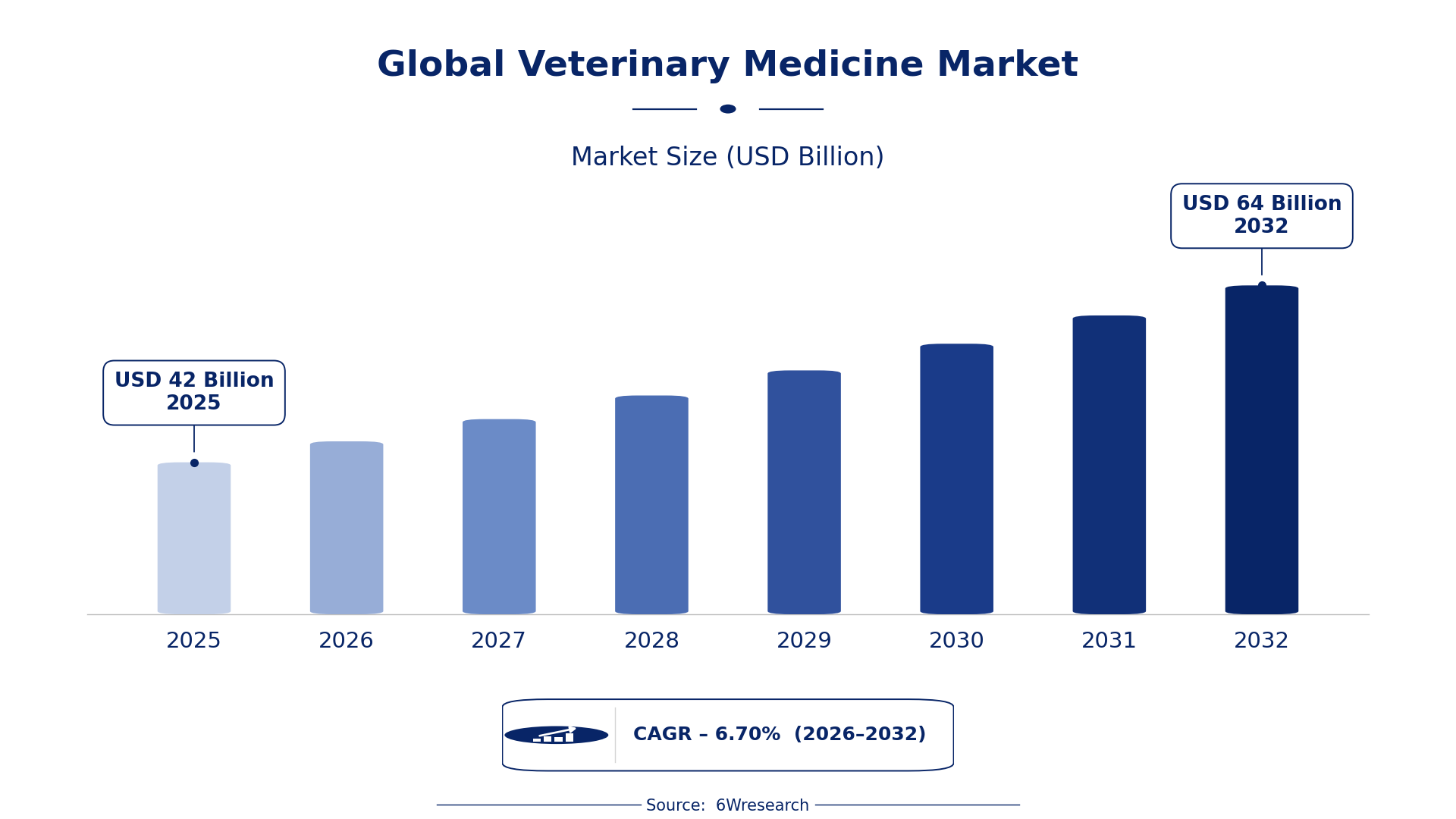
The Global Veterinary Medicine Market was estimated at USD 42 Billion in 2025 and is projected to reach USD 64 Billion by 2032, growing at a CAGR of 6.70% from 2026 to 2032.
Global Veterinary Medicine Market Synopsis
The current trajectory of the Global Veterinary Medicine Market highlights significant structural changes, propelled by rising pet ownership, combined with an increasing concern for animal health. These dynamics foster an ecosystem where veterinary medicine evolves to meet the nuanced needs of diverse animal populations, contributing to a more responsive healthcare framework.
Vital to multiple industries encompassing agriculture, pet care, and public health, this market's growth is primarily driven by the rising demand for advanced therapeutic solutions and preventive care strategies. Technological integration, particularly digital health solutions, is reshaping operational practices across veterinary clinics, thereby enhancing patient outcomes and overall service delivery.
Global Veterinary Medicine Market Year-wise Growth Rate and Key Drivers
This graph illustrates the annual growth rates of the Global Veterinary Medicine Market from 2022 to 2032, highlighting a steady upward trajectory and projected expansion over the forecast period.
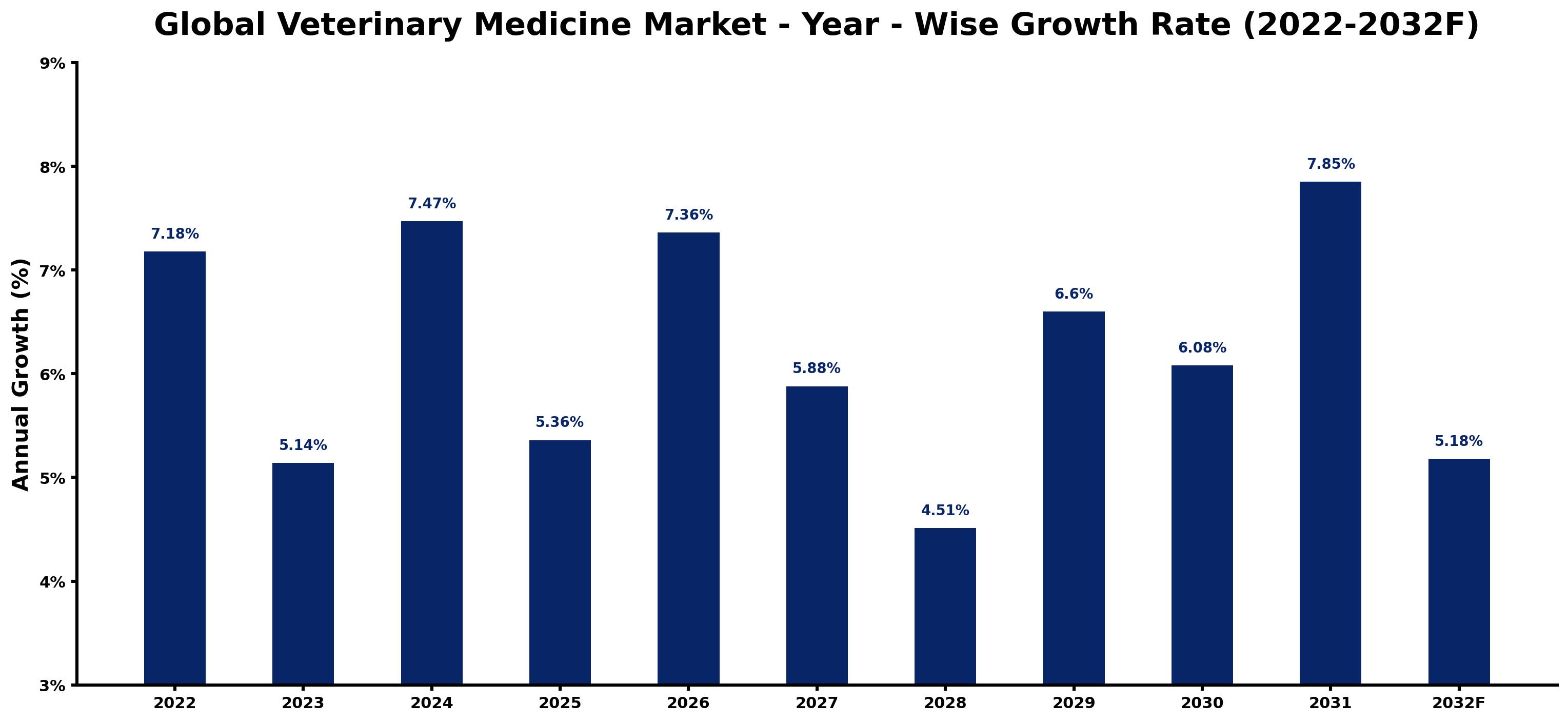
The table below presents the year‑wise growth rates along with the key drivers influencing the market
| Year | Growth Rate (%) | Major Drivers |
| 2022 | 7.18 | A shift toward enhanced veterinary medicine indicates changing preferences among pet owners. |
| 2023 | 5.14 | Increased investment in veterinary startups signals growing confidence in industry growth. |
| 2024 | 7.47 | Diagnostic imaging technologies are seeing rising costs, affecting veterinary service pricing. |
| 2025 | 5.36 | Veterinary clinics are adapting to new drug delivery systems for improved patient care. |
| 2026 | 7.36 | Veterinary hospitals are enhancing sustainability efforts to meet emerging ESG standards. |
| 2027 | 5.88 | In North America, pet owners increasingly seek telehealth platforms for veterinary consultations. |
| 2028 | 4.51 | Regulatory changes governing drug approvals streamline pathways for new veterinary medicines. |
| 2029 | 6.6 | Expanding market access through improved supply chains enhances veterinary services across regions. |
| 2030 | 6.08 | Veterinary manufacturers are innovating drug formulations to address chronic disease management. |
| 2031 | 7.85 | As supply chain dynamics shift, veterinary practices experience enhanced operational efficiencies. |
| 2032 | 5.18 | A growing skilled workforce is essential in advancing the veterinary medicine sector. |
Note - Market size estimations and growth projections presented in this report are based on 6Wresearch's proprietary research methodology, combining internal industry data, secondary research, and primary validation, updated periodically to reflect current market conditions. As markets evolve rapidly, figures for certain industries may vary slightly and are intended as informed estimates rather than absolute figures. For the most current market sizing, we recommend validating figures with a 6Wresearch analyst.
Global Veterinary Medicine Market Key Takeaways
Below are some of the specific key takeaways from the market, including:
- As of 2025, North America is expected to command approximately 48% of the Global Veterinary Medicine Market, driven by high pet ownership.
- The livestock segment is projected to witness a CAGR of 7.5% from 2026 to 2032, reflecting increasing investments in food security and agricultural productivity.
- Zoetis Inc. leads the market with innovative veterinary pharmaceuticals, holding a market share near 20% as of 2025.
- In 2022, the introduction of telemedicine for veterinary care gained traction, enhancing accessibility for pet owners.
- The Asia-Pacific region is projected as the fastest-growing market, with a forecast CAGR of 9% from 2026 to 2032, underpinned by rising awareness of livestock health.
Evaluation of Restraints in Global Veterinary Medicine Market
The Global Veterinary Medicine Market is encountering several significant restraints, primarily characterized by regulatory complexities and pricing pressures. For instance, the average cost of obtaining regulatory approval for new veterinary drugs can exceed $2 million, presenting a substantial barrier for smaller firms. Furthermore, competition drives down pricing, where established players often struggle with pricing strategies that do not sufficiently cover rising R&D costs. For example, the increasing demand for organic alternatives poses both a challenge and an opportunity; traditional pharmaceutical manufacturers face rising costs while navigating consumer preferences shifting towards more natural products.
Global Veterinary Medicine Market Trends
Several prominent trends are reshaping the Global Veterinary Medicine Market. One significant trend is the shift towards preventive care protocols, as pet owners increasingly recognize the importance of early interventions to mitigate health issues. For instance, companies like Merck are focusing on routine vaccination schedules combining technological solutions, resulting in improved compliance and health outcomes. Another trend involves the incorporation of data analytics in veterinary practice. By 2024, it is projected that 35% of veterinary clinics will adopt analytics tools, enabling practitioners to make informed decisions based on animal health data. Additionally, telehealth services are expanding rapidly; by 2025, 50% of veterinary consultations are expected to utilize telemedicine, enhancing access to healthcare and reducing costs for pet owners.
Global Veterinary Medicine Market Opportunities
Looking ahead, the Global Veterinary Medicine Market presents several compelling revenue opportunities. First, the rising demand for pet insurance is catalyzing growth in the market; companies such as Nationwide have reported growth rates of up to 10% annually in pet insurance subscriptions, translating to increased demand for veterinary services. Furthermore, the shift towards advanced diagnostic tools, such as point-of-care testing, offers significant revenue potential; a recent analysis projected this segment to reach USD 4 billion by 2030. Additionally, partnerships between veterinary clinics and pharmaceutical companies are fostering innovation; for instance, a collaboration between Boehringer Ingelheim and a tech startup aims to create a smart health monitor for livestock, marking a pivotal shift in how animal health is managed.
Global Veterinary Medicine Market by Type
The oral administration type currently leads the Global Veterinary Medicine Market, commanding approximately a 60% share as of 2025. This preference is attributed to the ease of administration and broader acceptance among animal owners. Meanwhile, the injection segment is poised to be the fastest-growing, projected to experience a CAGR of 8.5% from 2026 to 2032, driven by increasing adoption in advanced therapeutic applications requiring precise dosage delivery. The growing trend towards injectable vaccines and biologics supports this growth, as they are essential in addressing emerging animal diseases.
Global Veterinary Medicine Market by Application
The Global Veterinary Medicine Market is dominated by the companion animals segment, holding approximately a 65% market share as of 2025. This substantial share reflects the high investment pet owners are willing to make on their animals’ healthcare. In contrast, the livestock animals segment is projected to grow at a CAGR of 7.2% from 2026 to 2032, as the agricultural focus shifts towards optimizing health and productivity for meat and dairy output. This growth is spurred by governmental initiatives aimed at enhancing food safety and animal welfare.
Global Veterinary Medicine Market by Region
North America is the largest region in the Global Veterinary Medicine Market, accounting for roughly 48% of the total share in 2025, supported by high pet ownership rates and strong spending on veterinary care. Conversely, the Asia-Pacific region is the fastest growing, expected to achieve a CAGR of 9% from 2026 to 2032. This growth is largely driven by increasing investments in livestock health and growing awareness of animal diseases, facilitated by governmental support for agricultural improvement initiatives.
Government Initiatives in the Global Veterinary Medicine Market
The regulatory landscape for the Global Veterinary Medicine Market is continuously evolving, spurred by various government initiatives aimed at enhancing animal welfare and health standards. These initiatives aim to streamline regulations, support research, and promote the adoption of new technologies in veterinary medicine.
- U.S. Department of Agriculture (USDA) - Veterinary Medicine Loan Repayment Program, initiated in 2010, offering loan repayment for veterinarians working in underserved areas.
- European Medicines Agency (EMA) - Veterinary Medicinal Products Regulation (EU) 2019/6, effective from January 2022, enhancing regulation for veterinary medicinal products across the EU.
- Australia's Department of Agriculture, Water and the Environment - National Animal Health Plan, launched in 2022, focuses on disease management and animal health improvements.
- Health and Agriculture Ministry of India - National Action Plan on Antimicrobial Resistance, announced in 2021, aims to regulate antibiotic use in livestock and veterinary practices.
Future Insights of the Global Veterinary Medicine Market
The Global Veterinary Medicine Market is anticipated to undergo transformative changes through 2032, characterized by significant technological advancements and a shift towards integrated health management systems. Companies like Zoetis Inc. are investing heavily in digital platforms that combine diagnostics and treatment, expected to enhance care efficiency. The integration of AI in clinical practice will likely become mainstream, facilitating personalized treatment plans for both companion and livestock animals. These trends emphasize a need for adaptable business models and strategic partnerships to remain competitive in an evolving landscape.
Global Veterinary Medicine Market Latest Developments
Recent advancements in the Global Veterinary Medicine Market reflect a proactive approach to enhancing animal health and ensuring sustainable practices. The following are notable developments:
- In early 2023, Boehringer Ingelheim launched a novel vaccine targeting respiratory diseases in livestock, which is expected to improve herd health and productivity significantly.
- Merck announced an ongoing collaboration with a tech startup in mid-2023 to develop a new digital platform that integrates veterinary telehealth with traditional care, addressing accessibility issues.
- Elanco Animal Health is working on an upcoming initiative focused on sustainable feed additives, set to launch in late 2024, aimed at reducing antibiotic reliance in livestock.
- Virbac has recently completed the acquisition of an animal diagnostics company, enhancing its product portfolio and bolstering its market presence across Europe.
Global Veterinary Medicine Market Key Players and Industry Positioning
The Global Veterinary Medicine Market is characterized by a consolidated structure dominated by major players that leverage their strengths to maintain competitive advantages. These companies are actively expanding their portfolios and technological capabilities, positioning themselves to respond effectively to industry demands.
| Leading Company | Core Strength | Strategic Focus |
|---|---|---|
| Zoetis Inc. | Leading innovator in veterinary pharmaceuticals with a robust research pipeline. | Emphasizes digital solutions alongside traditional therapeutics. |
| Merck & Co., Inc. | Diverse product range in vaccines and pharmaceuticals for companion and livestock animals. | Invests in preventative health technologies and telemedicine. |
| Boehringer Ingelheim | Strong presence in both companion and livestock health segments with innovative treatments. | Focus on biologics and advanced vaccine development. |
| Elanco Animal Health | Expertise in animal nutrition and health solutions for livestock. | Strategizes on enhancing sustainability in animal production. |
| Virbac | Robust diagnostics capabilities and quality pet care products. | Expanding its footprint in European markets through acquisitions. |
Continuous investment in research and partnerships will remain crucial for these key players as they adapt to consumer preferences and regulatory changes in the veterinary landscape.
Key Attractiveness of the Report
- 10 Years of Market Numbers
- Historical Data Starting from 2022 to 2025
- Base Year: 2025
- Forecast Data until 2032
- Key Performance Indicators Impacting the Market
- Major Upcoming Developments and Projects
Key Highlights of the Report:
- Global Veterinary Medicine Market Outlook
- Market Size of Global Veterinary Medicine Market, 2025
- Forecast of Global Veterinary Medicine Market, 2032
- Historical Data and Forecast of Global Veterinary Medicine Revenues & Volume for the Period 2022-2032
- Global Veterinary Medicine Market Trend Evolution
- Global Veterinary Medicine Market Drivers and Challenges
- Global Veterinary Medicine Price Trends
- Global Veterinary Medicine Porter's Five Forces
- Global Veterinary Medicine Industry Life Cycle
- Historical Data and Forecast of Global Veterinary Medicine Market Revenues & Volume
- Historical Data and Forecast of Global Veterinary Medicine Market Revenues & Volume By Type for the Period 2022-2032
- Historical Data and Forecast of Global Veterinary Medicine Market Revenues & Volume By Oral for the Period 2022-2032
- Historical Data and Forecast of Global Veterinary Medicine Market Revenues & Volume By Injection for the Period 2022-2032
- Historical Data and Forecast of Global Veterinary Medicine Market Revenues & Volume By Other for the Period 2022-2032
- Historical Data and Forecast of Global Veterinary Medicine Market Revenues & Volume By Application for the Period 2022-2032
- Historical Data and Forecast of Global Veterinary Medicine Market Revenues & Volume By Companion Animals for the Period 2022-2032
- Historical Data and Forecast of Global Veterinary Medicine Market Revenues & Volume By Livestock Animals for the Period 2022-2032
- Historical Data and Forecast of North America Veterinary Medicine Market Revenues & Volume By Type for the Period 2022-2032
- Historical Data and Forecast of North America Veterinary Medicine Market Revenues & Volume By Oral for the Period 2022-2032
- Historical Data and Forecast of North America Veterinary Medicine Market Revenues & Volume By Injection for the Period 2022-2032
- Historical Data and Forecast of North America Veterinary Medicine Market Revenues & Volume By Other for the Period 2022-2032
- Historical Data and Forecast of North America Veterinary Medicine Market Revenues & Volume By Application for the Period 2022-2032
- Historical Data and Forecast of North America Veterinary Medicine Market Revenues & Volume By Companion Animals for the Period 2022-2032
- Historical Data and Forecast of North America Veterinary Medicine Market Revenues & Volume By Livestock Animals for the Period 2022-2032
- Historical Data and Forecast of United States of America Veterinary Medicine Market Revenues & Volume for the Period 2022-2032
- Historical Data and Forecast of Canada Veterinary Medicine Market Revenues & Volume for the Period 2022-2032
- Historical Data and Forecast of Rest of North America Veterinary Medicine Market Revenues & Volume for the Period 2022-2032
- Historical Data and Forecast of Latin America (LATAM) Veterinary Medicine Market Revenues & Volume By Type for the Period 2022-2032
- Historical Data and Forecast of Latin America (LATAM) Veterinary Medicine Market Revenues & Volume By Oral for the Period 2022-2032
- Historical Data and Forecast of Latin America (LATAM) Veterinary Medicine Market Revenues & Volume By Injection for the Period 2022-2032
- Historical Data and Forecast of Latin America (LATAM) Veterinary Medicine Market Revenues & Volume By Other for the Period 2022-2032
- Historical Data and Forecast of Latin America (LATAM) Veterinary Medicine Market Revenues & Volume By Application for the Period 2022-2032
- Historical Data and Forecast of Latin America (LATAM) Veterinary Medicine Market Revenues & Volume By Companion Animals for the Period 2022-2032
- Historical Data and Forecast of Latin America (LATAM) Veterinary Medicine Market Revenues & Volume By Livestock Animals for the Period 2022-2032
- Historical Data and Forecast of Brazil Veterinary Medicine Market Revenues & Volume for the Period 2022-2032
- Historical Data and Forecast of Mexico Veterinary Medicine Market Revenues & Volume for the Period 2022-2032
- Historical Data and Forecast of Argentina Veterinary Medicine Market Revenues & Volume for the Period 2022-2032
- Historical Data and Forecast of Rest of LATAM Veterinary Medicine Market Revenues & Volume for the Period 2022-2032
- Historical Data and Forecast of Asia Veterinary Medicine Market Revenues & Volume By Type for the Period 2022-2032
- Historical Data and Forecast of Asia Veterinary Medicine Market Revenues & Volume By Oral for the Period 2022-2032
- Historical Data and Forecast of Asia Veterinary Medicine Market Revenues & Volume By Injection for the Period 2022-2032
- Historical Data and Forecast of Asia Veterinary Medicine Market Revenues & Volume By Other for the Period 2022-2032
- Historical Data and Forecast of Asia Veterinary Medicine Market Revenues & Volume By Application for the Period 2022-2032
- Historical Data and Forecast of Asia Veterinary Medicine Market Revenues & Volume By Companion Animals for the Period 2022-2032
- Historical Data and Forecast of Asia Veterinary Medicine Market Revenues & Volume By Livestock Animals for the Period 2022-2032
- Historical Data and Forecast of China Veterinary Medicine Market Revenues & Volume for the Period 2022-2032
- Historical Data and Forecast of India Veterinary Medicine Market Revenues & Volume for the Period 2022-2032
- Historical Data and Forecast of Japan Veterinary Medicine Market Revenues & Volume for the Period 2022-2032
- Historical Data and Forecast of Rest of Asia Veterinary Medicine Market Revenues & Volume for the Period 2022-2032
- Historical Data and Forecast of Africa Veterinary Medicine Market Revenues & Volume By Type for the Period 2022-2032
- Historical Data and Forecast of Africa Veterinary Medicine Market Revenues & Volume By Oral for the Period 2022-2032
- Historical Data and Forecast of Africa Veterinary Medicine Market Revenues & Volume By Injection for the Period 2022-2032
- Historical Data and Forecast of Africa Veterinary Medicine Market Revenues & Volume By Other for the Period 2022-2032
- Historical Data and Forecast of Africa Veterinary Medicine Market Revenues & Volume By Application for the Period 2022-2032
- Historical Data and Forecast of Africa Veterinary Medicine Market Revenues & Volume By Companion Animals for the Period 2022-2032
- Historical Data and Forecast of Africa Veterinary Medicine Market Revenues & Volume By Livestock Animals for the Period 2022-2032
- Historical Data and Forecast of South Africa Veterinary Medicine Market Revenues & Volume for the Period 2022-2032
- Historical Data and Forecast of Nigeria Veterinary Medicine Market Revenues & Volume for the Period 2022-2032
- Historical Data and Forecast of Egypt Veterinary Medicine Market Revenues & Volume for the Period 2022-2032
- Historical Data and Forecast of Rest of Africa Veterinary Medicine Market Revenues & Volume for the Period 2022-2032
- Historical Data and Forecast of Europe Veterinary Medicine Market Revenues & Volume By Type for the Period 2022-2032
- Historical Data and Forecast of Europe Veterinary Medicine Market Revenues & Volume By Oral for the Period 2022-2032
- Historical Data and Forecast of Europe Veterinary Medicine Market Revenues & Volume By Injection for the Period 2022-2032
- Historical Data and Forecast of Europe Veterinary Medicine Market Revenues & Volume By Other for the Period 2022-2032
- Historical Data and Forecast of Europe Veterinary Medicine Market Revenues & Volume By Application for the Period 2022-2032
- Historical Data and Forecast of Europe Veterinary Medicine Market Revenues & Volume By Companion Animals for the Period 2022-2032
- Historical Data and Forecast of Europe Veterinary Medicine Market Revenues & Volume By Livestock Animals for the Period 2022-2032
- Historical Data and Forecast of United Kingdom Veterinary Medicine Market Revenues & Volume for the Period 2022-2032
- Historical Data and Forecast of France Veterinary Medicine Market Revenues & Volume for the Period 2022-2032
- Historical Data and Forecast of Germany Veterinary Medicine Market Revenues & Volume for the Period 2022-2032
- Historical Data and Forecast of Rest of Europe Veterinary Medicine Market Revenues & Volume for the Period 2022-2032
- Historical Data and Forecast of Middle East Veterinary Medicine Market Revenues & Volume By Type for the Period 2022-2032
- Historical Data and Forecast of Middle East Veterinary Medicine Market Revenues & Volume By Oral for the Period 2022-2032
- Historical Data and Forecast of Middle East Veterinary Medicine Market Revenues & Volume By Injection for the Period 2022-2032
- Historical Data and Forecast of Middle East Veterinary Medicine Market Revenues & Volume By Other for the Period 2022-2032
- Historical Data and Forecast of Middle East Veterinary Medicine Market Revenues & Volume By Application for the Period 2022-2032
- Historical Data and Forecast of Middle East Veterinary Medicine Market Revenues & Volume By Companion Animals for the Period 2022-2032
- Historical Data and Forecast of Middle East Veterinary Medicine Market Revenues & Volume By Livestock Animals for the Period 2022-2032
- Historical Data and Forecast of Saudi Arabia Veterinary Medicine Market Revenues & Volume for the Period 2022-2032
- Historical Data and Forecast of UAE Veterinary Medicine Market Revenues & Volume for the Period 2022-2032
- Historical Data and Forecast of Turkey Veterinary Medicine Market Revenues & Volume for the Period 2022-2032
- Historical Data and Forecast of Rest of Middle East Veterinary Medicine Market Revenues & Volume for the Period 2022-2032
- Global Veterinary Medicine Market - Key Performance Indicators
- Global Veterinary Medicine Market - Import Export Trade Statistics
- Global Veterinary Medicine Market - Opportunity Assessment By Countries
- Global Veterinary Medicine Market - Opportunity Assessment By Type
- Global Veterinary Medicine Market - Opportunity Assessment By Application
- Global Veterinary Medicine Market - Top Companies Market Share
- Global Veterinary Medicine Market - Top Companies Profiles
- Global Veterinary Medicine Market - Comparison of Players in Technical and Operating Parameters
- Global Veterinary Medicine Market - Strategic Recommendations
Markets Covered
The Global Veterinary Medicine Market report provides a detailed analysis of the following market segments:
By Regions and Countries:
- North America
- Europe
- LATAM
- Middle East
- Asia
- Africa
By Type:
- Oral
- Injection
- Other
By Application:
- Companion Animals
- Livestock Animals






































