Global Voluntary Carbon Credit Market Size & Growth Rate
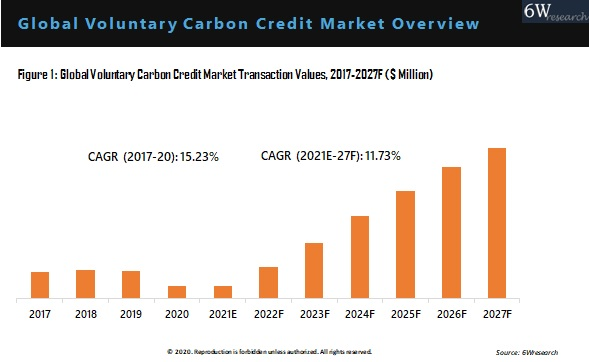
According to 6Wresearch internal database and industry insights, The Global Voluntary Carbon Credit Market was valued at USD 4.77 Billion in 2025 and is estimated to grow at USD 35.52 Billion by 2032, registering a CAGR of approximately 32.1% from 2026 to 2032.
Global Voluntary Carbon Credit Market Year-wise Growth Rate and Key Drivers (2022–2032)
This graph illustrates the annual growth rates of the Global Voluntary Carbon Credit Market from 2022 to 2032, highlighting gradual market development and stronger expansion during the forecast period.
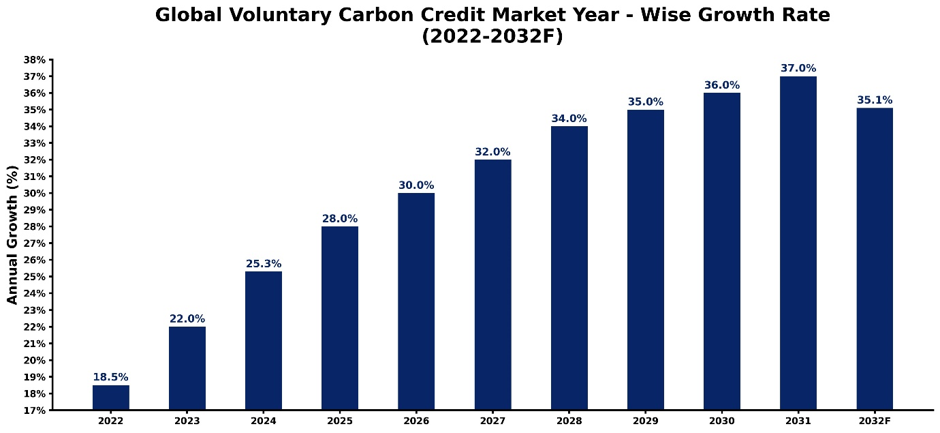
The following table presents the estimated annual growth rates of the Global Voluntary Carbon Credit Market for each year, along with the key factors influencing market performance during the respective period. The values are intended to highlight year-wise drivers rather than provide a direct comparison between individual years.
| Year | Est. Annual Growth (%) | Market Rationale |
| 2022 | 18.5% | Market recovery after pandemic disruption; increasing corporate climate commitments begin accelerating voluntary credit purchases. |
| 2023 | 22% | Growth supported by rising net-zero targets, expansion of nature-based projects, and increased awareness of carbon offset strategies. |
| 2024 | 25.3% | Stronger demand from corporates seeking emissions compensation; technology improvements enhance credit transparency and credibility. |
| 2025 | 28% | Market gains momentum from higher-quality credit demand, carbon removal projects, and institutional participation. |
| 2026 | 30% | Adoption expands as companies integrate carbon credits into sustainability strategies and supply-chain decarbonization plans. |
| 2027 | 32% | Increased liquidity, digital registries, and improved verification standards support broader market participation. |
| 2028 | 34% | Growth driven by aviation, technology firms, financial institutions, and increased demand for premium removal credits. |
| 2029 | 35% | Stronger pricing mechanisms and increased differentiation between low- and high-quality credits. |
| 2030 | 36% | Net-zero milestone pressure increases demand as companies accelerate carbon neutrality pathways. |
| 2031 | 37% | Global carbon market integration and improved regulatory alignment support continued expansion. |
| 2032 | 35.1% | Market reaches a more mature growth phase while maintaining strong expansion from corporate procurement and climate finance. |
Topics Covered in the Global Voluntary Carbon Credit Market Report
The Global Voluntary Carbon Credit Market report provides detailed analysis across Types, Project Types, and Regions. The report provides a detailed analysis of ongoing market trends, opportunities/high-growth areas, market drivers, market restraints, regulatory developments, project activity, and regional market dynamics to help stakeholders align strategies based on current and future market conditions.
Global Voluntary Carbon Credit Market Highlights
| Report Name | Global Voluntary Carbon Credit Market |
| Forecast period | 2026-2032 |
| Forecast size | USD 35.52 Billion by 2032 |
| CAGR | 32.1% |
| Growing Sector | Forestry & Land Use |
Global Voluntary Carbon Credit Market Synopsis
The Global Voluntary Carbon Credit Market growth is estimated to surge owing to increasing corporate commitments toward net-zero emissions, rising demand for carbon offsets, growing climate awareness, expanding investments in emission-reduction projects, and increasing participation from corporations, financial institutions, project developers, and sustainability-focused organizations. The voluntary carbon credit market (VCM) is a decentralized marketplace where private actors and governments buy and sell credits representing the reduction or removal of one metric tonne of carbon dioxide equivalent (tCO₂e) from the atmosphere. Growing emphasis on high-quality credits, transparent verification, and measurable environmental benefits is also expected to support market development.
Evaluation of Drivers in Global Voluntary Carbon Credit Market (2026–2032)
Below mentioned are some major drivers and their influence on the market dynamics:
| Market Driver | Primary Segment Affected | Why It Matters (Evidence) |
| Increasing corporate net-zero commitments | Voluntary, Industry | Growing corporate emission-reduction targets are increasing demand for credible carbon credits to complement internal decarbonization efforts. |
| Growing climate-policy focus | Compliance, Voluntary | Increasing government focus on emissions reduction and carbon-market mechanisms is encouraging wider participation in carbon markets. |
| Increased investment in forestry and land-use projects | Forestry & Land Use Project | There is great potential for carbon credits from projects on reforestation, conservation, and sustainable land management. |
| Increasing demand for high-integrity carbon credits | Voluntary | Buyers are increasingly emphasizing additionality, permanence, verification, and measurable emission reductions. |
| More corporate and institutional participation | Voluntary, Industry | Increased participation by corporations and investors is increasing transaction activity and market liquidity. |
The Global Voluntary Carbon Credit Market growth is estimated to reach around 32.1% CAGR between 2026 and 2032. This growth is attributed to multiple factors, such as rising corporate climate commitments, increasing number of carbon-reduction projects, and surging investments in sustainable development. Demand for voluntary carbon credits remains strong, with more than 90% of companies currently purchasing credits planning to continue, whereas the demand from corporates for carbon removal could be 46-110 million by 2030, 6-14 times current levels. Increasing government support for carbon-market mechanisms and growing demand for forestry, land-use, transportation, and industrial projects are expected to further strengthen market activity.
Evaluation of Restraints in Global Voluntary Carbon Credit Market
Below mentioned are some major restraints and their influence on market dynamics:
| Market Restraint | Primary Segment Affected | Why It Matters (Evidence) |
| Lack of standardization across carbon credits | Voluntary | Differences in methodologies and certification approaches can make it difficult for buyers to compare credit quality. |
| Concerns regarding credit quality | Forestry & Land Use Project, Others | Concerns surrounding additionality, permanence, leakage, and actual emission reductions can affect buyer confidence. |
| Regulatory uncertainty | Voluntary, Compliance | Evolving carbon-market regulations and accounting frameworks can create uncertainty for project developers and buyers. |
| Carbon-credit price volatility | Voluntary, Compliance | Credit prices can vary significantly according to project type, quality, geography, and buyer requirements. |
| Challenging measurement and verification requirements | Industry, Forestry & Land Use Project | Independent verification and accurate measurement can increase the cost of project development and its schedule. |
| Greenwashing concerns | Voluntary | Greater scrutiny of corporate environmental claims can reduce demand for credits perceived as lacking measurable environmental benefits. |
Challenges in the Global Voluntary Carbon Credit Market
The Global Voluntary Carbon Credit Market faces challenges that can affect its growth. Such major challenges are inconsistent methodologies, concerns over additionality and permanence, carbon-credit price volatility, evolving regulatory frameworks, and complex measurement, reporting, and verification requirements. Differences in methodologies across certification programs may make it difficult for buyers to assess credit quality while complex measurement and verification requirements can increase project development costs and timelines. Regulatory uncertainty, limited market liquidity and concerns over the actual environmental impact of certain projects may further slow large-scale corporate adoption.
Trends in Global Voluntary Carbon Credit Market
Below mentioned are some of the numerous trends that impact the market:
- Increasing Demand for High-Integrity Credits: Buyers are placing greater emphasis on independently verified projects, additionality, permanence, transparent methodologies, and measurable environmental outcomes.
- Rising Adoption of Nature-Based Carbon Projects: Forestry, reforestation, ecosystem restoration, and sustainable land-use projects are attracting increasing interest due to their carbon-removal and environmental benefits.
- Greater Focus on Project Co-Benefits: Carbon-credit buyers are increasingly evaluating some projects based on additional benefits such as biodiversity conservation, community development, and sustainable land management.
Investment Opportunities in the Global Voluntary Carbon Credit Market
Below mentioned are some significant investment opportunities including:
- Forestry & Land-Use Projects: Reforestation, afforestation, forest conservation, agroforestry, and ecosystem restoration projects can provide opportunities to make investment to create long-term carbon credits
- High-Integrity Carbon Credits: Buyers are becoming more selective, providing attractive opportunities in developing projects with strong additionality, permanence, measurable emission reductions, and credible verification
- Industrial Decarbonization Projects: Making investment in industrial efficiency, waste management, emissions reduction, and low-carbon technologies can create additional sources of carbon-credit generation.
Leading Players in Global Voluntary Carbon Credit Market
Stated below are some of the leading companies and organizations contributing significantly to the Global Voluntary Carbon Credit Market share:
1. Verra
| Company Name | Verra |
|---|---|
| Established Year | 2007 |
| Headquarters | Washington, D.C., United States |
| Official Website | Click Here |
Verra is a nonprofit organization that develops standards for sustainable development and climate action, including the Verified Carbon Standard.
2. Gold Standard Foundation
| Company Name | Gold Standard Foundation |
|---|---|
| Established Year | 2003 |
| Headquarters | Geneva, Switzerland |
| Official Website | Click Here |
Gold Standard Foundation develops certification standards for climate and sustainable development projects.
3. American Carbon Registry
| Company Name | American Carbon Registry |
|---|---|
| Established Year | 1996 |
| Headquarters | Arlington, Virginia, United States |
| Official Website | Click Here |
American Carbon Registry develops standards and methodologies for greenhouse-gas emissions reduction and removal projects.
4. Climate Action Reserve
| Company Name | Climate Action Reserve |
|---|---|
| Established Year | 2001 |
| Headquarters | Los Angeles, California, United States |
| Official Website | Click Here |
Climate Action Reserve develops carbon-offset standards and operates a registry for carbon-market projects.
5. Plan Vivo Foundation
| Company Name | Plan Vivo Foundation |
|---|---|
| Established Year | 1994 |
| Headquarters | Edinburgh, United Kingdom |
| Official Website | Click Here |
Plan Vivo Foundation develops standards for community-led land-use, ecosystem restoration, and climate projects.
Global Voluntary Carbon Credit Market: Government Initiatives
Governments across major economies are strengthening carbon-market frameworks and climate policies, creating a supportive environment for the development of the Voluntary Carbon Credit Market all across the globe. There are some initiatives such as the European Union Emissions Trading System, carbon-pricing programs in North America, emerging national carbon-market mechanisms in Asia Pacific, and climate strategies across Latin America and the Middle East & Africa, which are encouraging businesses to measure and reduce their greenhouse gas emissions. Governments are also increasing emphasis on carbon-credit integrity and alignment with international climate objectives. Such initiatives are expected to encourage corporate participation and investment in forestry, land-use, and other carbon-reduction projects.
Future Outlook of Global Voluntary Carbon Credit Market
The Global Voluntary Carbon Credit Market is expected to maintain strong growth, on account of increasing corporate net-zero commitments, expanding climate investments, development of carbon-market infrastructure, and rising demand for verified emission reductions. Forestry & Land Use projects are expected to remain important due to their carbon-removal potential, while Industry and Transportation projects are likely to gain importance as companies seek diversified decarbonization pathways. The increasing use of digital MRV technologies, carbon marketplaces, and high-integrity certification frameworks is also expected to strengthen market transparency, project credibility, and investor confidence.
Market Segmentation Analysis
The report offers a comprehensive study of the following market segments and their leading categories in the market:
By Types – Voluntary Dominated the Market, Compliance Expected to Witness Strong Growth
According to Ravi Bhandari, Research Head, 6Wresearch, the Voluntary segment accounted for a significant share of approximately 62.4% of the Global Voluntary Carbon Credit Market in 2025, supported by increasing participation from corporations seeking to achieve sustainability. On the other hand, during 2026–2032, the Compliance segment is expected to witness comparatively stronger growth with an estimated CAGR of 11.8%, driven by the expansion of carbon-pricing mechanisms, emission caps, and government-regulated carbon markets.
By Project Types – Forestry & Land Use Project Dominated the Market, Industry Expected to Witness Strong Growth
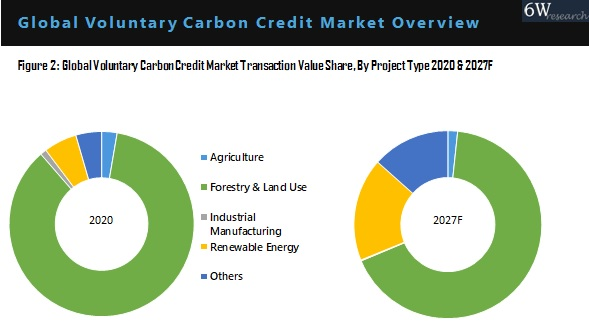
The Forestry & Land Use Project segment accounted for the largest share of approximately 46.8% of the Global Voluntary Carbon Credit Market in 2025, supported by strong demand for reforestation, forest conservation and sustainable land-management projects. However, during 2026–2032, the Industry segment is expected to witness comparatively stronger growth with an estimated CAGR of 12.6%, driven by increasing industrial decarbonization investments.
By Regions – North America Dominated the Market, Asia Pacific Expected to Witness Strong Growth
The North America region accounted for the largest share of approximately 31.6% of the Global Voluntary Carbon Credit Market in 2025, supported by strong corporate sustainability activity. However, during 2026–2032, Asia Pacific is expected to witness comparatively stronger growth with an estimated CAGR of 12.7%, driven by expanding industrial activity.
Note- Market size estimations and growth projections presented in this report are based on 6Wresearch's proprietary forecasting methodology, utilizing the latest available industry data, company disclosures, government publications, and primary research inputs.
Key Attractiveness of the Report
- 10 Years of Market Numbers
- Historical Data Starting from 2022 to 2025
- Base Year: 2025
- Forecast Data until 2032
- Key Performance Indicators Impacting the Market
- Major Upcoming Developments and Projects
Key Highlights of the Report:
- Global Voluntary Carbon Credit Market Outlook
- Market Size of Global Voluntary Carbon Credit Market, 2025
- Forecast of Global Voluntary Carbon Credit Market, 2032
- Historical Data and Forecast of Global Voluntary Carbon Credit Market Revenues & Volume for the Period 2022–2032
- Global Voluntary Carbon Credit Market Trend Evolution
- Global Voluntary Carbon Credit Market Drivers and Challenges
- Global Voluntary Carbon Credit Market Price Trends
- Global Voluntary Carbon Credit Porter's Five Forces
- Global Voluntary Carbon Credit Industry Life Cycle
- Historical Data and Forecast of Global Voluntary Carbon Credit Market Revenues & Volume By Types for the Period 2022–2032
- Historical Data and Forecast of Global Voluntary Carbon Credit Market Revenues & Volume By Voluntary for the Period 2022–2032
- Historical Data and Forecast of Global Voluntary Carbon Credit Market Revenues & Volume By Compliance for the Period 2022–2032
- Historical Data and Forecast of Global Voluntary Carbon Credit Market Revenues & Volume By Project Types for the Period 2022–2032
- Historical Data and Forecast of Global Voluntary Carbon Credit Market Revenues & Volume By Forestry & Land Use Project for the Period 2022–2032
- Historical Data and Forecast of Global Voluntary Carbon Credit Market Revenues & Volume By Transportation for the Period 2022–2032
- Historical Data and Forecast of Global Voluntary Carbon Credit Market Revenues & Volume By Industry for the Period 2022–2032
- Historical Data and Forecast of Global Voluntary Carbon Credit Market Revenues & Volume By Others for the Period 2022–2032
- Historical Data and Forecast of Global Voluntary Carbon Credit Market Revenues & Volume By Regions for the Period 2022–2032
- Historical Data and Forecast of Global Voluntary Carbon Credit Market Revenues & Volume By North America for the Period 2022–2032
- Historical Data and Forecast of Global Voluntary Carbon Credit Market Revenues & Volume By Latin America for the Period 2022–2032
- Historical Data and Forecast of Global Voluntary Carbon Credit Market Revenues & Volume By Asia Pacific for the Period 2022–2032
- Historical Data and Forecast of Global Voluntary Carbon Credit Market Revenues & Volume By Middle East & Africa for the Period 2022–2032
- Historical Data and Forecast of Global Voluntary Carbon Credit Market Revenues & Volume By Europe for the Period 2022–2032
- Global Voluntary Carbon Credit Import Export Trade Statistics
- Market Opportunity Assessment By Types
- Market Opportunity Assessment By Project Types
- Market Opportunity Assessment By Regions
- Global Voluntary Carbon Credit Top Companies Market Share
- Global Voluntary Carbon Credit Competitive Benchmarking By Technical and Operational Parameters
- Global Voluntary Carbon Credit Company Profiles
- Global Voluntary Carbon Credit Key Strategic Recommendations
Market Covered
The report offers a comprehensive study of the subsequent market segments:
By Types
- Voluntary
- Compliance
By Project Types
- Forestry & Land Use Project
- Transportation
- Industry
- Others
By Regions
- North America
- Latin America
- Asia Pacific
- Middle East & Africa
- Europe