Global Yacht Market Highlights
| Market Size (2025) | USD 10.5 Billion |
| Forecast Size (2032) | USD 15.8 Billion |
| CAGR | 6.00% |
| Base Year | 2025 |
| Forecast Period | 2026-2032 |
| Largest Region | North America |
| Fastest Growing Region | Asia |
| Largest Segment | Super yacht |
| Fastest Growing Segment | Sport yacht |
| Leading Companies | Bénéteau, Azimut-Benetti, Sunseeker, Ferretti Group, Pershing |
Global Yacht Market Size & Growth Rate (2026-2032)
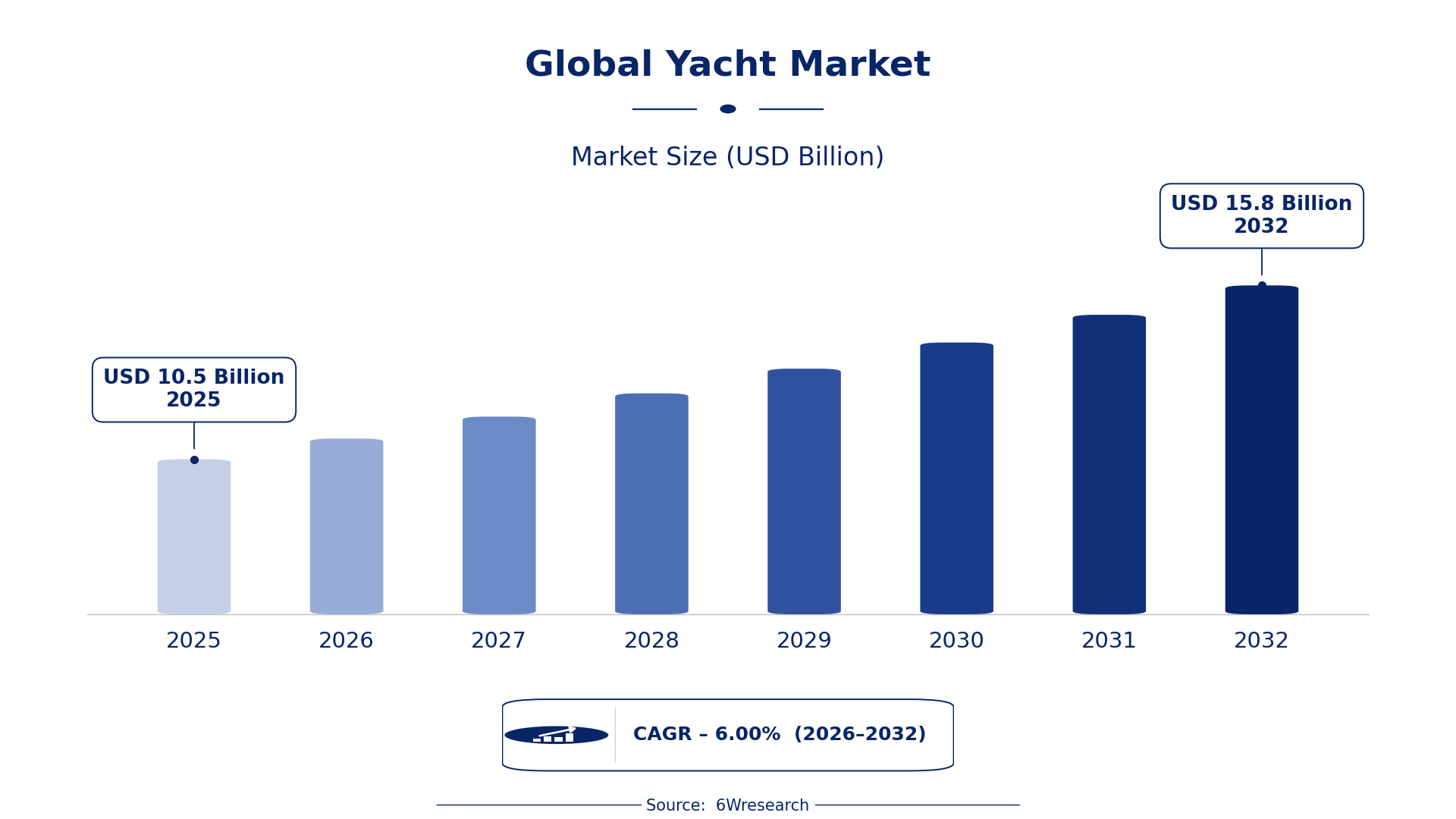
The Global Yacht Market was estimated at USD 10.5 Billion in 2025 and is projected to reach USD 15.8 Billion by 2032, growing at a CAGR of 6.00% from 2026 to 2032.
Global Yacht Market Synopsis
The landscape of the Global Yacht Market is evolving, marked by shifting consumer preferences toward personalized yachts and increased interest in sustainable boating practices. As more high-net-worth individuals look to yachts as symbols of luxury and status, the demand for innovative features and eco-friendly options has surged, setting the stage for a transformative period in the industry.
This market holds significant relevance for various industries including tourism and leisure, as it provides unique travel experiences that cater to affluent consumers. Changing regulations and the push for eco-friendly solutions drive manufacturers to innovate, establishing strong competitive dynamics in a sector that is distinct from adjacent markets focused on conventional marine transport.
Global Yacht Market Year-wise Growth Rate and Key Drivers
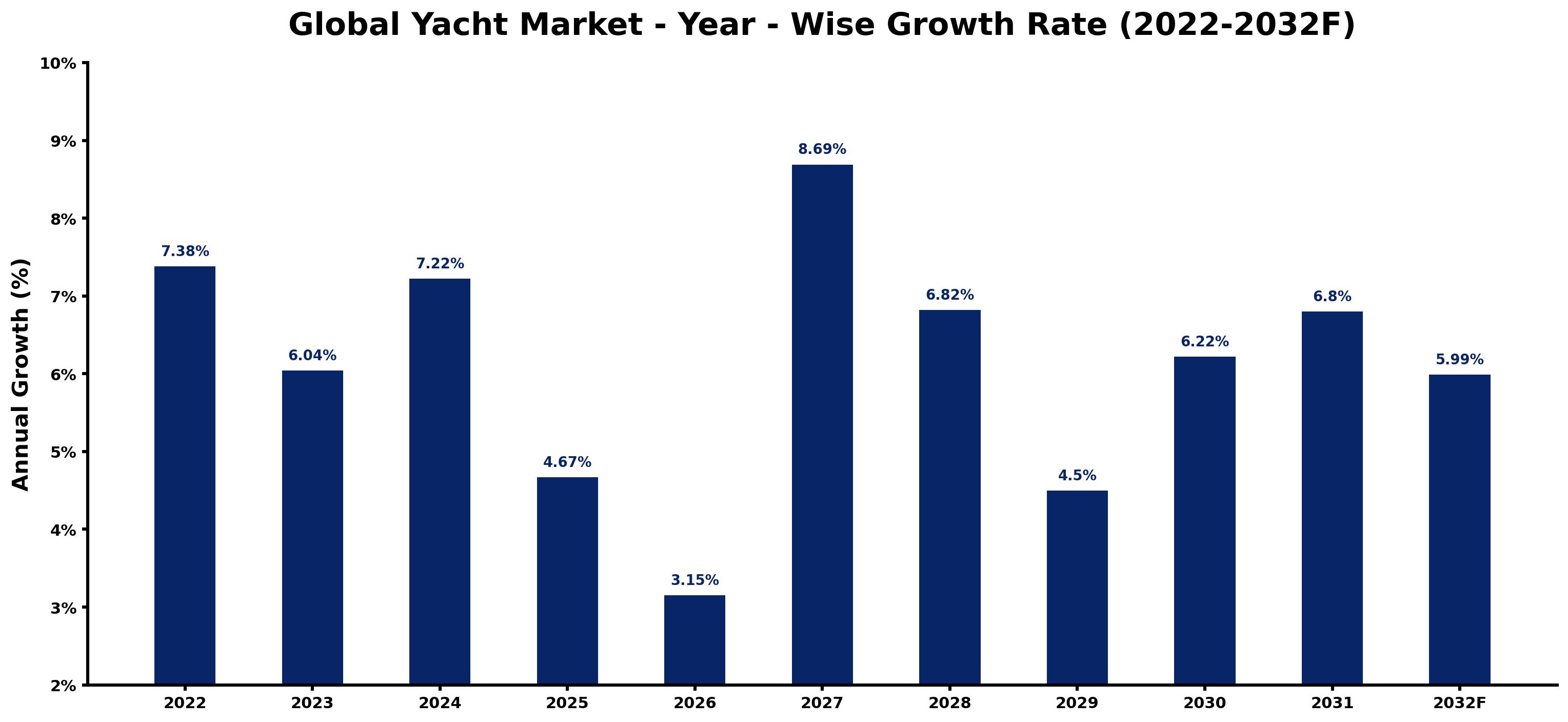
This graph illustrates the annual growth rates of the Global Yacht Market from 2022 to 2032, highlighting a steady upward trajectory and projected expansion over the forecast period.
The table below presents the year‑wise growth rates along with the key drivers influencing the market
| Year | Growth Rate (%) | Major Drivers |
| 2022 | 7.38 | Consumers increasingly seek luxury yachts for leisure activities and personalization options. |
| 2023 | 6.04 | Technological advancements in yacht design are enhancing performance and user experience. |
| 2024 | 7.22 | While buyers favor larger yachts, manufacturers adapt to diverse application preferences. |
| 2025 | 4.67 | Electric yachts are gaining popularity, broadening regional access to marine recreational activities. |
| 2026 | 3.15 | As competition intensifies, brands are differentiating through unique yacht features and services. |
| 2027 | 8.69 | Supply chain efficiency improvements are enabling faster yacht production and delivery timelines. |
| 2028 | 6.82 | Shipbuilders are responding to fluctuating raw material costs affecting yacht pricing structures. |
| 2029 | 4.5 | A shift toward skilled labor enhances craftsmanship, driving yacht quality and customer satisfaction. |
| 2030 | 6.22 | Affluent customers are increasing investments in luxury yachts, signaling market maturation trends. |
| 2031 | 6.8 | Implementing stricter environmental regulations drives innovations in sustainable yacht manufacturing practices. |
| 2032 | 5.99 | Within the luxury segment, consumers prioritize sustainability, influencing yacht design decisions. |
Note - Market size estimations and growth projections presented in this report are based on 6Wresearch's proprietary research methodology, combining internal industry data, secondary research, and primary validation, updated periodically to reflect current market conditions. As markets evolve rapidly, figures for certain industries may vary slightly and are intended as informed estimates rather than absolute figures. For the most current market sizing, we recommend validating figures with a 6Wresearch analyst.
Global Yacht Market Key Takeaways
Below are some of the specific key takeaways from the market, including:
- North America commands approximately 45% of the Global Yacht Market share as of 2025, supported by a high concentration of wealth and established manufacturers.
- The sport yacht segment is projected to grow at a CAGR of 7.5% from 2026 to 2032, reflecting increasing interest in high-speed leisure vessels.
- Hybrid propulsion systems are being implemented by manufacturers like Bénéteau, with an $8 million investment aimed at reducing emissions by 30%.
- The number of yacht charters is expected to rise by 20% in the next five years, driven by younger affluent consumers preferring shared ownership.
- In 2025, approximately 50% of the yachts sold will feature IoT integration, meeting the growing demand for smart technology among yacht owners.
Evaluation of Restraints in Global Yacht Market
Significant barriers impede growth in the Global Yacht Market, including high maintenance costs and regulatory compliance. The total cost of owning a yacht, including maintenance and docking fees, can exceed $200,000 annually. For example, stringent emissions regulations in Europe, particularly the EU's MARPOL Annex VI, mandate that yachts over a certain size must meet specific fuel efficiency standards, adding further operational costs. Competing against these economic pressures, manufacturers must strategically innovate to attract buyers despite potential financial constraints.
Global Yacht Market Trends
The Global Yacht Market is witnessing distinct trends that reflect broader technological and consumer behavior changes. A shift toward sustainable yachting has prompted companies like Azimut-Benetti to introduce eco-friendly yachts featuring recyclable materials and electric propulsion systems. Their latest model, the Azimut 55, launched in 2023, is designed to reduce carbon emissions by over 40%. Furthermore, increasing demand for bespoke design options is transforming how manufacturers approach yacht customization, with firms now offering tailored features to enhance personal luxury. The integration of smart technology in yacht design through IoT devices is reshaping the operational aspects, leading to innovations in navigation and onboard comfort.
Global Yacht Market Opportunities
Future revenue avenues in the Global Yacht Market are promising, particularly in the realms of electric propulsion and yacht chartering. For instance, the joint initiative between Ferretti Group and a leading battery manufacturer aims to introduce a new range of all-electric yachts by 2026, expected to capture a significant market share in eco-conscious consumer segments. Additionally, growth in the luxury travel sector positions yacht charters as a lucrative business opportunity, with projections indicating an increase in chartered yacht bookings to reach a valuation of $3 billion by 2030. Companies are also exploring the use of hydrogen fuel cells, presenting an innovative solution to meet the rising demand for sustainable luxury travel options.
Global Yacht Market by Types
The super yacht segment leads the Global Yacht Market, capturing approximately 38% share in 2025, largely due to its luxury appeal and advanced features. Conversely, the sport yacht segment is anticipated to be the fastest-growing, with a CAGR of 7.5% from 2026 to 2032, driven by increasing consumer interest in high-performance sailing. This interest is linked to a growing culture of competitive sailing and adventure tourism, which significantly influences purchase decisions among affluent buyers as they seek both leisure and performance.
Global Yacht Market by Length
The segment of yachts measuring 20 to 50 ft is the largest, comprising approximately 44% of the overall market share in 2025. In contrast, the segment comprising yachts above 50 ft is projected to grow at a CAGR of 8.2% from 2026 to 2032, as high-net-worth individuals increasingly gravitate toward larger and more luxurious vessels for both personal use and charter opportunities. The growing trend of extended voyages and luxury experiences at sea further accelerates consumer demand for larger yachts in this category.
Global Yacht Market by Region
North America is the largest market region, holding about 45% of the Global Yacht Market share in 2025. A favorable concentration of wealth and established yacht manufacturing bases drive this dominance. Meanwhile, the Asia region is expected to witness the fastest growth, with a CAGR of 8.0% from 2026 to 2032, primarily due to rising disposable incomes and a burgeoning interest in luxury leisure activities among affluent consumers. This growth is bolstered by governmental support for marine tourism and expanding yacht training programs in countries like China and Japan.
Government Initiatives in the Global Yacht Market
The regulatory landscape surrounding the Global Yacht Market is characterized by various government initiatives aimed at promoting sustainable practices and enhancing marine recreational sectors. These policies often encourage innovation among manufacturers and support future growth across the industry.
- International Maritime Organization, MARPOL Annex VI, 2022 – This regulation sets emission standards, compelling yacht manufacturers to adopt cleaner technologies.
- European Commission, Green Deal for Maritime Affairs, 2021 – This initiative provides funding incentives for sustainable boat designs and promotes eco-friendly materials.
- U.S. Coast Guard, Small Vessel Safety Program, 2020 – This ongoing program enhances safety standards for recreational boats, fostering market confidence.
- Fédération des Industries Nautiques, Nautical Industry Development Program, 2023 – A planned initiative to stimulate regional manufacturing capabilities and promote yacht tourism.
Future Insights of the Global Yacht Market
The Global Yacht Market is experiencing a shift toward electric propulsion systems and sustainable design, shaping the industry's trajectory through 2032. Companies like Ferretti Group are pioneering all-electric yacht models to cater to eco-conscious consumers, aligning with increasing regulatory pressures for reduced emissions. The demand for innovative navigational technologies is expected to rise as smart equipment integrates with construction, optimizing the onboard experience. This trend signals a transformative period, where sustainability and advanced technology redefine luxury boating.
Global Yacht Market Latest Developments
Recent advancements in the Global Yacht Market indicate a strong push for technological innovation and sustainable practices among leading manufacturers. Noteworthy developments include:
- Bénéteau has unveiled its hybrid yacht model in January 2023, aimed at enhancing fuel efficiency by 25%, positioning itself ahead in eco-friendly boating.
- Azimut-Benetti initiated a strategic partnership with a tech firm in March 2023 to incorporate advanced IoT systems, enhancing user experience through smart connectivity.
- Sunseeker plans to launch its new range of performance sport yachts featuring revolutionary hull designs in late 2024, aiming to capitalize on the fast-growing sport yacht segment.
- Ferretti Group recently outlined an investment of $50 million in 2023 to expand its manufacturing facilities, enhancing capacity to meet rising international demand.
Global Yacht Market Key Players and Industry Positioning
The competitive structure within the Global Yacht Market is highly consolidated, dominated by a few major players with strong brand recognition and customized offerings. Specialized expertise in luxury craftsmanship and innovative design sets leading companies apart, while regional expansions bolster their market positions.
| Leading Company | Core Strength | Strategic Focus |
|---|---|---|
| Bénéteau | Expertise in hybrid propulsion technologies | Expanding into sustainable boating solutions |
| Azimut-Benetti | Luxury design and customization capabilities | Incorporating smart technology integration |
| Sunseeker | Performance-oriented yacht designs | Focusing on high-speed leisure vessels |
| Ferretti Group | Strong manufacturing footprint | Investing in electric and all-electric yacht ranges |
| Pershing | High-performance luxury yachts | Targeting young, affluent sailors |
The strategic differentiations among these players highlight a competitive market that favors innovation and customer-centric approaches, as firms strive to capture emerging consumer demands.
Key Attractiveness of the Report
- 10 Years of Market Numbers
- Historical Data Starting from 2022 to 2025
- Base Year: 2025
- Forecast Data until 2032
- Key Performance Indicators Impacting the Market
- Major Upcoming Developments and Projects
Key Highlights of the Report:
- Global Yacht Market Outlook
- Market Size of Global Yacht Market, 2025
- Forecast of Global Yacht Market, 2032
- Historical Data and Forecast of Global Yacht Revenues & Volume for the Period 2022-2032
- Global Yacht Market Trend Evolution
- Global Yacht Market Drivers and Challenges
- Global Yacht Price Trends
- Global Yacht Porter's Five Forces
- Global Yacht Industry Life Cycle
- Historical Data and Forecast of Global Yacht Market Revenues & Volume
- Historical Data and Forecast of Global Yacht Market Revenues & Volume By Types for the Period 2022-2032
- Historical Data and Forecast of Global Yacht Market Revenues & Volume By Super yacht for the Period 2022-2032
- Historical Data and Forecast of Global Yacht Market Revenues & Volume By Flybridge yacht for the Period 2022-2032
- Historical Data and Forecast of Global Yacht Market Revenues & Volume By Sport yacht for the Period 2022-2032
- Historical Data and Forecast of Global Yacht Market Revenues & Volume By Long range yacht for the Period 2022-2032
- Historical Data and Forecast of Global Yacht Market Revenues & Volume By Others for the Period 2022-2032
- Historical Data and Forecast of Global Yacht Market Revenues & Volume By Length for the Period 2022-2032
- Historical Data and Forecast of Global Yacht Market Revenues & Volume By Up to 20 ft for the Period 2022-2032
- Historical Data and Forecast of Global Yacht Market Revenues & Volume By 20 to 50 ft for the Period 2022-2032
- Historical Data and Forecast of Global Yacht Market Revenues & Volume By Above 50 ft for the Period 2022-2032
- Historical Data and Forecast of North America Yacht Market Revenues & Volume By Types for the Period 2022-2032
- Historical Data and Forecast of North America Yacht Market Revenues & Volume By Super yacht for the Period 2022-2032
- Historical Data and Forecast of North America Yacht Market Revenues & Volume By Flybridge yacht for the Period 2022-2032
- Historical Data and Forecast of North America Yacht Market Revenues & Volume By Sport yacht for the Period 2022-2032
- Historical Data and Forecast of North America Yacht Market Revenues & Volume By Long range yacht for the Period 2022-2032
- Historical Data and Forecast of North America Yacht Market Revenues & Volume By Others for the Period 2022-2032
- Historical Data and Forecast of North America Yacht Market Revenues & Volume By Length for the Period 2022-2032
- Historical Data and Forecast of North America Yacht Market Revenues & Volume By Up to 20 ft for the Period 2022-2032
- Historical Data and Forecast of North America Yacht Market Revenues & Volume By 20 to 50 ft for the Period 2022-2032
- Historical Data and Forecast of North America Yacht Market Revenues & Volume By Above 50 ft for the Period 2022-2032
- Historical Data and Forecast of United States of America Yacht Market Revenues & Volume for the Period 2022-2032
- Historical Data and Forecast of Canada Yacht Market Revenues & Volume for the Period 2022-2032
- Historical Data and Forecast of Rest of North America Yacht Market Revenues & Volume for the Period 2022-2032
- Historical Data and Forecast of Latin America (LATAM) Yacht Market Revenues & Volume By Types for the Period 2022-2032
- Historical Data and Forecast of Latin America (LATAM) Yacht Market Revenues & Volume By Super yacht for the Period 2022-2032
- Historical Data and Forecast of Latin America (LATAM) Yacht Market Revenues & Volume By Flybridge yacht for the Period 2022-2032
- Historical Data and Forecast of Latin America (LATAM) Yacht Market Revenues & Volume By Sport yacht for the Period 2022-2032
- Historical Data and Forecast of Latin America (LATAM) Yacht Market Revenues & Volume By Long range yacht for the Period 2022-2032
- Historical Data and Forecast of Latin America (LATAM) Yacht Market Revenues & Volume By Others for the Period 2022-2032
- Historical Data and Forecast of Latin America (LATAM) Yacht Market Revenues & Volume By Length for the Period 2022-2032
- Historical Data and Forecast of Latin America (LATAM) Yacht Market Revenues & Volume By Up to 20 ft for the Period 2022-2032
- Historical Data and Forecast of Latin America (LATAM) Yacht Market Revenues & Volume By 20 to 50 ft for the Period 2022-2032
- Historical Data and Forecast of Latin America (LATAM) Yacht Market Revenues & Volume By Above 50 ft for the Period 2022-2032
- Historical Data and Forecast of Brazil Yacht Market Revenues & Volume for the Period 2022-2032
- Historical Data and Forecast of Mexico Yacht Market Revenues & Volume for the Period 2022-2032
- Historical Data and Forecast of Argentina Yacht Market Revenues & Volume for the Period 2022-2032
- Historical Data and Forecast of Rest of LATAM Yacht Market Revenues & Volume for the Period 2022-2032
- Historical Data and Forecast of Asia Yacht Market Revenues & Volume By Types for the Period 2022-2032
- Historical Data and Forecast of Asia Yacht Market Revenues & Volume By Super yacht for the Period 2022-2032
- Historical Data and Forecast of Asia Yacht Market Revenues & Volume By Flybridge yacht for the Period 2022-2032
- Historical Data and Forecast of Asia Yacht Market Revenues & Volume By Sport yacht for the Period 2022-2032
- Historical Data and Forecast of Asia Yacht Market Revenues & Volume By Long range yacht for the Period 2022-2032
- Historical Data and Forecast of Asia Yacht Market Revenues & Volume By Others for the Period 2022-2032
- Historical Data and Forecast of Asia Yacht Market Revenues & Volume By Length for the Period 2022-2032
- Historical Data and Forecast of Asia Yacht Market Revenues & Volume By Up to 20 ft for the Period 2022-2032
- Historical Data and Forecast of Asia Yacht Market Revenues & Volume By 20 to 50 ft for the Period 2022-2032
- Historical Data and Forecast of Asia Yacht Market Revenues & Volume By Above 50 ft for the Period 2022-2032
- Historical Data and Forecast of China Yacht Market Revenues & Volume for the Period 2022-2032
- Historical Data and Forecast of India Yacht Market Revenues & Volume for the Period 2022-2032
- Historical Data and Forecast of Japan Yacht Market Revenues & Volume for the Period 2022-2032
- Historical Data and Forecast of Rest of Asia Yacht Market Revenues & Volume for the Period 2022-2032
- Historical Data and Forecast of Africa Yacht Market Revenues & Volume By Types for the Period 2022-2032
- Historical Data and Forecast of Africa Yacht Market Revenues & Volume By Super yacht for the Period 2022-2032
- Historical Data and Forecast of Africa Yacht Market Revenues & Volume By Flybridge yacht for the Period 2022-2032
- Historical Data and Forecast of Africa Yacht Market Revenues & Volume By Sport yacht for the Period 2022-2032
- Historical Data and Forecast of Africa Yacht Market Revenues & Volume By Long range yacht for the Period 2022-2032
- Historical Data and Forecast of Africa Yacht Market Revenues & Volume By Others for the Period 2022-2032
- Historical Data and Forecast of Africa Yacht Market Revenues & Volume By Length for the Period 2022-2032
- Historical Data and Forecast of Africa Yacht Market Revenues & Volume By Up to 20 ft for the Period 2022-2032
- Historical Data and Forecast of Africa Yacht Market Revenues & Volume By 20 to 50 ft for the Period 2022-2032
- Historical Data and Forecast of Africa Yacht Market Revenues & Volume By Above 50 ft for the Period 2022-2032
- Historical Data and Forecast of South Africa Yacht Market Revenues & Volume for the Period 2022-2032
- Historical Data and Forecast of Nigeria Yacht Market Revenues & Volume for the Period 2022-2032
- Historical Data and Forecast of Egypt Yacht Market Revenues & Volume for the Period 2022-2032
- Historical Data and Forecast of Rest of Africa Yacht Market Revenues & Volume for the Period 2022-2032
- Historical Data and Forecast of Europe Yacht Market Revenues & Volume By Types for the Period 2022-2032
- Historical Data and Forecast of Europe Yacht Market Revenues & Volume By Super yacht for the Period 2022-2032
- Historical Data and Forecast of Europe Yacht Market Revenues & Volume By Flybridge yacht for the Period 2022-2032
- Historical Data and Forecast of Europe Yacht Market Revenues & Volume By Sport yacht for the Period 2022-2032
- Historical Data and Forecast of Europe Yacht Market Revenues & Volume By Long range yacht for the Period 2022-2032
- Historical Data and Forecast of Europe Yacht Market Revenues & Volume By Others for the Period 2022-2032
- Historical Data and Forecast of Europe Yacht Market Revenues & Volume By Length for the Period 2022-2032
- Historical Data and Forecast of Europe Yacht Market Revenues & Volume By Up to 20 ft for the Period 2022-2032
- Historical Data and Forecast of Europe Yacht Market Revenues & Volume By 20 to 50 ft for the Period 2022-2032
- Historical Data and Forecast of Europe Yacht Market Revenues & Volume By Above 50 ft for the Period 2022-2032
- Historical Data and Forecast of United Kingdom Yacht Market Revenues & Volume for the Period 2022-2032
- Historical Data and Forecast of France Yacht Market Revenues & Volume for the Period 2022-2032
- Historical Data and Forecast of Germany Yacht Market Revenues & Volume for the Period 2022-2032
- Historical Data and Forecast of Rest of Europe Yacht Market Revenues & Volume for the Period 2022-2032
- Historical Data and Forecast of Middle East Yacht Market Revenues & Volume By Types for the Period 2022-2032
- Historical Data and Forecast of Middle East Yacht Market Revenues & Volume By Super yacht for the Period 2022-2032
- Historical Data and Forecast of Middle East Yacht Market Revenues & Volume By Flybridge yacht for the Period 2022-2032
- Historical Data and Forecast of Middle East Yacht Market Revenues & Volume By Sport yacht for the Period 2022-2032
- Historical Data and Forecast of Middle East Yacht Market Revenues & Volume By Long range yacht for the Period 2022-2032
- Historical Data and Forecast of Middle East Yacht Market Revenues & Volume By Others for the Period 2022-2032
- Historical Data and Forecast of Middle East Yacht Market Revenues & Volume By Length for the Period 2022-2032
- Historical Data and Forecast of Middle East Yacht Market Revenues & Volume By Up to 20 ft for the Period 2022-2032
- Historical Data and Forecast of Middle East Yacht Market Revenues & Volume By 20 to 50 ft for the Period 2022-2032
- Historical Data and Forecast of Middle East Yacht Market Revenues & Volume By Above 50 ft for the Period 2022-2032
- Historical Data and Forecast of Saudi Arabia Yacht Market Revenues & Volume for the Period 2022-2032
- Historical Data and Forecast of UAE Yacht Market Revenues & Volume for the Period 2022-2032
- Historical Data and Forecast of Turkey Yacht Market Revenues & Volume for the Period 2022-2032
- Historical Data and Forecast of Rest of Middle East Yacht Market Revenues & Volume for the Period 2022-2032
- Global Yacht Market - Key Performance Indicators
- Global Yacht Market - Import Export Trade Statistics
- Global Yacht Market - Opportunity Assessment By Countries
- Global Yacht Market - Opportunity Assessment By Types
- Global Yacht Market - Opportunity Assessment By Length
- Global Yacht Market - Top Companies Market Share
- Global Yacht Market - Top Companies Profiles
- Global Yacht Market - Comparison of Players in Technical and Operating Parameters
- Global Yacht Market - Strategic Recommendations
Markets Covered
The Global Yacht Market report provides a detailed analysis of the following market segments:
By Regions and Countries:
- North America
- Europe
- LATAM
- Middle East
- Asia
- Africa
By Types:
- Super yacht
- Flybridge yacht
- Sport yacht
- Long range yacht
- Others
By Length:
- Up to 20 ft
- 20 to 50 ft
- Above 50 ft






































