Guatemala Table Olives Market Top 5 Importing Countries and Market Competition (HHI) Analysis
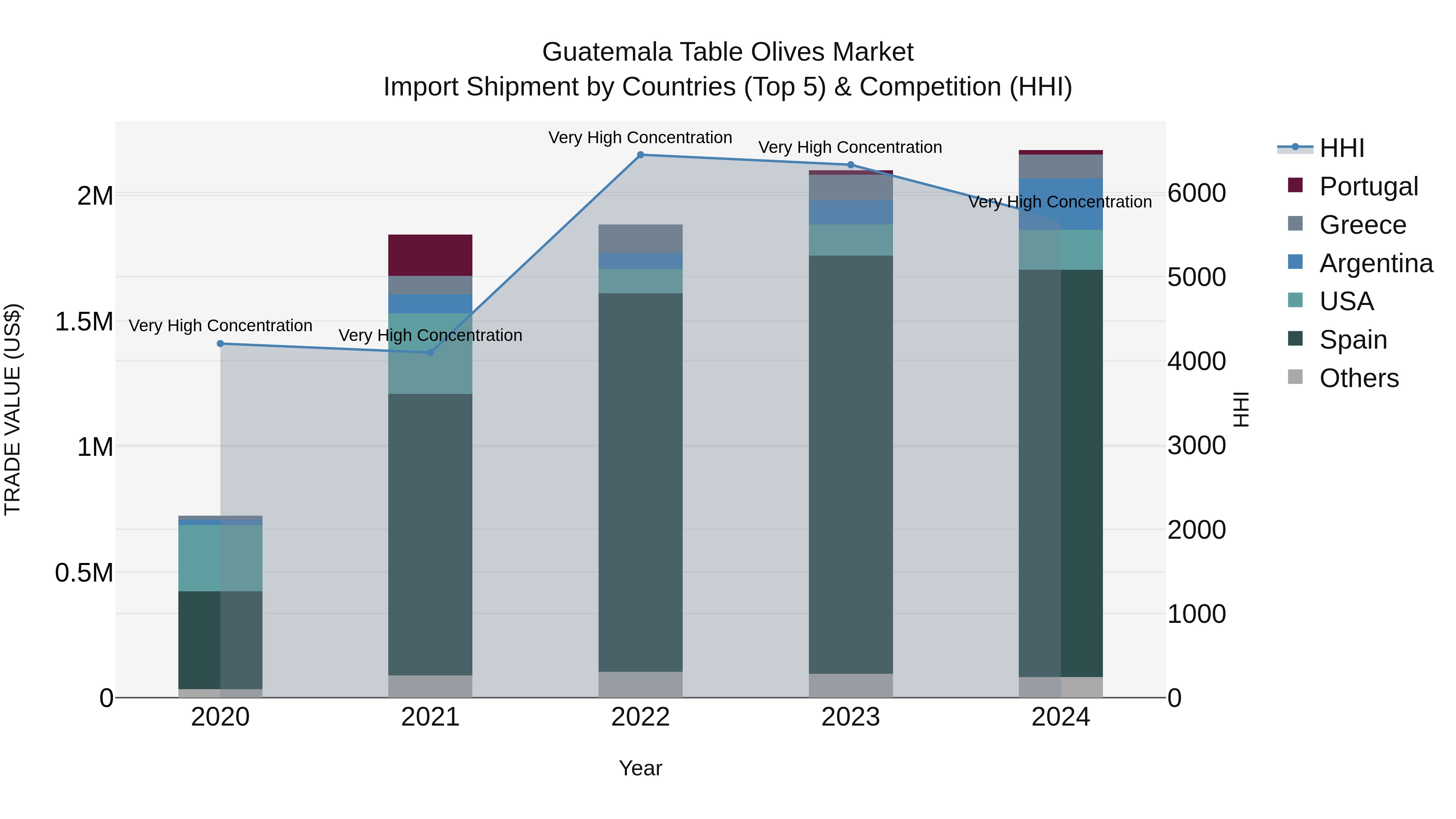
Guatemala`s table olives import market continued to showcase strong growth in 2024, with top exporting countries being Spain, Argentina, USA, Greece, and Italy. The high Herfindahl-Hirschman Index (HHI) indicates a very concentrated market, potentially leading to challenges for smaller players. The impressive Compound Annual Growth Rate (CAGR) of 31.69% from 2020 to 2024 highlights the increasing demand for table olives in Guatemala. Additionally, the growth rate of 3.78% from 2023 to 2024 suggests a steady expansion in import shipments, indicating a positive outlook for the market in the coming years.
Guatemala Table Olives Market Synopsis
The Guatemala Table Olives market is a growing segment within the country`s food industry, driven by increasing consumer demand for healthier and more diverse food options. The market offers a variety of table olive products, including green and black olives, stuffed olives, and olive spreads. Local producers are focusing on improving quality and expanding their product offerings to cater to changing consumer preferences. The market is also influenced by global trends in the olive industry, such as sustainable farming practices and organic production. Key players in the Guatemala Table Olives market include both domestic producers and international brands, creating a competitive landscape that encourages innovation and product development. Overall, the market shows promising growth potential as consumers continue to embrace the health benefits and culinary versatility of table olives.
Guatemala Table Olives Market Trends
In the Guatemala Table Olives Market, there is a growing trend towards healthier eating habits, leading to an increased demand for natural and organic table olives. Consumers are seeking products that are free from preservatives and artificial additives, driving manufacturers to offer a wider range of organic and natural table olive options. Additionally, there is a rising interest in specialty and gourmet table olives, as consumers are becoming more adventurous in trying new flavors and varieties. This presents an opportunity for producers to innovate and introduce unique and premium table olive products to cater to this niche market segment. Furthermore, the increasing popularity of Mediterranean cuisine in Guatemala is boosting the consumption of table olives, providing a favorable environment for market growth and expansion.
Guatemala Table Olives Market Challenges
In the Guatemala Table Olives Market, several challenges are faced, including competition from imported olives, limited consumer awareness and preference for local olives, and lack of infrastructure for olive cultivation and processing. Imported olives from countries with established olive industries often dominate the market, making it difficult for local producers to compete on price and quality. Additionally, Guatemalan consumers may not be as familiar with table olives compared to other types of fruits and vegetables, leading to lower demand. Furthermore, the lack of proper infrastructure for olive cultivation and processing hinders the growth of the domestic industry, resulting in limited production capacity and higher production costs. Overcoming these challenges will require targeted marketing efforts, investment in technology and infrastructure, and fostering consumer education on the benefits and uses of table olives.
Guatemala Table Olives Market Investment Opportunities
The Guatemala Table Olives Market is primarily driven by factors such as increasing consumer awareness about the health benefits of olives, growing demand for Mediterranean cuisine, and the rising trend of healthy snacking options. The market is also influenced by the expanding retail sector, which offers a wide variety of olive products to consumers. Additionally, the emergence of innovative flavors and packaging formats in the table olives market is attracting more customers. Moreover, the preference for organic and natural products among the health-conscious population is further boosting the demand for table olives in Guatemala. Overall, these drivers are contributing to the growth of the Guatemala Table Olives Market, creating opportunities for manufacturers and retailers to expand their product offerings and reach a wider consumer base.
Guatemala Table Olives Market Government Polices
Government policies related to the Guatemala Table Olives Market primarily focus on promoting the growth and sustainability of the industry. The government provides support through agricultural subsidies, export incentives, and research and development programs to enhance the quality and competitiveness of locally produced table olives. Additionally, regulatory measures are in place to ensure food safety standards are met, including inspection and certification processes for producers. The government also encourages investment in modern farming techniques and infrastructure to increase productivity and expand market access for Guatemalan table olive producers. Overall, the government`s policies aim to boost the domestic table olive industry, strengthen its position in the global market, and contribute to the country`s agricultural development goals.
Guatemala Table Olives Market Future Outlook
The future outlook for the Guatemala Table Olives Market appears positive, with steady growth anticipated in the coming years. Factors contributing to this optimistic outlook include increasing consumer awareness of the health benefits of olives, growing demand for Mediterranean cuisine in Guatemala, and a rising trend towards healthier eating habits. The market is also expected to benefit from expanding distribution channels and the introduction of innovative product offerings to cater to changing consumer preferences. Additionally, the country`s favorable climate for olive cultivation presents opportunities for local farmers to increase production and meet the rising demand for table olives both domestically and potentially in export markets. Overall, the Guatemala Table Olives Market is poised for growth and development in the foreseeable future.
Key Highlights of the Report:
- Guatemala Table Olives Market Outlook
- Market Size of Guatemala Table Olives Market, 2024
- Forecast of Guatemala Table Olives Market, 2031
- Historical Data and Forecast of Guatemala Table Olives Revenues & Volume for the Period 2021- 2031
- Guatemala Table Olives Market Trend Evolution
- Guatemala Table Olives Market Drivers and Challenges
- Guatemala Table Olives Price Trends
- Guatemala Table Olives Porter's Five Forces
- Guatemala Table Olives Industry Life Cycle
- Historical Data and Forecast of Guatemala Table Olives Market Revenues & Volume By Type for the Period 2021- 2031
- Historical Data and Forecast of Guatemala Table Olives Market Revenues & Volume By Black Olive for the Period 2021- 2031
- Historical Data and Forecast of Guatemala Table Olives Market Revenues & Volume By Green Olive for the Period 2021- 2031
- Historical Data and Forecast of Guatemala Table Olives Market Revenues & Volume By Application for the Period 2021- 2031
- Historical Data and Forecast of Guatemala Table Olives Market Revenues & Volume By Online Store for the Period 2021- 2031
- Historical Data and Forecast of Guatemala Table Olives Market Revenues & Volume By Supermarket for the Period 2021- 2031
- Historical Data and Forecast of Guatemala Table Olives Market Revenues & Volume By Convenience Store for the Period 2021- 2031
- Historical Data and Forecast of Guatemala Table Olives Market Revenues & Volume By Other for the Period 2021- 2031
- Guatemala Table Olives Import Export Trade Statistics
- Market Opportunity Assessment By Type
- Market Opportunity Assessment By Application
- Guatemala Table Olives Top Companies Market Share
- Guatemala Table Olives Competitive Benchmarking By Technical and Operational Parameters
- Guatemala Table Olives Company Profiles
- Guatemala Table Olives Key Strategic Recommendations






































