Guyana Semiconductor Silicon Wafer Market Top 5 Importing Countries and Market Competition (HHI) Analysis
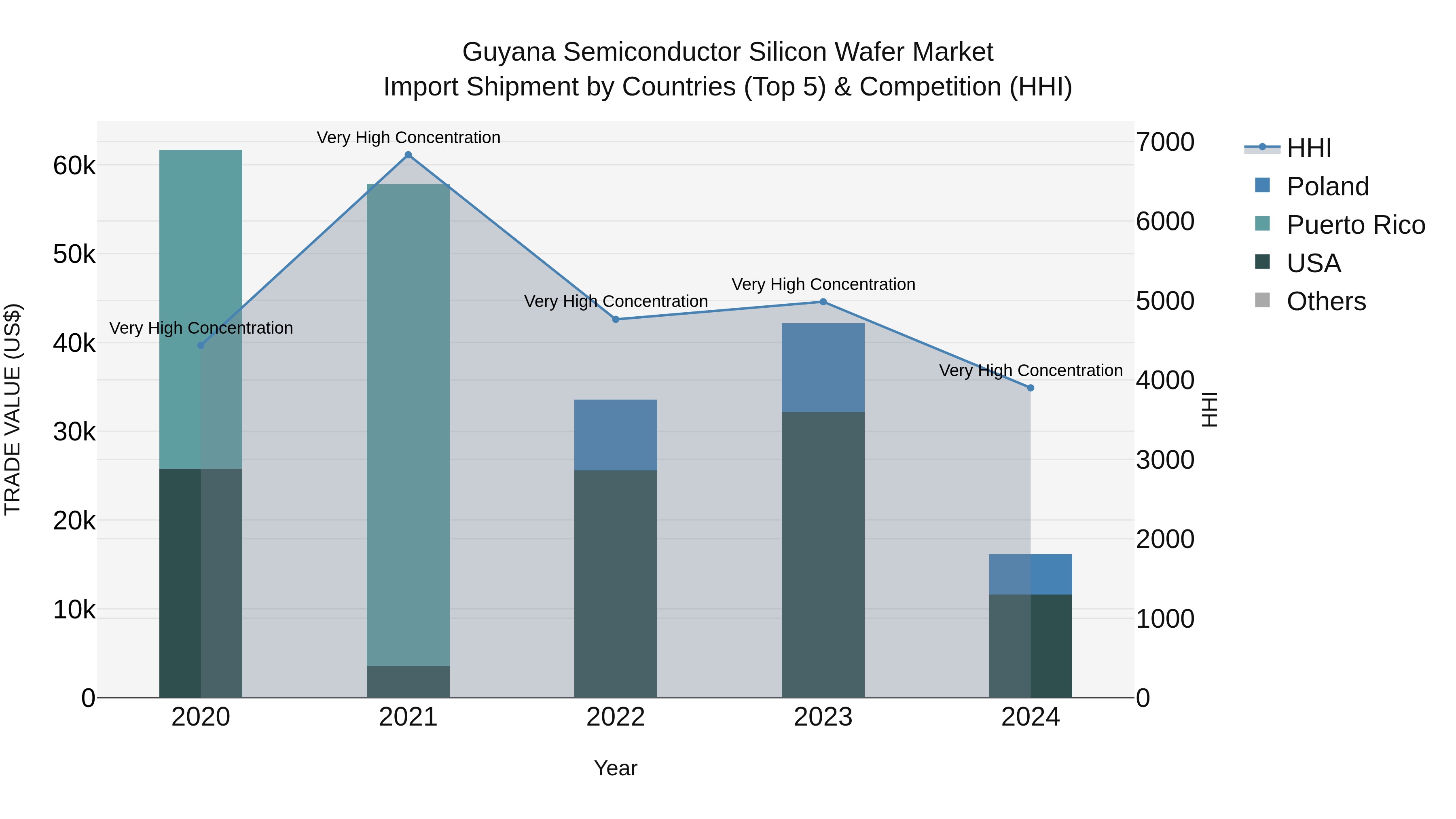
In 2024, Guyana continued to heavily rely on semiconductor silicon wafer imports, with the USA, Poland, and Puerto Rico emerging as the top exporting countries. Despite the high Herfindahl-Hirschman Index (HHI) indicating a concentrated market, the industry experienced a significant decline with a negative Compound Annual Growth Rate (CAGR) of -28.42% from 2020 to 2024. The growth rate plummeted further in 2024, registering at -61.61%. This data suggests a challenging landscape for semiconductor silicon wafer imports in Guyana, highlighting the need for strategic adjustments and market diversification.
Guyana Semiconductor Silicon Wafer Market Overview
The Guyana Semiconductor Silicon Wafer market is a niche but growing segment within the country`s electronics industry. The demand for silicon wafers in Guyana is primarily driven by the increasing adoption of semiconductor devices in various applications such as telecommunications, automotive, and consumer electronics. The market is characterized by the presence of a few key players offering a range of silicon wafer products in different sizes and specifications. As the country continues to develop its technological infrastructure and attract investments in the electronics sector, the demand for semiconductor silicon wafers is expected to rise steadily. Key factors influencing market growth include advancements in semiconductor technology, government initiatives supporting the electronics industry, and the expanding consumer electronics market in Guyana.
Guyana Semiconductor Silicon Wafer Market Trends and Opportunities
In the Guyana Semiconductor Silicon Wafer Market, one notable trend is the increasing demand for silicon wafers in various applications such as consumer electronics, automotive, and healthcare devices. This demand is driven by the growing adoption of advanced technologies like 5G, IoT, and AI, which require high-performance semiconductor components. Additionally, there is a rising focus on renewable energy sources, leading to the utilization of silicon wafers in solar panels and energy storage systems. This presents opportunities for wafer manufacturers to expand their production capacity and cater to the evolving needs of the market. Collaborations with local semiconductor companies and government initiatives to develop the semiconductor industry further contribute to the growth prospects in the Guyana Semiconductor Silicon Wafer Market.
Guyana Semiconductor Silicon Wafer Market Challenges
The Guyana Semiconductor Silicon Wafer Market faces several challenges, including limited local manufacturing capabilities leading to high import dependency, fluctuating global supply chain dynamics impacting availability and pricing, and a relatively small market size resulting in limited economies of scale for local players. Additionally, the lack of skilled workforce and infrastructure constraints pose barriers to market growth and technological advancement. Regulatory uncertainties and a lack of government support for the semiconductor industry further hinder the market`s development. Addressing these challenges will require investments in local manufacturing capabilities, fostering partnerships with global suppliers, enhancing workforce training programs, and implementing supportive policies to stimulate market growth and competitiveness in the Guyana Semiconductor Silicon Wafer Market.
Guyana Semiconductor Silicon Wafer Market Drivers
The Guyana Semiconductor Silicon Wafer Market is primarily driven by the increasing demand for electronic devices such as smartphones, tablets, and laptops, which require semiconductor silicon wafers for their manufacturing. Additionally, the growing adoption of advanced technologies like Internet of Things (IoT) and artificial intelligence (AI) is further fueling the demand for semiconductor silicon wafers in the country. The presence of key market players investing in research and development activities to enhance the efficiency and performance of silicon wafers also contributes to the market growth. Furthermore, government initiatives to promote the semiconductor industry and attract foreign investments in the country are expected to drive the Guyana Semiconductor Silicon Wafer Market in the coming years.
Guyana Semiconductor Silicon Wafer Market Government Policies
The Guyana government has been actively promoting the development of the semiconductor industry through various policies and initiatives. This includes offering tax incentives to attract semiconductor companies to establish manufacturing facilities in the country, providing funding for research and development in semiconductor technology, and supporting local semiconductor startups through grants and mentorship programs. Additionally, the government has invested in infrastructure improvements to support the growth of the semiconductor industry, such as upgrading power supply reliability and enhancing transportation networks. Overall, these policies are aimed at fostering a conducive environment for the growth of the semiconductor silicon wafer market in Guyana and positioning the country as a competitive player in the global semiconductor industry.
Guyana Semiconductor Silicon Wafer Market Future Outlook
The future outlook for the Guyana Semiconductor Silicon Wafer Market appears promising, driven by the increasing demand for semiconductors in various industries such as electronics, automotive, and telecommunications. The growing trend of digitalization and technological advancements is expected to fuel the market growth further. Additionally, the government`s initiatives to promote the semiconductor industry and attract investments are likely to create opportunities for market expansion. However, challenges such as the high cost of production and the need for skilled labor may pose some obstacles. Overall, with the rising demand for electronic devices and the push towards innovation, the Guyana Semiconductor Silicon Wafer Market is anticipated to experience steady growth in the coming years.
Key Highlights of the Report:
- Guyana Semiconductor Silicon Wafer Market Outlook
- Market Size of Guyana Semiconductor Silicon Wafer Market, 2024
- Forecast of Guyana Semiconductor Silicon Wafer Market, 2031
- Historical Data and Forecast of Guyana Semiconductor Silicon Wafer Revenues & Volume for the Period 2021- 2031
- Guyana Semiconductor Silicon Wafer Market Trend Evolution
- Guyana Semiconductor Silicon Wafer Market Drivers and Challenges
- Guyana Semiconductor Silicon Wafer Price Trends
- Guyana Semiconductor Silicon Wafer Porter's Five Forces
- Guyana Semiconductor Silicon Wafer Industry Life Cycle
- Historical Data and Forecast of Guyana Semiconductor Silicon Wafer Market Revenues & Volume By Diameter for the Period 2021- 2031
- Historical Data and Forecast of Guyana Semiconductor Silicon Wafer Market Revenues & Volume By Less Than 150 Mm for the Period 2021- 2031
- Historical Data and Forecast of Guyana Semiconductor Silicon Wafer Market Revenues & Volume By 200 Mm for the Period 2021- 2031
- Historical Data and Forecast of Guyana Semiconductor Silicon Wafer Market Revenues & Volume By 300 Mm and Above for the Period 2021- 2031
- Historical Data and Forecast of Guyana Semiconductor Silicon Wafer Market Revenues & Volume By Product for the Period 2021- 2031
- Historical Data and Forecast of Guyana Semiconductor Silicon Wafer Market Revenues & Volume By Logic for the Period 2021- 2031
- Historical Data and Forecast of Guyana Semiconductor Silicon Wafer Market Revenues & Volume By Memory for the Period 2021- 2031
- Historical Data and Forecast of Guyana Semiconductor Silicon Wafer Market Revenues & Volume By Analog for the Period 2021- 2031
- Historical Data and Forecast of Guyana Semiconductor Silicon Wafer Market Revenues & Volume By Application for the Period 2021- 2031
- Historical Data and Forecast of Guyana Semiconductor Silicon Wafer Market Revenues & Volume By Consumer Electronics for the Period 2021- 2031
- Historical Data and Forecast of Guyana Semiconductor Silicon Wafer Market Revenues & Volume By Industrial for the Period 2021- 2031
- Historical Data and Forecast of Guyana Semiconductor Silicon Wafer Market Revenues & Volume By Telecommunication for the Period 2021- 2031
- Historical Data and Forecast of Guyana Semiconductor Silicon Wafer Market Revenues & Volume By Automotive for the Period 2021- 2031
- Guyana Semiconductor Silicon Wafer Import Export Trade Statistics
- Market Opportunity Assessment By Diameter
- Market Opportunity Assessment By Product
- Market Opportunity Assessment By Application
- Guyana Semiconductor Silicon Wafer Top Companies Market Share
- Guyana Semiconductor Silicon Wafer Competitive Benchmarking By Technical and Operational Parameters
- Guyana Semiconductor Silicon Wafer Company Profiles
- Guyana Semiconductor Silicon Wafer Key Strategic Recommendations






































