Hong Kong Canned Food Market Top 5 Importing Countries and Market Competition (HHI) Analysis
In 2024, Hong Kong saw a diverse range of canned food imports from top exporting countries such as South Korea, Thailand, China, Japan, and Portugal. The market remains competitive with low concentration levels, allowing for a variety of choices for consumers. Despite a slight decline in the compound annual growth rate (CAGR) from 2020-24 at -5.62%, the market showed signs of stabilization with a marginal decrease in growth rate from 2023-24 at -0.72%. This data suggests a resilient market with opportunities for both domestic and international canned food suppliers in Hong Kong.
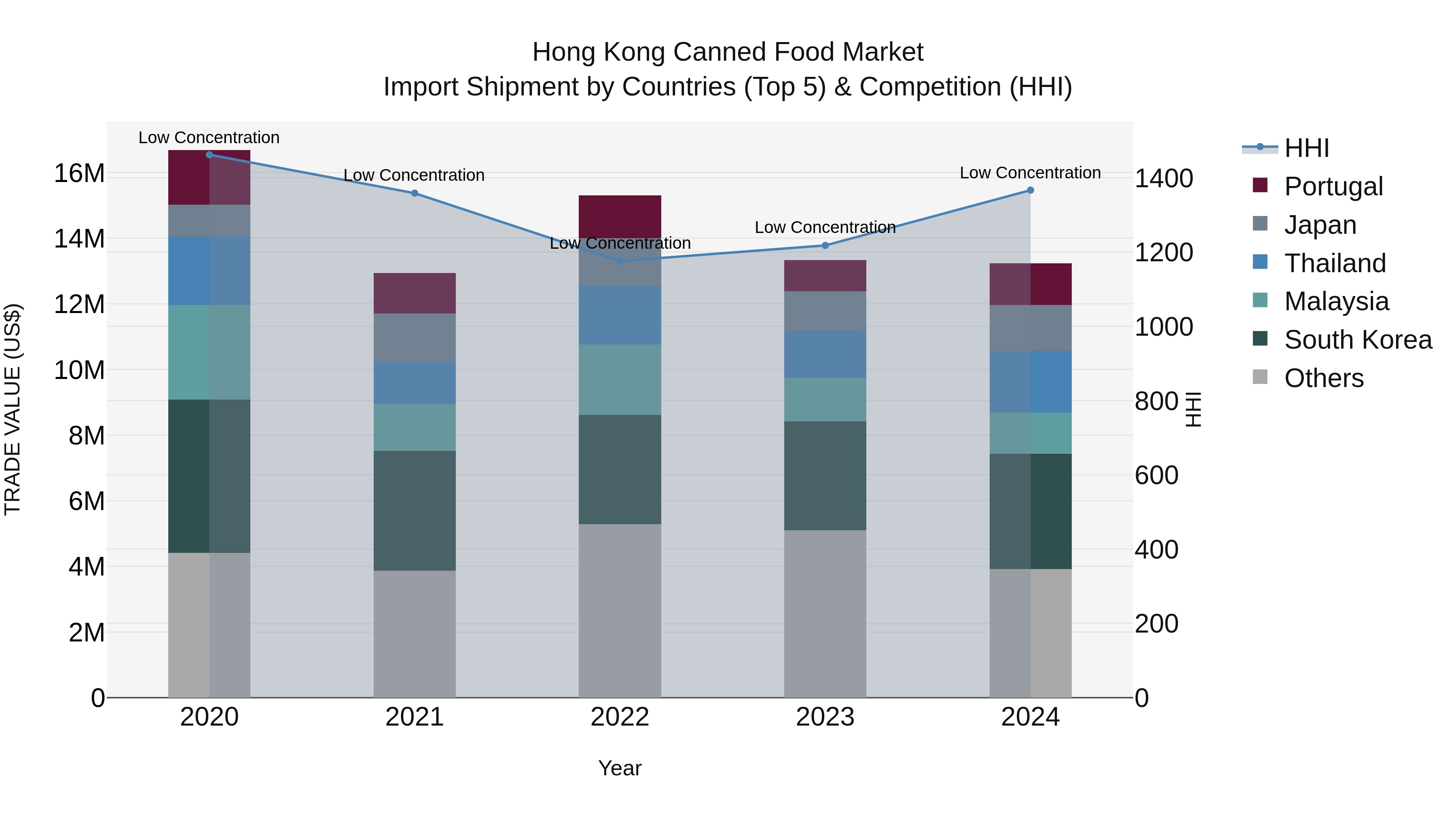
Hong Kong Canned Food Market Synopsis
The canned food market in Hong Kong is robust, catering to both local and expatriate populations. The convenience and long shelf life of canned food products make them a popular choice in households and restaurants.
Drivers of the market
The canned food market in Hong Kong is driven by the growing demand for convenient and long-lasting food products. As busy lifestyles lead consumers to seek easy meal solutions, the popularity of canned foods is rising. The emphasis on food safety and quality assurance also supports the growth of the canned food market.
Challenges of the market
This market faces growing consumer preference for fresh and frozen products, which are perceived as healthier. Fluctuations in the prices of raw ingredients and packaging materials, along with regulatory scrutiny of preservatives and additives, present further challenges.
Government Policy of the market
The Canned Food market in Hong Kong is influenced by government regulations that prioritize food safety and quality. The government enforces strict guidelines for the production and labeling of canned food products, ensuring compliance with health regulations. Policies support consumer education about the nutritional value and safety of canned foods. Additionally, the government promotes initiatives that encourage local sourcing of ingredients for canned products, enhancing food security and sustainability.
Key Highlights of the Report:
- Hong Kong Canned Food Market Outlook
- Market Size of Hong Kong Canned Food Market, 2024
- Forecast of Hong Kong Canned Food Market, 2031
- Historical Data and Forecast of Hong Kong Canned Food Revenues & Volume for the Period 2021-2031
- Hong Kong Canned Food Market Trend Evolution
- Hong Kong Canned Food Market Drivers and Challenges
- Hong Kong Canned Food Price Trends
- Hong Kong Canned Food Porter`s Five Forces
- Hong Kong Canned Food Industry Life Cycle
- Historical Data and Forecast of Hong Kong Canned Food Market Revenues & Volume By Product Type for the Period 2021-2031
- Historical Data and Forecast of Hong Kong Canned Food Market Revenues & Volume By Canned meat & seafood for the Period 2021-2031
- Historical Data and Forecast of Hong Kong Canned Food Market Revenues & Volume By Canned fruit & vegetables for the Period 2021-2031
- Historical Data and Forecast of Hong Kong Canned Food Market Revenues & Volume By Canned ready meals for the Period 2021-2031
- Historical Data and Forecast of Hong Kong Canned Food Market Revenues & Volume By Others for the Period 2021-2031
- Historical Data and Forecast of Hong Kong Canned Food Market Revenues & Volume By Type for the Period 2021-2031
- Historical Data and Forecast of Hong Kong Canned Food Market Revenues & Volume By Organic for the Period 2021-2031
- Historical Data and Forecast of Hong Kong Canned Food Market Revenues & Volume By Conventional for the Period 2021-2031
- Historical Data and Forecast of Hong Kong Canned Food Market Revenues & Volume By Distribution Channel for the Period 2021-2031
- Historical Data and Forecast of Hong Kong Canned Food Market Revenues & Volume By Supermarket/Hypermarket for the Period 2021-2031
- Historical Data and Forecast of Hong Kong Canned Food Market Revenues & Volume By Convenience stores for the Period 2021-2031
- Historical Data and Forecast of Hong Kong Canned Food Market Revenues & Volume By E-commerce for the Period 2021-2031
- Historical Data and Forecast of Hong Kong Canned Food Market Revenues & Volume By Others for the Period 2021-2031
- Hong Kong Canned Food Import Export Trade Statistics
- Market Opportunity Assessment By Product Type
- Market Opportunity Assessment By Type
- Market Opportunity Assessment By Distribution Channel
- Hong Kong Canned Food Top Companies Market Share
- Hong Kong Canned Food Competitive Benchmarking By Technical and Operational Parameters
- Hong Kong Canned Food Company Profiles
- Hong Kong Canned Food Key Strategic Recommendations






































