Hong Kong Chillers Market Top 5 Importing Countries and Market Competition (HHI) Analysis
In 2024, Hong Kong`s chillers import market saw a shift in concentration, moving from high concentration in 2023 to low concentration. The top exporting countries to Hong Kong were Ireland, China, USA, Italy, and Japan. Despite a negative compound annual growth rate (CAGR) of -1.97% from 2020 to 2024, the market experienced a significant decline in growth rate of -32.9% from 2023 to 2024. This data suggests a challenging landscape for chillers import shipments in Hong Kong, indicating potential shifts in market dynamics and competitive forces at play.
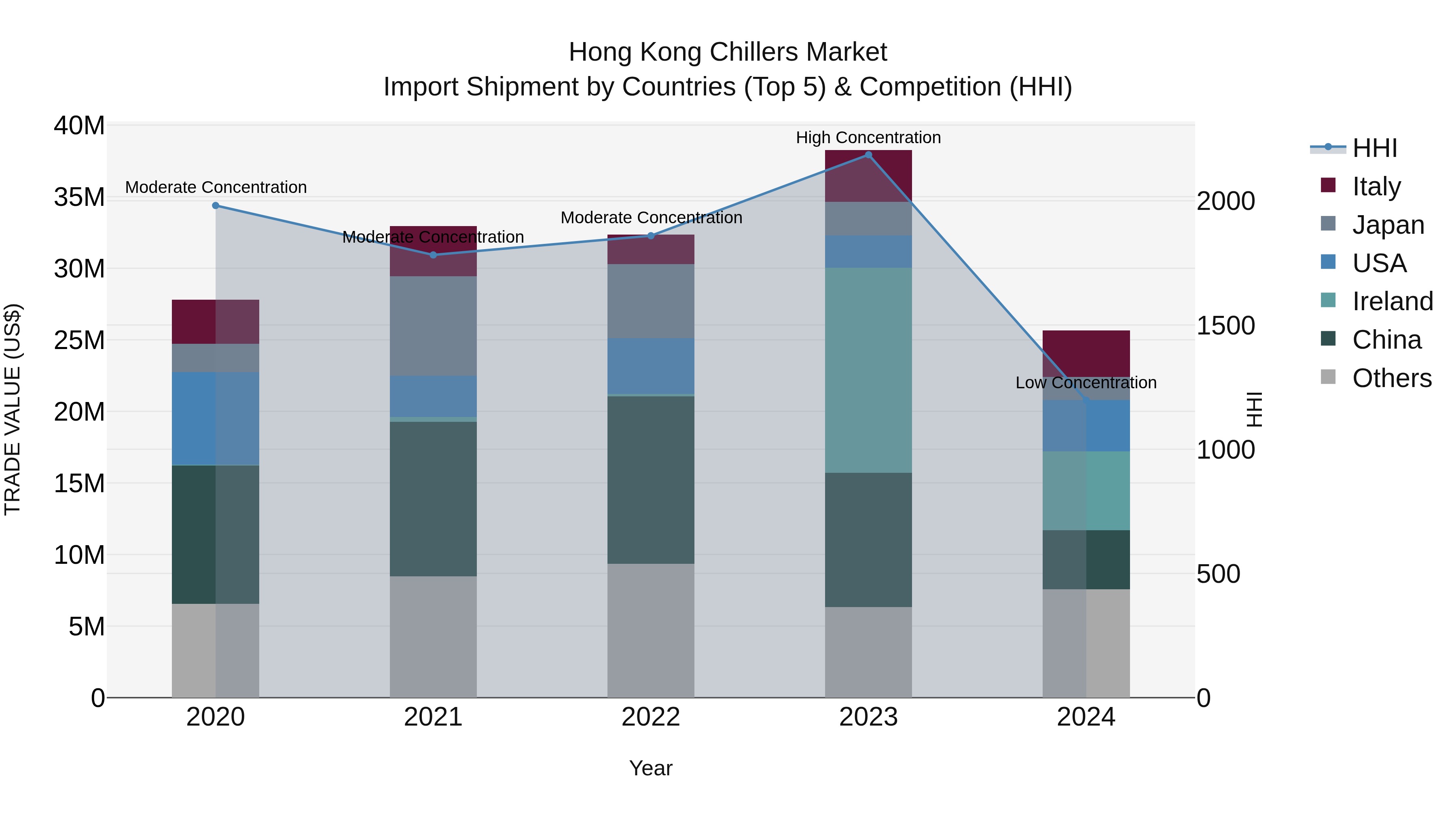
Hong Kong Chillers Market Synopsis
The chillers market in Hong Kong is growing due to the increasing demand for efficient cooling solutions across various industries, including residential, commercial, and industrial sectors. With the rise in temperature and humidity levels, there is a growing need for reliable and energy-efficient cooling systems. The market is characterized by technological advancements, such as the development of smart chillers and eco-friendly refrigerants. Additionally, government initiatives aimed at energy conservation and sustainability are further supporting the adoption of modern chiller systems.
Drivers of the market
The chillers market in Hong Kong is driven by the increasing demand for air conditioning systems in commercial and residential buildings. The region`s tropical climate, coupled with growing urbanization and infrastructure development, is fueling the market for energy-efficient chillers.
Challenges of the market
High energy consumption and the need for energy-efficient solutions present significant challenges in the chillers market. Additionally, the growing emphasis on environmental sustainability requires continuous innovation in refrigerants and cooling technology.
Government Policy of the market
The Chillers market in Hong Kong is shaped by government regulations focusing on energy efficiency and environmental compliance for cooling systems. The government enforces guidelines to ensure that chillers meet performance and safety standards for various applications, including commercial and industrial use. Policies promote research into innovative chiller technologies that enhance efficiency and reduce greenhouse gas emissions. Additionally, the government supports initiatives aimed at improving the overall sustainability of cooling solutions.
Key Highlights of the Report:
- Hong Kong Chillers Market Outlook
- Market Size of Hong Kong Chillers Market, 2024
- Forecast of Hong Kong Chillers Market, 2031
- Historical Data and Forecast of Hong Kong Chillers Revenues & Volume for the Period 2021-2031
- Hong Kong Chillers Market Trend Evolution
- Hong Kong Chillers Market Drivers and Challenges
- Hong Kong Chillers Price Trends
- Hong Kong Chillers Porter`s Five Forces
- Hong Kong Chillers Industry Life Cycle
- Historical Data and Forecast of Hong Kong Chillers Market Revenues & Volume By Type for the Period 2021-2031
- Historical Data and Forecast of Hong Kong Chillers Market Revenues & Volume By Scroll for the Period 2021-2031
- Historical Data and Forecast of Hong Kong Chillers Market Revenues & Volume By Screw for the Period 2021-2031
- Historical Data and Forecast of Hong Kong Chillers Market Revenues & Volume By Centrifugal for the Period 2021-2031
- Historical Data and Forecast of Hong Kong Chillers Market Revenues & Volume By Reciprocating for the Period 2021-2031
- Historical Data and Forecast of Hong Kong Chillers Market Revenues & Volume By Absorption for the Period 2021-2031
- Historical Data and Forecast of Hong Kong Chillers Market Revenues & Volume By End Use Industry for the Period 2021-2031
- Historical Data and Forecast of Hong Kong Chillers Market Revenues & Volume By Plastic for the Period 2021-2031
- Historical Data and Forecast of Hong Kong Chillers Market Revenues & Volume By Chemical & Petrochemical for the Period 2021-2031
- Historical Data and Forecast of Hong Kong Chillers Market Revenues & Volume By Rubber for the Period 2021-2031
- Historical Data and Forecast of Hong Kong Chillers Market Revenues & Volume By Food & Beverage for the Period 2021-2031
- Historical Data and Forecast of Hong Kong Chillers Market Revenues & Volume By Medical & Pharmaceutical for the Period 2021-2031
- Historical Data and Forecast of Hong Kong Chillers Market Revenues & Volume By Capacity for the Period 2021-2031
- Historical Data and Forecast of Hong Kong Chillers Market Revenues & Volume By >17.5 kW for the Period 2021-2031
- Historical Data and Forecast of Hong Kong Chillers Market Revenues & Volume By 17.6-50 kW for the Period 2021-2031
- Historical Data and Forecast of Hong Kong Chillers Market Revenues & Volume By 51-100 kW for the Period 2021-2031
- Historical Data and Forecast of Hong Kong Chillers Market Revenues & Volume By 101-200 kW for the Period 2021-2031
- Historical Data and Forecast of Hong Kong Chillers Market Revenues & Volume By 201-350 kW for the Period 2021-2031
- Historical Data and Forecast of Hong Kong Chillers Market Revenues & Volume By 351-500 kW for the Period 2021-2031
- Historical Data and Forecast of Hong Kong Chillers Market Revenues & Volume By 501-700 kW for the Period 2021-2031
- Historical Data and Forecast of Hong Kong Chillers Market Revenues & Volume By 701-900 kW for the Period 2021-2031
- Hong Kong Chillers Import Export Trade Statistics
- Market Opportunity Assessment By Type
- Market Opportunity Assessment By End Use Industry
- Market Opportunity Assessment By Capacity
- Hong Kong Chillers Top Companies Market Share
- Hong Kong Chillers Competitive Benchmarking By Technical and Operational Parameters
- Hong Kong Chillers Company Profiles
- Hong Kong Chillers Key Strategic Recommendations






































