Hong Kong Deodorants and Anti-perspirant Products Market Top 5 Importing Countries and Market Competition (HHI) Analysis
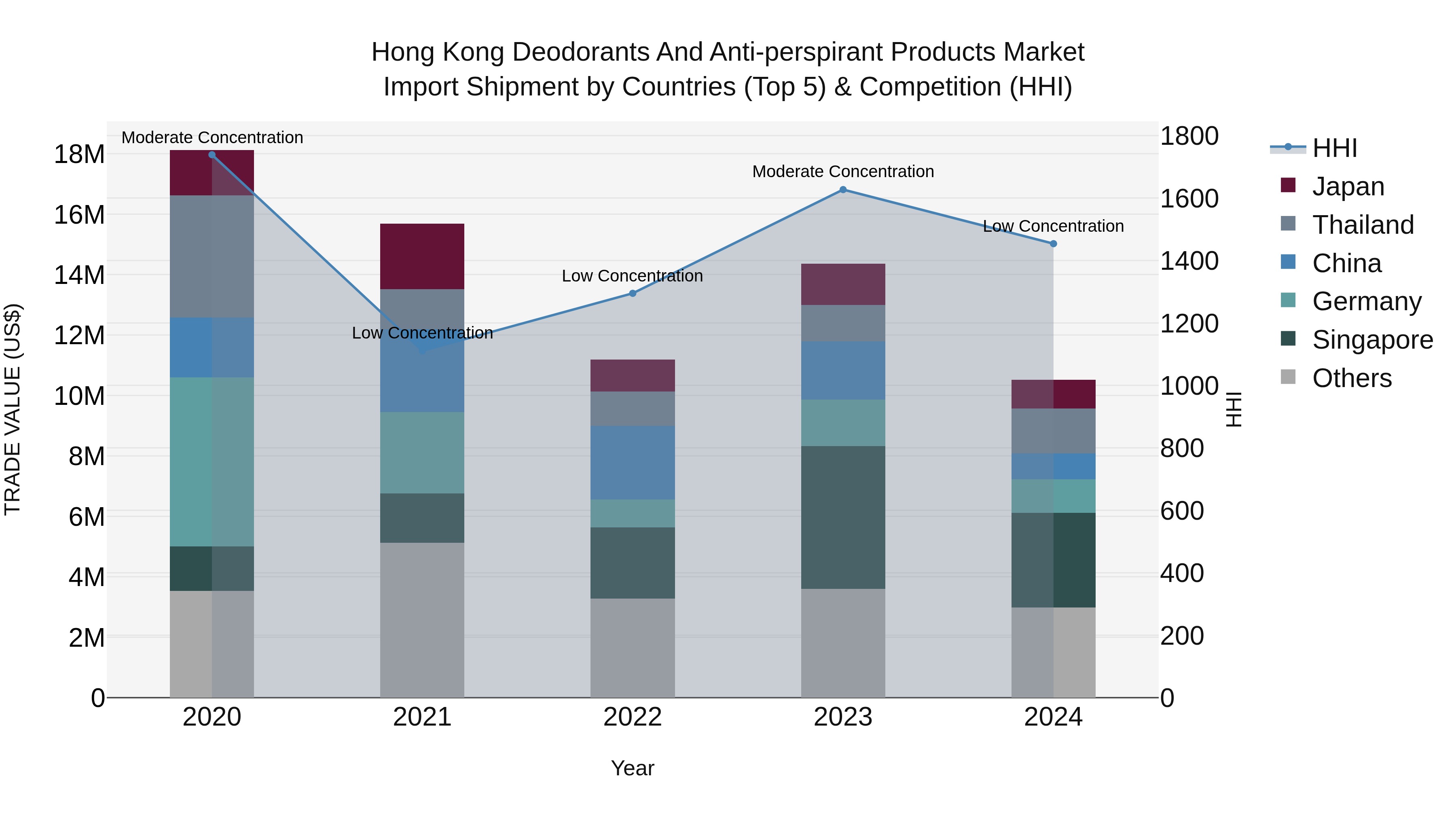
The Hong Kong market for deodorants and anti-perspirant products saw a shift in concentration levels from moderate to low in 2024, indicating a more diversified import market. Top exporting countries Singapore, Thailand, Germany, Japan, and China have maintained their presence, contributing to the industry`s resilience. However, the negative CAGR of -12.7% from 2020 to 2024 and a significant growth rate decline of -26.75% in 2024 suggest challenges in the market. To thrive in this competitive landscape, companies may need to focus on innovation, marketing strategies, and product differentiation to capture consumer interest and drive growth.
Key Highlights of the Report:
- Hong Kong Deodorants and Anti-Perspirant Products Market Outlook
- Market Size of Hong Kong Deodorants and Anti-Perspirant Products Market, 2025
- Forecast of Hong Kong Deodorants and Anti-Perspirant Products Market, 2032
- Historical Data and Forecast of Hong Kong Deodorants and Anti-Perspirant Products Revenues & Volume for the Period 2022 - 2032F
- Hong Kong Deodorants and Anti-Perspirant Products Market Trend Evolution
- Hong Kong Deodorants and Anti-Perspirant Products Market Drivers and Challenges
- Hong Kong Deodorants and Anti-Perspirant Products Price Trends
- Hong Kong Deodorants and Anti-Perspirant Products Porter`s Five Forces
- Hong Kong Deodorants and Anti-Perspirant Products Industry Life Cycle
- Historical Data and Forecast of Hong Kong Deodorants and Anti-Perspirant Products Market Revenues & Volume By Function for the Period 2022 - 2032F
- Historical Data and Forecast of Hong Kong Deodorants and Anti-Perspirant Products Market Revenues & Volume By Aerosol Spray for the Period 2022 - 2032F
- Historical Data and Forecast of Hong Kong Deodorants and Anti-Perspirant Products Market Revenues & Volume By Cream for the Period 2022 - 2032F
- Historical Data and Forecast of Hong Kong Deodorants and Anti-Perspirant Products Market Revenues & Volume By Roll-On for the Period 2022 - 2032F
- Historical Data and Forecast of Hong Kong Deodorants and Anti-Perspirant Products Market Revenues & Volume By Gel for the Period 2022 - 2032F
- Historical Data and Forecast of Hong Kong Deodorants and Anti-Perspirant Products Market Revenues & Volume By Ingredient for the Period 2022 - 2032F
- Historical Data and Forecast of Hong Kong Deodorants and Anti-Perspirant Products Market Revenues & Volume By Alcohol for the Period 2022 - 2032F
- Historical Data and Forecast of Hong Kong Deodorants and Anti-Perspirant Products Market Revenues & Volume By Antimicrobials for the Period 2022 - 2032F
- Historical Data and Forecast of Hong Kong Deodorants and Anti-Perspirant Products Market Revenues & Volume By Conditioner and Moisturizer for the Period 2022 - 2032F
- Historical Data and Forecast of Hong Kong Deodorants and Anti-Perspirant Products Market Revenues & Volume By Fragrances for the Period 2022 - 2032F
- Historical Data and Forecast of Hong Kong Deodorants and Anti-Perspirant Products Market Revenues & Volume By Paraben and Propellants for the Period 2022 - 2032F
- Historical Data and Forecast of Hong Kong Deodorants and Anti-Perspirant Products Market Revenues & Volume By Others for the Period 2022 - 2032F
- Hong Kong Deodorants and Anti-Perspirant Products Import Export Trade Statistics
- Market Opportunity Assessment By Function
- Market Opportunity Assessment By Ingredient
- Hong Kong Deodorants and Anti-Perspirant Products Top Companies Market Share
- Hong Kong Deodorants and Anti-Perspirant Products Competitive Benchmarking By Technical and Operational Parameters
- Hong Kong Deodorants and Anti-Perspirant Products Company Profiles
- Hong Kong Deodorants and Anti-Perspirant Products Key Strategic Recommendations






































