Hong Kong Glycerol Market Top 5 Importing Countries and Market Competition (HHI) Analysis
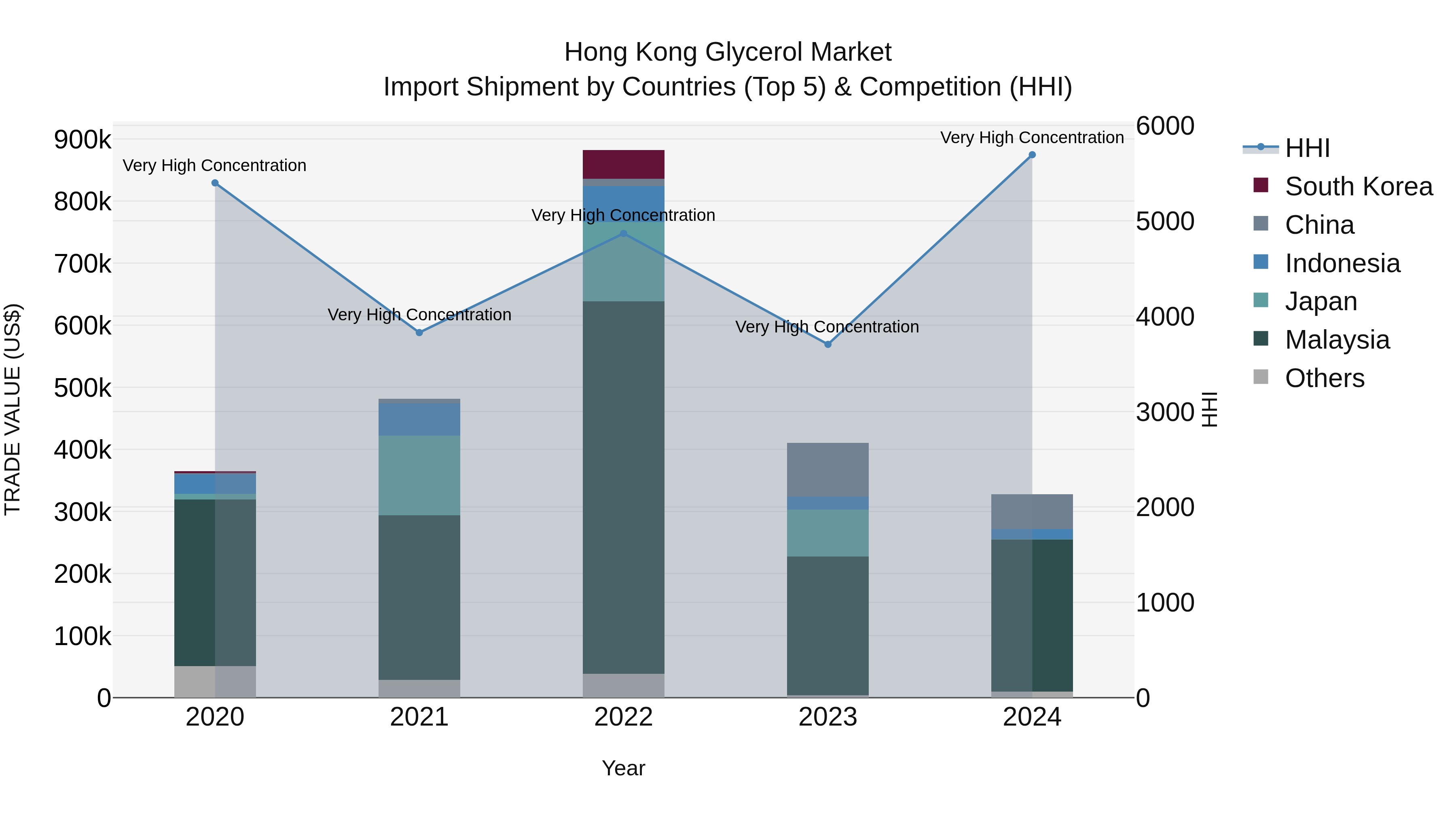
Hong Kong`s glycerol import market in 2024 continues to be dominated by Malaysia, China, Indonesia, UK, and USA. Despite a high concentration with a high Herfindahl-Hirschman Index (HHI), the market experienced a negative Compound Annual Growth Rate (CAGR) of -2.61% from 2020 to 2024. The growth rate plummeted even further in 2024 with a -20.15% decline compared to the previous year. This suggests a challenging environment for glycerol importers in Hong Kong, potentially impacted by various factors such as global economic conditions and changing market dynamics.
Hong Kong Glycerol Market Synopsis
The glycerol market in Hong Kong is expanding, driven by its versatility and use in various industrial and consumer products. Glycerol is used in pharmaceuticals, food and beverages, cosmetics, and as a feedstock for biofuels. The market is supported by the growing demand for eco-friendly and biodegradable products, along with the rise in bio-based chemicals and renewable energy sources.
Drivers of the market
The drivers of the Hong Kong glycerol market include the growing demand for glycerol in various applications, such as personal care, food and beverages, and pharmaceuticals. The increasing use of glycerol as a solvent, moisturizer, and emulsifier in a wide range of consumer products supports market growth. Additionally, the push for bio-based chemicals and renewable resources further drives the glycerol market.
Challenges of the market
The glycerol market in Hong Kong faces challenges with maintaining consistent product quality, as the supply chain for raw materials is often unstable. Regulatory standards regarding purity and safety also increase production costs, making it difficult for businesses to maintain profitability.
Government Policy of the market
The glycerol market is subject to Hong Kong regulations on chemical safety and environmental sustainability. Policies promoting the use of bio-based materials influence the glycerol industry, especially in applications such as cosmetics, food, and pharmaceuticals. The government also enforces strict import regulations to ensure that glycerol products meet international safety and environmental standards.
Key Highlights of the Report:
- Hong Kong Glycerol Market Outlook
- Market Size of Hong Kong Glycerol Market, 2024
- Forecast of Hong Kong Glycerol Market, 2031
- Historical Data and Forecast of Hong Kong Glycerol Revenues & Volume for the Period 2021-2031
- Hong Kong Glycerol Market Trend Evolution
- Hong Kong Glycerol Market Drivers and Challenges
- Hong Kong Glycerol Price Trends
- Hong Kong Glycerol Porter`s Five Forces
- Hong Kong Glycerol Industry Life Cycle
- Historical Data and Forecast of Hong Kong Glycerol Market Revenues & Volume By Source for the Period 2021-2031
- Historical Data and Forecast of Hong Kong Glycerol Market Revenues & Volume By Biodiesel for the Period 2021-2031
- Historical Data and Forecast of Hong Kong Glycerol Market Revenues & Volume By Fatty Alcohols for the Period 2021-2031
- Historical Data and Forecast of Hong Kong Glycerol Market Revenues & Volume By Fatty Acids for the Period 2021-2031
- Historical Data and Forecast of Hong Kong Glycerol Market Revenues & Volume By Soap for the Period 2021-2031
- Historical Data and Forecast of Hong Kong Glycerol Market Revenues & Volume By Type for the Period 2021-2031
- Historical Data and Forecast of Hong Kong Glycerol Market Revenues & Volume By Crude for the Period 2021-2031
- Historical Data and Forecast of Hong Kong Glycerol Market Revenues & Volume By Refined for the Period 2021-2031
- Historical Data and Forecast of Hong Kong Glycerol Market Revenues & Volume By End-use for the Period 2021-2031
- Historical Data and Forecast of Hong Kong Glycerol Market Revenues & Volume By Food & Beverage for the Period 2021-2031
- Historical Data and Forecast of Hong Kong Glycerol Market Revenues & Volume By Pharmaceutical for the Period 2021-2031
- Historical Data and Forecast of Hong Kong Glycerol Market Revenues & Volume By Nutraceutical for the Period 2021-2031
- Historical Data and Forecast of Hong Kong Glycerol Market Revenues & Volume By Personal Care & Cosmetics for the Period 2021-2031
- Historical Data and Forecast of Hong Kong Glycerol Market Revenues & Volume By Industrial for the Period 2021-2031
- Historical Data and Forecast of Hong Kong Glycerol Market Revenues & Volume By Others for the Period 2021-2031
- Hong Kong Glycerol Import Export Trade Statistics
- Market Opportunity Assessment By Source
- Market Opportunity Assessment By Type
- Market Opportunity Assessment By End-use
- Hong Kong Glycerol Top Companies Market Share
- Hong Kong Glycerol Competitive Benchmarking By Technical and Operational Parameters
- Hong Kong Glycerol Company Profiles
- Hong Kong Glycerol Key Strategic Recommendations






































