Hong Kong Kaolin Market Top 5 Importing Countries and Market Competition (HHI) Analysis
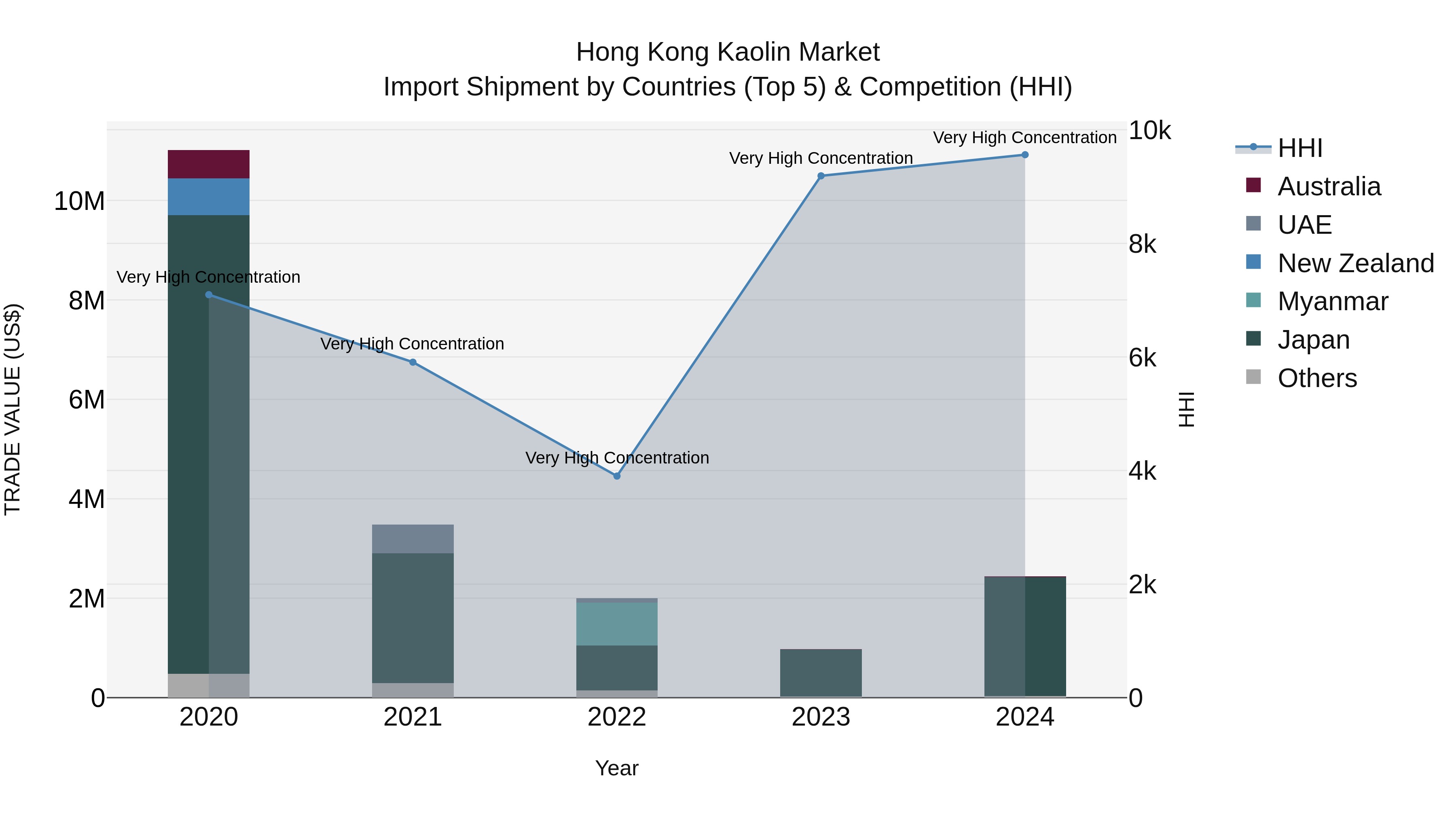
The Hong Kong kaolin import market in 2024 saw significant contributions from Japan, USA, Australia, UK, and Netherlands. Despite a steep negative CAGR from 2020-24, there was a remarkable growth spurt in 2024 with a growth rate of 149.33%. The high concentration of the Herfindahl-Hirschman Index (HHI) indicates a competitive landscape dominated by a few key players. This data suggests a dynamic and evolving market for kaolin imports in Hong Kong, with potential opportunities for both suppliers and buyers to capitalize on emerging trends.
Hong Kong Kaolin Market Synopsis
The kaolin market in Hong Kong is primarily influenced by its applications in ceramics, paper, and paint industries. Kaolin`s properties, such as whiteness and plasticity, make it a valuable raw material for manufacturers seeking to enhance product quality. The market is expected to grow as demand for high-quality kaolin continues, driven by the expanding construction and manufacturing sectors. Additionally, innovations in processing techniques are enhancing the versatility of kaolin in various applications, further supporting market growth.
Drivers of the market
The Hong Kong Kaolin Market is driven by its applications in various industries, including ceramics, paper, and plastics. The growing demand for high-quality kaolin in the production of ceramics and porcelain enhances market dynamics. Additionally, the increasing use of kaolin as a filler in paper and plastic manufacturing supports market growth. The continuous innovations in processing techniques aimed at improving kaolin quality and functionality further contribute to the market`s expansion.
Challenges of the market
The Hong Kong Kaolin Market faces challenges from fluctuating demand in key end-use industries, such as ceramics and paper. Environmental regulations concerning mining activities can complicate operations and increase costs. Additionally, competition from alternative materials can impact market share. The need for continuous investment in production technologies to meet quality standards poses further challenges for kaolin producers.
Government Policy of the market
The kaolin market is subject to government regulations that ensure environmentally responsible mining practices. The government promotes sustainable development in the mining sector, offering guidelines for land reclamation and resource management. Policies supporting R&D into kaolin applications further enhance the market`s potential across various industries.
Key Highlights of the Report:
- Hong Kong Kaolin Market Outlook
- Market Size of Hong Kong Kaolin Market, 2024
- Forecast of Hong Kong Kaolin Market, 2031
- Historical Data and Forecast of Hong Kong Kaolin Revenues & Volume for the Period 2021-2031
- Hong Kong Kaolin Market Trend Evolution
- Hong Kong Kaolin Market Drivers and Challenges
- Hong Kong Kaolin Price Trends
- Hong Kong Kaolin Porter`s Five Forces
- Hong Kong Kaolin Industry Life Cycle
- Historical Data and Forecast of Hong Kong Kaolin Market Revenues & Volume By Process for the Period 2021-2031
- Historical Data and Forecast of Hong Kong Kaolin Market Revenues & Volume By Water-washed for the Period 2021-2031
- Historical Data and Forecast of Hong Kong Kaolin Market Revenues & Volume By Airfloat for the Period 2021-2031
- Historical Data and Forecast of Hong Kong Kaolin Market Revenues & Volume By Calcined for the Period 2021-2031
- Historical Data and Forecast of Hong Kong Kaolin Market Revenues & Volume By Delaminated for the Period 2021-2031
- Historical Data and Forecast of Hong Kong Kaolin Market Revenues & Volume By Surface-modified & Unprocessed for the Period 2021-2031
- Historical Data and Forecast of Hong Kong Kaolin Market Revenues & Volume By End-users for the Period 2021-2031
- Historical Data and Forecast of Hong Kong Kaolin Market Revenues & Volume By Ceramics & Sanitarywares for the Period 2021-2031
- Historical Data and Forecast of Hong Kong Kaolin Market Revenues & Volume By Fiberglass for the Period 2021-2031
- Historical Data and Forecast of Hong Kong Kaolin Market Revenues & Volume By Paints & Coatings for the Period 2021-2031
- Historical Data and Forecast of Hong Kong Kaolin Market Revenues & Volume By Rubber for the Period 2021-2031
- Historical Data and Forecast of Hong Kong Kaolin Market Revenues & Volume By Adhesives & Sealants for the Period 2021-2031
- Historical Data and Forecast of Hong Kong Kaolin Market Revenues & Volume By Plastics for the Period 2021-2031
- Historical Data and Forecast of Hong Kong Kaolin Market Revenues & Volume By Others for the Period 2021-2031
- Hong Kong Kaolin Import Export Trade Statistics
- Market Opportunity Assessment By Process
- Market Opportunity Assessment By End-users
- Hong Kong Kaolin Top Companies Market Share
- Hong Kong Kaolin Competitive Benchmarking By Technical and Operational Parameters
- Hong Kong Kaolin Company Profiles
- Hong Kong Kaolin Key Strategic Recommendations






































