Hong Kong Lumber Market Top 5 Importing Countries and Market Competition (HHI) Analysis
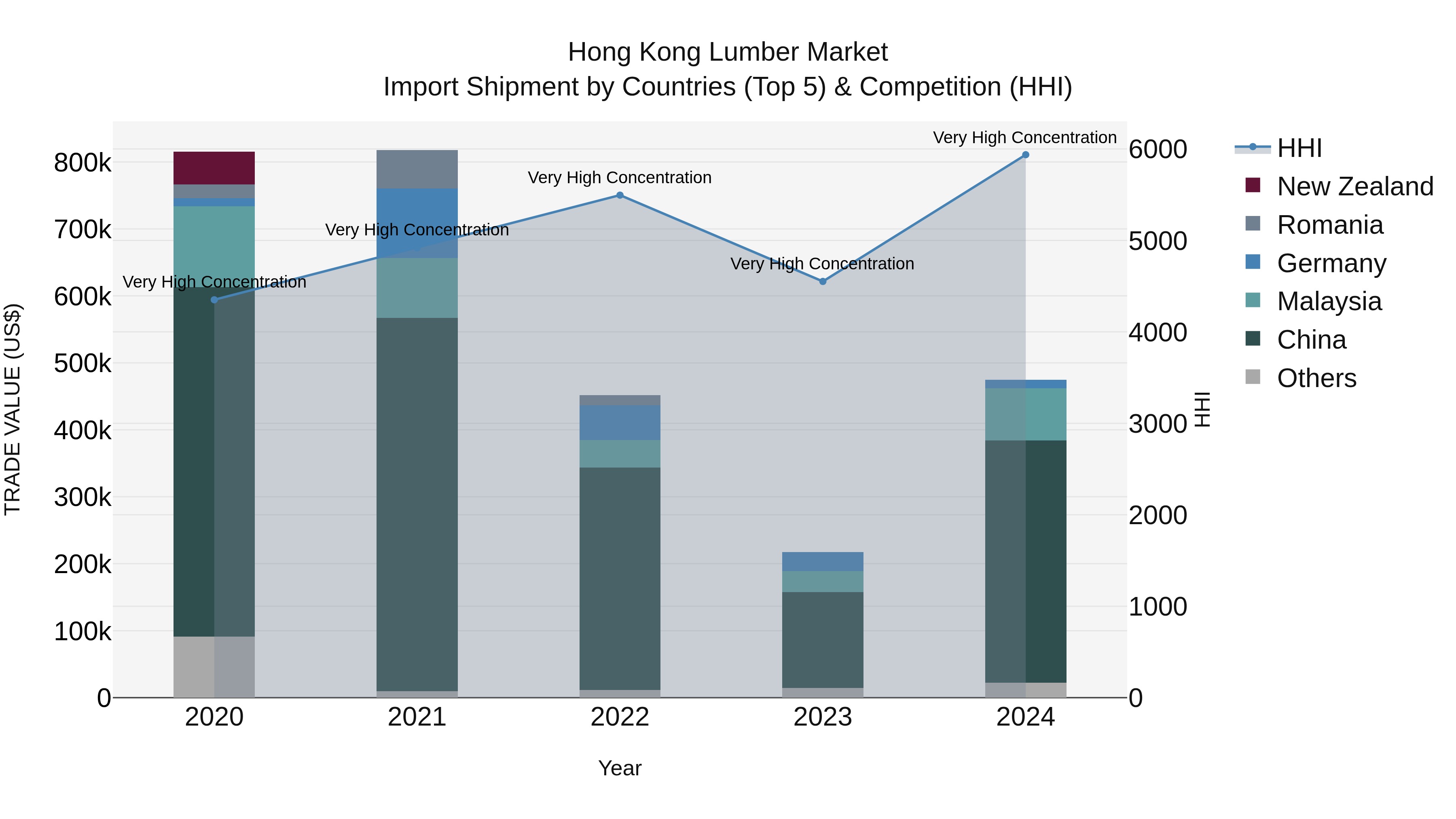
In 2024, Hong Kong continued to rely heavily on lumber imports from China, Malaysia, Macao SAR, Germany, and Finland, with China being the top exporter. The high Herfindahl-Hirschman Index (HHI) indicates a concentrated market, possibly leading to limited competition. The compound annual growth rate (CAGR) from 2020 to 2024 was negative at -12.65%, but there was a notable growth spurt in 2024 with a growth rate of 118.54% compared to the previous year. This suggests potential shifts in the lumber import market dynamics in Hong Kong.
Hong Kong Lumber Market Synopsis
The lumber market in Hong Kong is integral to the construction industry, which continues to grow due to urban development projects. The demand for lumber is bolstered by residential and commercial construction activities, with a focus on sustainable wood sourcing and advanced timber technologies.
Drivers of the market
The Hong Kong Lumber Market is driven by the increasing demand for sustainable construction materials and the rising trend of green building practices. As Hong Kong continues to develop and urbanize, the need for high-quality lumber for residential and commercial construction is on the rise. The growing awareness of environmental issues and the benefits of using renewable materials are encouraging builders and architects to choose lumber over synthetic alternatives. Additionally, the governments initiatives to promote sustainable forestry practices and responsible sourcing of timber are supporting market growth. The rise in DIY home improvement projects and furniture making among consumers is further boosting the demand for lumber in Hong Kong.
Challenges of the market
The lumber market in Hong Kong struggles with issues related to limited domestic timber resources, reliance on imports, and volatile global prices. Environmental regulations, particularly concerning deforestation and sustainable sourcing, also add to the complexities of the market.
Government Policy of the market
In Hong Kong, the lumber market is shaped by government policies aimed at promoting sustainable forestry practices and environmental conservation. Regulations that mandate certification for timber products ensure that only sustainably sourced lumber is used in construction and manufacturing. The government`s commitment to reducing deforestation and promoting reforestation initiatives influences market dynamics by encouraging the use of alternative materials and innovative wood treatment technologies. Furthermore, urban development projects and the need for green building materials drive the demand for high-quality lumber, necessitating compliance with safety and sustainability standards.
Key Highlights of the Report:
- Hong Kong Lumber Market Outlook
- Market Size of Hong Kong Lumber Market, 2024
- Forecast of Hong Kong Lumber Market, 2031
- Historical Data and Forecast of Hong Kong Lumber Revenues & Volume for the Period 2021-2031
- Hong Kong Lumber Market Trend Evolution
- Hong Kong Lumber Market Drivers and Challenges
- Hong Kong Lumber Price Trends
- Hong Kong Lumber Porter`s Five Forces
- Hong Kong Lumber Industry Life Cycle
- Historical Data and Forecast of Hong Kong Lumber Market Revenues & Volume By Types for the Period 2021-2031
- Historical Data and Forecast of Hong Kong Lumber Market Revenues & Volume By Hardwood Lumber for the Period 2021-2031
- Historical Data and Forecast of Hong Kong Lumber Market Revenues & Volume By Softwood Lumber for the Period 2021-2031
- Historical Data and Forecast of Hong Kong Lumber Market Revenues & Volume By Application for the Period 2021-2031
- Historical Data and Forecast of Hong Kong Lumber Market Revenues & Volume By Construction for the Period 2021-2031
- Historical Data and Forecast of Hong Kong Lumber Market Revenues & Volume By Furniture for the Period 2021-2031
- Historical Data and Forecast of Hong Kong Lumber Market Revenues & Volume By Flooring for the Period 2021-2031
- Historical Data and Forecast of Hong Kong Lumber Market Revenues & Volume By Moldings for the Period 2021-2031
- Historical Data and Forecast of Hong Kong Lumber Market Revenues & Volume By Others for the Period 2021-2031
- Hong Kong Lumber Import Export Trade Statistics
- Market Opportunity Assessment By Types
- Market Opportunity Assessment By Application
- Hong Kong Lumber Top Companies Market Share
- Hong Kong Lumber Competitive Benchmarking By Technical and Operational Parameters
- Hong Kong Lumber Company Profiles
- Hong Kong Lumber Key Strategic Recommendations






































