Hong Kong Semiconductor Silicon Wafer Market Top 5 Importing Countries and Market Competition (HHI) Analysis
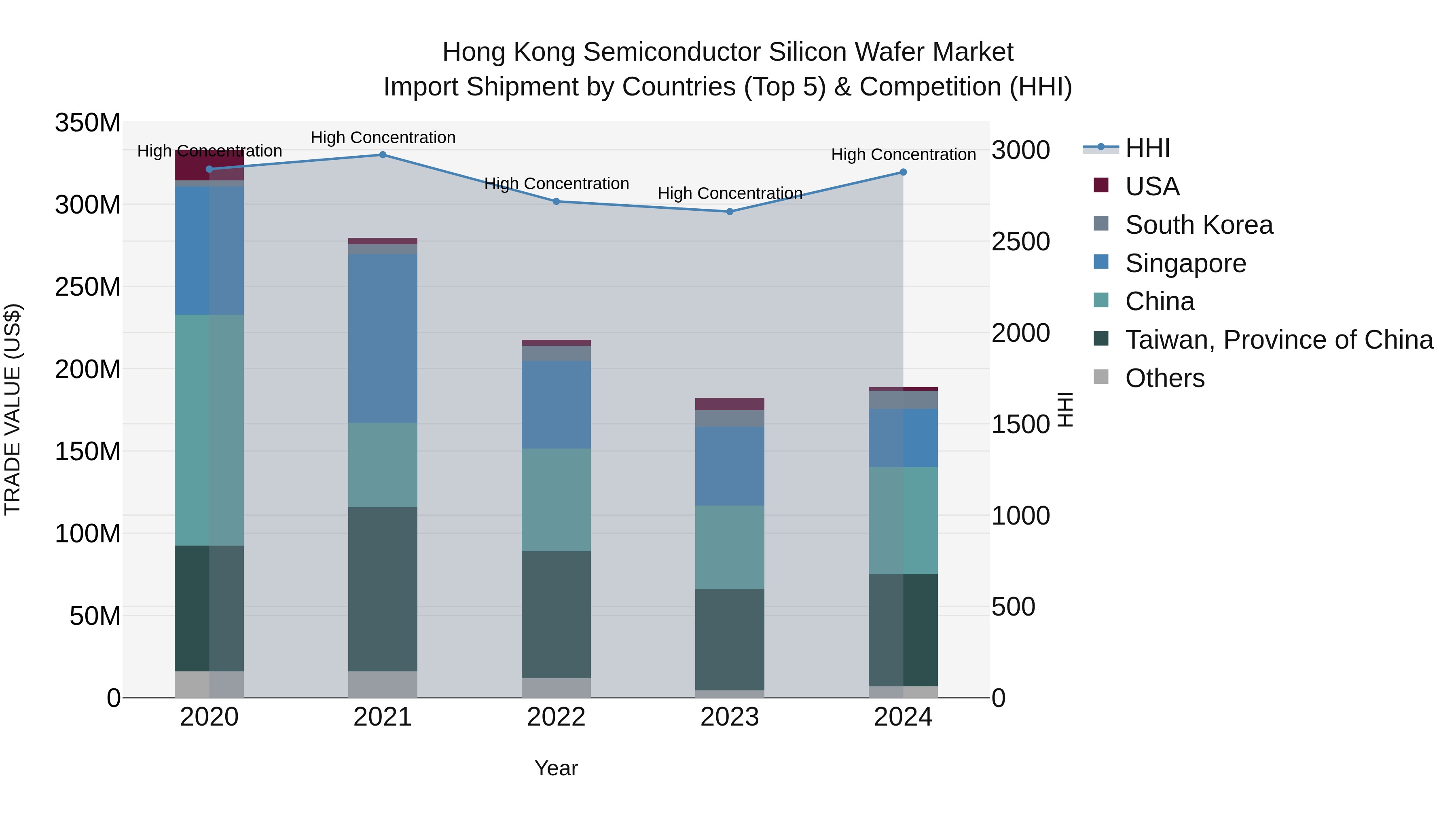
In 2024, Hong Kong continued to be a key player in the semiconductor silicon wafer import market, with top exporters including Taiwan, China, Singapore, South Korea, and Vietnam. The market remained highly concentrated with a high Herfindahl-Hirschman Index (HHI). Despite a negative compound annual growth rate (CAGR) from 2020 to 2024, there was a slight improvement in the growth rate from 2023 to 2024. This data suggests a complex market landscape with potential for shifts in supply dynamics and competitive positioning among key exporters.
Hong Kong Semiconductor Silicon Wafer Market Overview
The Hong Kong semiconductor silicon wafer market is experiencing robust growth driven by increasing demand for electronic devices such as smartphones, tablets, and wearables. The market is primarily dominated by leading semiconductor manufacturers who are investing heavily in research and development to enhance wafer technology and meet the growing demand for advanced semiconductor products. With the rise of emerging technologies like Internet of Things (IoT) and artificial intelligence (AI), the demand for silicon wafers is expected to continue its upward trajectory. Additionally, the government`s initiatives to promote innovation and technology in Hong Kong are further fueling the market growth. The competitive landscape is characterized by strategic collaborations, mergers, and acquisitions among key players to strengthen their market position and expand their product offerings.
Hong Kong Semiconductor Silicon Wafer Market Trends and Opportunities
The Hong Kong Semiconductor Silicon Wafer Market is experiencing growth due to the increasing demand for consumer electronics, automotive applications, and the rise of 5G technology. The market is witnessing a trend towards the development of smaller and more energy-efficient semiconductor devices, driving the demand for advanced silicon wafers with higher levels of integration. Opportunities lie in the expansion of wafer fabrication facilities, collaborations between industry players to innovate new technologies, and the growing adoption of AI and IoT devices that require semiconductor components. Additionally, the push towards renewable energy sources like solar power creates further opportunities for silicon wafer manufacturers in Hong Kong. Overall, the market shows promise for growth and technological advancements in the near future.
Hong Kong Semiconductor Silicon Wafer Market Challenges
In the Hong Kong Semiconductor Silicon Wafer Market, one of the main challenges faced is the intense competition from other semiconductor manufacturing hubs in the region, such as Taiwan and South Korea. This competition puts pressure on Hong Kong-based companies to innovate continuously and improve their production efficiency to remain competitive. Additionally, the increasing complexity and miniaturization of semiconductor devices require advanced silicon wafer technologies and production processes, which can be costly to implement and maintain. Furthermore, geopolitical uncertainties and trade tensions can impact the supply chain and market dynamics, leading to fluctuations in demand and pricing. Overall, navigating these challenges requires strategic planning, investment in research and development, and strong partnerships with key industry players to ensure competitiveness and sustainability in the Hong Kong Semiconductor Silicon Wafer Market.
Hong Kong Semiconductor Silicon Wafer Market Drivers
The Hong Kong Semiconductor Silicon Wafer Market is primarily driven by the increasing demand for consumer electronics, automotive applications, and the growing adoption of 5G technology. The rising demand for smartphones, tablets, and other electronic devices has fueled the need for advanced semiconductor components, driving the demand for silicon wafers. Additionally, the automotive industry`s shift towards electric vehicles and autonomous driving technologies has further boosted the demand for silicon wafers used in power electronics and sensors. The deployment of 5G networks in Hong Kong has also created opportunities for silicon wafer suppliers as 5G technology requires advanced semiconductor materials for network infrastructure and devices. Overall, the market is expected to continue growing as these industries drive the demand for high-quality silicon wafers in Hong Kong.
Hong Kong Semiconductor Silicon Wafer Market Government Policies
The Hong Kong government has implemented various policies to support the semiconductor silicon wafer market within the region. This includes offering incentives and subsidies to attract semiconductor companies to establish operations in Hong Kong, as well as providing support for research and development activities in the semiconductor industry. Additionally, the government has focused on improving the infrastructure and supply chain capabilities related to semiconductor manufacturing to enhance the competitiveness of the market. Hong Kong also aims to strengthen partnerships with key industry players and promote collaboration between academia and industry to drive innovation and growth in the semiconductor silicon wafer market. Overall, the government`s policies are geared towards creating a conducive environment for the development and expansion of the semiconductor industry in Hong Kong.
Hong Kong Semiconductor Silicon Wafer Market Future Outlook
The future outlook for the Hong Kong Semiconductor Silicon Wafer Market appears promising, driven by increasing demand for consumer electronics, automotive applications, and emerging technologies such as 5G, IoT, and AI. The market is expected to witness steady growth due to the rising adoption of advanced semiconductor technologies in various industries. Additionally, the government`s support for the development of the semiconductor industry and the presence of key players in the region are likely to fuel market expansion. However, increasing competition from other semiconductor manufacturing hubs and global economic uncertainties may pose challenges to market growth. Overall, the Hong Kong Semiconductor Silicon Wafer Market is anticipated to experience robust growth in the coming years, supported by technological advancements and evolving industry trends.
Key Highlights of the Report:
- Hong Kong Semiconductor Silicon Wafer Market Outlook
- Market Size of Hong Kong Semiconductor Silicon Wafer Market, 2024
- Forecast of Hong Kong Semiconductor Silicon Wafer Market, 2031
- Historical Data and Forecast of Hong Kong Semiconductor Silicon Wafer Revenues & Volume for the Period 2021- 2031
- Hong Kong Semiconductor Silicon Wafer Market Trend Evolution
- Hong Kong Semiconductor Silicon Wafer Market Drivers and Challenges
- Hong Kong Semiconductor Silicon Wafer Price Trends
- Hong Kong Semiconductor Silicon Wafer Porter's Five Forces
- Hong Kong Semiconductor Silicon Wafer Industry Life Cycle
- Historical Data and Forecast of Hong Kong Semiconductor Silicon Wafer Market Revenues & Volume By Diameter for the Period 2021- 2031
- Historical Data and Forecast of Hong Kong Semiconductor Silicon Wafer Market Revenues & Volume By Less Than 150 Mm for the Period 2021- 2031
- Historical Data and Forecast of Hong Kong Semiconductor Silicon Wafer Market Revenues & Volume By 200 Mm for the Period 2021- 2031
- Historical Data and Forecast of Hong Kong Semiconductor Silicon Wafer Market Revenues & Volume By 300 Mm and Above for the Period 2021- 2031
- Historical Data and Forecast of Hong Kong Semiconductor Silicon Wafer Market Revenues & Volume By Product for the Period 2021- 2031
- Historical Data and Forecast of Hong Kong Semiconductor Silicon Wafer Market Revenues & Volume By Logic for the Period 2021- 2031
- Historical Data and Forecast of Hong Kong Semiconductor Silicon Wafer Market Revenues & Volume By Memory for the Period 2021- 2031
- Historical Data and Forecast of Hong Kong Semiconductor Silicon Wafer Market Revenues & Volume By Analog for the Period 2021- 2031
- Historical Data and Forecast of Hong Kong Semiconductor Silicon Wafer Market Revenues & Volume By Application for the Period 2021- 2031
- Historical Data and Forecast of Hong Kong Semiconductor Silicon Wafer Market Revenues & Volume By Consumer Electronics for the Period 2021- 2031
- Historical Data and Forecast of Hong Kong Semiconductor Silicon Wafer Market Revenues & Volume By Industrial for the Period 2021- 2031
- Historical Data and Forecast of Hong Kong Semiconductor Silicon Wafer Market Revenues & Volume By Telecommunication for the Period 2021- 2031
- Historical Data and Forecast of Hong Kong Semiconductor Silicon Wafer Market Revenues & Volume By Automotive for the Period 2021- 2031
- Hong Kong Semiconductor Silicon Wafer Import Export Trade Statistics
- Market Opportunity Assessment By Diameter
- Market Opportunity Assessment By Product
- Market Opportunity Assessment By Application
- Hong Kong Semiconductor Silicon Wafer Top Companies Market Share
- Hong Kong Semiconductor Silicon Wafer Competitive Benchmarking By Technical and Operational Parameters
- Hong Kong Semiconductor Silicon Wafer Company Profiles
- Hong Kong Semiconductor Silicon Wafer Key Strategic Recommendations






































