Hong Kong Touchscreen Controller Market Top 5 Importing Countries and Market Competition (HHI) Analysis
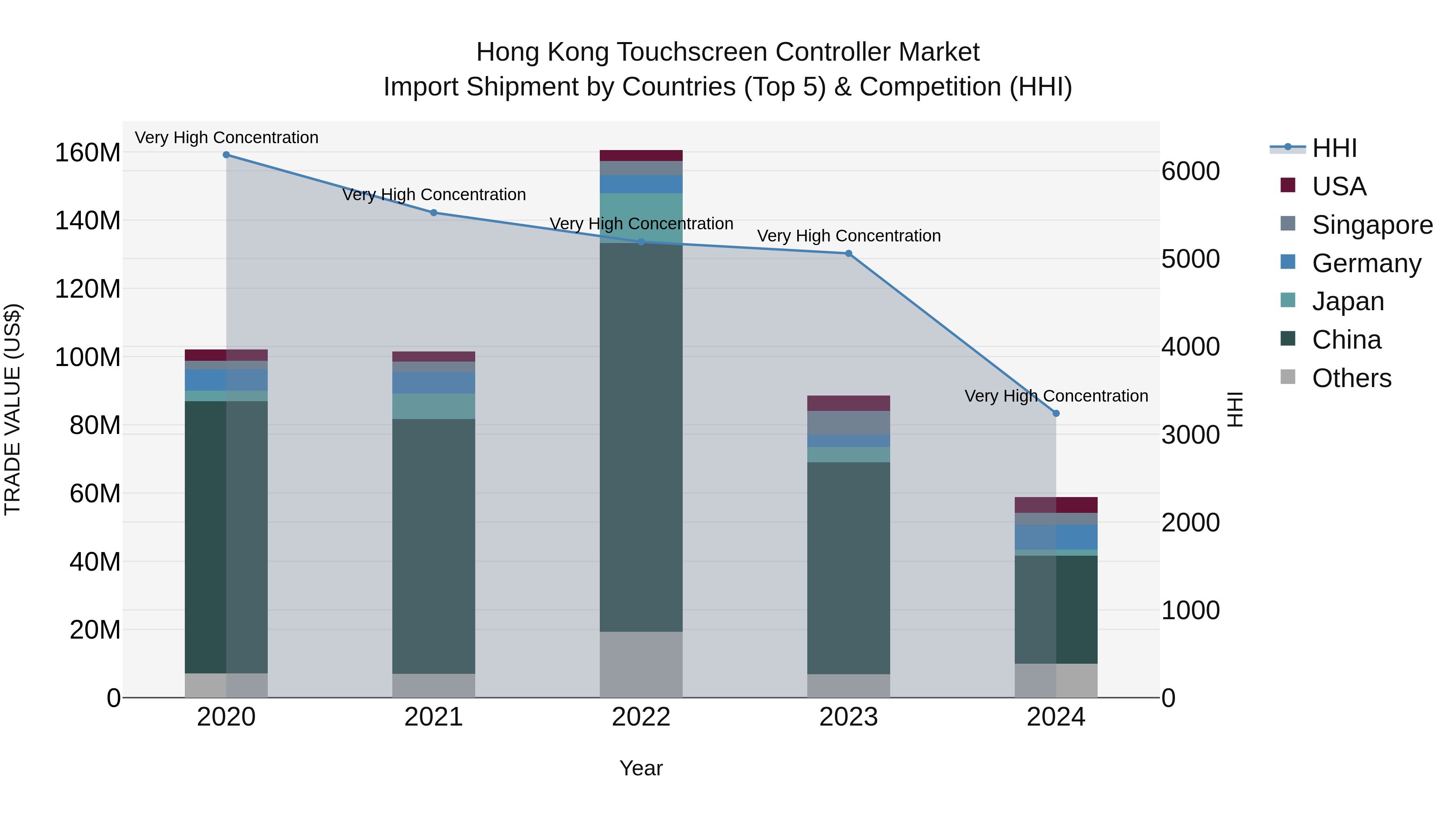
In 2024, Hong Kong continued to see a high concentration of touchscreen controller imports, with top exporters being China, Germany, Taiwan, USA, and Singapore. Despite the challenging market conditions, the industry experienced a significant decline with a CAGR of -12.88% from 2020 to 2024. The growth rate plummeted by -33.62% in 2024 compared to the previous year, indicating a tough operating environment for touchscreen controller importers in Hong Kong. This trend may prompt companies to reassess their strategies and adapt to the changing market dynamics to stay competitive.
Key Highlights of the Report:
- Hong Kong Touchscreen Controller Market Outlook
- Market Size of Hong Kong Touchscreen Controller Market, 2025
- Forecast of Hong Kong Touchscreen Controller Market, 2032
- Historical Data and Forecast of Hong Kong Touchscreen Controller Revenues & Volume for the Period 2022 - 2032F
- Hong Kong Touchscreen Controller Market Trend Evolution
- Hong Kong Touchscreen Controller Market Drivers and Challenges
- Hong Kong Touchscreen Controller Price Trends
- Hong Kong Touchscreen Controller Porter`s Five Forces
- Hong Kong Touchscreen Controller Industry Life Cycle
- Historical Data and Forecast of Hong Kong Touchscreen Controller Market Revenues & Volume By Technology for the Period 2022 - 2032F
- Historical Data and Forecast of Hong Kong Touchscreen Controller Market Revenues & Volume By Resistive for the Period 2022 - 2032F
- Historical Data and Forecast of Hong Kong Touchscreen Controller Market Revenues & Volume By Capacitive for the Period 2022 - 2032F
- Historical Data and Forecast of Hong Kong Touchscreen Controller Market Revenues & Volume By Interface for the Period 2022 - 2032F
- Historical Data and Forecast of Hong Kong Touchscreen Controller Market Revenues & Volume By I2C (Inter-Integrated Circuit) for the Period 2022 - 2032F
- Historical Data and Forecast of Hong Kong Touchscreen Controller Market Revenues & Volume By Serial Peripheral Interface for the Period 2022 - 2032F
- Historical Data and Forecast of Hong Kong Touchscreen Controller Market Revenues & Volume By USB (Universal Serial Bus) for the Period 2022 - 2032F
- Historical Data and Forecast of Hong Kong Touchscreen Controller Market Revenues & Volume By UART (Universal Asynchronous Receiver/Transmitter) for the Period 2022 - 2032F
- Historical Data and Forecast of Hong Kong Touchscreen Controller Market Revenues & Volume By HID over USB for the Period 2022 - 2032F
- Historical Data and Forecast of Hong Kong Touchscreen Controller Market Revenues & Volume By Touchscreen Technology for the Period 2022 - 2032F
- Historical Data and Forecast of Hong Kong Touchscreen Controller Market Revenues & Volume By Single-touch Technology for the Period 2022 - 2032F
- Historical Data and Forecast of Hong Kong Touchscreen Controller Market Revenues & Volume By Multi-touch Technology for the Period 2022 - 2032F
- Historical Data and Forecast of Hong Kong Touchscreen Controller Market Revenues & Volume By Screen Size for the Period 2022 - 2032F
- Historical Data and Forecast of Hong Kong Touchscreen Controller Market Revenues & Volume By Small & Medium for the Period 2022 - 2032F
- Historical Data and Forecast of Hong Kong Touchscreen Controller Market Revenues & Volume By Large for the Period 2022 - 2032F
- Hong Kong Touchscreen Controller Import Export Trade Statistics
- Market Opportunity Assessment By Technology
- Market Opportunity Assessment By Interface
- Market Opportunity Assessment By Touchscreen Technology
- Market Opportunity Assessment By Screen Size
- Hong Kong Touchscreen Controller Top Companies Market Share
- Hong Kong Touchscreen Controller Competitive Benchmarking By Technical and Operational Parameters
- Hong Kong Touchscreen Controller Company Profiles
- Hong Kong Touchscreen Controller Key Strategic Recommendations






































