Hong Kong SAR Transformers Market Size Growth Rate
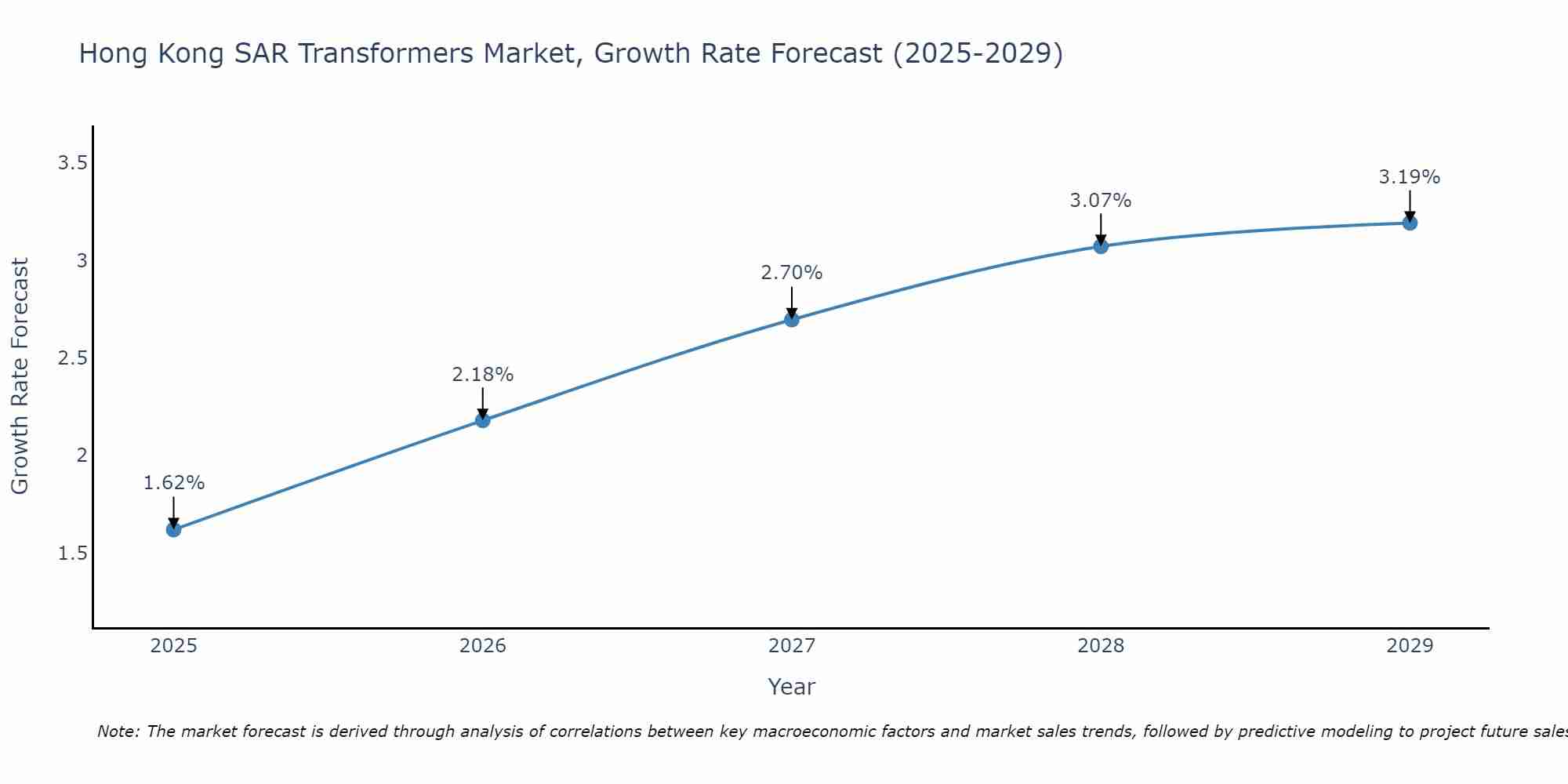
The Hong Kong SAR Transformers Market is poised for steady growth rate improvements from 2025 to 2029. The growth rate starts at 1.62% in 2025 and reaches 3.19% by 2029.
Transformers Market: Hong Kong SAR vs Top 5 Major Economies in 2027 (Asia)
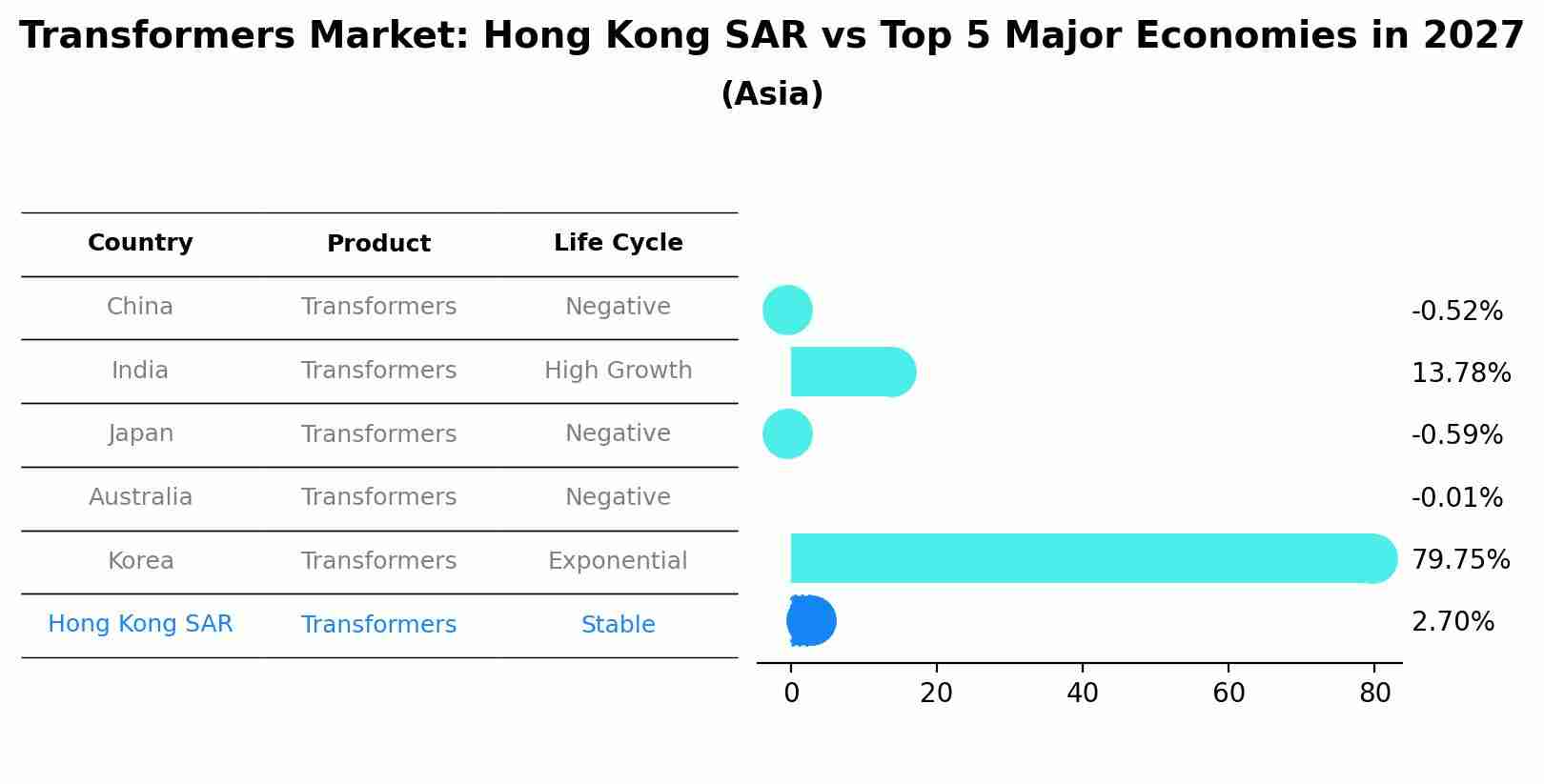
Hong Kong SAR's Transformers market is anticipated to experience a stable growth rate of 2.70% by 2027, reflecting trends observed in the largest economy China, followed by India, Japan, Australia and South Korea.
Key Highlights of the Report:
- Hong Kong Transformers Market Outlook
- Market Size of Hong Kong Transformers Market, 2024
- Forecast of Hong Kong Transformers Market, 2031
- Historical Data and Forecast of Hong Kong Transformers Revenues & Volume for the Period 2021-2031
- Hong Kong Transformers Market Trend Evolution
- Hong Kong Transformers Market Drivers and Challenges
- Hong Kong Transformers Price Trends
- Hong Kong Transformers Porter`s Five Forces
- Hong Kong Transformers Industry Life Cycle
- Historical Data and Forecast of Hong Kong Transformers Market Revenues & Volume By Cooling for the Period 2021-2031
- Historical Data and Forecast of Hong Kong Transformers Market Revenues & Volume By Oil-Cooled for the Period 2021-2031
- Historical Data and Forecast of Hong Kong Transformers Market Revenues & Volume By Air-Cooled for the Period 2021-2031
- Historical Data and Forecast of Hong Kong Transformers Market Revenues & Volume By Power Ratings for the Period 2021-2031
- Historical Data and Forecast of Hong Kong Transformers Market Revenues & Volume By Small Power Transformer for the Period 2021-2031
- Historical Data and Forecast of Hong Kong Transformers Market Revenues & Volume By Medium Power Transformer for the Period 2021-2031
- Historical Data and Forecast of Hong Kong Transformers Market Revenues & Volume By Large Power Transformer for the Period 2021-2031
- Historical Data and Forecast of Hong Kong Transformers Market Revenues & Volume By Applications for the Period 2021-2031
- Historical Data and Forecast of Hong Kong Transformers Market Revenues & Volume By Smart Grid for the Period 2021-2031
- Historical Data and Forecast of Hong Kong Transformers Market Revenues & Volume By Smart Transformer for the Period 2021-2031
- Historical Data and Forecast of Hong Kong Transformers Market Revenues & Volume By Green Energy for the Period 2021-2031
- Historical Data and Forecast of Hong Kong Transformers Market Revenues & Volume By Power infrastructure for the Period 2021-2031
- Hong Kong Transformers Import Export Trade Statistics
- Market Opportunity Assessment By Cooling
- Market Opportunity Assessment By Power Ratings
- Market Opportunity Assessment By Applications
- Hong Kong Transformers Top Companies Market Share
- Hong Kong Transformers Competitive Benchmarking By Technical and Operational Parameters
- Hong Kong Transformers Company Profiles
- Hong Kong Transformers Key Strategic Recommendations






































