Hungary Apiculture Market Size, Share & Growth Rate
The Hungary Apiculture Market was estimated at USD 1382 Million in 2025 and is projected to reach USD 1988 Million by 2032, growing at a CAGR of 5.3% from 2026 to 2032. This growth trajectory is primarily fueled by increasing consumer awareness regarding the health benefits of honey, alongside a robust tradition of beekeeping in Hungary. Furthermore, the rise in organic and locally sourced honey products reflects a significant shift towards sustainability that is capturing the attention of health-conscious consumers.
Hungary Apiculture Market Year-wise Growth Rate and Key Drivers
This graph highlights how the Hungary Apiculture Market has steadily grown over the years, supported by major growth factors.
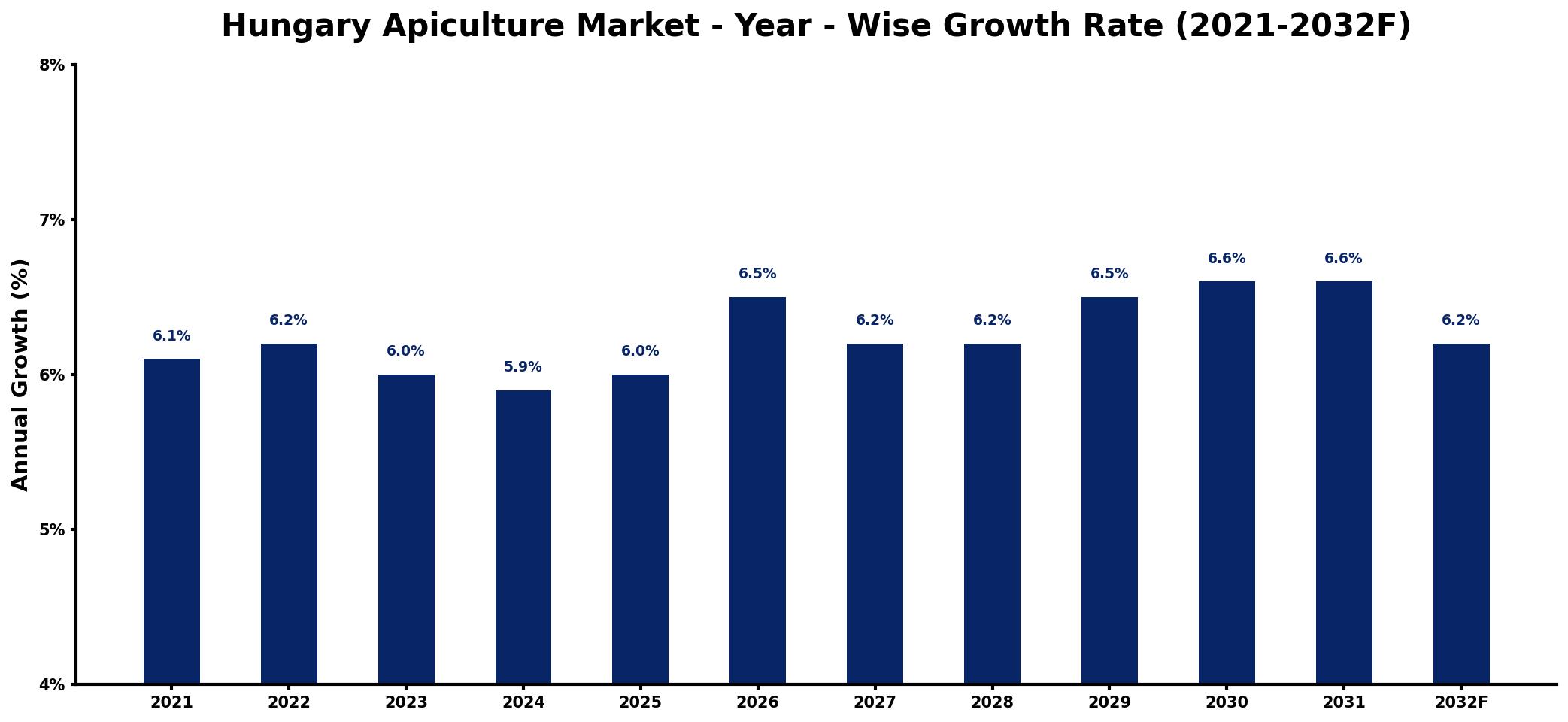
The table below presents the year‑wise growth rates along with the key drivers influencing the market
| Year | Growth Rate | Major Drivers |
| 2021 | 6.1% | Rising interest in local food |
| 2022 | 6.2% | Increased consumer health awareness |
| 2023 | 6.0% | Growth in organic farming practices |
| 2024 | 5.9% | Expansion of online retail channels |
| 2025 | 6.0% | Investment in sustainable practices |
| 2026 | 6.5% | Emergence of new market players |
| 2027 | 6.2% | strengthening underlying market demand |
| 2028 | 6.2% | Increased demand for natural products |
| 2029 | 6.5% | Strengthening of export opportunities |
| 2030 | 6.6% | Development of innovative packaging solutions |
| 2031 | 6.6% | Collaboration among local producers |
| 2032 | 6.2% | Rise in community-supported agriculture |
Note: Market size estimations and growth projections presented in this report are based on 6Wresearch's proprietary forecasting methodology, utilizing the latest available industry data, government publications, and primary research inputs.
Hungary Apiculture Market Synopsis
The Hungary apiculture market is currently riding a wave of popularity, largely due to its rich beekeeping heritage and the high demand for diverse honey varieties. However, while the present outlook is promising, the market faces significant challenges, particularly related to climate change and the prevalence of pests and diseases affecting bee populations.
Looking ahead, the market is projected to evolve, supported by increasing investments in sustainable practices and technology. Government initiatives to promote honey production and environmental conservation will likely play a pivotal role in shaping the future of beekeeping in Hungary, ensuring that the industry remains vibrant and competitive.
Hungary Apiculture Market Key Takeaways
- Hungary boasts a strong tradition of beekeeping, producing unique honey varieties recognized for their quality.
- The demand for organic honey and locally sourced products is on the rise, driven by health and sustainability trends.
- Technological innovations are being adopted to enhance productivity and efficiency in beekeeping practices.
- Government support through subsidies and training programs is crucial for maintaining sustainable practices in the industry.
- Challenges such as climate change and pest outbreaks require ongoing attention and solutions to safeguard honey production.
Evaluation of Restraints in Hungary Apiculture Market
Despite the positive growth outlook, the Hungary Apiculture Market grapples with several critical restraints. Climate change poses a significant risk, as unpredictable weather patterns can disrupt bee foraging activities and lead to diminished honey yields. Additionally, the introduction and spread of pests, such as Varroa mites, can devastate bee colonies, further threatening production capabilities. Local producers also face stiff competition from lower-priced imported honey, which can undercut market prices and profit margins. These issues create a complex landscape that requires strategic navigation to ensure the sector's sustainability and resilience.
Hungary Apiculture Market Trends
Current trends within the Hungary Apiculture Market highlight a shift towards organic and sustainable beekeeping practices. As consumers increasingly seek out natural products, many beekeepers are adopting organic certification to meet this demand. Additionally, technology is revolutionizing traditional practices; hive monitoring systems and data analytics tools are becoming commonplace, enhancing beekeepers' ability to manage their operations effectively. Conservation efforts are also gaining traction, reflecting a commitment to protect bee populations and biodiversity, which are vital for sustaining the ecosystem.
Hungary Apiculture Market Opportunities
The Hungary Apiculture Market is ripe with investment opportunities, particularly as consumer interest in high-quality honey continues to grow. Entrepreneurs can explore avenues for expanding beekeeping operations or investing in modern beekeeping equipment and technology. Additionally, the development of value-added products, such as beeswax candles or propolis-based skincare items, can enhance profitability. Collaborations with local beekeepers for honey sourcing and partnerships with beekeeping associations can further open doors to new markets, both domestically and internationally.
Government Initiatives in the Hungary Apiculture Market
The Hungarian government has instituted several policies aimed at bolstering the apiculture market. These measures include financial incentives for beekeepers to invest in modern equipment, comprehensive training programs designed to enhance beekeeping techniques, and proactive strategies to combat the threats posed by pests and diseases. Additionally, the establishment of quality standards and certification processes serves to elevate the reputation of Hungarian honey in both local and international markets, contributing to industry growth and sustainability.
Future Insights of the Hungary Apiculture Market
The outlook for the Hungary Apiculture Market appears optimistic as the demand for honey and related bee products is set to rise both within the country and abroad. Factors such as growing health awareness, interest in organic products, and recognition of the ecological importance of bees are driving this growth. Government initiatives aimed at fostering sustainable beekeeping practices are likely to further enhance market prospects. However, it remains essential for stakeholders to address the challenges posed by climate change and pest management to secure the industry's long-term viability.
Hungary Apiculture Market Latest Developments (2025 - 2026)
Recent developments within the Hungary Apiculture Market indicate a notable increase in the adoption of technological innovations among beekeepers, enhancing operational efficiency and productivity. Simultaneously, consumer interest in organic and locally-sourced honey is driving many producers to pursue organic certification and sustainable practices. Government programs are actively supporting these trends, which are expected to result in a more resilient and prosperous apiculture sector in Hungary.
Hungary Apiculture Market - Key Attractiveness of the Report
- 10 Years of Market Numbers
- Historical Data Starting from 2022 to 2025
- Base Year: 2025
- Forecast Data until 2032
- Key Performance Indicators Impacting the Market
- Major Upcoming Developments and Projects
Key Highlights of the Report:
- Hungary Apiculture Market Outlook
- Market Size of Hungary Apiculture Market, 2025
- Forecast of Hungary Apiculture Market, 2032
- Historical Data and Forecast of Hungary Apiculture Revenues & Volume for the Period 2022-2032F
- Hungary Apiculture Market Trend Evolution
- Hungary Apiculture Market Drivers and Challenges
- Hungary Apiculture Price Trends
- Hungary Apiculture Porter's Five Forces
- Hungary Apiculture Industry Life Cycle
- Historical Data and Forecast of Hungary Apiculture Market Revenues & Volume By Product Type for the Period 2022-2032F
- Historical Data and Forecast of Hungary Apiculture Market Revenues & Volume By Honey for the Period 2022-2032F
- Historical Data and Forecast of Hungary Apiculture Market Revenues & Volume By Beeswax for the Period 2022-2032F
- Historical Data and Forecast of Hungary Apiculture Market Revenues & Volume By Live-bees for the Period 2022-2032F
- Historical Data and Forecast of Hungary Apiculture Market Revenues & Volume By Others for the Period 2022-2032F
- Historical Data and Forecast of Hungary Apiculture Market Revenues & Volume By Application for the Period 2022-2032F
- Historical Data and Forecast of Hungary Apiculture Market Revenues & Volume By Medical for the Period 2022-2032F
- Historical Data and Forecast of Hungary Apiculture Market Revenues & Volume By Food Beverages for the Period 2022-2032F
- Historical Data and Forecast of Hungary Apiculture Market Revenues & Volume By Cosmetics for the Period 2022-2032F
- Historical Data and Forecast of Hungary Apiculture Market Revenues & Volume By Others for the Period 2022-2032F
- Hungary Apiculture Import Export Trade Statistics
- Market Opportunity Assessment By Product Type
- Market Opportunity Assessment By Application
- Hungary Apiculture Top Companies Market Share
- Hungary Apiculture Competitive Benchmarking By Technical and Operational Parameters
- Hungary Apiculture Company Profiles
- Hungary Apiculture Key Strategic Recommendations






































