Hungary App Analytics Market Size & Growth Rate (2026-2032)
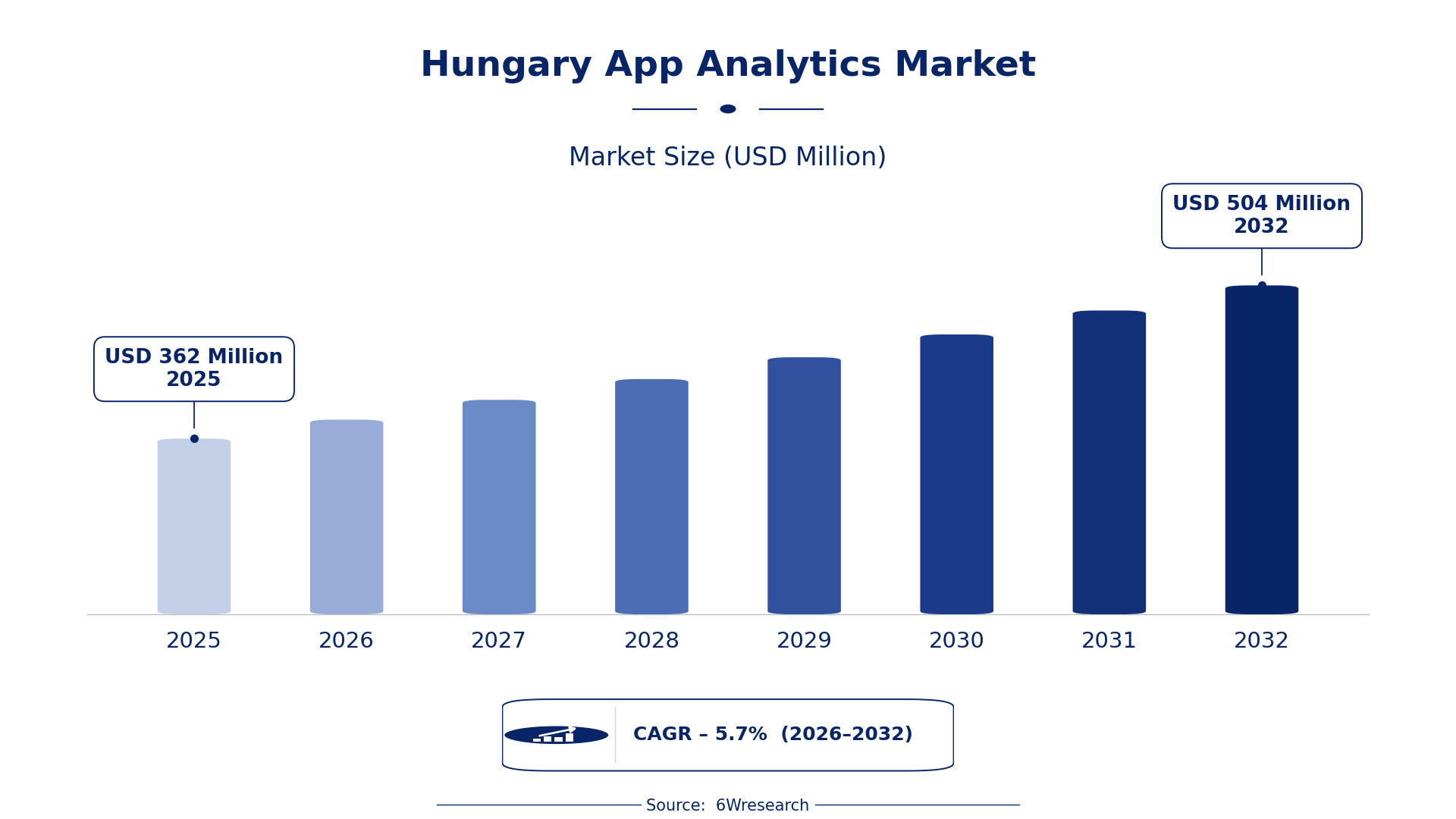
The Hungary App Analytics Market was estimated at USD 362 Million in 2025 and is projected to reach USD 504 Million by 2032, growing at a CAGR of 5.7% from 2026 to 2032.
Hungary App Analytics Market Synopsis
The demand for app analytics tools in Hungary is soaring, driven by the rapid proliferation of mobile applications across various sectors. Organizations are increasingly prioritizing data-driven insights to enhance user engagement and app performance.
The growing competition in the app market compels businesses to adopt sophisticated analytics solutions. As a result, there is a significant push towards understanding user behavior and optimizing applications to meet consumer expectations.
Hungary App Analytics Market Year-wise Growth Rate and Key Drivers
This graph illustrates the annual growth rates of the Hungary App Analytics Market from 2021 to 2032, highlighting a steady upward trajectory and projected expansion over the forecast period.
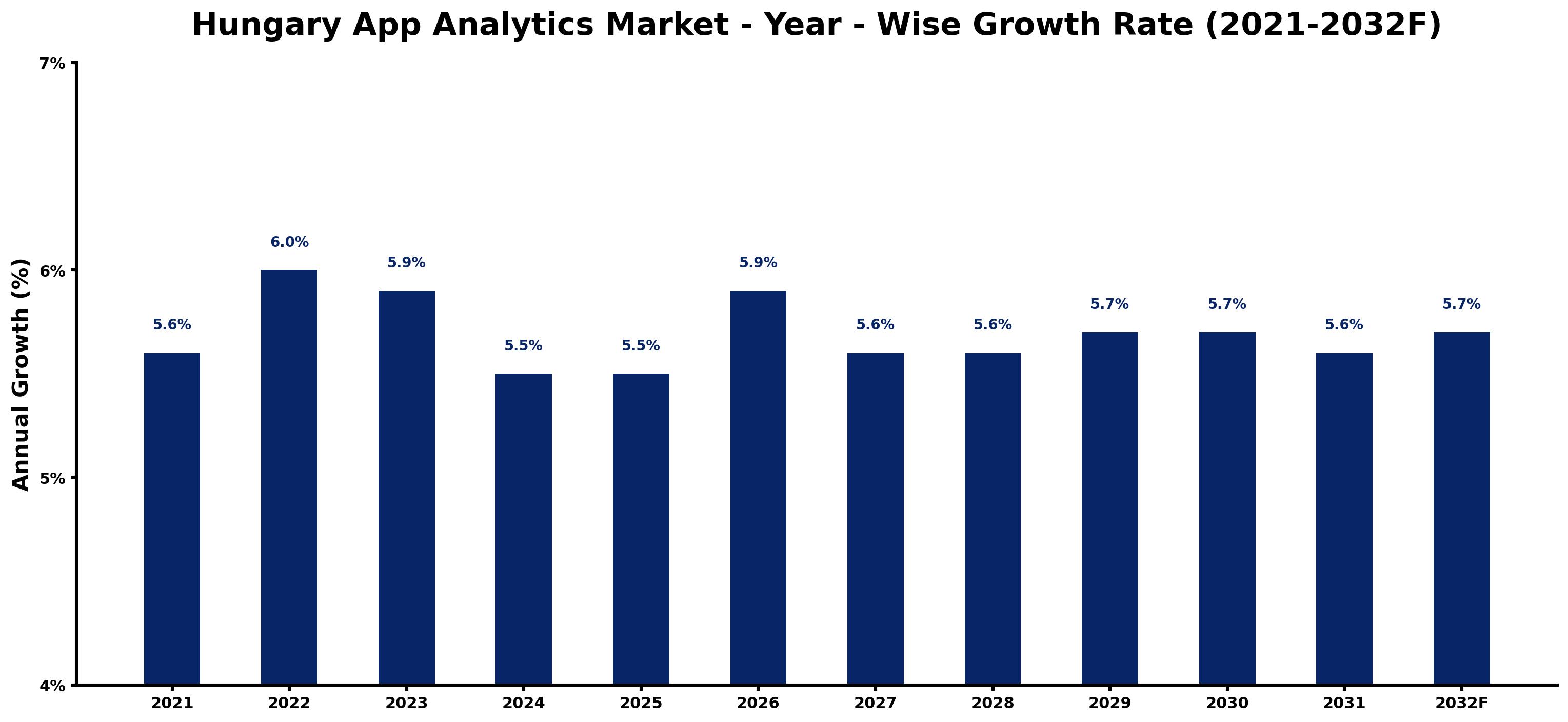
The table below presents the year‑wise growth rates along with the key drivers influencing the market
| Year | Growth Rate | Major Drivers |
| 2021 | 5.6% | Rise in mobile app usage among Hungarian youth. |
| 2022 | 6.0% | Increase in local app startups seeking analytics solutions. |
| 2023 | 5.9% | Hungarian government promoting digital services adoption initiatives. |
| 2024 | 5.5% | Growing need for KYC compliance in financial applications. |
| 2025 | 5.5% | Increased e-commerce activities boosting app performance tracking. |
| 2026 | 5.9% | Adoption of AI-driven analytics in local app development. |
| 2027 | 5.6% | Hungary’s regulatory support for data-driven mobile strategies. |
| 2028 | 5.6% | Surge in remote work apps requiring user analysis tools. |
| 2029 | 5.7% | Focus on user experience in Hungarian mobile gaming sector. |
| 2030 | 5.7% | Emergence of augmented reality apps demanding detailed insights. |
| 2031 | 5.6% | Growing importance of data privacy laws influencing analytics demand. |
| 2032 | 5.7% | Local businesses seeking to enhance app engagement strategies. |
Note: Market size estimations and growth projections presented in this report are based on 6Wresearch's proprietary forecasting methodology, utilizing the latest available industry data, government publications, and primary research inputs.
Hungary App Analytics Market Key Takeaways
Below are some of the specific key takeaways from the market, including:
- The increasing adoption of mobile applications is a primary driver of market growth.
- Real-time analytics and advanced user behavior tracking are becoming essential tools for businesses.
- Data privacy regulations, particularly GDPR, are shaping how companies approach app analytics.
- There is a notable gap in awareness and understanding of app analytics among smaller enterprises.
- Opportunities exist for innovative analytics solutions that align with evolving consumer needs.
Evaluation of Restraints in Hungary App Analytics Market
The Hungary App Analytics Market faces several restraints that could limit its growth potential. A significant challenge is the limited awareness of the value of app analytics, especially among smaller businesses. Many companies struggle to recognize how these tools can enhance user experience and boost retention rates.
Additionally, there is a shortage of skilled professionals who can effectively implement and utilize app analytics tools. This skills gap hampers the ability of businesses to derive actionable insights from their data. Compliance with stringent data privacy regulations also adds complexity to the collection and analysis of app data.
Hungary App Analytics Market Trends
Several trends are shaping the Hungary App Analytics Market. The demand for real-time data analytics is rising, allowing businesses to make swift decisions based on user behavior. Companies are also focusing on advanced tracking methods to gain deeper insights into user engagement.
Personalized marketing strategies are gaining traction, as businesses seek to tailor their offerings to meet the specific needs of their user base. on top of that, with increasing emphasis on data privacy, there is a growing trend toward implementing analytics solutions that comply with regulations while protecting user information.
Hungary App Analytics Market Opportunities
The market is ripe with opportunities for growth and investment. There is a clear demand for innovative analytics tools that provide actionable insights for app developers and marketers. Companies that can offer solutions tailored to specific industries will find significant opportunities for expansion.
on top of that, as businesses increasingly focus on data-driven strategies, there is a chance for firms to develop solutions that not only enhance app performance but also improve user experience. The intersection of data analytics and mobile app monetization presents another avenue for growth.
Government Initiatives in the Hungary App Analytics Market
Government policies in Hungary are actively influencing the App Analytics Market, primarily through data protection regulations. The introduction of GDPR has set a framework that mandates responsible data handling, requiring companies to be transparent in their data collection practices. This regulatory environment is crucial for building consumer trust in the analytics market.
- A regulatory framework introduced in 2018 mandates data protection compliance, ensuring that personal data collected through app analytics is handled securely.
- A national initiative launched in early 2023 aims to enhance data literacy among businesses, focusing on the importance of app analytics for optimizing user engagement.
- Currently, there is an ongoing effort to develop a public-private partnership aimed at improving the technological infrastructure necessary for advanced app analytics capabilities.
- A planned campaign is set to launch in 2026, promoting the adoption of anonymized data practices to bolster user privacy while still gaining valuable insights.
Future Insights of the Hungary App Analytics Market
Looking ahead to 2026-2032, the Hungary App Analytics Market is expected to experience robust growth. As mobile app usage continues to rise, businesses will increasingly recognize the need for sophisticated analytics tools to understand user behavior and optimize app performance. The proliferation of smartphones and the expanding app economy will further fuel this growth.
Companies that can innovate and provide tailored analytics solutions will likely emerge as leaders in this sector. The future will also see a heightened focus on data privacy, influencing how companies develop and market their analytics tools.
Hungary App Analytics Market Latest Developments
Recent activity in the Hungary App Analytics Market indicates a vibrant industry moving towards more advanced analytics solutions. Over the past year, there has been a noticeable increase in collaborations aimed at enhancing data analytics capabilities. Companies are investing in technologies that can provide deeper insights into user behavior, which is critical in the current competitive environment.
- A major technology vendor announced a new analytics solution in Q1 2023 designed to provide real-time insights into user engagement metrics.
- An initiative that began in mid-2023 is currently underway, focusing on training programs to bridge the skills gap in app analytics among local businesses.
- A leading regional operator recently launched a pilot project aimed at integrating advanced analytics into mobile app monetization strategies, which is expected to wrap up by late 2024.
- Plans are in place for a national conference on data analytics scheduled for early 2025, bringing together key stakeholders to discuss trends and innovations in the app analytics space.
Hungary App Analytics Market - Key Attractiveness of the Report
- 10 Years of Market Numbers
- Historical Data Starting from 2022 to 2025
- Base Year: 2025
- Forecast Data until 2032
- Key Performance Indicators Impacting the Market
- Major Upcoming Developments and Projects
Key Highlights of the Report:
- Hungary App Analytics Market Outlook
- Market Size of Hungary App Analytics Market, 2025
- Forecast of Hungary App Analytics Market, 2032
- Historical Data and Forecast of Hungary App Analytics Revenues & Volume for the Period 2022-2032F
- Hungary App Analytics Market Trend Evolution
- Hungary App Analytics Market Drivers and Challenges
- Hungary App Analytics Price Trends
- Hungary App Analytics Porter's Five Forces
- Hungary App Analytics Industry Life Cycle
- Historical Data and Forecast of Hungary App Analytics Market Revenues & Volume By Component for the Period 2022-2032F
- Historical Data and Forecast of Hungary App Analytics Market Revenues & Volume By Software for the Period 2022-2032F
- Historical Data and Forecast of Hungary App Analytics Market Revenues & Volume By Services for the Period 2022-2032F
- Historical Data and Forecast of Hungary App Analytics Market Revenues & Volume By Application for the Period 2022-2032F
- Historical Data and Forecast of Hungary App Analytics Market Revenues & Volume By Revenue analytics for the Period 2022-2032F
- Historical Data and Forecast of Hungary App Analytics Market Revenues & Volume By App performance analytics and operations for the Period 2022-2032F
- Historical Data and Forecast of Hungary App Analytics Market Revenues & Volume By User analytics for the Period 2022-2032F
- Historical Data and Forecast of Hungary App Analytics Market Revenues & Volume By Ad monitoring and marketing analytics for the Period 2022-2032F
- Historical Data and Forecast of Hungary App Analytics Market Revenues & Volume By Type for the Period 2022-2032F
- Historical Data and Forecast of Hungary App Analytics Market Revenues & Volume By Mobile app analytics for the Period 2022-2032F
- Historical Data and Forecast of Hungary App Analytics Market Revenues & Volume By Web app analytics for the Period 2022-2032F
- Historical Data and Forecast of Hungary App Analytics Market Revenues & Volume By Vertical for the Period 2022-2032F
- Historical Data and Forecast of Hungary App Analytics Market Revenues & Volume By Banking, Financial Services, and Insurance (BFSI) for the Period 2022-2032F
- Historical Data and Forecast of Hungary App Analytics Market Revenues & Volume By Retail for the Period 2022-2032F
- Historical Data and Forecast of Hungary App Analytics Market Revenues & Volume By Media and entertainment for the Period 2022-2032F
- Historical Data and Forecast of Hungary App Analytics Market Revenues & Volume By Logistics, travel, and transportation for the Period 2022-2032F
- Historical Data and Forecast of Hungary App Analytics Market Revenues & Volume By Telecom and IT for the Period 2022-2032F
- Historical Data and Forecast of Hungary App Analytics Market Revenues & Volume By Others for the Period 2022-2032F
- Hungary App Analytics Import Export Trade Statistics
- Market Opportunity Assessment By Component
- Market Opportunity Assessment By Application
- Market Opportunity Assessment By Type
- Market Opportunity Assessment By Vertical
- Hungary App Analytics Top Companies Market Share
- Hungary App Analytics Competitive Benchmarking By Technical and Operational Parameters
- Hungary App Analytics Company Profiles
- Hungary App Analytics Key Strategic Recommendations






































