Hungary Auto Catalyst Market Size (2020-2030)
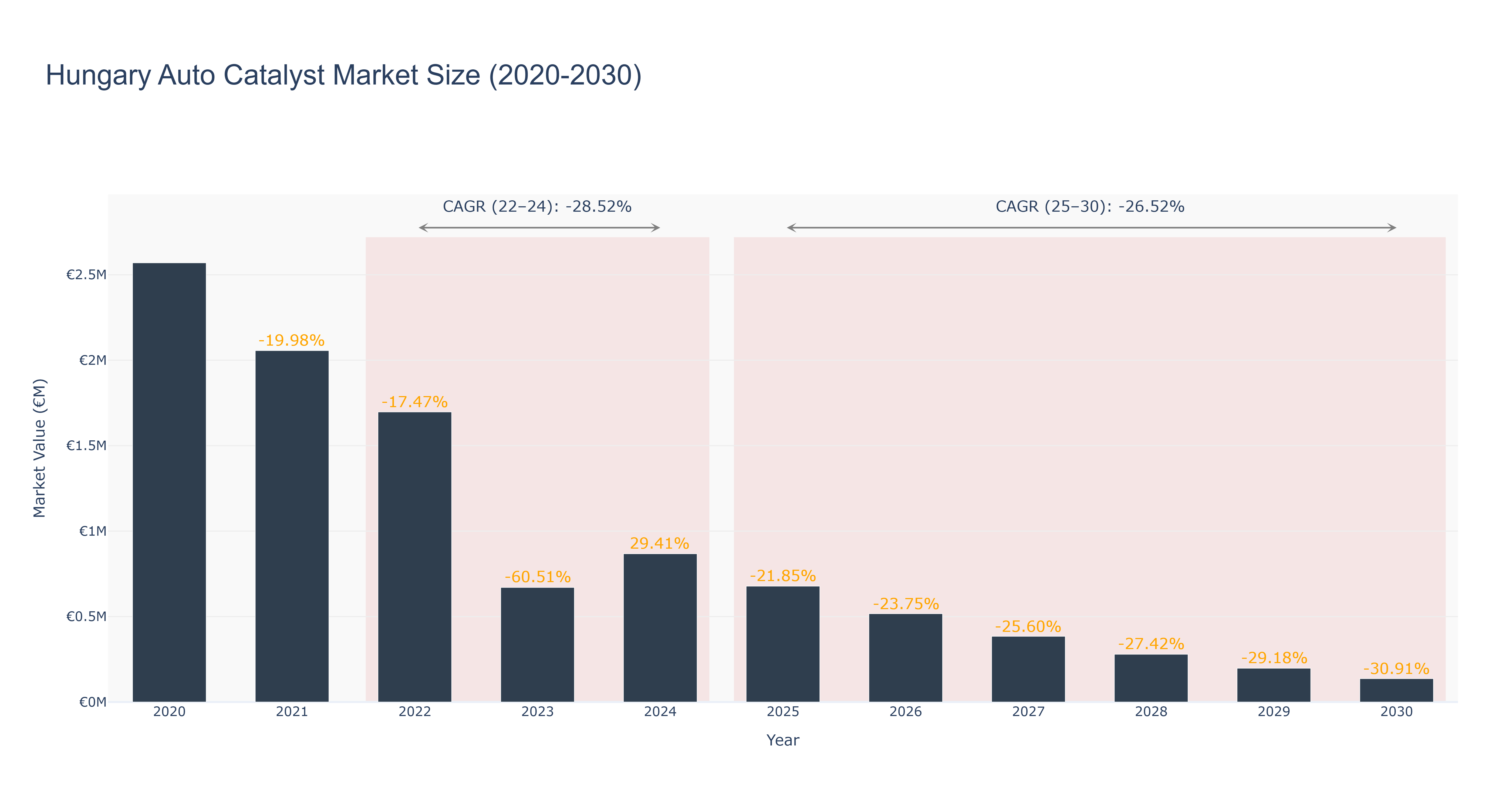
Hungary Auto Catalyst Market has experienced a significant decline in market size from €2.57 million in 2020 to €0.14 million in 2030, with a peak in 2020. The actual market size decreased consistently from 2020 to 2030, with a notable 29.41% increase in 2024. The market is forecasted to continue shrinking with a CAGR of -26.52% from 2025 to 2030. The decline in market size can be attributed to various factors such as changes in regulations, technological advancements reducing the demand for auto catalysts, and shifts in consumer preferences towards electric vehicles. To counter this trend, Hungary is investing in research and development projects to enhance the efficiency and effectiveness of auto catalysts, aiming to revitalize the market in the near future. Industry drivers for the Hungary Auto Catalyst Market include stringent emission regulations, growing environmental awareness, and the automotive industry's focus on sustainability. These factors are expected to drive the demand for advanced auto catalyst technologies in the coming years.
Hungary Auto Catalyst Market: Production & Trade Performance (2019-2025)
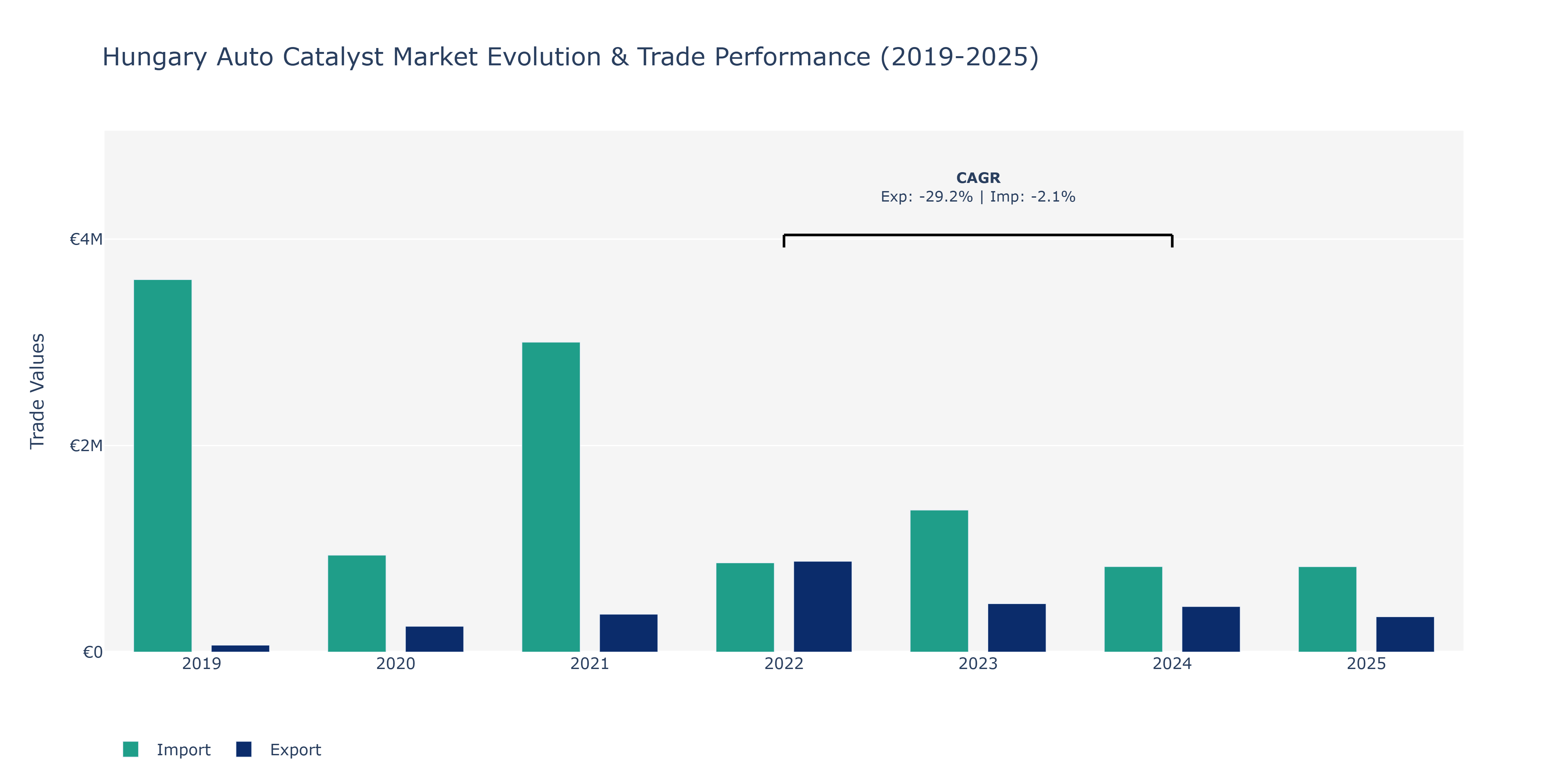
In the Hungary Auto Catalyst Market, exports experienced a notable fluctuation over the years. Starting at €66.82 thousand in 2019, exports surged to €878.69 thousand in 2022, marking a significant peak. However, the trend reversed in the following years, with a decline to €468.53 thousand in 2023 and €440.61 thousand in 2024. This trend may be attributed to shifts in global demand for auto catalysts, influenced by regulatory changes and technological advancements affecting the automotive industry. On the imports front, there was a steady increase from €3.61 million in 2019 to €3.0 million in 2021, before experiencing a slight decline to €2.78 million in 2024. The decrease in imports could be linked to local production capacity enhancements or changes in supply chain strategies within the sector. Such fluctuations underline the market's sensitivity to external factors and the need for strategic planning in response to dynamic market conditions.
Key Highlights of the Report:
- Hungary Auto catalyst Market Outlook
- Market Size of Hungary Auto catalyst Market, 2025
- Forecast of Hungary Auto catalyst Market, 2032
- Historical Data and Forecast of Hungary Auto catalyst Revenues & Volume for the Period 2022-2032F
- Hungary Auto catalyst Market Trend Evolution
- Hungary Auto catalyst Market Drivers and Challenges
- Hungary Auto catalyst Price Trends
- Hungary Auto catalyst Porter's Five Forces
- Hungary Auto catalyst Industry Life Cycle
- Historical Data and Forecast of Hungary Auto catalyst Market Revenues & Volume By Application for the Period 2022-2032F
- Historical Data and Forecast of Hungary Auto catalyst Market Revenues & Volume By LDV-Diesel for the Period 2022-2032F
- Historical Data and Forecast of Hungary Auto catalyst Market Revenues & Volume By LDV-Gasoline for the Period 2022-2032F
- Historical Data and Forecast of Hungary Auto catalyst Market Revenues & Volume By HDV for the Period 2022-2032F
- Hungary Auto catalyst Import Export Trade Statistics
- Market Opportunity Assessment By Application
- Hungary Auto catalyst Top Companies Market Share
- Hungary Auto catalyst Competitive Benchmarking By Technical and Operational Parameters
- Hungary Auto catalyst Company Profiles
- Hungary Auto catalyst Key Strategic Recommendations






































