Hungary Automotive Brake Pads Market Size Growth Rate
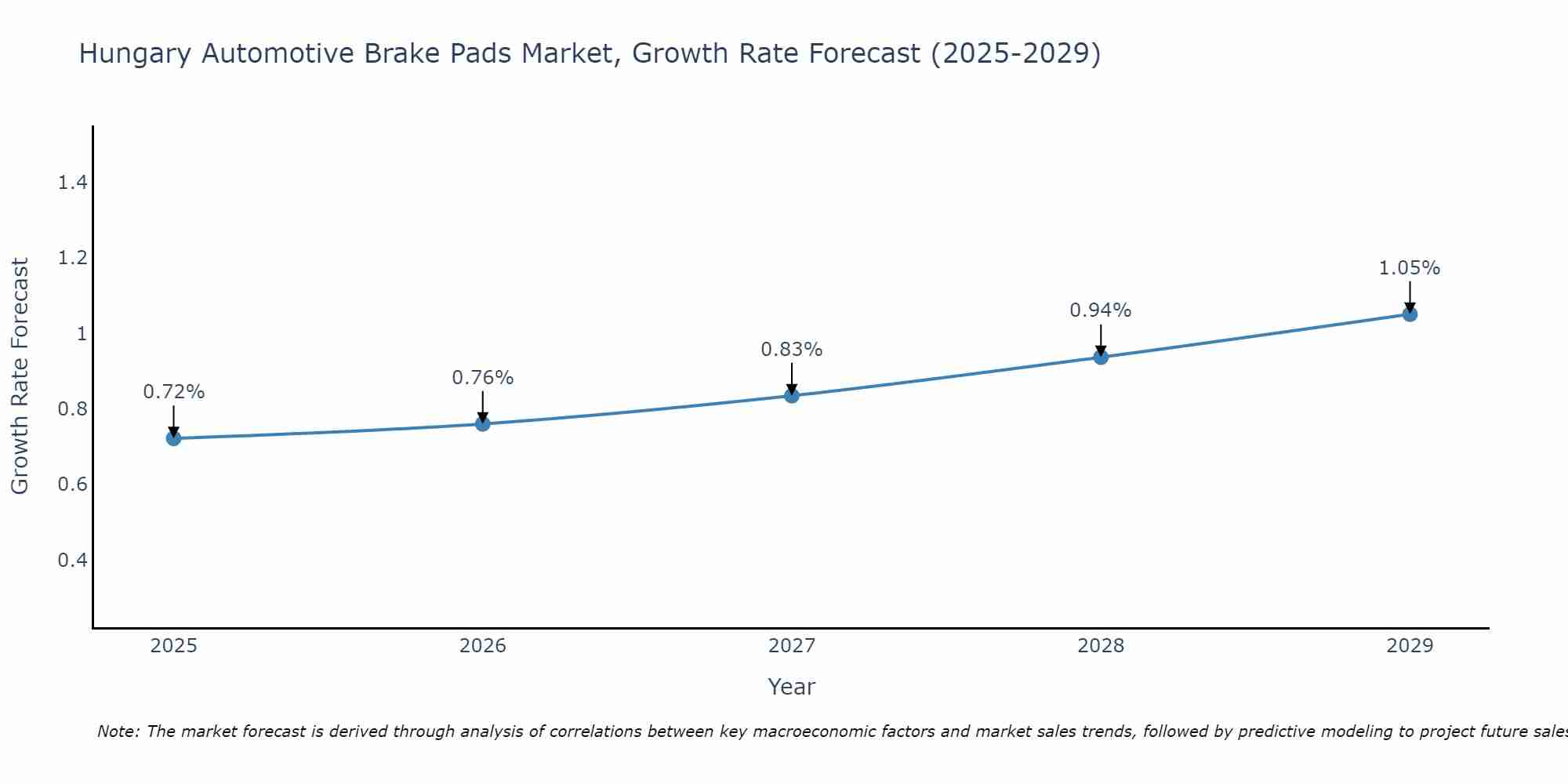
The Hungary Automotive Brake Pads Market is likely to experience consistent growth rate gains over the period 2025 to 2029. Commencing at 0.72% in 2025, growth builds up to 1.05% by 2029.
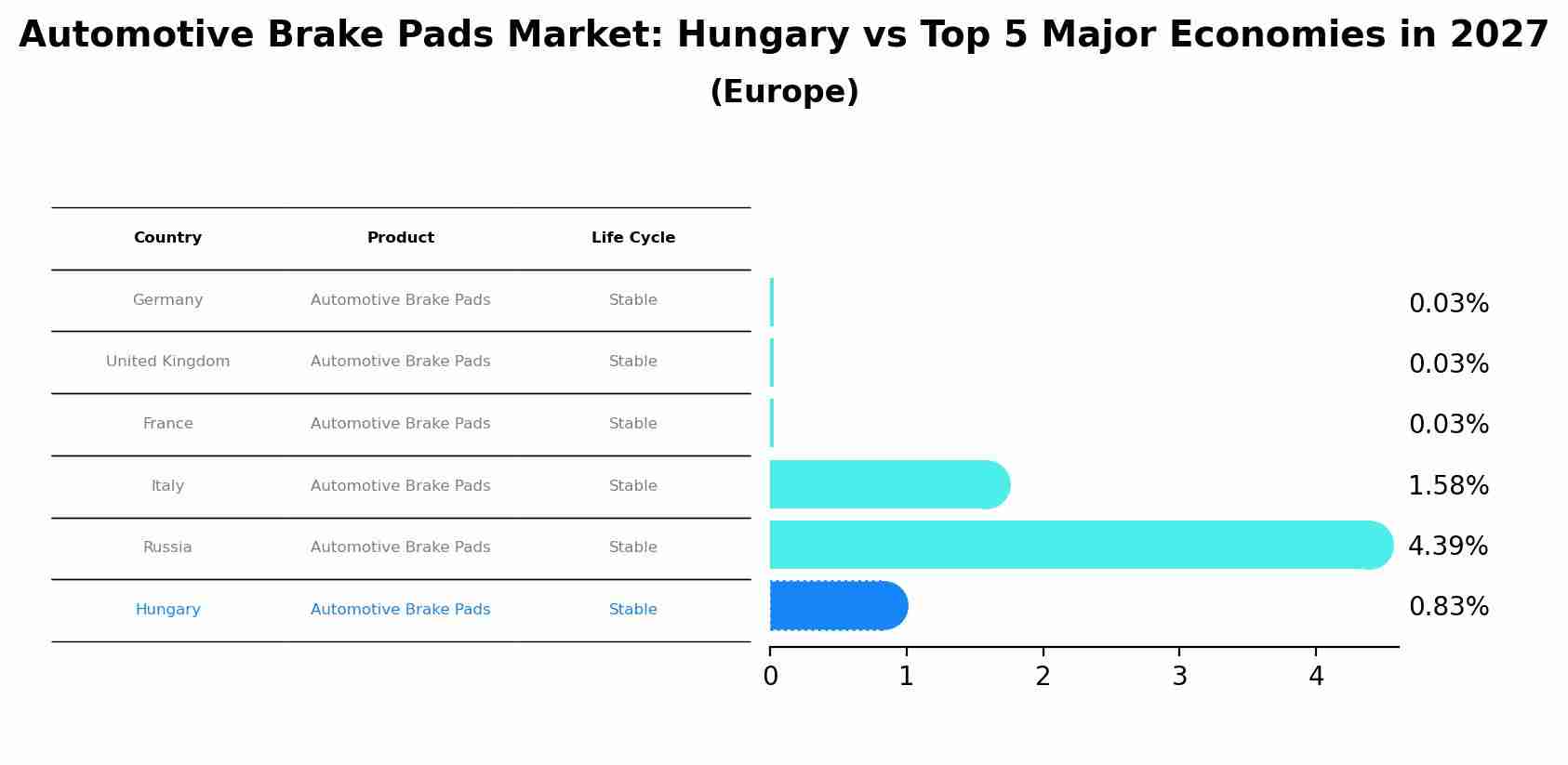
Automotive Brake Pads Market: Hungary vs Top 5 Major Economies in 2027 (Europe)
In the Europe region, the Automotive Brake Pads market in Hungary is projected to expand at a stable growth rate of 0.83% by 2027. The largest economy is Germany, followed by United Kingdom, France, Italy and Russia.
Hungary Automotive Brake Pads Market Overview
The Hungary Automotive Brake Pads Market is experiencing steady growth driven by the increasing demand for passenger and commercial vehicles. The market is characterized by the presence of both domestic and international manufacturers offering a wide range of brake pad products to meet the diverse needs of consumers. Factors such as stringent safety regulations, technological advancements in brake pad materials, and the rising focus on vehicle maintenance are key drivers shaping the market landscape. Additionally, the growing awareness among consumers regarding the importance of high-quality brake pads in ensuring vehicle safety is further fueling market growth. Market players are focusing on product innovations, strategic collaborations, and expanding their distribution networks to gain a competitive edge in this evolving market segment.
Hungary Automotive Brake Pads Market Trends
The Hungary Automotive Brake Pads Market is witnessing a shift towards eco-friendly and longer-lasting brake pad materials such as ceramic and semi-metallic compounds. This trend is driven by increasing environmental concerns and the demand for improved performance and durability. Additionally, there is a growing focus on innovation and technology advancements in brake pad manufacturing to enhance safety features and reduce noise levels during braking. The market is also experiencing a rise in demand for premium brake pads that offer superior performance and reliability, especially in the luxury vehicle segment. Overall, the Hungary Automotive Brake Pads Market is expected to continue evolving with a strong emphasis on sustainability, performance, and technological advancements.
Hungary Automotive Brake Pads Market Challenges
In the Hungary Automotive Brake Pads Market, one of the key challenges faced is the increasing competition from low-cost imported brake pads, particularly from countries with lower production costs. This can result in pricing pressure for local manufacturers and distributors, impacting their profit margins. Additionally, the market is experiencing a shift towards electric vehicles which require different types of brake pads, necessitating investment in research and development to meet changing consumer preferences. Furthermore, ensuring compliance with stringent regulations and standards regarding brake pad safety and environmental impact poses a challenge for market players. Overall, navigating these competitive pressures, adapting to technological advancements, and meeting regulatory requirements are critical challenges for stakeholders in the Hungary Automotive Brake Pads Market.
Hungary Automotive Brake Pads Market Investment Opportunities
The Hungary Automotive Brake Pads Market presents several investment opportunities for both domestic and international investors. With a growing automotive industry and increasing consumer demand for high-quality brake pads, there is a need for innovative and environmentally friendly products in the market. Investing in research and development to create superior brake pad solutions, such as ceramic or composite materials, could give companies a competitive edge. Additionally, partnerships with local automotive manufacturers and distributors can help expand market reach and increase sales. As the automotive industry in Hungary continues to evolve, investing in the production, distribution, and marketing of brake pads could be a lucrative opportunity for investors looking to capitalize on the country`s growing market.
Hungary Automotive Brake Pads Market Government Policy
The Hungarian government has implemented various policies related to the Automotive Brake Pads Market to ensure consumer safety and environmental protection. These policies include regulations on the quality standards of brake pads to meet safety requirements and reduce air pollution from brake dust. Additionally, there are regulations in place to promote the use of eco-friendly materials in brake pad production to minimize environmental impact. The government also emphasizes the importance of regular maintenance and inspections of brake systems to ensure optimal performance and safety on the roads. Overall, these policies aim to enhance road safety, protect the environment, and promote sustainable practices in the Hungarian Automotive Brake Pads Market.
Hungary Automotive Brake Pads Market Future Outlook
The Hungary Automotive Brake Pads Market is expected to show steady growth in the coming years, driven by factors such as increasing vehicle sales, rising demand for aftermarket brake pads, and a growing focus on vehicle safety. With advancements in technology leading to the development of high-performance brake pads that offer improved durability and efficiency, consumers are likely to opt for premium products. Additionally, the implementation of stringent regulations regarding vehicle safety standards is anticipated to further boost the demand for high-quality brake pads in Hungary. Market players are expected to focus on product innovation and strategic partnerships to capitalize on the growing opportunities in the automotive brake pads market in Hungary.
Key Highlights of the Report:
- Hungary Automotive Brake Pads Market Outlook
- Market Size of Hungary Automotive Brake Pads Market, 2021
- Forecast of Hungary Automotive Brake Pads Market, 2031
- Historical Data and Forecast of Hungary Automotive Brake Pads Revenues & Volume for the Period 2018 - 2031
- Hungary Automotive Brake Pads Market Trend Evolution
- Hungary Automotive Brake Pads Market Drivers and Challenges
- Hungary Automotive Brake Pads Price Trends
- Hungary Automotive Brake Pads Porter's Five Forces
- Hungary Automotive Brake Pads Industry Life Cycle
- Historical Data and Forecast of Hungary Automotive Brake Pads Market Revenues & Volume By Vehicle for the Period 2018 - 2031
- Historical Data and Forecast of Hungary Automotive Brake Pads Market Revenues & Volume By Passenger Car for the Period 2018 - 2031
- Historical Data and Forecast of Hungary Automotive Brake Pads Market Revenues & Volume By LCV for the Period 2018 - 2031
- Historical Data and Forecast of Hungary Automotive Brake Pads Market Revenues & Volume By HCV for the Period 2018 - 2031
- Historical Data and Forecast of Hungary Automotive Brake Pads Market Revenues & Volume By Two-wheelers for the Period 2018 - 2031
- Historical Data and Forecast of Hungary Automotive Brake Pads Market Revenues & Volume By Material for the Period 2018 - 2031
- Historical Data and Forecast of Hungary Automotive Brake Pads Market Revenues & Volume By Semi-metallic for the Period 2018 - 2031
- Historical Data and Forecast of Hungary Automotive Brake Pads Market Revenues & Volume By Non-asbestos Organic (NAO) for the Period 2018 - 2031
- Historical Data and Forecast of Hungary Automotive Brake Pads Market Revenues & Volume By Low-metallic NAO for the Period 2018 - 2031
- Historical Data and Forecast of Hungary Automotive Brake Pads Market Revenues & Volume By Ceramic for the Period 2018 - 2031
- Historical Data and Forecast of Hungary Automotive Brake Pads Market Revenues & Volume By Sales Outlet for the Period 2018 - 2031
- Historical Data and Forecast of Hungary Automotive Brake Pads Market Revenues & Volume By OEM for the Period 2018 - 2031
- Historical Data and Forecast of Hungary Automotive Brake Pads Market Revenues & Volume By Aftermarket for the Period 2018 - 2031
- Historical Data and Forecast of Hungary Automotive Brake Pads Market Revenues & Volume By Position for the Period 2018 - 2031
- Historical Data and Forecast of Hungary Automotive Brake Pads Market Revenues & Volume By Front for the Period 2018 - 2031
- Historical Data and Forecast of Hungary Automotive Brake Pads Market Revenues & Volume By Front & Rear for the Period 2018 - 2031
- Hungary Automotive Brake Pads Import Export Trade Statistics
- Market Opportunity Assessment By Vehicle
- Market Opportunity Assessment By Material
- Market Opportunity Assessment By Sales Outlet
- Market Opportunity Assessment By Position
- Hungary Automotive Brake Pads Top Companies Market Share
- Hungary Automotive Brake Pads Competitive Benchmarking By Technical and Operational Parameters
- Hungary Automotive Brake Pads Company Profiles
- Hungary Automotive Brake Pads Key Strategic Recommendations






































