Hungary Ballast Water Treatment Market Size, Share & Growth Rate
The Hungary Ballast Water Treatment Market was estimated at USD 335 Million in 2025 and is projected to reach USD 465 Million by 2032, growing at a CAGR of 4.8% from 2026 to 2032. This growth trajectory is primarily fueled by the stringent enforcement of international regulations aimed at mitigating the risks posed by invasive aquatic species. In Hungary, the maritime industry is increasingly adopting advanced treatment technologies to comply with these regulations, leading to significant investments in ballast water management systems.
Hungary Ballast Water Treatment Market Year-wise Growth Rate and Key Drivers
This graph highlights how the Hungary Ballast Water Treatment Market has steadily grown over the years, supported by major growth factors.
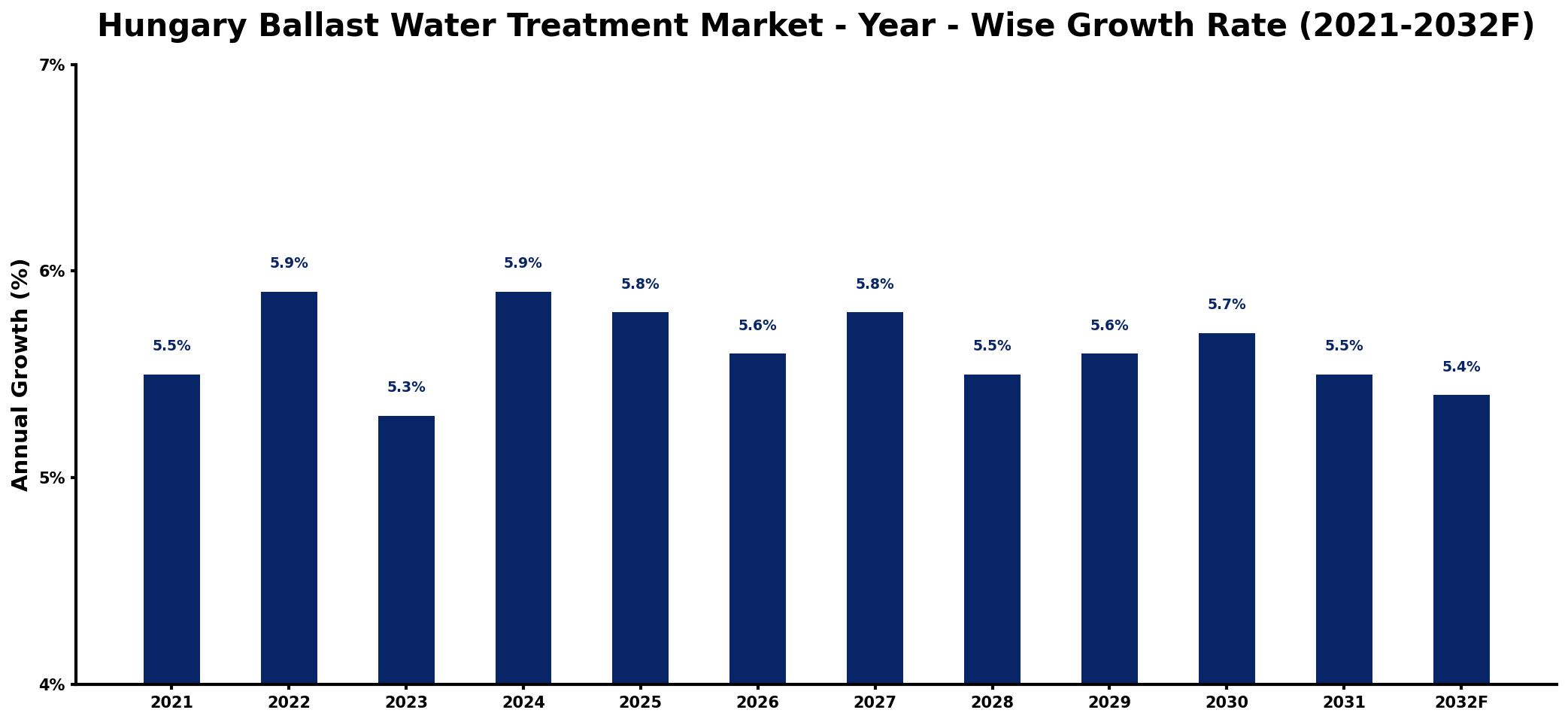
The table below presents the year‑wise growth rates along with the key drivers influencing the market
| Year | Growth Rate | Major Drivers |
| 2021 | 5.5% | Increased environmental regulation compliance |
| 2022 | 5.9% | Rising demand for sustainable solutions |
| 2023 | 5.3% | Expansion of shipping industry investments |
| 2024 | 5.9% | Growing focus on maritime sustainability |
| 2025 | 5.8% | Emerging technologies in marine sectors |
| 2026 | 5.6% | Strengthening international trade agreements |
| 2027 | 5.8% | Development of innovative compliance solutions |
| 2028 | 5.5% | Heightened awareness of ecological impacts |
| 2029 | 5.6% | Investment in marine infrastructure projects |
| 2030 | 5.7% | Collaboration among shipping stakeholders |
| 2031 | 5.5% | Enhanced government support initiatives |
| 2032 | 5.4% | Rising consumer demand for eco-friendliness |
Note: Market size estimations and growth projections presented in this report are based on 6Wresearch's proprietary forecasting methodology, utilizing the latest available industry data, government publications, and primary research inputs.
Hungary Ballast Water Treatment Market Synopsis
The most compelling force currently shaping the Hungary Ballast Water Treatment Market is the robust implementation of the International Maritime Organization's Ballast Water Management Convention. As vessels operating in Hungarian waters are mandated to adhere to these international standards, there is a notable rise in the demand for effective and reliable treatment systems.
Moreover, heightened environmental awareness among ship operators and stakeholders is amplifying the focus on ecosystem preservation. This trend is not only driving compliance but is also fostering the development of innovative, cost-effective treatment solutions that cater to local industry needs.
Hungary Ballast Water Treatment Market Key Takeaways
- The market is experiencing growth driven by compliance with international regulations.
- Technological advancements are enhancing the efficiency and cost-effectiveness of treatment systems.
- Growing public awareness about the environmental impact of untreated ballast water is a significant market driver.
- The Hungarian government is actively supporting initiatives to improve ballast water management practices.
- Investment opportunities are emerging in innovative treatment technologies tailored for local maritime operations.
Evaluation of Restraints in Hungary Ballast Water Treatment Market
Despite the positive growth trajectory, the Hungary Ballast Water Treatment Market faces significant restraints. Compliance with rigorous regulations poses a substantial challenge, particularly for smaller maritime operators who may struggle to finance the necessary investment in advanced treatment technologies. These financial constraints can lead to delays in adopting compliant systems, which in turn hampers market growth. Moreover, the need for continuous technological upgrades to meet evolving regulatory standards creates an ongoing burden for industry participants, further complicating market dynamics.
Hungary Ballast Water Treatment Market Trends
Current trends in the Hungary Ballast Water Treatment Market highlight a shift toward integrating more automated and digital solutions into treatment systems. The advent of IoT and data analytics is paving the way for smart management solutions, enabling real-time monitoring of ballast water quality and treatment efficacy. Additionally, partnerships between technology providers and shipping companies are becoming increasingly prevalent, fostering innovation and operational efficiencies.
Hungary Ballast Water Treatment Market Opportunities
The Hungary Ballast Water Treatment Market presents lucrative growth opportunities, particularly for companies specializing in innovative treatment technologies. As demand for compliant systems increases, there is a clear pathway for investment in R&D aimed at developing more effective and less costly treatment solutions. Furthermore, the growing emphasis on environmental sustainability is driving interest in alternative treatment methods, including natural and chemical-free systems, providing a competitive edge for forward-thinking companies.
Government Initiatives in the Hungary Ballast Water Treatment Market
The Hungarian government has taken significant strides in aligning national ballast water treatment regulations with international standards. This alignment ensures that ships entering Hungarian ports are equipped with certified treatment systems. Additionally, the government is fostering awareness campaigns aimed at educating ship operators and stakeholders about the importance of effective ballast water management. Such initiatives underline Hungary's commitment to preserving its marine ecosystems and complying with global environmental standards.
Future Insights of the Hungary Ballast Water Treatment Market
Looking ahead to 2026-2032, the Hungary Ballast Water Treatment Market is set to continue its upward trajectory as regulatory frameworks evolve and become more stringent. This period is likely to see a surge in technological innovations that address the growing need for efficient treatment solutions. As environmental consciousness intensifies among stakeholders, companies that embrace sustainable practices and invest in cutting-edge technology will find themselves well-positioned for success in this expanding market.
Hungary Ballast Water Treatment Market Latest Developments (2025 - 2026)
Recent developments in the Hungary Ballast Water Treatment Market reflect a dynamic landscape, with increased collaboration between the public and private sectors. There have been initiatives aimed at enhancing the availability of financing options for smaller shipping companies to adopt compliant treatment systems. Furthermore, advancements in treatment technology are being showcased at industry conferences, drawing attention to innovative solutions that could redefine ballast water management in the coming years.
Hungary Ballast Water Treatment Market - Key Attractiveness of the Report
- 10 Years of Market Numbers
- Historical Data Starting from 2022 to 2025
- Base Year: 2025
- Forecast Data until 2032
- Key Performance Indicators Impacting the Market
- Major Upcoming Developments and Projects
Key Highlights of the Report:
- Hungary Ballast Water Treatment Market Outlook
- Market Size of Hungary Ballast Water Treatment Market, 2025
- Forecast of Hungary Ballast Water Treatment Market, 2032
- Historical Data and Forecast of Hungary Ballast Water Treatment Revenues & Volume for the Period 2022-2032F
- Hungary Ballast Water Treatment Market Trend Evolution
- Hungary Ballast Water Treatment Market Drivers and Challenges
- Hungary Ballast Water Treatment Price Trends
- Hungary Ballast Water Treatment Porter's Five Forces
- Hungary Ballast Water Treatment Industry Life Cycle
- Historical Data and Forecast of Hungary Ballast Water Treatment Market Revenues & Volume By Technology for the Period 2022-2032F
- Historical Data and Forecast of Hungary Ballast Water Treatment Market Revenues & Volume By Physical Disinfection for the Period 2022-2032F
- Historical Data and Forecast of Hungary Ballast Water Treatment Market Revenues & Volume By Mechanical Method for the Period 2022-2032F
- Historical Data and Forecast of Hungary Ballast Water Treatment Market Revenues & Volume By Chemical Method for the Period 2022-2032F
- Historical Data and Forecast of Hungary Ballast Water Treatment Market Revenues & Volume By Service for the Period 2022-2032F
- Historical Data and Forecast of Hungary Ballast Water Treatment Market Revenues & Volume By Installation & Calibration for the Period 2022-2032F
- Historical Data and Forecast of Hungary Ballast Water Treatment Market Revenues & Volume By Performance Measurement for the Period 2022-2032F
- Historical Data and Forecast of Hungary Ballast Water Treatment Market Revenues & Volume By Recommissioning for the Period 2022-2032F
- Hungary Ballast Water Treatment Import Export Trade Statistics
- Market Opportunity Assessment By Technology
- Market Opportunity Assessment By Service
- Hungary Ballast Water Treatment Top Companies Market Share
- Hungary Ballast Water Treatment Competitive Benchmarking By Technical and Operational Parameters
- Hungary Ballast Water Treatment Company Profiles
- Hungary Ballast Water Treatment Key Strategic Recommendations






































