Hungary Bottle Filling Machine Market Size, Share & Growth Rate
The Hungary Bottle Filling Machine Market was estimated at USD 520 Million in 2025 and is projected to reach USD 740 Million by 2032, growing at a CAGR of 5.2% from 2026 to 2032. This robust growth trajectory can be attributed to the escalating demand for packaged beverages, driven by changing consumer preferences and rising disposable incomes. Additionally, a surge in foreign investments in Hungary's beverage sector is further propelling the need for sophisticated bottling machinery.
Hungary Bottle Filling Machine Market Growth Rate Analysis (2021-2032)
The Hungary bottle filling machine market has experienced a steady upward trend, highlighted by a growth rate of 5.8% in 2021, followed by a consistent increase to 6.0% in both 2022 and 2023. The surge in demand can largely be attributed to the country's robust industrial manufacturing sector, which is increasingly adopting advanced automation technologies to enhance operational efficiency. Additionally, the anticipated growth of consumer demand in the beverage sector has spurred investments in modern filling equipment. Looking ahead, the market is projected to maintain a strong expansion with growth rates reaching 6.4% by 2030, underscoring a stable environment bolstered by ongoing digitalization and infrastructure improvements within Hungary's manufacturing landscape.
Hungary Bottle Filling Machine Market Year-wise Growth Rate and Key Drivers
This graph highlights how the Hungary Bottle Filling Machine Market has steadily grown over the past five years, supported by major growth factors.
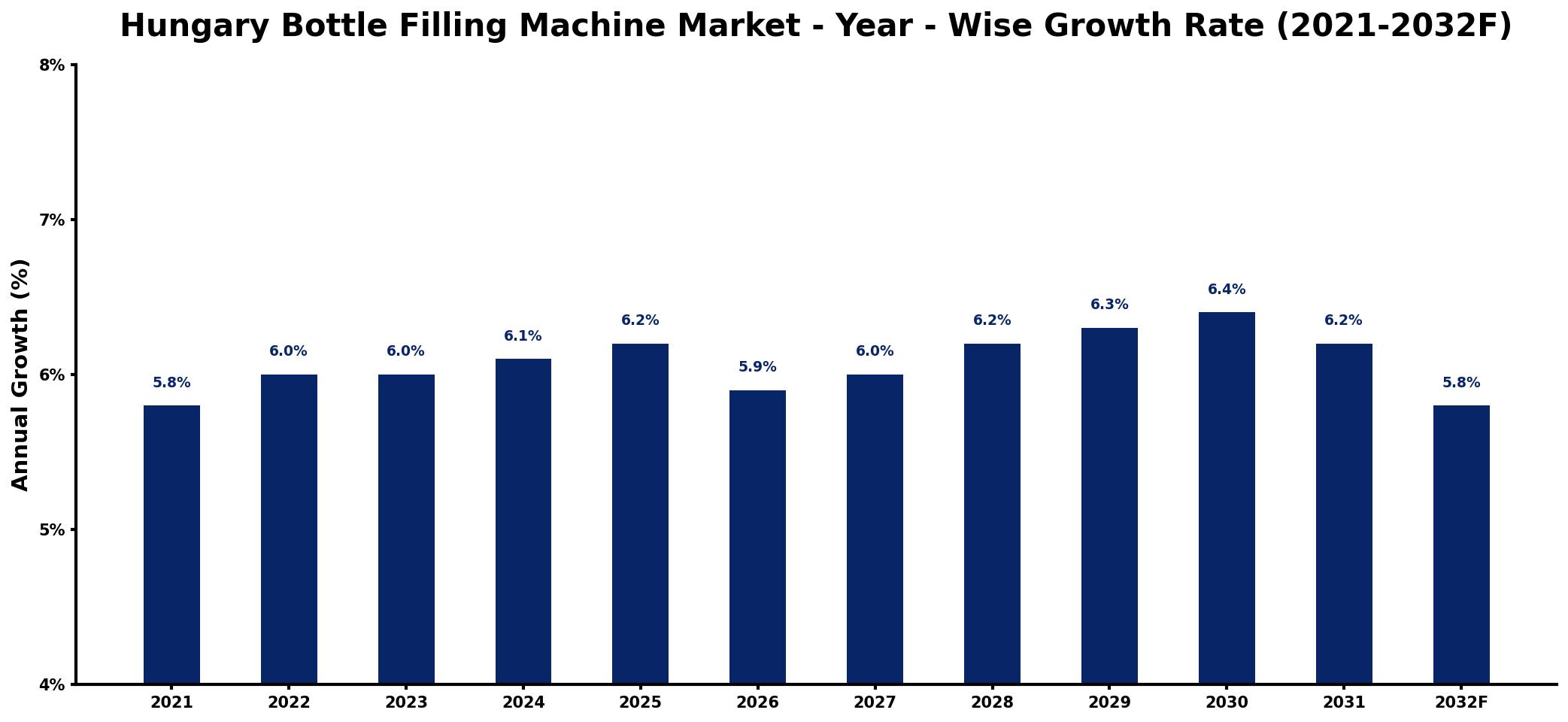
The table below presents the year‑wise growth rates along with the key drivers influencing the market
| Year | Growth Rate | Major Drivers |
| 2021 | 5.8% | Rising demand for sustainable packaging |
| 2022 | 6.0% | Increased investments in automation technology |
| 2023 | 6.0% | Growth in beverage production capacity |
| 2024 | 6.1% | rising end-use demand growth |
| 2025 | 6.2% | Surge in e-commerce distribution networks |
| 2026 | 5.9% | Demand for high-efficiency solutions |
| 2027 | 6.0% | Emergence of eco-friendly practices |
| 2028 | 6.2% | Innovations in production processes |
| 2029 | 6.3% | Strengthening local manufacturing capabilities |
| 2030 | 6.4% | Adoption of smart technology integration |
| 2031 | 6.2% | Focus on energy-efficient operations |
| 2032 | 5.8% | Investments in research and development |
Note: Market size estimations and growth projections presented in this report are based on 6Wresearch's proprietary forecasting methodology, utilizing the latest available industry data, government publications, and primary research inputs.
Hungary Bottle Filling Machine Market Synopsis
Currently, the Hungary bottle filling machine market is experiencing a transformation, bolstered by technological advancements and evolving consumer habits. As urban populations grow and lifestyles change, the demand for convenience-oriented packaging solutions has increased significantly.
Moreover, the country's strategic location within Central Europe makes it an attractive destination for international beverage brands looking to establish or expand production capabilities. This influx of investment is creating opportunities for innovative bottling solutions that cater to various segments of the market.
Hungary Bottle Filling Machine Market Key Takeaways
- The market is fueled by increased disposable incomes leading to higher demand for bottled beverages.
- Technological advancements in automation and IoT are reshaping production efficiency.
- Government initiatives are positively influencing investments in food and beverage processing.
- Consumer preferences are shifting towards convenience packaging, especially with PET bottles.
- High capital costs and skill shortages present operational challenges for industry players.
Evaluation of Restraints in Hungary Bottle Filling Machine Market
Despite the favorable growth environment, the Hungary bottle filling machine market faces specific restraints that could impede progress. High capital investments required for advanced bottling machinery can deter smaller companies from upgrading or expanding their production lines. Additionally, fluctuations in raw material prices affect overall production costs, making it challenging to maintain competitive pricing. Lastly, there is a notable shortage of skilled labor, which not only complicates operations but can also delay production schedules, further constraining market growth.
Hungary Bottle Filling Machine Market Trends
Several key trends are currently shaping the Hungary bottle filling machine market. Automation is becoming increasingly important as manufacturers seek to improve efficiency and reduce labor costs. Additionally, the integration of IoT technologies is enhancing machine connectivity and providing valuable data analytics capabilities, allowing for real-time adjustments and improved operational management. Furthermore, sustainability is gaining traction, with companies exploring eco-friendly materials and processes to align with consumer preferences and regulatory demands.
Hungary Bottle Filling Machine Market Opportunities
Opportunities abound in the Hungary bottle filling machine market, especially for manufacturers offering innovative solutions that cater to the evolving needs of consumers. The growing trend towards sustainable packaging presents a unique opportunity for companies to develop machines that utilize biodegradable or recyclable materials. Furthermore, as local beverage producers look to upscale their operations in response to rising demand, there is significant potential for tailored solutions that enhance production capabilities while adhering to quality standards.
Government Initiatives in the Hungary Bottle Filling Machine Market
The Hungarian government has taken proactive steps to bolster its food and beverage processing industries, thereby fostering a conducive environment for investment in technology. Initiatives aimed at enhancing production efficiencies and supporting local manufacturers are paving the way for growth in the bottle filling machine market. Furthermore, regulations encouraging quality and safety in food and beverages are prompting companies to adopt advanced machinery, which aligns with market growth goals.
Future Insights of the Hungary Bottle Filling Machine Market
Looking ahead to 2026-2032, the Hungary bottle filling machine market is poised for steady growth, driven by increasing consumer demand for convenience and quality. As technological innovations continue to evolve, manufacturers will need to adapt to remain competitive, focusing on automation and sustainability. Additionally, as Hungary strengthens its position as a hub for beverage production in Central Europe, ongoing investments in infrastructure and technology will play a crucial role in shaping the market landscape.
Hungary Bottle Filling Machine Market Latest Developments (2025 - 2026)
In recent months, the Hungary bottle filling machine market has seen increased activity, with several companies exploring collaborations to enhance production capabilities. There is a marked shift towards adopting more sustainable practices, with manufacturers seeking to integrate eco-friendly technologies. Furthermore, ongoing developments in IoT applications are making headlines, as businesses leverage data analytics for operational efficiency. Overall, the market is adapting to changing consumer needs and technological advancements.
Hungary Bottle Filling Machine Market - Key Attractiveness of the Report
- 10 Years of Market Numbers
- Historical Data Starting from 2022 to 2025
- Base Year: 2025
- Forecast Data until 2032
- Key Performance Indicators Impacting the Market
- Major Upcoming Developments and Projects
Key Highlights of the Report:
- Hungary Bottle Filling Machine Market Outlook
- Market Size of Hungary Bottle Filling Machine Market, 2025
- Forecast of Hungary Bottle Filling Machine Market, 2032
- Historical Data and Forecast of Hungary Bottle Filling Machine Revenues & Volume for the Period 2022-2032F
- Hungary Bottle Filling Machine Market Trend Evolution
- Hungary Bottle Filling Machine Market Drivers and Challenges
- Hungary Bottle Filling Machine Price Trends
- Hungary Bottle Filling Machine Porter's Five Forces
- Hungary Bottle Filling Machine Industry Life Cycle
- Historical Data and Forecast of Hungary Bottle Filling Machine Market Revenues & Volume By Bottle Type for the Period 2022-2032F
- Historical Data and Forecast of Hungary Bottle Filling Machine Market Revenues & Volume By PET Bottles for the Period 2022-2032F
- Historical Data and Forecast of Hungary Bottle Filling Machine Market Revenues & Volume By Glass Bottles for the Period 2022-2032F
- Historical Data and Forecast of Hungary Bottle Filling Machine Market Revenues & Volume By Others for the Period 2022-2032F
- Historical Data and Forecast of Hungary Bottle Filling Machine Market Revenues & Volume By Application for the Period 2022-2032F
- Historical Data and Forecast of Hungary Bottle Filling Machine Market Revenues & Volume By Food Products for the Period 2022-2032F
- Historical Data and Forecast of Hungary Bottle Filling Machine Market Revenues & Volume By Beverages for the Period 2022-2032F
- Historical Data and Forecast of Hungary Bottle Filling Machine Market Revenues & Volume By Chemicals & Pharmaceuticals for the Period 2022-2032F
- Historical Data and Forecast of Hungary Bottle Filling Machine Market Revenues & Volume By Cosmetics for the Period 2022-2032F
- Hungary Bottle Filling Machine Import Export Trade Statistics
- Market Opportunity Assessment By Bottle Type
- Market Opportunity Assessment By Application
- Hungary Bottle Filling Machine Top Companies Market Share
- Hungary Bottle Filling Machine Competitive Benchmarking By Technical and Operational Parameters
- Hungary Bottle Filling Machine Company Profiles
- Hungary Bottle Filling Machine Key Strategic Recommendations






































