Hungary Cargo Shipping Market Size, Share & Growth Rate
The Hungary Cargo Shipping Market was estimated at USD 751 Million in 2025 and is projected to reach USD 1099 Million by 2032, growing at a CAGR of 5.6% from 2026 to 2032. This growth trajectory is primarily driven by Hungary's strategic location at the heart of Central Europe, which facilitates cross-border trade. Additionally, the burgeoning e-commerce sector and ongoing infrastructure enhancements further bolster the demand for efficient cargo shipping solutions.
Hungary Cargo Shipping Market Year-wise Growth Rate and Key Drivers
This graph highlights how the Hungary Cargo Shipping Market has steadily grown over the years, supported by major growth factors.
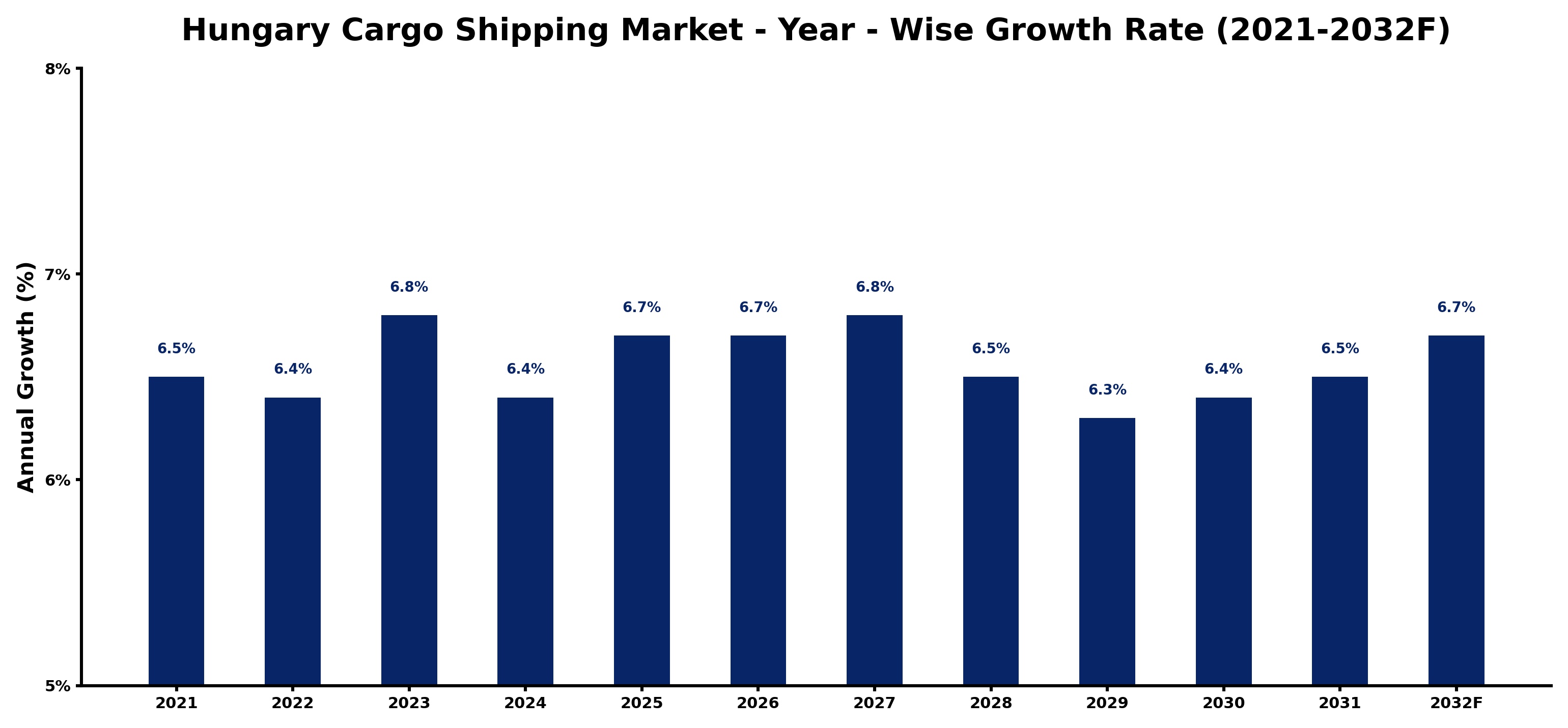
The table below presents the year‑wise growth rates along with the key drivers influencing the market
| Year | Growth Rate | Major Drivers |
| 2021 | 6.5% | Increasing industrial automation investments |
| 2022 | 6.4% | Increasing industrial infrastructure investments |
| 2023 | 6.8% | Increasing industrial infrastructure investments |
| 2024 | 6.4% | Increasing industrial infrastructure investments |
| 2025 | 6.7% | Increasing industrial infrastructure investments |
| 2026 | 6.7% | Increasing industrial infrastructure investments |
| 2027 | 6.8% | Expansion of commercial construction activities |
| 2028 | 6.5% | Increasing industrial automation investments |
| 2029 | 6.3% | Government infrastructure modernization initiatives |
| 2030 | 6.4% | Growing urbanization and commercial development |
| 2031 | 6.5% | Growing urbanization and commercial development |
| 2032 | 6.7% | Expansion of manufacturing activities |
Note - Market size estimations and growth projections presented in this report are based on 6Wresearch's advanced forecasting approach, validated with industry datasets as of June 2026.
Hungary Cargo Shipping Market Synopsis
A significant aspect of the Hungary Cargo Shipping Market is its reliance on multimodal transport solutions. The integration of road, rail, and inland waterways provides a flexible and efficient logistics framework essential for both import and export activities. Furthermore, the increasing demand for reliable delivery mechanisms across various sectors, particularly in light of rising e-commerce, has added urgency to the expansion of cargo services.
Infrastructure development is another pivotal element shaping the market. Modernization initiatives aimed at enhancing port facilities and terminal capacities are underway, ensuring Hungary can meet growing freight volumes. These improvements are not just about capacity; they also emphasize sustainability, which is becoming increasingly important in global shipping practices.
Hungary Cargo Shipping Market Key Takeaways
- Hungary's central geographic position in Europe enhances its attractiveness as a cargo shipping hub.
- The expanding e-commerce sector is creating significant demand for innovative logistics solutions.
- Government investments in transportation infrastructure are pivotal in driving market growth.
- Environmental sustainability is increasingly influencing operational practices and regulations.
- Competitive dynamics among domestic and international shipping firms are reshaping service offerings.
Evaluation of Restraints in Hungary Cargo Shipping Market
Despite its growth prospects, the Hungary Cargo Shipping Market faces notable restraints. Competition from neighboring countries' ports creates a challenging landscape, where regional shipping hubs may offer lower tariffs or more advanced facilities. Infrastructure limitations remain a concern, especially in road and rail networks, which can lead to inefficiencies in cargo movement. Additionally, fluctuating fuel prices and environmental regulations necessitate constant adaptation from shipping companies, impacting their operational costs and strategies.
Hungary Cargo Shipping Market Trends
Key trends currently shaping the Hungary Cargo Shipping Market include the adoption of digital logistics technologies. Automation and real-time tracking are enhancing transparency and efficiency within the supply chain. Moreover, an increased focus on sustainability is prompting companies to explore greener shipping methods, aligning with international standards and consumer expectations. As global trade evolves, these trends are set to redefine operational practices across the sector.
Hungary Cargo Shipping Market Opportunities
The market holds significant opportunities for growth and investment, particularly in logistics innovation. Implementing advanced technologies such as AI and IoT can streamline operations and reduce costs, appealing to e-commerce businesses that demand speed and efficiency. Additionally, strategic partnerships among logistics providers can enhance service offerings and create competitive advantages. The increasing focus on environmental sustainability presents avenues for companies to differentiate themselves through greener practices.
Government Initiatives in the Hungary Cargo Shipping Market
The Hungarian government plays a crucial role in fostering the cargo shipping market's growth through strategic investments in infrastructure and regulatory frameworks. Policies aimed at enhancing port facilities and ensuring compliance with international maritime standards are in place. Moreover, initiatives promoting trade agreements with neighboring countries further support the efficiency and connectivity of Hungary's shipping routes, reinforcing the country's position as a pivotal logistics hub in Central Europe.
Future Insights of the Hungary Cargo Shipping Market
Looking ahead to 2026-2032, the Hungary Cargo Shipping Market is poised for robust expansion. The continuous growth of the e-commerce sector will drive further demand for logistics solutions, while ongoing government support for infrastructure development will enhance operational capabilities. Additionally, the industry's shift towards sustainability will reshape the competitive landscape, as companies that prioritize eco-friendly practices are likely to gain a significant advantage in the evolving market.
Hungary Cargo Shipping Market Latest Developments (May 2025 - June 2026)
Recent developments in the Hungary Cargo Shipping Market indicate a concerted effort towards modernization and sustainability. Initiatives focused on upgrading port facilities are being accelerated to handle increasing cargo volumes efficiently. Furthermore, logistics firms are actively investing in green technologies to align with environmental regulations and respond to consumer demand for sustainable shipping practices. These trends are reshaping the market dynamics, fostering a competitive environment that emphasizes innovation and operational efficiency.
Hungary Cargo Shipping Market - Key Attractiveness of the Report
- 10 Years of Market Numbers
- Historical Data Starting from 2022 to 2025
- Base Year: 2025
- Forecast Data until 2032
- Key Performance Indicators Impacting the Market
- Major Upcoming Developments and Projects
Key Highlights of the Report:
- Hungary Cargo Shipping Market Outlook
- Market Size of Hungary Cargo Shipping Market, 2025
- Forecast of Hungary Cargo Shipping Market, 2032
- Historical Data and Forecast of Hungary Cargo Shipping Revenues & Volume for the Period 2022-2032F
- Hungary Cargo Shipping Market Trend Evolution
- Hungary Cargo Shipping Market Drivers and Challenges
- Hungary Cargo Shipping Price Trends
- Hungary Cargo Shipping Porter's Five Forces
- Hungary Cargo Shipping Industry Life Cycle
- Historical Data and Forecast of Hungary Cargo Shipping Market Revenues & Volume By Cargo Infrastructure for the Period 2022-2032F
- Historical Data and Forecast of Hungary Cargo Shipping Market Revenues & Volume By Port Developments in Asia for the Period 2022-2032F
- Historical Data and Forecast of Hungary Cargo Shipping Market Revenues & Volume By Port Developments in Europe for the Period 2022-2032F
- Historical Data and Forecast of Hungary Cargo Shipping Market Revenues & Volume By Port Developments in North America for the Period 2022-2032F
- Historical Data and Forecast of Hungary Cargo Shipping Market Revenues & Volume By Port Developments in South America for the Period 2022-2032F
- Historical Data and Forecast of Hungary Cargo Shipping Market Revenues & Volume By Port Developments in Africa for the Period 2022-2032F
- Historical Data and Forecast of Hungary Cargo Shipping Market Revenues & Volume By Cargo Type for the Period 2022-2032F
- Historical Data and Forecast of Hungary Cargo Shipping Market Revenues & Volume By Container Cargo for the Period 2022-2032F
- Historical Data and Forecast of Hungary Cargo Shipping Market Revenues & Volume By Bulk Cargo for the Period 2022-2032F
- Historical Data and Forecast of Hungary Cargo Shipping Market Revenues & Volume By General Cargo for the Period 2022-2032F
- Historical Data and Forecast of Hungary Cargo Shipping Market Revenues & Volume By Oil & Gas for the Period 2022-2032F
- Historical Data and Forecast of Hungary Cargo Shipping Market Revenues & Volume By Industry Type for the Period 2022-2032F
- Historical Data and Forecast of Hungary Cargo Shipping Market Revenues & Volume By Food, Manufacturing for the Period 2022-2032F
- Historical Data and Forecast of Hungary Cargo Shipping Market Revenues & Volume By Oil & Ores for the Period 2022-2032F
- Historical Data and Forecast of Hungary Cargo Shipping Market Revenues & Volume By Electrical & Electronics for the Period 2022-2032F
- Hungary Cargo Shipping Import Export Trade Statistics
- Market Opportunity Assessment By Cargo Infrastructure
- Market Opportunity Assessment By Cargo Type
- Market Opportunity Assessment By Industry Type
- Hungary Cargo Shipping Top Companies Market Share
- Hungary Cargo Shipping Competitive Benchmarking By Technical and Operational Parameters
- Hungary Cargo Shipping Company Profiles
- Hungary Cargo Shipping Key Strategic Recommendations






































