Hungary Chlorine Market: Import Trend Analysis
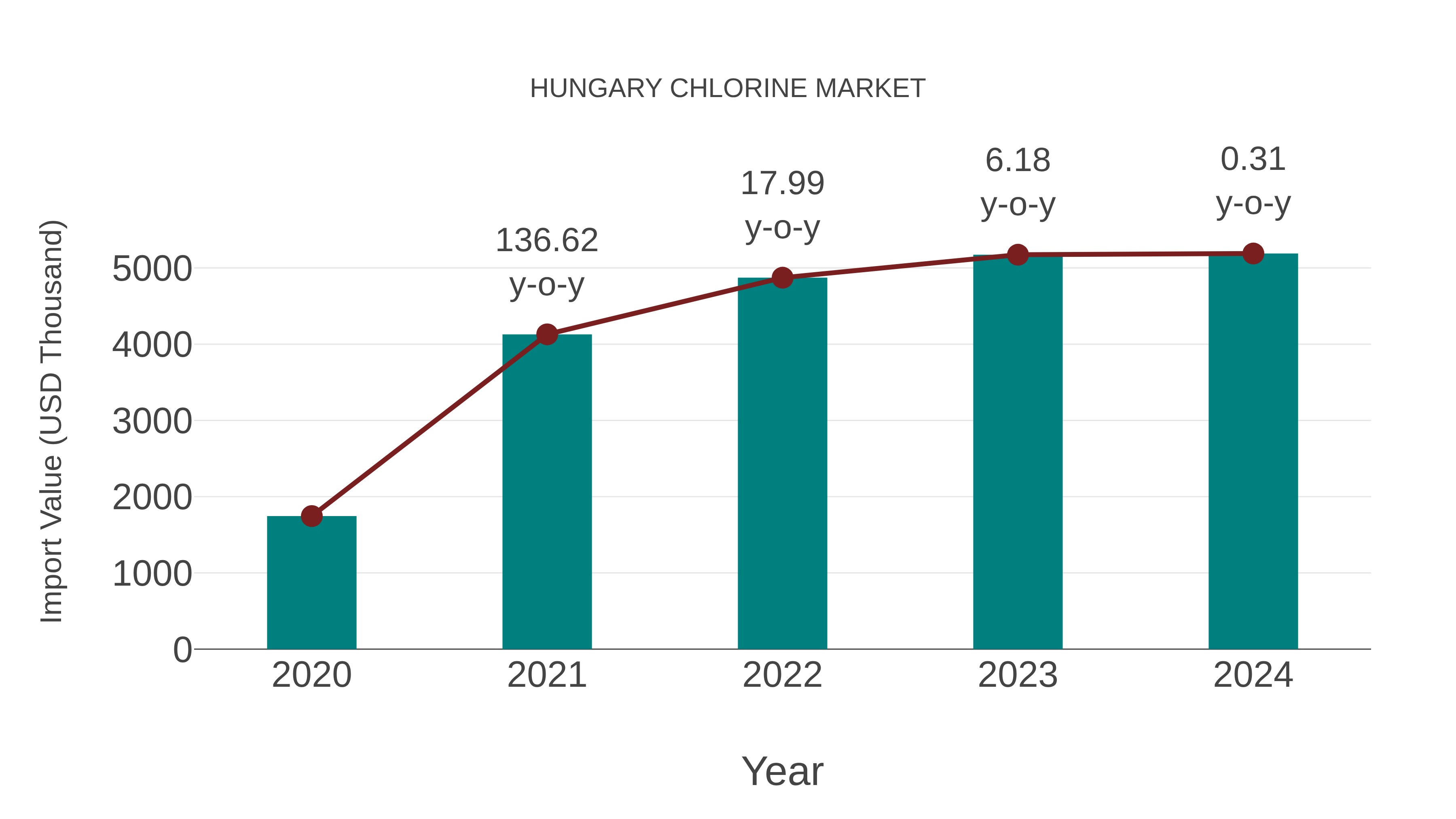
In the Hungary chlorine market, the import trend showed a modest growth rate of 0.31% from 2023 to 2024, with a notable compound annual growth rate (CAGR) of 31.32% for the period 2020-2024. This significant CAGR indicates a strong import momentum driven by factors such as increased industrial demand or shifts in supply chains.
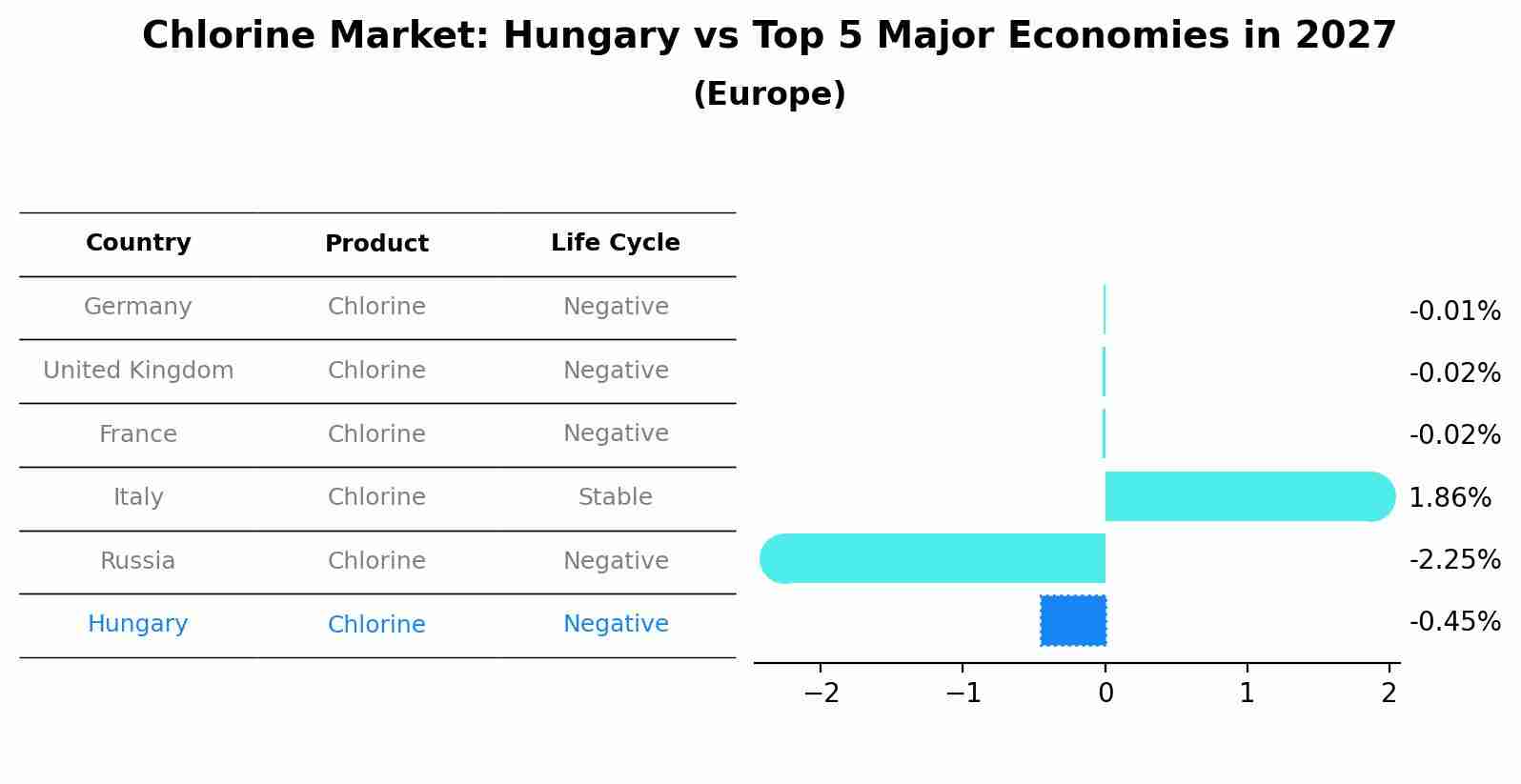
Chlorine Market: Hungary vs Top 5 Major Economies in 2027 (Europe)
Hungary's Chlorine market is anticipated to experience a negative growth rate of -0.45% by 2027, reflecting trends observed in the largest economy Germany, followed by United Kingdom, France, Italy and Russia.
Hungary Chlorine Market Overview
The Hungary chlorine market is influenced by factors such as industrial growth, water treatment activities, and the demand for chlor-alkali products in various end-use industries. Chlorine is a versatile chemical widely used in applications such as water disinfection, chemical synthesis, plastics manufacturing, and pulp bleaching. The market is characterized by the presence of established chlorine manufacturers with integrated production facilities and extensive distribution networks. Key players in the Hungary chlorine market are focusing on capacity expansions, technological advancements, and sustainability initiatives to meet the growing demand for chlorine products and maintain their competitive position in the market.
Drivers of the market
In Hungary, the chlorine market is experiencing steady growth driven by the increasing demand for chlorine in water treatment, chemicals manufacturing, and pharmaceutical applications. Chlorine is a versatile chemical with widespread usage in disinfection, bleaching, and synthesis of various organic and inorganic compounds. The market is benefiting from the growing population and urbanization in Hungary, which is driving the demand for clean water and sanitation solutions. Moreover, stringent regulations regarding water quality and environmental protection are spurring investments in water treatment infrastructure, thereby fueling the demand for chlorine. Additionally, ongoing research and development activities aimed at enhancing the efficiency and sustainability of chlorine production processes are supporting market growth.
Challenges of the market
The chlorine market in Hungary faces challenges related to market volatility and price fluctuations influenced by factors such as supply-demand dynamics and regulatory changes. Market players must adapt to changing market conditions while ensuring stable supply chains and maintaining product quality and safety standards.
Government Policy of the market
The Hungary government implements policies to ensure the sustainable production, distribution, and use of chlorine, a critical chemical commodity with applications across various industries. Regulatory frameworks for safety standards, environmental protection, and waste management aim to mitigate risks associated with chlorine handling and storage while promoting responsible practices. Moreover, support for technological advancements and process improvements in chlorine production facilities contributes to efficiency gains and environmental sustainability in the Hungary chlorine market. Collaboration with international partners and participation in industry initiatives facilitate knowledge exchange and best practice sharing, enhancing the competitiveness and resilience of Hungary chlorine market in the global context.
Key Highlights of the Report:
- Hungary Chlorine Market Outlook
- Market Size of Hungary Chlorine Market, 2021
- Forecast of Hungary Chlorine Market, 2028
- Historical Data and Forecast of Hungary Chlorine Revenues & Volume for the Period 2018 - 2028
- Hungary Chlorine Market Trend Evolution
- Hungary Chlorine Market Drivers and Challenges
- Hungary Chlorine Price Trends
- Hungary Chlorine Porter's Five Forces
- Hungary Chlorine Industry Life Cycle
- Historical Data and Forecast of Hungary Chlorine Market Revenues & Volume By Application for the Period 2018 - 2028
- Historical Data and Forecast of Hungary Chlorine Market Revenues & Volume By EDC/PVC for the Period 2018 - 2028
- Historical Data and Forecast of Hungary Chlorine Market Revenues & Volume By Isocyanates and Oxygenates for the Period 2018 - 2028
- Historical Data and Forecast of Hungary Chlorine Market Revenues & Volume By Chloromethanes for the Period 2018 - 2028
- Historical Data and Forecast of Hungary Chlorine Market Revenues & Volume By Solvents and Epichlorohydrin for the Period 2018 - 2028
- Historical Data and Forecast of Hungary Chlorine Market Revenues & Volume By Inorganic Chemicals for the Period 2018 - 2028
- Historical Data and Forecast of Hungary Chlorine Market Revenues & Volume By Other Applications for the Period 2018 - 2028
- Historical Data and Forecast of Hungary Chlorine Market Revenues & Volume By End-user Industry for the Period 2018 - 2028
- Historical Data and Forecast of Hungary Chlorine Market Revenues & Volume By Water Treatment for the Period 2018 - 2028
- Historical Data and Forecast of Hungary Chlorine Market Revenues & Volume By Pharmaceutical for the Period 2018 - 2028
- Historical Data and Forecast of Hungary Chlorine Market Revenues & Volume By Chemicals for the Period 2018 - 2028
- Historical Data and Forecast of Hungary Chlorine Market Revenues & Volume By Paper and Pulp for the Period 2018 - 2028
- Historical Data and Forecast of Hungary Chlorine Market Revenues & Volume By Plastic for the Period 2018 - 2028
- Historical Data and Forecast of Hungary Chlorine Market Revenues & Volume By Pesticides for the Period 2018 - 2028
- Historical Data and Forecast of Hungary Chlorine Market Revenues & Volume By Other End-user Industries for the Period 2018 - 2028
- Hungary Chlorine Import Export Trade Statistics
- Market Opportunity Assessment By Application
- Market Opportunity Assessment By End-user Industry
- Hungary Chlorine Top Companies Market Share
- Hungary Chlorine Competitive Benchmarking By Technical and Operational Parameters
- Hungary Chlorine Company Profiles
- Hungary Chlorine Key Strategic Recommendations






































