Hungary Cigarette Lighter Market Size (2020-2030)
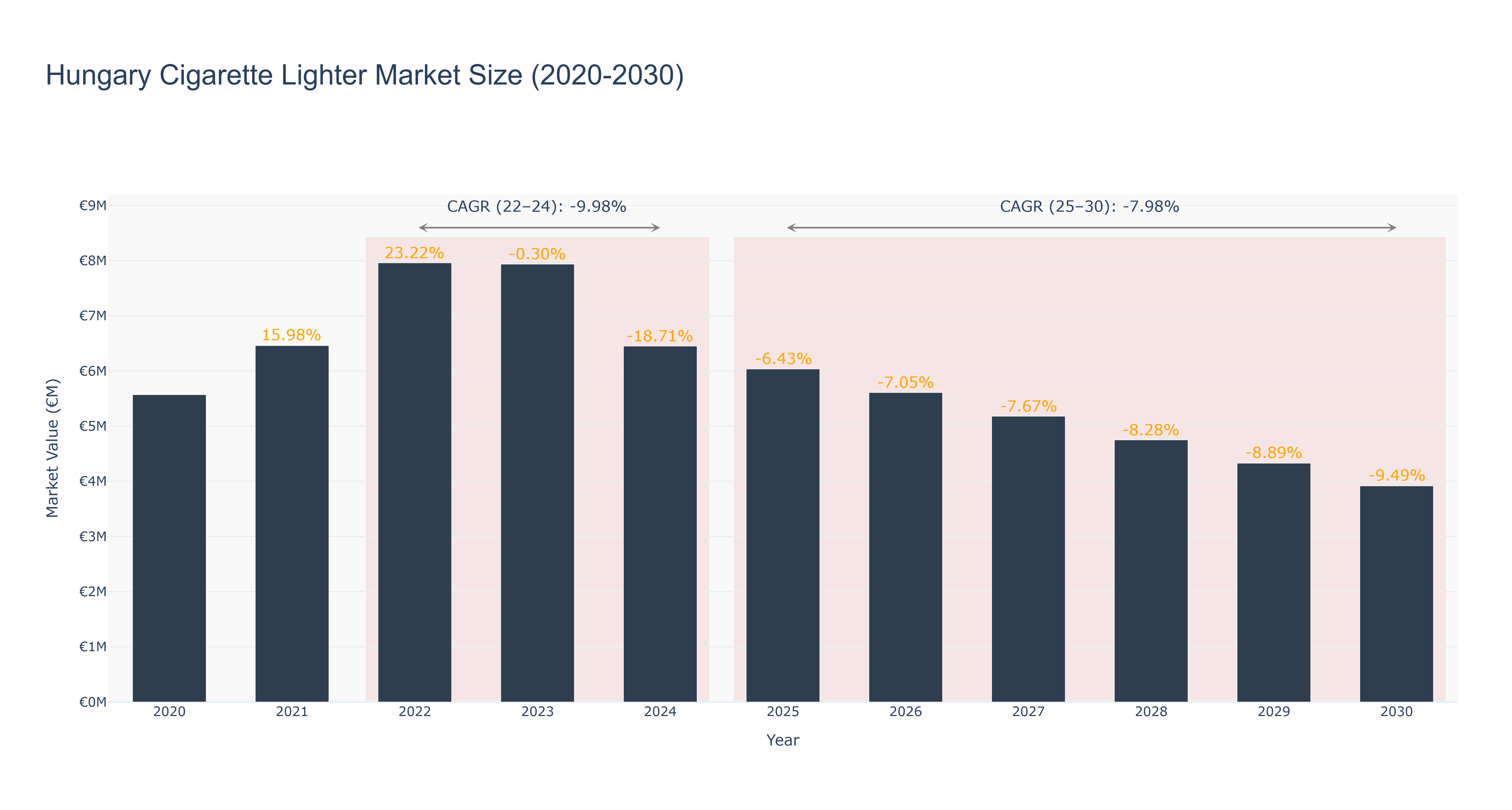
The Hungary Cigarette Lighter Market experienced significant fluctuations from 2020 to 2024, peaking at €7.96 million in 2022, with a remarkable growth rate of 23.22% that year. However, this upward trend was short-lived, as the market contracted to €6.45 million in 2024, reflecting a CAGR of -9.98% during the actual data period. The forecasted outlook for 2025 to 2030 suggests continued decline, with projected market sizes decreasing from €6.04 million in 2025 to €3.92 million by 2030, resulting in a CAGR of -7.98%. Contributing factors to this downturn include increasing environmental awareness leading to reduced demand for disposable products, alongside a shift toward sustainable alternatives. Although there are no specific upcoming projects directly impacting this market, broader trends in consumer behavior and regulatory pressures on single-use plastics may further influence future developments within the sector.
Hungary Cigarette Lighter Market: Production & Trade Performance (2019-2025)
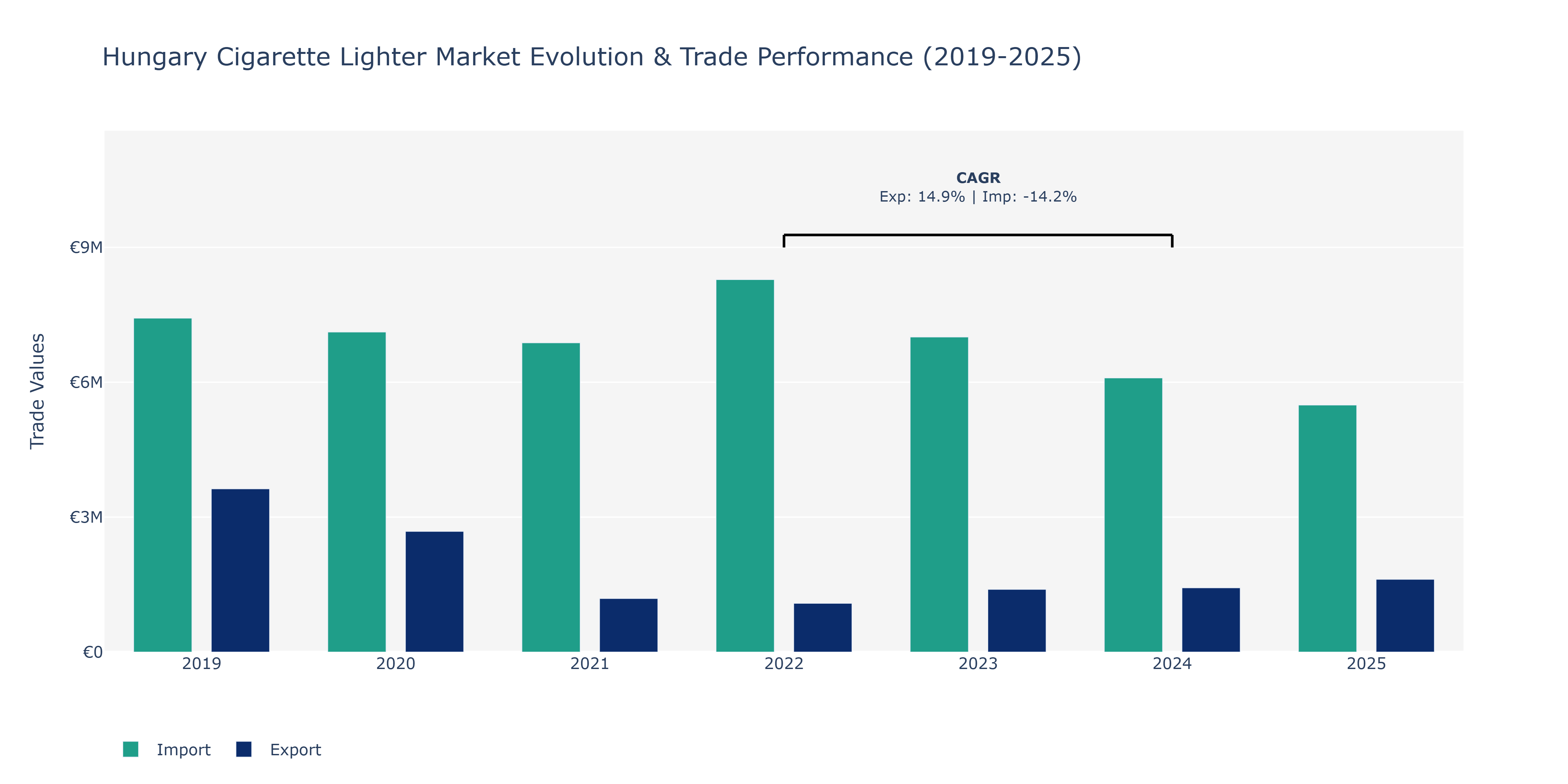
The Hungary Cigarette Lighter Market saw a fluctuating pattern in both Exports and Imports from 2019 to 2025. In 2019, Imports were significantly higher than Exports, with figures at €3.63 million and €7.43 million, respectively. A notable decline in 2021 was observed for both metrics, with Exports dropping to €1.19 million and Imports to €6.88 million. The year 2022 marked a slight uptick in Exports to €1.08 million while Imports surged to €8.28 million. By 2024, Exports increased to €1.43 million, showcasing a recovery trend, while Imports declined to €6.09 million. In 2025, Exports continued to rise to €1.62 million, while Imports decreased further to €5.49 million. The fluctuations could be attributed to various factors such as changing consumer preferences, economic conditions affecting disposable income, and regulatory changes impacting trade dynamics in the cigarette lighter market in Hungary.
Hungary Cigarette Lighter Market Overview
The cigarette lighter market in Hungary is facing challenges due to stricter regulations on smoking and a decline in smoking rates. However, despite these challenges, there is still a demand for cigarette lighters, particularly among smokers who prefer convenience and reliability. Manufacturers in this market are exploring opportunities to diversify their product offerings, such as introducing eco-friendly lighters or targeting niche markets.
Drivers of the market
The cigarette lighter market in Hungary has witnessed steady growth, albeit facing challenges from the broader global trend of declining tobacco consumption. Despite efforts to discourage smoking through regulatory measures and public health campaigns, the demand for cigarette lighters remains relatively stable. Factors such as convenience, affordability, and the habitual nature of smoking contribute to sustaining the market, although there is a gradual shift towards alternative smoking cessation methods.
Challenges of the market
The Hungary cigarette lighter market encounters challenges related to regulatory restrictions, declining smoking rates, and competition from alternative products. Tighter regulations on smoking and tobacco-related products may limit the sale and distribution of cigarette lighters, impacting market growth. Moreover, as smoking rates decline globally, the demand for cigarette lighters may decrease, requiring companies in this market to explore diversification or innovation to sustain revenue. Additionally, the availability of alternative smoking cessation products, such as electronic cigarettes, poses a competitive threat to traditional cigarette lighters.
Government Policy of the market
In contrast, the cigarette lighter market in Hungary has faced challenges due to stricter regulations on smoking and tobacco consumption. Government policies aimed at reducing smoking rates have led to a decline in cigarette lighter sales. Additionally, awareness campaigns highlighting the health risks associated with smoking have further dampened demand for cigarette lighters.
Key Highlights of the Report:
- Hungary Cigarette Lighter Market Outlook
- Market Size of Hungary Cigarette Lighter Market, 2019
- Forecast of Hungary Cigarette Lighter Market, 2026
- Historical Data and Forecast of Hungary Cigarette Lighter Revenues & Volume for the Period 2016 - 2026
- Hungary Cigarette Lighter Market Trend Evolution
- Hungary Cigarette Lighter Market Drivers and Challenges
- Hungary Cigarette Lighter Price Trends
- Hungary Cigarette Lighter Porter's Five Forces
- Hungary Cigarette Lighter Industry Life Cycle
- Historical Data and Forecast of Hungary Cigarette Lighter Market Revenues & Volume By Type for the Period 2016 - 2026
- Historical Data and Forecast of Hungary Cigarette Lighter Market Revenues & Volume By Flint Cigarette Lighter for the Period 2016 - 2026
- Historical Data and Forecast of Hungary Cigarette Lighter Market Revenues & Volume By Electronic Cigarette Lighter for the Period 2016 - 2026
- Historical Data and Forecast of Hungary Cigarette Lighter Market Revenues & Volume By Others for the Period 2016 - 2026
- Historical Data and Forecast of Hungary Cigarette Lighter Market Revenues & Volume By Material for the Period 2016 - 2026
- Historical Data and Forecast of Hungary Cigarette Lighter Market Revenues & Volume By Plastic for the Period 2016 - 2026
- Historical Data and Forecast of Hungary Cigarette Lighter Market Revenues & Volume By Metal for the Period 2016 - 2026
- Historical Data and Forecast of Hungary Cigarette Lighter Market Revenues & Volume By Distribution Channels for the Period 2016 - 2026
- Historical Data and Forecast of Hungary Cigarette Lighter Market Revenues & Volume By Tobacco shops for the Period 2016 - 2026
- Historical Data and Forecast of Hungary Cigarette Lighter Market Revenues & Volume By Supermarkets and Hypermarkets for the Period 2016 - 2026
- Historical Data and Forecast of Hungary Cigarette Lighter Market Revenues & Volume By Convenience Stores for the Period 2016 - 2026
- Historical Data and Forecast of Hungary Cigarette Lighter Market Revenues & Volume By Online Stores for the Period 2016 - 2026
- Historical Data and Forecast of Hungary Cigarette Lighter Market Revenues & Volume By Others for the Period 2016 - 2026
- Hungary Cigarette Lighter Import Export Trade Statistics
- Market Opportunity Assessment By Type
- Market Opportunity Assessment By Material
- Market Opportunity Assessment By Distribution Channels
- Hungary Cigarette Lighter Top Companies Market Share
- Hungary Cigarette Lighter Competitive Benchmarking By Technical and Operational Parameters
- Hungary Cigarette Lighter Company Profiles
- Hungary Cigarette Lighter Key Strategic Recommendations






































