Hungary Cloud Professional Services Market Size & Growth Rate (2026-2032)
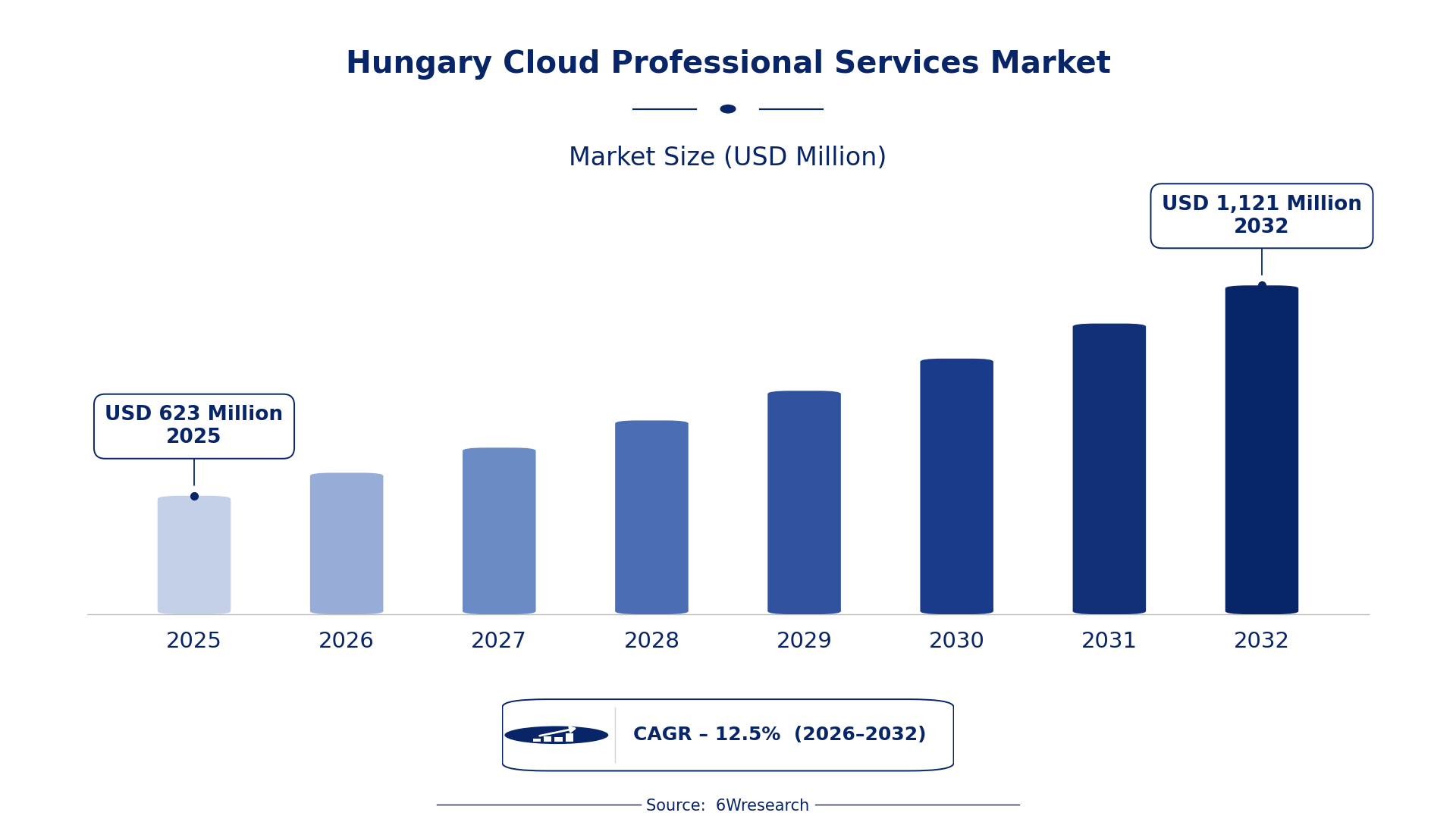
The Hungary Cloud Professional Services Market was estimated at USD 623 Million in 2025 and is projected to reach USD 1121 Million by 2032, growing at a CAGR of 12.5% from 2026 to 2032.
Hungary Cloud Professional Services Market Synopsis
The demand for cloud professional services in Hungary is surging, as organizations increasingly recognize the need for expert guidance in navigating complex cloud landscapes. Companies are not just migrating to the cloud; they are seeking to optimize their existing cloud environments to drive efficiency and cost savings.
As businesses across various sectors adopt cloud technologies, the need for tailored consulting and managed services has never been more pressing. This shift is pushing providers to enhance their offerings to meet specific industry requirements, making specialized expertise a key differentiator in the market.
Hungary Cloud Professional Services Market Year-wise Growth Rate and Key Drivers
This graph illustrates the annual growth rates of the Hungary Cloud Professional Services Market from 2021 to 2032, highlighting a steady upward trajectory and projected expansion over the forecast period.
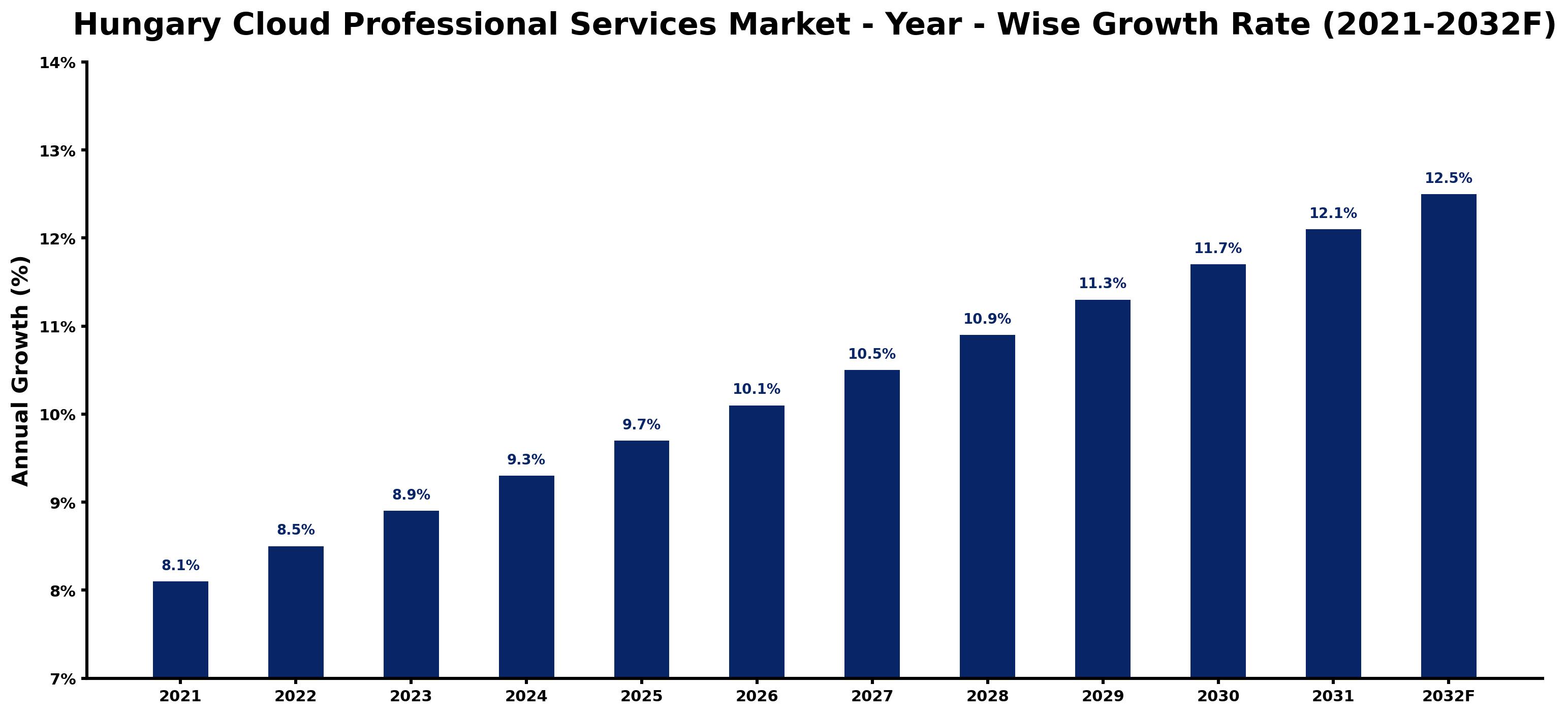
The table below presents the year‑wise growth rates along with the key drivers influencing the market
| Year | Growth Rate | Major Drivers |
| 2021 | 8.1% | Rapid digitalization among SMEs in Hungary increasing cloud reliance. |
| 2022 | 8.5% | Hungarian startups receiving EU funding for cloud innovation. |
| 2023 | 8.9% | Adoption of e-Government services requiring cloud infrastructure upgrades. |
| 2024 | 9.3% | Increased internet penetration supporting cloud service accessibility. |
| 2025 | 9.7% | Local regulations promoting data center establishment in Hungary. |
| 2026 | 10.1% | Market growth fueled by demand for AI-driven cloud services. |
| 2027 | 10.5% | Rising focus on sustainability pushing green cloud solutions. |
| 2028 | 10.9% | Corporate cloud migrations driven by cost-efficiency mandates. |
| 2029 | 11.3% | Growing cybersecurity concerns elevating cloud service necessity. |
| 2030 | 11.7% | New tech hubs fostering cloud service provider collaborations. |
| 2031 | 12.1% | Boost in educational programs enhancing cloud skillsets. |
| 2032 | 12.5% | Increased investments in local tech ecosystems supporting cloud growth. |
Note: Market size estimations and growth projections presented in this report are based on 6Wresearch's proprietary forecasting methodology, utilizing the latest available industry data, government publications, and primary research inputs.
Hungary Cloud Professional Services Market Key Takeaways
Below are some of the specific key takeaways from the market, including:
- The market is experiencing rapid growth due to increasing cloud technology adoption across sectors.
- Organizations are prioritizing operational efficiency and cost reduction through cloud solutions.
- Specialized expertise in cloud migration and management is in high demand.
- Awareness and understanding of cloud benefits remain critical challenges for many businesses.
- Government initiatives are fostering a supportive environment for cloud service adoption.
Evaluation of Restraints in Hungary Cloud Professional Services Market
Despite the growth potential, the Hungary Cloud Professional Services Market is hindered by a pervasive lack of awareness among businesses. Many organizations are still hesitant to transition from traditional IT infrastructures, primarily due to concerns surrounding data security and compliance. This reluctance limits the market's full potential, as companies miss out on the efficiencies that cloud solutions can provide. A cultural shift in understanding the long-term benefits of cloud adoption is essential for overcoming these barriers.
Hungary Cloud Professional Services Market Trends
The trend towards hybrid cloud solutions is gaining traction, as organizations seek flexibility in managing workloads. This approach allows businesses to balance the benefits of both on-premise and cloud environments, catering to specific needs.
on top of that, automation and artificial intelligence are becoming integral to cloud professional services, enabling providers to deliver more efficient and customized solutions. As businesses strive for agility, these technological advancements are reshaping service delivery models.
Hungary Cloud Professional Services Market Opportunities
The market offers significant opportunities for investment in specialized service areas, particularly in compliance and security solutions. As regulations evolve, firms that can navigate these complexities will find a growing client base.
Additionally, the burgeoning startup ecosystem in Hungary presents ripe opportunities for cloud service providers to partner with innovative businesses, further driving growth in the sector.
Government Initiatives in the Hungary Cloud Professional Services Market
The Hungarian government is actively promoting the adoption of cloud technologies across various sectors, seeing it as a catalyst for modernization and economic growth. Recent policies are designed to create a supportive ecosystem that encourages businesses to transition to cloud platforms, ensuring compliance with data protection regulations.
- A national digital infrastructure upgrade programme launched in early 2025 aims to enhance cloud accessibility for businesses.
- Current initiatives are underway to incentivize companies to adopt cloud solutions through tax benefits and grants.
- A regulatory framework introduced in late 2025 focuses on data protection, reinforcing consumer trust in cloud services.
- Upcoming public-private partnerships are planned to expand cloud service offerings in underserved regions by 2027.
Future Insights of the Hungary Cloud Professional Services Market
Looking ahead, the Hungary Cloud Professional Services Market is expected to undergo significant transformation as organizations continue to embrace digitalization. The ongoing push for innovation and efficiency will fuel demand for advanced cloud solutions, particularly in sectors like finance, healthcare, and manufacturing.
As businesses increasingly prioritize agility and scalability, cloud service providers that offer tailored solutions will likely capture a larger market share. The focus will shift toward integrating AI and machine learning capabilities, further enhancing service delivery and operational efficiency.
Hungary Cloud Professional Services Market Latest Developments
In the past year, the Hungary Cloud Professional Services Market has seen a flurry of activity as organizations adapt to shifting technological demands. The emphasis has been on enhancing service offerings and ensuring compliance with evolving regulations, all while driving operational efficiency.
- A major technology vendor launched a new cloud optimization service in Q1 2025, aimed at helping organizations reduce costs.
- An initiative that began in mid-2025 focuses on developing cloud training programs for IT professionals, addressing the skills gap in the market.
- New partnerships between local startups and cloud service providers are currently underway to create innovative solutions tailored to the Hungarian market.
- Upcoming regulatory changes expected by late 2026 aim to streamline compliance processes for cloud service providers.
Hungary Cloud Professional Services Market - Key Attractiveness of the Report
- 10 Years of Market Numbers
- Historical Data Starting from 2022 to 2025
- Base Year: 2025
- Forecast Data until 2032
- Key Performance Indicators Impacting the Market
- Major Upcoming Developments and Projects
Key Highlights of the Report:
- Hungary Cloud Professional Services Market Outlook
- Market Size of Hungary Cloud Professional Services Market, 2025
- Forecast of Hungary Cloud Professional Services Market, 2032
- Historical Data and Forecast of Hungary Cloud Professional Services Revenues & Volume for the Period 2022-2032F
- Hungary Cloud Professional Services Market Trend Evolution
- Hungary Cloud Professional Services Market Drivers and Challenges
- Hungary Cloud Professional Services Price Trends
- Hungary Cloud Professional Services Porter's Five Forces
- Hungary Cloud Professional Services Industry Life Cycle
- Historical Data and Forecast of Hungary Cloud Professional Services Market Revenues & Volume By Service Type for the Period 2022-2032F
- Historical Data and Forecast of Hungary Cloud Professional Services Market Revenues & Volume By Consulting for the Period 2022-2032F
- Historical Data and Forecast of Hungary Cloud Professional Services Market Revenues & Volume By Integration & Optimization for the Period 2022-2032F
- Historical Data and Forecast of Hungary Cloud Professional Services Market Revenues & Volume By Implementation & Migration for the Period 2022-2032F
- Historical Data and Forecast of Hungary Cloud Professional Services Market Revenues & Volume By Application Development & Modernization for the Period 2022-2032F
- Historical Data and Forecast of Hungary Cloud Professional Services Market Revenues & Volume By Service Model for the Period 2022-2032F
- Historical Data and Forecast of Hungary Cloud Professional Services Market Revenues & Volume By Platform as a Service (PaaS) for the Period 2022-2032F
- Historical Data and Forecast of Hungary Cloud Professional Services Market Revenues & Volume By Software as a Service (SaaS) for the Period 2022-2032F
- Historical Data and Forecast of Hungary Cloud Professional Services Market Revenues & Volume By Infrastructure as a Service (IaaS) for the Period 2022-2032F
- Historical Data and Forecast of Hungary Cloud Professional Services Market Revenues & Volume By Deployment Model for the Period 2022-2032F
- Historical Data and Forecast of Hungary Cloud Professional Services Market Revenues & Volume By Public Cloud for the Period 2022-2032F
- Historical Data and Forecast of Hungary Cloud Professional Services Market Revenues & Volume By Private Cloud for the Period 2022-2032F
- Historical Data and Forecast of Hungary Cloud Professional Services Market Revenues & Volume By Organization Size for the Period 2022-2032F
- Historical Data and Forecast of Hungary Cloud Professional Services Market Revenues & Volume By Small and Medium-Sized Enterprises (SMEs) for the Period 2022-2032F
- Historical Data and Forecast of Hungary Cloud Professional Services Market Revenues & Volume By Large Enterprises for the Period 2022-2032F
- Historical Data and Forecast of Hungary Cloud Professional Services Market Revenues & Volume By Vertical for the Period 2022-2032F
- Historical Data and Forecast of Hungary Cloud Professional Services Market Revenues & Volume By Baanking, Financial Services, and insurance (BFSI) for the Period 2022-2032F
- Historical Data and Forecast of Hungary Cloud Professional Services Market Revenues & Volume By Retail & Consumer Goods for the Period 2022-2032F
- Historical Data and Forecast of Hungary Cloud Professional Services Market Revenues & Volume By IT & ITeS for the Period 2022-2032F
- Historical Data and Forecast of Hungary Cloud Professional Services Market Revenues & Volume By Telecommunications for the Period 2022-2032F
- Historical Data and Forecast of Hungary Cloud Professional Services Market Revenues & Volume By Healthcare & Life Sciences for the Period 2022-2032F
- Historical Data and Forecast of Hungary Cloud Professional Services Market Revenues & Volume By Manufacturing for the Period 2022-2032F
- Historical Data and Forecast of Hungary Cloud Professional Services Market Revenues & Volume By Energy & Utilities for the Period 2022-2032F
- Historical Data and Forecast of Hungary Cloud Professional Services Market Revenues & Volume By Government & Defense for the Period 2022-2032F
- Hungary Cloud Professional Services Import Export Trade Statistics
- Market Opportunity Assessment By Service Type
- Market Opportunity Assessment By Service Model
- Market Opportunity Assessment By Deployment Model
- Market Opportunity Assessment By Organization Size
- Market Opportunity Assessment By Vertical
- Hungary Cloud Professional Services Top Companies Market Share
- Hungary Cloud Professional Services Competitive Benchmarking By Technical and Operational Parameters
- Hungary Cloud Professional Services Company Profiles
- Hungary Cloud Professional Services Key Strategic Recommendations






































