Hungary Cnc Controller Market: Import Trend Analysis
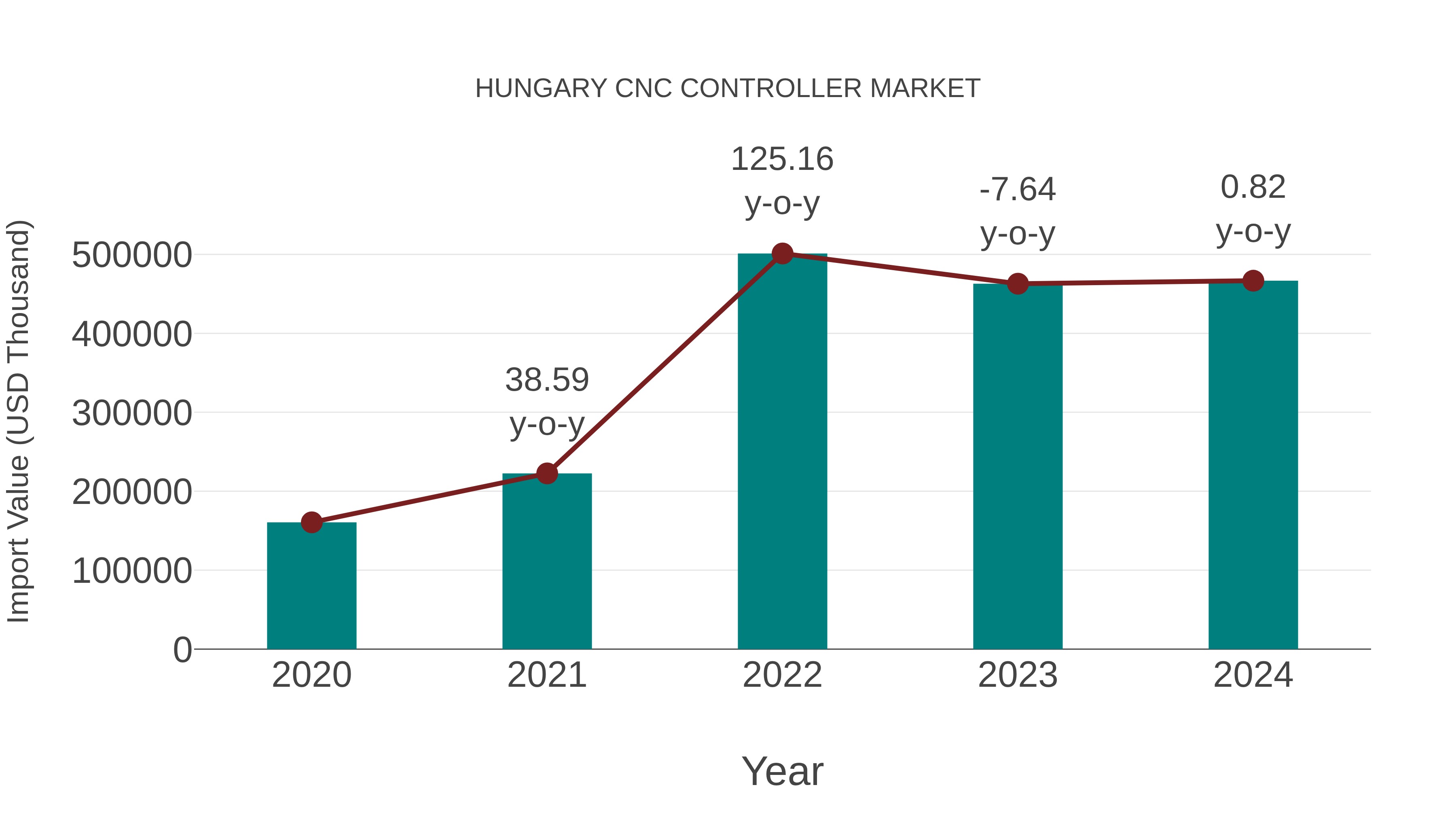
Hungary`s import trend for the CNC controller market exhibited a growth rate of 0.82% from 2023 to 2024, with a notable compound annual growth rate (CAGR) of 30.56% from 2020 to 2024. This significant CAGR suggests a sustained import momentum driven by increased demand for CNC controllers in Hungary, reflecting a stable and expanding market for such products during the period analyzed.
Hungary CNC Controller Market Overview
The CNC controller market in Hungary is witnessing steady growth, propelled by the widespread adoption of CNC (Computer Numerical Control) technology across various manufacturing sectors. CNC controllers play a crucial role in automating machining processes, increasing precision, and improving productivity. As Hungary industries continue to modernize and upgrade their manufacturing facilities, the demand for advanced CNC controllers with features such as multi-axis control and networking capabilities is expected to surge.
Drivers of the market
The Hungary CNC Controller Market is witnessing steady growth due to the rising adoption of computer numerical control (CNC) machines across various manufacturing industries. CNC controllers play a crucial role in automating and controlling the movement of machine tools, thereby improving precision, productivity, and efficiency in manufacturing processes. The increasing demand for high-quality machined components, coupled with advancements in CNC technology, is driving market growth in Hungary. Moreover, the integration of CNC controllers with IoT and AI technologies is further fueling market expansion by enabling predictive maintenance and real-time monitoring capabilities.
Challenges of the market
The CNC (Computer Numerical Control) controller market in Hungary encounters several challenges, predominantly related to technological advancements and market competition. One of the primary challenges is the rapid pace of technological innovation, which leads to frequent obsolescence of existing CNC controller systems.
Government Policy of the market
The Hungary government recognizes the significance of CNC (Computer Numerical Control) technology in advancing manufacturing capabilities and promoting industrial automation. Policies aimed at enhancing the competitiveness of the manufacturing sector include incentives for the adoption of CNC controllers and related technologies. Government initiatives focus on providing training programs and financial support to small and medium-sized enterprises (SMEs) to facilitate the integration of CNC solutions into their production processes. Moreover, collaborations between industry stakeholders and academic institutions are encouraged to promote research and development in CNC technology, ensuring continuous innovation and growth in the market.
Key Highlights of the Report:
- Hungary CNC Controller Market Outlook
- Market Size of Hungary CNC Controller Market, 2025
- Forecast of Hungary CNC Controller Market, 2032
- Historical Data and Forecast of Hungary CNC Controller Revenues & Volume for the Period 2022-2032F
- Hungary CNC Controller Market Trend Evolution
- Hungary CNC Controller Market Drivers and Challenges
- Hungary CNC Controller Price Trends
- Hungary CNC Controller Porter's Five Forces
- Hungary CNC Controller Industry Life Cycle
- Historical Data and Forecast of Hungary CNC Controller Market Revenues & Volume By Offering for the Period 2022-2032F
- Historical Data and Forecast of Hungary CNC Controller Market Revenues & Volume By Hardware for the Period 2022-2032F
- Historical Data and Forecast of Hungary CNC Controller Market Revenues & Volume By Software & Services for the Period 2022-2032F
- Historical Data and Forecast of Hungary CNC Controller Market Revenues & Volume By Axis Type for the Period 2022-2032F
- Historical Data and Forecast of Hungary CNC Controller Market Revenues & Volume By 2-Axis for the Period 2022-2032F
- Historical Data and Forecast of Hungary CNC Controller Market Revenues & Volume By 3-Axis for the Period 2022-2032F
- Historical Data and Forecast of Hungary CNC Controller Market Revenues & Volume By 4-Axis for the Period 2022-2032F
- Historical Data and Forecast of Hungary CNC Controller Market Revenues & Volume By 5-Axis for the Period 2022-2032F
- Historical Data and Forecast of Hungary CNC Controller Market Revenues & Volume By Multi-axis for the Period 2022-2032F
- Hungary CNC Controller Import Export Trade Statistics
- Market Opportunity Assessment By Offering
- Market Opportunity Assessment By Axis Type
- Hungary CNC Controller Top Companies Market Share
- Hungary CNC Controller Competitive Benchmarking By Technical and Operational Parameters
- Hungary CNC Controller Company Profiles
- Hungary CNC Controller Key Strategic Recommendations






































