Hungary Content Analytics Market Size & Growth Rate (2026-2032)
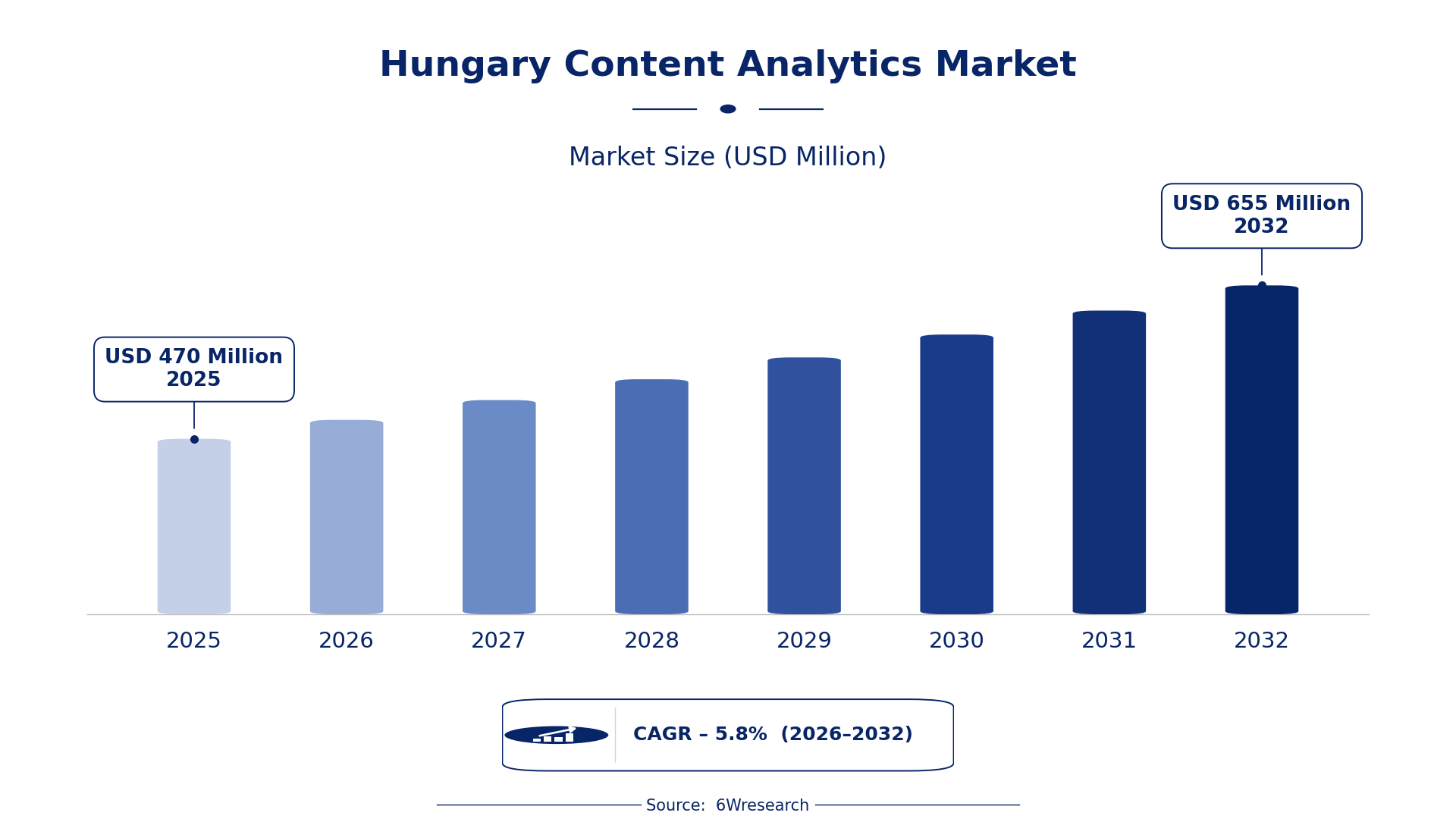
The Hungary Content Analytics Market was estimated at USD 470 Million in 2025 and is projected to reach USD 655 Million by 2032, growing at a CAGR of 5.8% from 2026 to 2032.
Hungary Content Analytics Market Synopsis
The key force propelling the Hungary Content Analytics Market is the surging demand for actionable insights derived from vast amounts of unstructured data. Businesses are increasingly recognizing the value of harnessing analytics to transform data into strategic advantages, particularly as digital content proliferates across various sectors.
As companies seek to enhance customer experiences and optimize decision-making processes, the integration of advanced analytics tools has become essential. This trend is particularly pronounced within industries such as retail, finance, and media, where understanding consumer behavior through content analysis can directly influence market positioning.
Hungary Content Analytics Market Year-wise Growth Rate and Key Drivers
This graph illustrates the annual growth rates of the Hungary Content Analytics Market from 2021 to 2032, highlighting a steady upward trajectory and projected expansion over the forecast period.
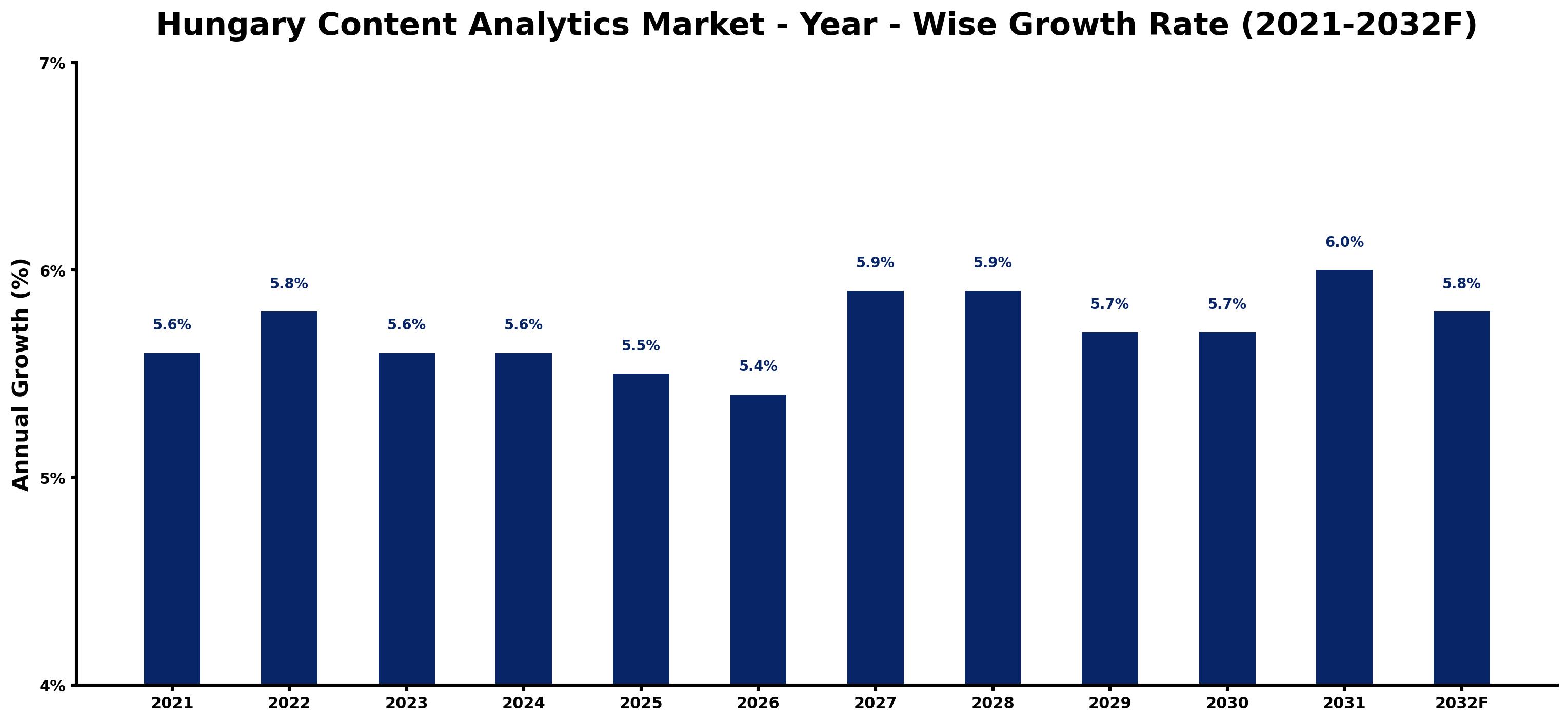
The table below presents the year‑wise growth rates along with the key drivers influencing the market
| Year | Growth Rate | Major Drivers |
| 2021 | 5.6% | Rise of local tech startups focusing on analytics solutions. |
| 2022 | 5.8% | Increased investment in digital content by Hungarian SMEs. |
| 2023 | 5.6% | Government support for digital literacy initiatives boosting content usage. |
| 2024 | 5.6% | Hungary's media regulations encouraging data-driven content strategies. |
| 2025 | 5.5% | Adoption of AI technologies by Hungarian content providers. |
| 2026 | 5.4% | Growth of Hungarian social media platforms amplifying content demand. |
| 2027 | 5.9% | Rising popularity of localized content attracting advertisers in Hungary. |
| 2028 | 5.9% | Increased mobile internet penetration enhancing content accessibility. |
| 2029 | 5.7% | Demand for personalized marketing in Hungary's retail sector. |
| 2030 | 5.7% | Emergence of cultural events promoting local content creation. |
| 2031 | 6.0% | Hungary's focus on intellectual property rights boosting content safety. |
| 2032 | 5.8% | Increased collaboration between tech firms and content creators. |
Note: Market size estimations and growth projections presented in this report are based on 6Wresearch's proprietary forecasting methodology, utilizing the latest available industry data, government publications, and primary research inputs.
Hungary Content Analytics Market Key Takeaways
Below are some of the specific key takeaways from the market, including:
- The increasing volume of digital content is driving demand for sophisticated content analytics solutions.
- Natural language processing and machine learning are becoming standard features in analytics tools.
- Organizations are prioritizing data-driven strategies to improve customer engagement and operational efficiency.
- Data privacy concerns pose challenges for the deployment of content analytics technologies.
- Government initiatives aimed at promoting ethical data use are shaping the market dynamics.
Evaluation of Restraints in Hungary Content Analytics Market
Despite its promising growth trajectory, the Hungary Content Analytics Market faces notable restraints. Data privacy regulations are a primary concern, as businesses must navigate stringent guidelines while implementing analytics solutions. These regulations can hinder the speed and scope of data utilization, ultimately affecting the effectiveness of content analysis efforts. on top of that, ensuring the accuracy and relevance of analytics outputs remains a significant challenge. Organizations must invest in high-quality data management practices to derive meaningful insights, which can often be resource-intensive.
Hungary Content Analytics Market Trends
Several trends are currently shaping the Hungary Content Analytics Market. One of the most prominent is the shift towards real-time analytics, enabling businesses to react swiftly to consumer behavior and market changes. Companies are increasingly adopting cloud-based analytics solutions, which offer scalability and flexibility. Additionally, the rise of social media has intensified the need for sentiment analysis, compelling organizations to harness content analytics tools that can interpret public opinion effectively. The focus on personalized marketing strategies is also driving demand for analytics that can segment audiences and tailor content accordingly.
Hungary Content Analytics Market Opportunities
Opportunities for growth in the Hungary Content Analytics Market are abundant. As businesses invest in digital transformation, there is an increasing need for analytics solutions that can manage and interpret large datasets efficiently. The integration of AI capabilities presents a compelling avenue for enhancing analytics accuracy and predictive power. on top of that, sectors such as healthcare and finance are beginning to recognize the value of content analytics in improving operational efficiency and customer satisfaction. This recognition paves the way for innovative applications of analytics in these industries, creating avenues for investment and expansion.
Government Initiatives in the Hungary Content Analytics Market
The Hungarian government is increasingly focused on utilizing data analytics to enhance public services and drive economic growth. Current policies emphasize ethical data use and transparency, which are essential for fostering trust in analytics technologies. As the government promotes digital infrastructure improvements, it supports advancements that align with the needs of the content analytics market.
- A recently completed initiative involved the establishment of a national data governance framework aimed at enhancing data privacy and ethical usage standards.
- A current program is underway to bolster digital skills among public sector employees, ensuring they can effectively use analytics tools to improve service delivery.
- Plans are in place for a forthcoming public-private partnership designed to expand access to analytics technologies in rural areas by 2028.
- The government is also developing a regulatory body focused on overseeing the ethical use of AI and analytics technologies across various sectors.
Future Insights of the Hungary Content Analytics Market
Looking ahead to 2026-2032, the Hungary Content Analytics Market is expected to evolve significantly. The push towards more integrated and intelligent analytics systems will likely dominate the landscape, as organizations seek solutions that not only analyze data but also provide actionable recommendations. The growing emphasis on customer-centric approaches will drive demand for tools that can offer deeper insights into consumer preferences and behaviors. As regulatory frameworks become more defined, businesses will also need to adapt their strategies to ensure compliance while maximizing the benefits of content analytics.
Hungary Content Analytics Market Latest Developments
In the past year, the Hungary Content Analytics Market has seen various developments that reflect its growth and the increasing importance of data analytics. Companies are actively refining their analytics offerings, with many focusing on enhancing user experiences and outcomes through advanced technologies.
- A leading technology vendor launched a new content analytics platform in early 2025, designed to incorporate machine learning capabilities for improved data interpretation.
- Currently ongoing is an initiative by a major regional player to integrate advanced sentiment analysis features into their existing analytics suite, aimed at enhancing customer feedback mechanisms.
- A rollout is planned for late 2026 of a comprehensive training program aimed at equipping businesses with the necessary skills to utilize content analytics effectively.
- Recent partnerships between analytics firms and educational institutions are fostering innovation in data analytics research, which began in Q1 2025 and remains ongoing.
Hungary Content Analytics Market - Key Attractiveness of the Report
- 10 Years of Market Numbers
- Historical Data Starting from 2022 to 2025
- Base Year: 2025
- Forecast Data until 2032
- Key Performance Indicators Impacting the Market
- Major Upcoming Developments and Projects
Key Highlights of the Report:
- Hungary Content Analytics Market Outlook
- Market Size of Hungary Content Analytics Market, 2025
- Forecast of Hungary Content Analytics Market, 2032
- Historical Data and Forecast of Hungary Content Analytics Revenues & Volume for the Period 2022-2032F
- Hungary Content Analytics Market Trend Evolution
- Hungary Content Analytics Market Drivers and Challenges
- Hungary Content Analytics Price Trends
- Hungary Content Analytics Porter's Five Forces
- Hungary Content Analytics Industry Life Cycle
- Historical Data and Forecast of Hungary Content Analytics Market Revenues & Volume By Application for the Period 2022-2032F
- Historical Data and Forecast of Hungary Content Analytics Market Revenues & Volume By Speech Analytics for the Period 2022-2032F
- Historical Data and Forecast of Hungary Content Analytics Market Revenues & Volume By Text Analytics for the Period 2022-2032F
- Historical Data and Forecast of Hungary Content Analytics Market Revenues & Volume By Web Analytics for the Period 2022-2032F
- Historical Data and Forecast of Hungary Content Analytics Market Revenues & Volume By Social Media Analytics for the Period 2022-2032F
- Historical Data and Forecast of Hungary Content Analytics Market Revenues & Volume By Others for the Period 2022-2032F
- Historical Data and Forecast of Hungary Content Analytics Market Revenues & Volume By Deployment Type for the Period 2022-2032F
- Historical Data and Forecast of Hungary Content Analytics Market Revenues & Volume By On-Premises for the Period 2022-2032F
- Historical Data and Forecast of Hungary Content Analytics Market Revenues & Volume By Cloud/Hosted for the Period 2022-2032F
- Historical Data and Forecast of Hungary Content Analytics Market Revenues & Volume By Vertical for the Period 2022-2032F
- Historical Data and Forecast of Hungary Content Analytics Market Revenues & Volume By BFSI (Banking, Financial Services and Insurance) for the Period 2022-2032F
- Historical Data and Forecast of Hungary Content Analytics Market Revenues & Volume By Retail & Consumer Goods for the Period 2022-2032F
- Historical Data and Forecast of Hungary Content Analytics Market Revenues & Volume By IT & Telecom for the Period 2022-2032F
- Historical Data and Forecast of Hungary Content Analytics Market Revenues & Volume By Healthcare for the Period 2022-2032F
- Historical Data and Forecast of Hungary Content Analytics Market Revenues & Volume By Media & Entertainment for the Period 2022-2032F
- Historical Data and Forecast of Hungary Content Analytics Market Revenues & Volume By Government for the Period 2022-2032F
- Historical Data and Forecast of Hungary Content Analytics Market Revenues & Volume By Travel & Hospitality for the Period 2022-2032F
- Historical Data and Forecast of Hungary Content Analytics Market Revenues & Volume By Others for the Period 2022-2032F
- Hungary Content Analytics Import Export Trade Statistics
- Market Opportunity Assessment By Application
- Market Opportunity Assessment By Deployment Type
- Market Opportunity Assessment By Vertical
- Hungary Content Analytics Top Companies Market Share
- Hungary Content Analytics Competitive Benchmarking By Technical and Operational Parameters
- Hungary Content Analytics Company Profiles
- Hungary Content Analytics Key Strategic Recommendations






































