Hungary Data Classification Market Size & Growth Rate (2026-2032)
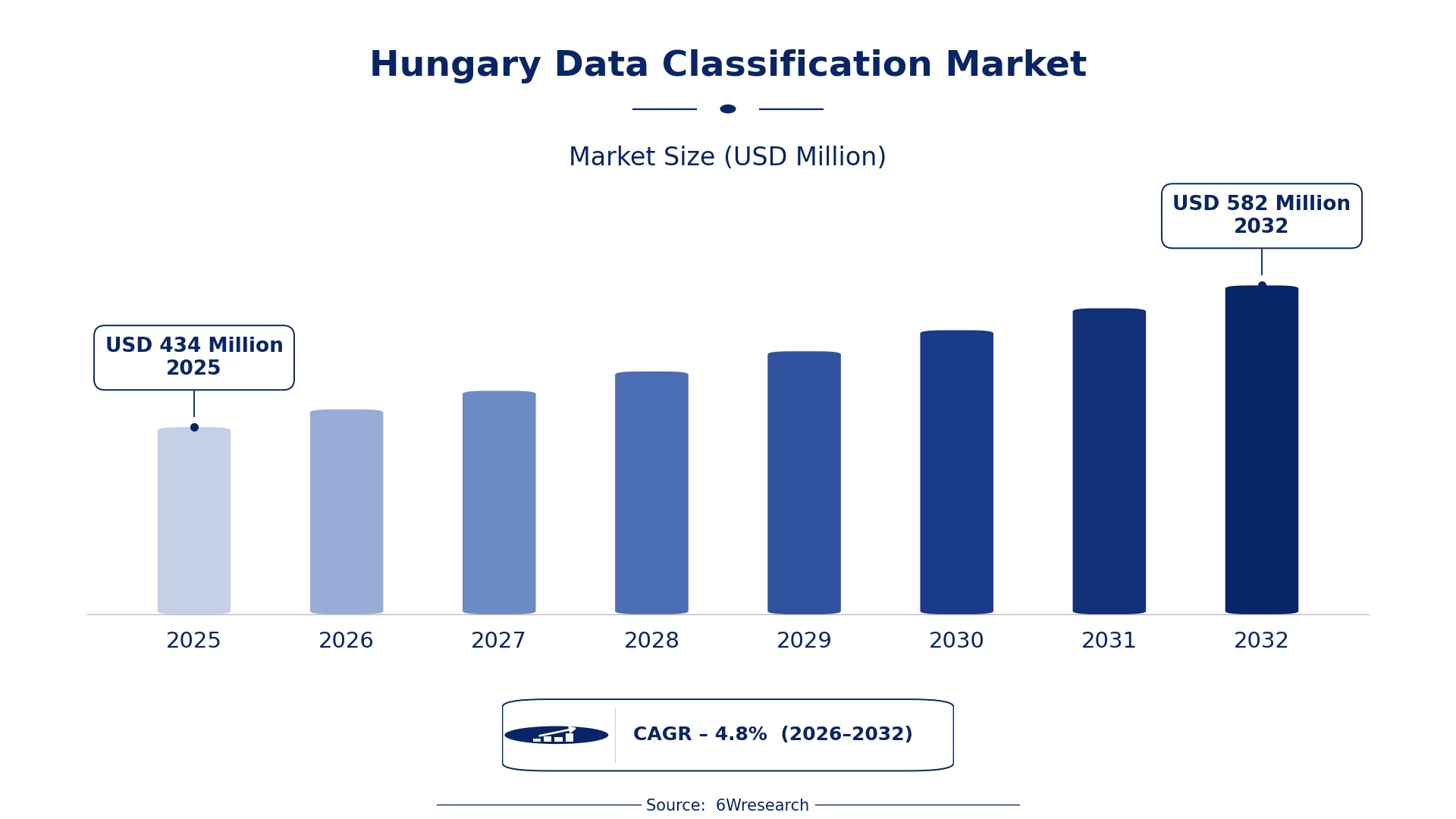
The Hungary Data Classification Market was estimated at USD 434 Million in 2025 and is projected to reach USD 582 Million by 2032, growing at a CAGR of 4.8% from 2026 to 2032.
Hungary Data Classification Market Synopsis
The demand for data classification solutions in Hungary is surging, driven by organizations’ urgent need to manage and secure expansive data assets. As businesses increasingly shift towards digital transformations, the complexity and volume of data have necessitated advanced tools capable of automated classification, ensuring compliance with stringent regulations like GDPR.
As data privacy concerns escalate, the Hungarian market is responding by integrating innovative technologies. Tools that leverage machine learning for classification are gaining traction, enabling firms to efficiently tag and safeguard sensitive information. This market momentum signals a substantial pivot towards prioritizing data governance and risk mitigation strategies.
Hungary Data Classification Market Year-wise Growth Rate and Key Drivers
This graph illustrates the annual growth rates of the Hungary Data Classification Market from 2021 to 2032, highlighting a steady upward trajectory and projected expansion over the forecast period.
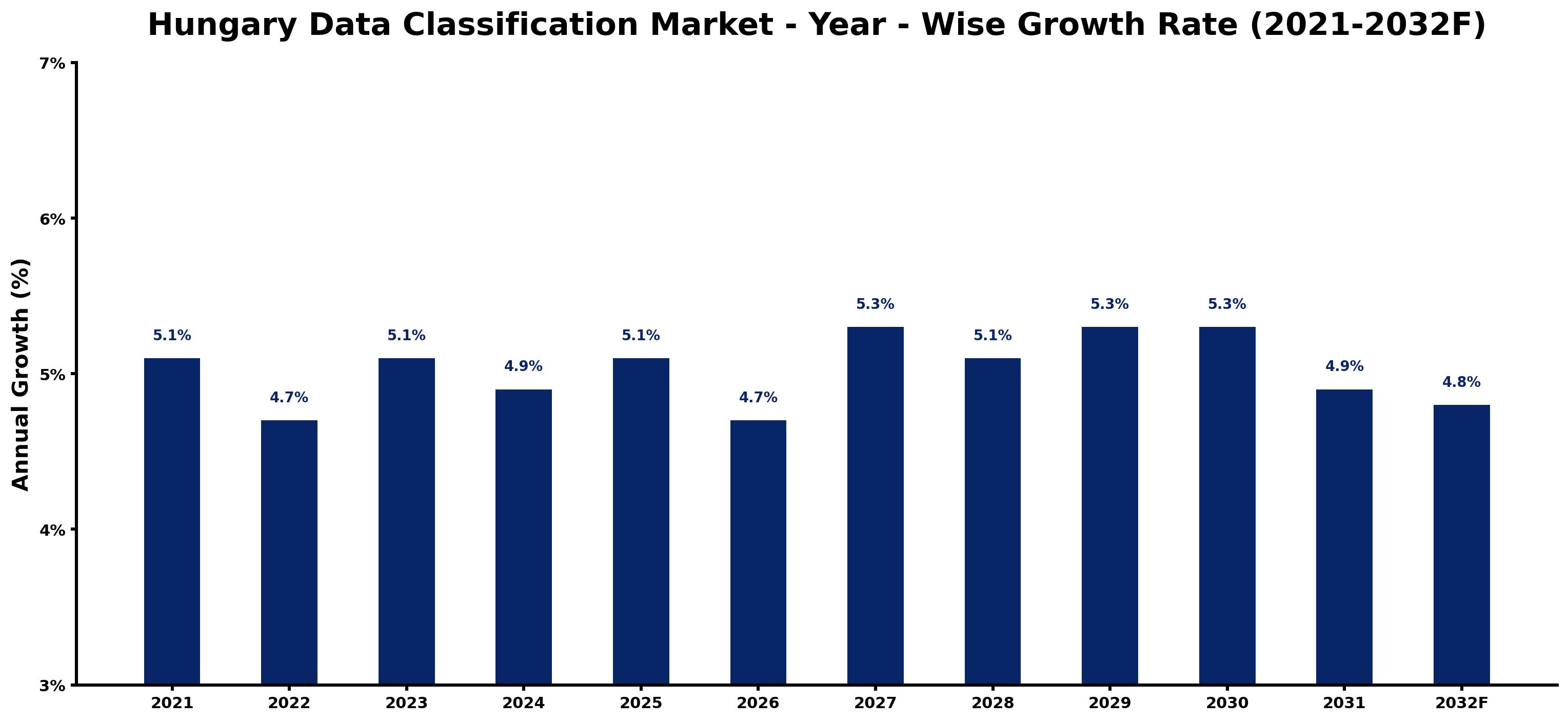
The table below presents the year‑wise growth rates along with the key drivers influencing the market
| Year | Growth Rate | Major Drivers |
| 2021 | 5.1% | GDPR compliance driving data classification investments. |
| 2022 | 4.7% | Rising need for data protection due to cyber threats. |
| 2023 | 5.1% | Regulatory focus on data privacy enhances market growth. |
| 2024 | 4.9% | Digital transformation efforts boost data governance initiatives. |
| 2025 | 5.1% | Local SMEs investing in data management solutions. |
| 2026 | 4.7% | Increased awareness of data breaches drives demand. |
| 2027 | 5.3% | Government initiatives promoting IT security standards. |
| 2028 | 5.1% | Growing e-commerce necessitates robust data classification. |
| 2029 | 5.3% | International partnerships enhance data classification technologies. |
| 2030 | 5.3% | Educational campaigns on data privacy spur market interest. |
| 2031 | 4.9% | Local startups focusing on innovative data solutions increase. |
| 2032 | 4.8% | High internet penetration fuels demand for data services. |
Note: Market size estimations and growth projections presented in this report are based on 6Wresearch's proprietary forecasting methodology, utilizing the latest available industry data, government publications, and primary research inputs.
Hungary Data Classification Market Key Takeaways
Below are some of the specific key takeaways from the market, including:
- The market is largely driven by compliance requirements stemming from GDPR and other local regulations.
- Machine learning-based solutions are becoming essential for effective data classification and security.
- There is a notable shift toward automated tools that reduce manual classification efforts.
- Organizations face challenges in implementing consistent classification policies across diverse IT environments.
- Growing awareness of data privacy issues is leading businesses to invest in enhanced data protection measures.
Evaluation of Restraints in Hungary Data Classification Market
Despite the growth potential, the Hungary Data Classification Market grapples with several limitations. Many organizations struggle with defining clear and effective classification policies, particularly given the varied nature of data types across their IT landscapes. Aligning IT, legal, and business units to establish consistent classification criteria is challenging, often requiring significant collaboration and resource investment. on top of that, the integration of automated classification tools into legacy systems can be fraught with technical hurdles, delaying implementation timelines.
Hungary Data Classification Market Trends
Several key trends are shaping the Hungary Data Classification Market. First, there is an increasing reliance on artificial intelligence and machine learning technologies, which streamline the classification process while enhancing accuracy. Secondly, organizations are gravitating towards cloud-based solutions to facilitate data access and ensure seamless updates in compliance with regulatory changes. This trend reflects a broader shift toward digital solutions, highlighting the need for agility in data management.
on top of that, data loss prevention (DLP) solutions are increasingly intertwined with classification tools, as firms seek comprehensive strategies to mitigate the risk of data breaches. Businesses are also prioritizing user education and awareness, recognizing that human error can often compromise data security initiatives.
Hungary Data Classification Market Opportunities
The market presents numerous growth opportunities, particularly for vendors offering advanced automated classification tools tailored for various sectors. Industries such as finance and healthcare, which are heavily regulated and data-intensive, are prime candidates for investment in classification solutions. There is also a growing demand for consulting services to help organizations craft and implement effective classification policies. As the landscape continues to evolve, partnerships between tech firms and compliance experts will likely yield innovative solutions that enhance data governance.
Government Initiatives in the Hungary Data Classification Market
The Hungarian government is actively shaping the data classification market through a range of regulatory measures aimed at protecting sensitive information. With the implementation of stringent data privacy laws and compliance frameworks, businesses are increasingly adopting data classification solutions to meet these requirements. This proactive approach underscores the government's commitment to bolstering data protection and cybersecurity.
- A national data protection framework introduced in 2025 mandates businesses to classify data according to sensitivity levels.
- Currently underway is a governmental initiative promoting public-private partnerships aimed at enhancing data security infrastructure.
- A planned regulatory update by 2026 will further define the responsibilities of data controllers and processors regarding classification standards.
- Recent training programs initiated by the government focus on increasing awareness of data classification among corporate stakeholders.
- Ongoing reviews of compliance requirements are ensuring that data classification practices align with evolving EU regulations.
Future Insights of the Hungary Data Classification Market
Looking ahead to 2026-2032, the Hungary Data Classification Market is expected to witness substantial evolution, driven by continued regulatory pressures and technological advancements. Organizations will prioritize investing in advanced classification solutions to stay compliant while effectively managing data risks. Expect to see increased collaboration across sectors as businesses adopt integrated approaches to data classification and security. The growing necessity for agile and responsive data management strategies will further fuel demand for innovative tools that streamline classification processes.
Hungary Data Classification Market Latest Developments
Over the past year, the Hungary Data Classification Market has experienced significant activity as organizations adapt to regulatory changes and enhance their data governance strategies. The momentum surrounding digital transformation has led to a surge in interest and investment in automated classification technologies.
- A major technology vendor launched a new automated data classification solution in Q1 2025, designed to help businesses enhance compliance with GDPR.
- An ongoing initiative by a regional operator aims to integrate advanced machine learning capabilities into existing classification tools, enhancing their accuracy and efficiency.
- A partnership between two leading cybersecurity firms was announced in early 2025, focusing on developing comprehensive data protection frameworks that include classification methodologies.
- A rollout expected to begin in mid-2026 involves the introduction of a standardized data classification protocol for public sector organizations.
- Recent product upgrades announced by a prominent software provider focus on enhancing user experience in data tagging and classification workflows.
Hungary Data Classification Market - Key Attractiveness of the Report
- 10 Years of Market Numbers
- Historical Data Starting from 2022 to 2025
- Base Year: 2025
- Forecast Data until 2032
- Key Performance Indicators Impacting the Market
- Major Upcoming Developments and Projects
Key Highlights of the Report:
- Hungary Data Classification Market Outlook
- Market Size of Hungary Data Classification Market, 2025
- Forecast of Hungary Data Classification Market, 2032
- Historical Data and Forecast of Hungary Data Classification Revenues & Volume for the Period 2022-2032F
- Hungary Data Classification Market Trend Evolution
- Hungary Data Classification Market Drivers and Challenges
- Hungary Data Classification Price Trends
- Hungary Data Classification Porter's Five Forces
- Hungary Data Classification Industry Life Cycle
- Historical Data and Forecast of Hungary Data Classification Market Revenues & Volume By Component for the Period 2022-2032F
- Historical Data and Forecast of Hungary Data Classification Market Revenues & Volume By Solutions (Standalone and Integrated) for the Period 2022-2032F
- Historical Data and Forecast of Hungary Data Classification Market Revenues & Volume By Services for the Period 2022-2032F
- Historical Data and Forecast of Hungary Data Classification Market Revenues & Volume By Application for the Period 2022-2032F
- Historical Data and Forecast of Hungary Data Classification Market Revenues & Volume By Access Control for the Period 2022-2032F
- Historical Data and Forecast of Hungary Data Classification Market Revenues & Volume By GRC for the Period 2022-2032F
- Historical Data and Forecast of Hungary Data Classification Market Revenues & Volume By Web for the Period 2022-2032F
- Historical Data and Forecast of Hungary Data Classification Market Revenues & Volume By Mobile & Email Protection for the Period 2022-2032F
- Historical Data and Forecast of Hungary Data Classification Market Revenues & Volume By Centralized Management for the Period 2022-2032F
- Historical Data and Forecast of Hungary Data Classification Market Revenues & Volume By Methodology for the Period 2022-2032F
- Historical Data and Forecast of Hungary Data Classification Market Revenues & Volume By Content-based Classification for the Period 2022-2032F
- Historical Data and Forecast of Hungary Data Classification Market Revenues & Volume By Context-based Classification for the Period 2022-2032F
- Historical Data and Forecast of Hungary Data Classification Market Revenues & Volume By User-based Classification for the Period 2022-2032F
- Historical Data and Forecast of Hungary Data Classification Market Revenues & Volume By Vertical for the Period 2022-2032F
- Historical Data and Forecast of Hungary Data Classification Market Revenues & Volume By BFSI for the Period 2022-2032F
- Historical Data and Forecast of Hungary Data Classification Market Revenues & Volume By Healthcare and Lifesciences for the Period 2022-2032F
- Historical Data and Forecast of Hungary Data Classification Market Revenues & Volume By Government and Defense for the Period 2022-2032F
- Historical Data and Forecast of Hungary Data Classification Market Revenues & Volume By Education for the Period 2022-2032F
- Historical Data and Forecast of Hungary Data Classification Market Revenues & Volume By Telecom for the Period 2022-2032F
- Historical Data and Forecast of Hungary Data Classification Market Revenues & Volume By Media and Entertainment for the Period 2022-2032F
- Historical Data and Forecast of Hungary Data Classification Market Revenues & Volume By Others (Retail and Ecommerce, Manufacturing, and Energy and Utilities) for the Period 2022-2032F
- Hungary Data Classification Import Export Trade Statistics
- Market Opportunity Assessment By Component
- Market Opportunity Assessment By Application
- Market Opportunity Assessment By Methodology
- Market Opportunity Assessment By Vertical
- Hungary Data Classification Top Companies Market Share
- Hungary Data Classification Competitive Benchmarking By Technical and Operational Parameters
- Hungary Data Classification Company Profiles
- Hungary Data Classification Key Strategic Recommendations






































