Hungary Digital Signature Market Size & Growth Rate (2026-2032)
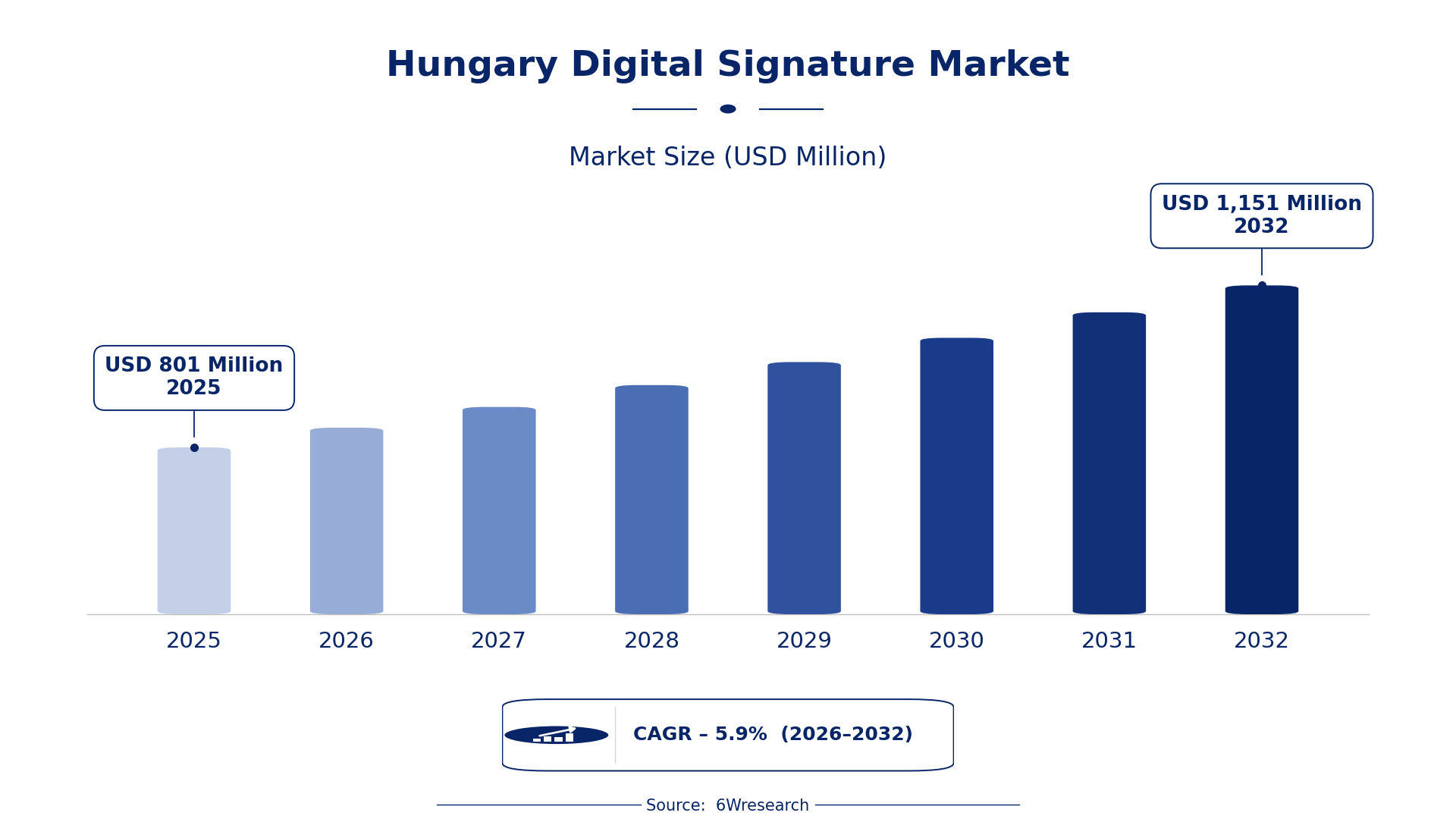
The Hungary Digital Signature Market was estimated at USD 801 Million in 2025 and is projected to reach USD 1151 Million by 2032, growing at a CAGR of 5.9% from 2026 to 2032.
Hungary Digital Signature Market Synopsis
The adoption of digital signatures in Hungary is accelerating, driven by an increasing need for secure and legally binding electronic transactions. Businesses, government agencies, and legal entities are moving away from traditional paper methods, recognizing the efficiency and compliance benefits that digital signatures offer.
This growth is fueled by advances in technology, particularly in cryptography and blockchain, which enhance the integrity and authentication of electronic documents. As organizations pivot toward digitalization, the market is set to gain momentum, attracting investment and innovation.
Hungary Digital Signature Market Year-wise Growth Rate and Key Drivers
This graph illustrates the annual growth rates of the Hungary Digital Signature Market from 2021 to 2032, highlighting a steady upward trajectory and projected expansion over the forecast period.
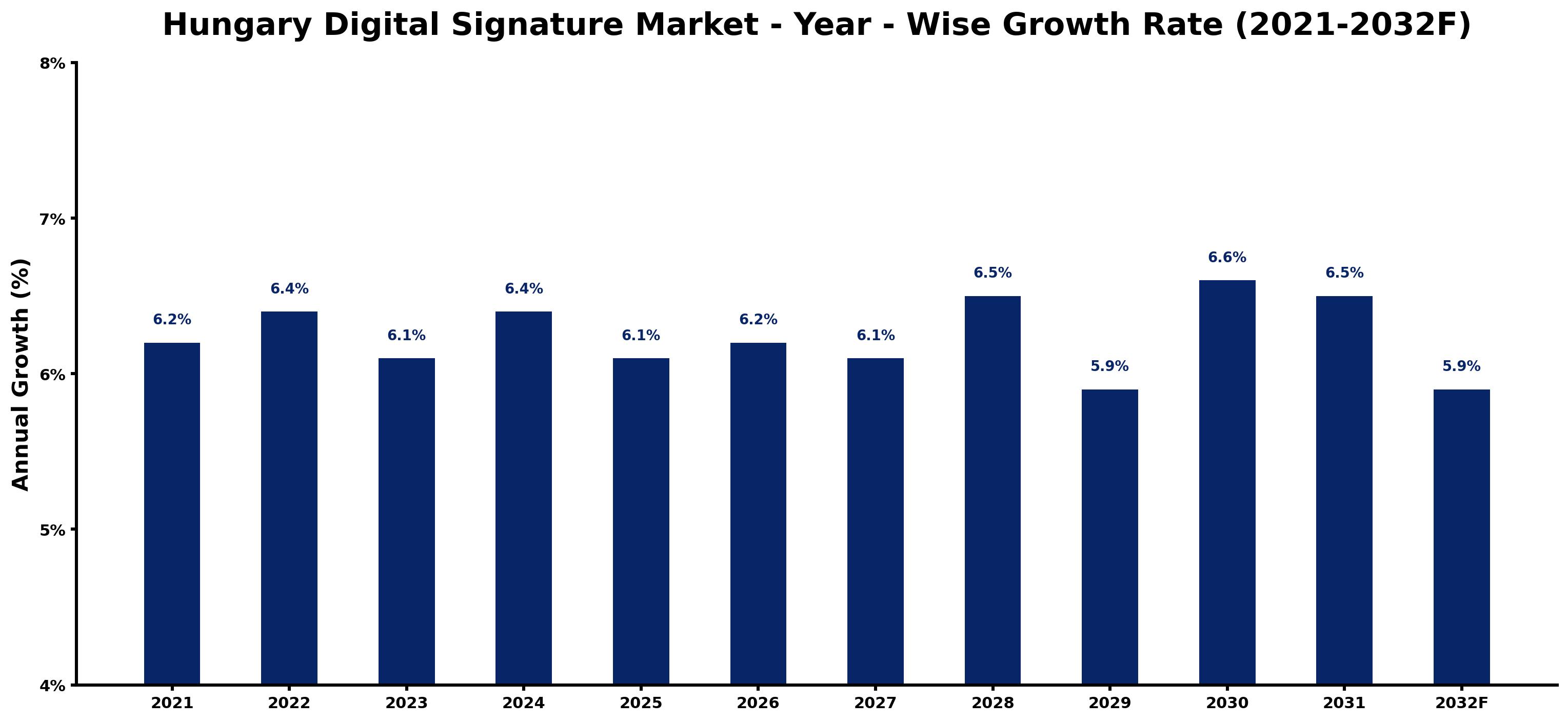
The table below presents the year‑wise growth rates along with the key drivers influencing the market
| Year | Growth Rate | Major Drivers |
| 2021 | 6.2% | Hungarian government promotes digital identity utilization |
| 2022 | 6.4% | New e-signature regulations by the National Authority |
| 2023 | 6.1% | Increased remote work driving digital document signing |
| 2024 | 6.4% | EU funding for digital transformation projects in Hungary |
| 2025 | 6.1% | Rising e-commerce in Hungary boosting signature needs |
| 2026 | 6.2% | Growing adoption of FinTech solutions requiring digital signatures |
| 2027 | 6.1% | Healthcare sector digitization increases demand for e-signatures |
| 2028 | 6.5% | Legal framework for online contracts strengthening market growth |
| 2029 | 5.9% | Education sector embracing digital platforms for document signing |
| 2030 | 6.6% | Compliance with GDPR enhances digital signature usage |
| 2031 | 6.5% | Public sector pushing for paperless transactions via e-signatures |
| 2032 | 5.9% | SMEs increasingly adopting e-signatures for operational efficiency |
Note: Market size estimations and growth projections presented in this report are based on 6Wresearch's proprietary forecasting methodology, utilizing the latest available industry data, government publications, and primary research inputs.
Hungary Digital Signature Market Key Takeaways
Below are some of the specific key takeaways from the market, including:
- The market is witnessing a shift toward electronic solutions that streamline workflows and reduce reliance on paper.
- Growth is spurred by increased regulatory support and demand for compliance with data protection standards.
- Technological advancements in security protocols are improving the reliability of digital signatures.
- The rise of e-government initiatives is further driving the adoption of digital signature solutions.
- Interoperability issues and security concerns remain areas requiring focused attention to enable broader acceptance.
Evaluation of Restraints in Hungary Digital Signature Market
Despite the positive outlook, the Hungary digital signature market faces several restraints that could limit its growth. Security and legal validity are paramount concerns for technology providers who must ensure their solutions meet stringent regulatory requirements. Additionally, the complexities surrounding interoperability between various systems can hinder seamless adoption across different sectors. The market players also struggle with the evolving nature of regulations that can impact implementation timelines and costs, creating uncertainty for stakeholders.
Hungary Digital Signature Market Trends
Several trends are emerging in the Hungary digital signature market. A clear shift towards cloud-based solutions is becoming apparent, as organizations favor scalable options that reduce IT overhead. Enhanced user experiences, driven by intuitive interfaces and mobile capabilities, are attracting a broader customer base. Furthermore, the integration of artificial intelligence and machine learning in authentication processes is improving security measures and efficiency in verification.
Hungary Digital Signature Market Opportunities
Opportunities for growth in this market are substantial. The increasing emphasis on digital transformation across various sectors means that businesses are actively seeking efficient, compliant solutions to meet their needs. Additionally, as remote work becomes more prevalent, organizations are adopting digital signatures to facilitate document transactions securely and conveniently. The ongoing investments in e-government initiatives provide a fertile ground for technological adoption and partnerships.
Government Initiatives in the Hungary Digital Signature Market
Government policy in Hungary plays a crucial role in shaping the digital signature market. The regulatory framework surrounding electronic signatures is evolving to support secure digital transactions and enhance public trust. This focus on regulation is vital for ensuring compliance and facilitating broader adoption of digital signature solutions.
- A regulatory framework introduced in 2025 mandates secure electronic signature usage across public sector contracts.
- Currently ongoing, a national digital identity program aims to improve accessibility and security for citizens engaged in digital transactions.
- Planned initiatives for 2026 include a comprehensive review of electronic document management standards to bolster market growth.
- Recent efforts to promote e-government services through funding initiatives are encouraging the uptake of digital signatures across municipalities.
- The establishment of a dedicated body to oversee the implementation of digital signature regulations was completed in late 2025.
Future Insights of the Hungary Digital Signature Market
Looking ahead to 2026-2032, the Hungary digital signature market is expected to continue its upward trajectory. With increasing government backing and a cultural shift toward digital solutions, the landscape will likely see enhanced innovations. As companies prioritize compliance and efficiency, the necessity for reliable digital signature solutions will become more pronounced. The intersection of emerging technologies such as blockchain and advanced cryptography will play a critical role in shaping the future of this market.
Hungary Digital Signature Market Latest Developments
The last year has seen a flurry of activity in the Hungary digital signature market. Vendors are actively investing in technology upgrades and partnerships to enhance their offerings and respond to the growing demand for secure electronic transactions. With regulatory changes underway, stakeholders are adapting quickly to maintain compliance and improve user trust.
- A major technology vendor announced a new cloud-based digital signature solution in early 2025, aimed at improving user accessibility and security features.
- In mid-2025, a consortium of firms began a pilot project to integrate blockchain technology into digital signature systems for enhanced security.
- An initiative that commenced in late 2025 is focused on building public awareness regarding the benefits and use of digital signatures.
- Expected to begin in Q2 2026, a public-private partnership will introduce a digital signature training program to support businesses transitioning to electronic solutions.
- A recently completed upgrade of the national digital identity platform in early 2025 is now facilitating faster electronic transactions across government services.
Hungary Digital Signature Market - Key Attractiveness of the Report
- 10 Years of Market Numbers
- Historical Data Starting from 2022 to 2025
- Base Year: 2025
- Forecast Data until 2032
- Key Performance Indicators Impacting the Market
- Major Upcoming Developments and Projects
Key Highlights of the Report:
- Hungary Digital Signature Market Outlook
- Market Size of Hungary Digital Signature Market, 2025
- Forecast of Hungary Digital Signature Market, 2032
- Historical Data and Forecast of Hungary Digital Signature Revenues & Volume for the Period 2022-2032F
- Hungary Digital Signature Market Trend Evolution
- Hungary Digital Signature Market Drivers and Challenges
- Hungary Digital Signature Price Trends
- Hungary Digital Signature Porter's Five Forces
- Hungary Digital Signature Industry Life Cycle
- Historical Data and Forecast of Hungary Digital Signature Market Revenues & Volume By Component for the Period 2022-2032F
- Historical Data and Forecast of Hungary Digital Signature Market Revenues & Volume By Solutions for the Period 2022-2032F
- Historical Data and Forecast of Hungary Digital Signature Market Revenues & Volume By Services for the Period 2022-2032F
- Historical Data and Forecast of Hungary Digital Signature Market Revenues & Volume By Solution for the Period 2022-2032F
- Historical Data and Forecast of Hungary Digital Signature Market Revenues & Volume By Software for the Period 2022-2032F
- Historical Data and Forecast of Hungary Digital Signature Market Revenues & Volume By Hardware for the Period 2022-2032F
- Historical Data and Forecast of Hungary Digital Signature Market Revenues & Volume By Vertical for the Period 2022-2032F
- Historical Data and Forecast of Hungary Digital Signature Market Revenues & Volume By BFSI for the Period 2022-2032F
- Historical Data and Forecast of Hungary Digital Signature Market Revenues & Volume By Government for the Period 2022-2032F
- Historical Data and Forecast of Hungary Digital Signature Market Revenues & Volume By Defense for the Period 2022-2032F
- Historical Data and Forecast of Hungary Digital Signature Market Revenues & Volume By Legal for the Period 2022-2032F
- Historical Data and Forecast of Hungary Digital Signature Market Revenues & Volume By Real Estate for the Period 2022-2032F
- Historical Data and Forecast of Hungary Digital Signature Market Revenues & Volume By Organization Size for the Period 2022-2032F
- Historical Data and Forecast of Hungary Digital Signature Market Revenues & Volume By Large Enterprises for the Period 2022-2032F
- Historical Data and Forecast of Hungary Digital Signature Market Revenues & Volume By Small and Medium-Sized Enterprises (SMEs) for the Period 2022-2032F
- Historical Data and Forecast of Hungary Digital Signature Market Revenues & Volume By Deployment Mode for the Period 2022-2032F
- Historical Data and Forecast of Hungary Digital Signature Market Revenues & Volume By Cloud for the Period 2022-2032F
- Historical Data and Forecast of Hungary Digital Signature Market Revenues & Volume By On-Premises for the Period 2022-2032F
- Hungary Digital Signature Import Export Trade Statistics
- Market Opportunity Assessment By Component
- Market Opportunity Assessment By Solution
- Market Opportunity Assessment By Vertical
- Market Opportunity Assessment By Organization Size
- Market Opportunity Assessment By Deployment Mode
- Hungary Digital Signature Top Companies Market Share
- Hungary Digital Signature Competitive Benchmarking By Technical and Operational Parameters
- Hungary Digital Signature Company Profiles
- Hungary Digital Signature Key Strategic Recommendations






































