Hungary Distribution Boards Market: Import Trend Analysis
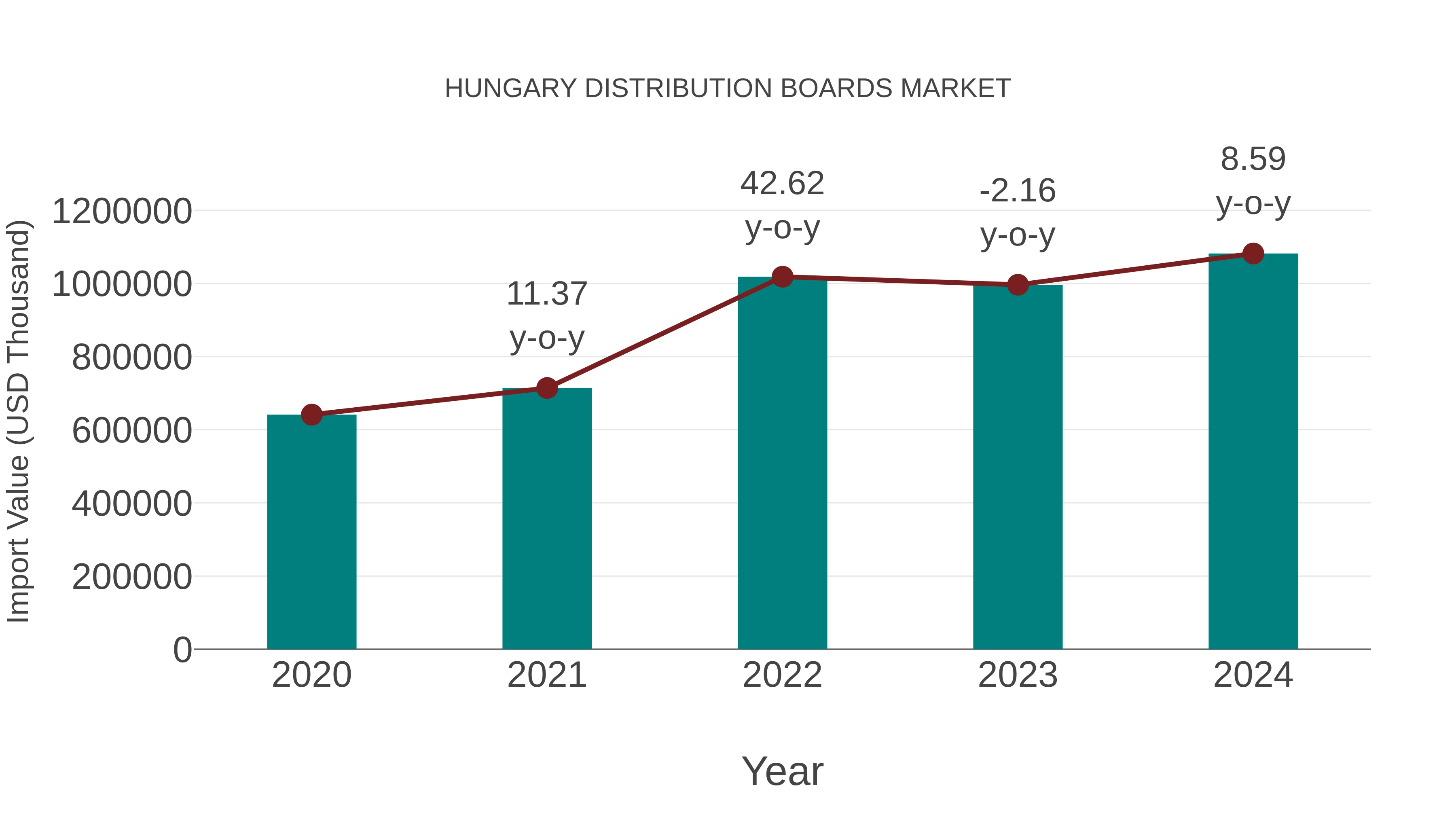
In the Hungary distribution boards market, the import trend showed a notable growth rate of 8.59% from 2023 to 2024, with a compound annual growth rate (CAGR) of 13.97% spanning 2020 to 2024. This robust import momentum can be attributed to increasing demand for quality electrical equipment in the region, indicating a steady market stability over the analyzed period.
Hungary Distribution Boards Market Overview
The Hungary Distribution Boards Market is experiencing steady growth driven by factors such as increasing investments in infrastructure development, rising demand for reliable electricity supply, and the adoption of smart grid technologies. Distribution boards play a critical role in safely distributing electricity within buildings and industrial facilities, ensuring efficient power distribution and protection against electrical faults. Key players in the market are focusing on product innovation, incorporating advanced technologies such as digital monitoring and remote control capabilities to enhance operational efficiency and safety. With the construction sector witnessing growth and the government initiatives supporting energy efficiency measures, the Hungary Distribution Boards Market is poised for further expansion in the coming years.
Hungary Distribution Boards Market Trends
The Hungary Distribution Boards Market is experiencing a trend towards smart and energy-efficient solutions, driven by increasing awareness of sustainability and the need for cost-effective energy management. Manufacturers in the market are focusing on developing products that incorporate advanced technologies such as IoT connectivity, remote monitoring capabilities, and energy management systems to optimize energy consumption and improve overall efficiency. Additionally, there is a growing emphasis on modular and customizable distribution boards to cater to the diverse requirements of different industries and applications. With the increasing adoption of renewable energy sources and the push towards digitalization, the Hungary Distribution Boards Market is expected to continue its trajectory towards innovative and sustainable solutions in the coming years.
Hungary Distribution Boards Market Challenges
In the Hungary Distribution Boards Market, some challenges faced include intense competition among key players leading to price wars, increasing raw material costs impacting profit margins, and the need for continuous innovation to meet changing customer demands. Additionally, stringent regulations and standards governing electrical equipment pose a challenge for manufacturers in terms of compliance and certification requirements. The market also faces the challenge of adapting to emerging technologies such as smart grids and renewable energy sources, necessitating investments in research and development to stay relevant in a rapidly evolving industry landscape. Overall, navigating these challenges requires companies in the Hungary Distribution Boards Market to be agile, cost-effective, and responsive to market dynamics to maintain a competitive edge and sustain growth.
Hungary Distribution Boards Market Investment Opportunities
The Hungary Distribution Boards Market presents investment opportunities in the growing demand for smart and energy-efficient solutions. With increasing focus on sustainable practices and technological advancements, there is a rising need for distribution boards that can optimize energy usage and offer remote monitoring capabilities. Investing in innovative products such as smart distribution boards that integrate IoT technology for real-time data analysis and control can be lucrative. Additionally, the market is witnessing a trend towards modular and customizable distribution boards to meet specific customer requirements. Collaborating with local manufacturers to develop tailored solutions or expanding distribution networks to reach a wider customer base can also be strategic investment opportunities in the Hungary Distribution Boards Market.
Hungary Distribution Boards Market Government Policy
Government policies related to the Hungary Distribution Boards Market primarily focus on ensuring compliance with safety standards, promoting energy efficiency, and encouraging innovation in the sector. The Hungarian government has implemented regulations that require distribution boards to meet specific technical criteria to guarantee the safety of electrical installations. Additionally, there are incentives and subsidies available to companies that invest in energy-efficient distribution boards, aligning with the country`s efforts to reduce energy consumption and greenhouse gas emissions. The government also supports research and development initiatives in the market to foster innovation and drive technological advancements. Overall, these policies aim to create a competitive and sustainable distribution boards market in Hungary while prioritizing safety, efficiency, and innovation.
Hungary Distribution Boards Market Future Outlook
The Hungary Distribution Boards Market is projected to witness steady growth over the coming years, driven by increasing investments in residential, commercial, and industrial infrastructure. With the rising demand for electricity and the shift towards renewable energy sources, there is a growing need for efficient and reliable distribution boards to manage and distribute power effectively. The market is also expected to benefit from technological advancements such as smart distribution boards that offer improved monitoring and control capabilities. Additionally, government initiatives aimed at modernizing the country`s electrical infrastructure are likely to further propel market growth. Overall, the Hungary Distribution Boards Market is anticipated to expand as the country continues to focus on enhancing its energy infrastructure and ensuring a reliable power supply for various applications.
Key Highlights of the Report:
- Hungary Distribution Boards Market Outlook
- Market Size of Hungary Distribution Boards Market, 2025
- Forecast of Hungary Distribution Boards Market, 2032
- Historical Data and Forecast of Hungary Distribution Boards Revenues & Volume for the Period 2022 - 2032F
- Hungary Distribution Boards Market Trend Evolution
- Hungary Distribution Boards Market Drivers and Challenges
- Hungary Distribution Boards Price Trends
- Hungary Distribution Boards Porter's Five Forces
- Hungary Distribution Boards Industry Life Cycle
- Historical Data and Forecast of Hungary Distribution Boards Market Revenues & Volume By Voltage Rating for the Period 2022 - 2032F
- Historical Data and Forecast of Hungary Distribution Boards Market Revenues & Volume By Low Voltage for the Period 2022 - 2032F
- Historical Data and Forecast of Hungary Distribution Boards Market Revenues & Volume By Medium Voltage for the Period 2022 - 2032F
- Historical Data and Forecast of Hungary Distribution Boards Market Revenues & Volume By End Use for the Period 2022 - 2032F
- Historical Data and Forecast of Hungary Distribution Boards Market Revenues & Volume By Transmission & Distribution Utilities for the Period 2022 - 2032F
- Historical Data and Forecast of Hungary Distribution Boards Market Revenues & Volume By Manufacturing & Processing Industry for the Period 2022 - 2032F
- Historical Data and Forecast of Hungary Distribution Boards Market Revenues & Volume By Commercial & Residential for the Period 2022 - 2032F
- Historical Data and Forecast of Hungary Distribution Boards Market Revenues & Volume By Others for the Period 2022 - 2032F
- Hungary Distribution Boards Import Export Trade Statistics
- Market Opportunity Assessment By Voltage Rating
- Market Opportunity Assessment By End Use
- Hungary Distribution Boards Top Companies Market Share
- Hungary Distribution Boards Competitive Benchmarking By Technical and Operational Parameters
- Hungary Distribution Boards Company Profiles
- Hungary Distribution Boards Key Strategic Recommendations






































