Hungary Electrical and electronics Market Summary
The hungary electrical and electronics market was estimated at USD 355 Million in 2025 and is projected to reach USD 487 Million by 2032, growing at a CAGR of 5.6% from 2026 to 2032.
Hungary Electrical and electronics Market Year-wise Growth Rate and Key Drivers
This graph highlights how the Hungary Electrical and electronics Market has steadily grown over the past five years, supported by major growth factors.
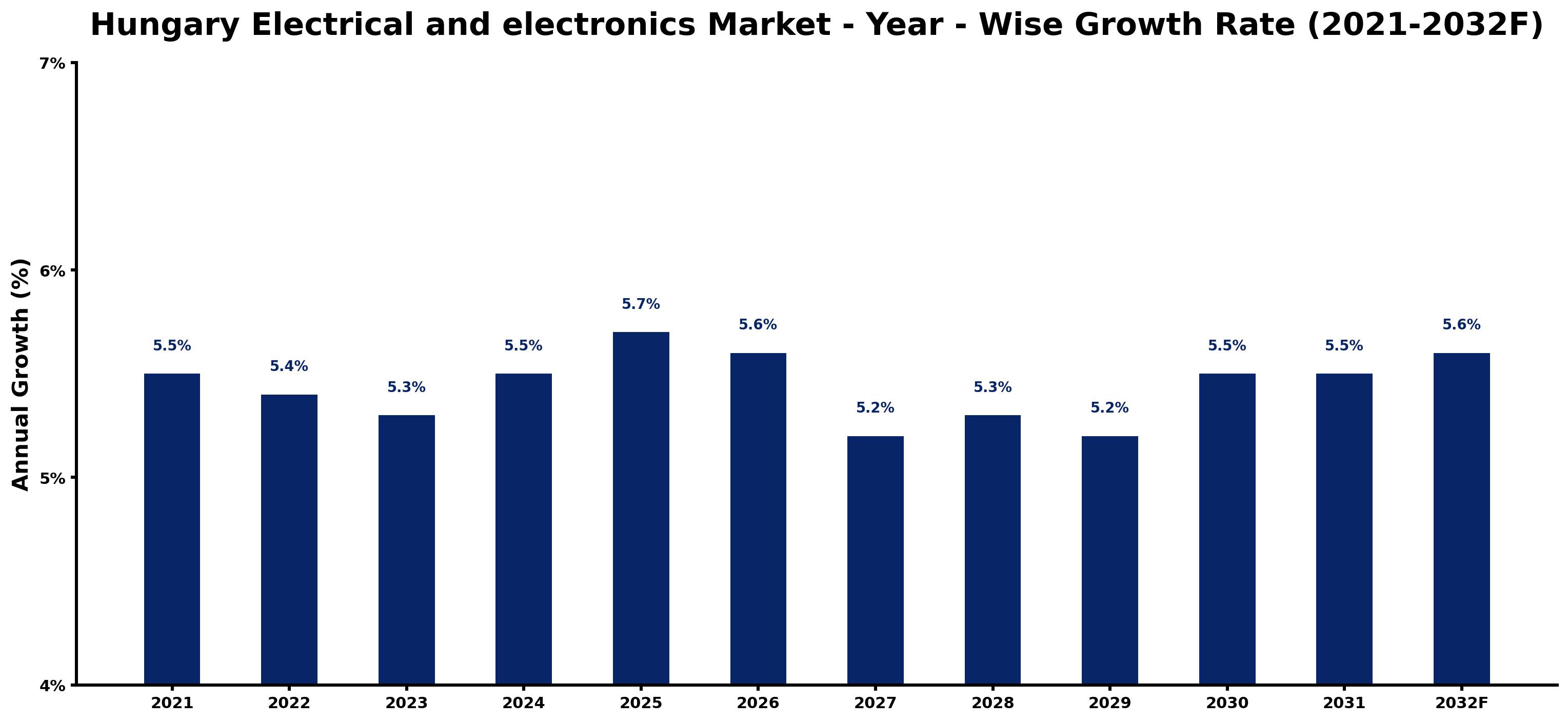
The table below presents the year wise growth rates along with the key drivers influencing the market
| Year | Growth Rate | Major Drivers |
| 2021 | 5.5% | Post-lockdown retail projects revitalized consumer electronics spending across Hungary's urban centers. |
| 2022 | 5.4% | Emerging local startups began introducing innovative smart home solutions to the market. |
| 2023 | 5.3% | Sustainability trends encouraged manufacturers to focus on energy-efficient product designs. |
| 2024 | 5.5% | Increased disposable income fueled demand for premium audio and visual electronics. |
| 2025 | 5.7% | Local demand for electric vehicles spurred growth in charging infrastructure investments. |
| 2026 | 5.6% | Expansion of e-commerce platforms reshaped consumer electronics purchasing behaviors significantly. |
| 2027 | 5.2% | Legacy copper grid failures prompted investments in modern, resilient electrical systems nationwide. |
| 2028 | 5.3% | Corporate sustainability commitments necessitated the adoption of eco-friendly electronic manufacturing processes. |
| 2029 | 5.2% | Rising interest in home automation systems led to new partnerships among tech companies. |
| 2030 | 5.5% | Regional trade agreements enhanced Hungary's position as a manufacturing and distribution hub. |
| 2031 | 5.5% | Consumer preference shifted towards integrated technology for seamless smart home experiences. |
| 2032 | 5.6% | Advances in digital infrastructure facilitated widespread adoption of IoT devices across households. |
Note - Market size estimations and growth projections presented in this report are based on 6Wresearch's advanced forecasting approach, validated with industry datasets as of June 2026.
Hungary Electrical and electronics Market Synopsis
The Hungary Electrical and electronics Market is projected to reach 5.6% and witness significant growth during the forecast period (2026-2032). This market is fundamentally driven by the increasing demand for smart, energy-efficient products as consumers transition towards more digitized and automated lifestyles. Factors such as rising disposable income, advancements in technology, and a heightened focus on sustainability and renewable energy sources play pivotal roles in shaping market dynamics.
Hungary Electrical and electronics Market Growth Drivers
The growth of the Hungary Electrical and electronics Market is underpinned by several key drivers:
- Technological advancements are continually evolving the landscape of the electrical and electronics sector, fostering innovation in product development. This includes the proliferation of smart devices that integrate seamless connectivity and automation capabilities.
- The rising disposable income among the Hungarian population enables greater spending on consumer electronics, spanning categories such as smartphones, home appliances, and innovative electronic solutions.
- The trend towards automation across various sectors fuels demand for industrial electronics, as businesses strive for efficiency and operational optimization.
- Renewable energy initiatives in Hungary further stimulate the market, as consumers and industries increasingly adopt eco-friendly solutions and energy-efficient products, reducing their carbon footprint.
- The growing population and urbanization contribute to the demand for advanced electrical infrastructure, thereby bolstering the growth of the electrical equipment segment.
Hungary Electrical and electronics Market Trends and Opportunities
Currently, the Hungary Electrical and electronics Market is undergoing a transformative phase characterized by notable trends:
- There is an escalating interest in smart home technology, which encompasses smart lighting, connected thermostats, and advanced security systems, reflecting consumer preferences for convenience and efficiency.
- Sustainability is becoming a critical focus in product development; manufacturers are increasingly committing to eco-friendly practices, including energy-efficient designs and sustainable materials.
- E-commerce plays a significant role in reshaping consumer buying behaviors, with an upsurge in online purchases of electrical and electronics products, providing retailers with new opportunities.
- The growth of Internet of Things (IoT) devices drives demand for interconnectivity solutions, enabling consumers to control and automate home environments through mobile applications and cloud technology.
- Further investment in electric vehicle infrastructure is expected, reflecting the global push towards electrification and reducing reliance on fossil fuels, thereby creating opportunities in related sectors.
Hungary Electrical and electronics Market Challenges and Restraints
Despite the positive outlook, several challenges could impede the growth of the Hungary Electrical and electronics Market:
- Intensifying competition from both domestic and international players compels firms to innovate continuously while maintaining competitive pricing, impacting margins and market share.
- Rapid technological advancements necessitate significant investments in R&D; companies must remain agile and responsive to evolving market demands and trends.
- Changes in regulatory requirements and compliance obligations could create challenges for new product launches, affecting timelines and operational strategies.
- Fluctuations in raw material costs and currency exchange rates complicate pricing strategies and could squeeze profit margins for manufacturers and distributors alike.
- The need to balance innovation with environmental responsibility might pose challenges, as companies must integrate sustainability into their product development processes while meeting consumer expectations.
Hungary Electrical and electronics Market Investment Opportunities
Investment opportunities within the Hungary Electrical and electronics Market reveal promising potential:
- Smart home technologies represent a vibrant area for investment, as the demand for integrated and efficient solutions continues to escalate among consumers.
- Renewable energy systems are gaining traction, providing investors opportunities to invest in projects that support sustainable development and energy independence.
- Electronic components manufacturing offers significant growth potential, buoyed by the ongoing demand for high-quality and reliable electronic components in various applications.
- The push for electric vehicle infrastructure is a critical growth area, presenting opportunities for companies involved in manufacturing charging stations and related technologies.
- Public-private partnerships may provide avenues for investment in cutting-edge research, enhancing the development of technologies that meet future market needs.
Hungary Electrical and electronics Market Government Investment and Initiatives
In Hungary, government policies significantly influence the electrical and electronics market, focusing on innovation, sustainability, and competitiveness:
- The government actively promotes initiatives for research and development, offering incentives such as tax breaks and various funding programs to stimulate innovation within the sector.
- Regulations ensuring safety and quality for electrical and electronic products help maintain high standards across the market, aligning with European Union compliance measures.
- Initiatives aimed at enhancing energy efficiency are encouraged, with incentives designed to foster the adoption of green technologies and practices among businesses.
- Public investment in infrastructure development aligns with the country's strategic goals, aimed at modernizing the electrical grid and promoting the use of smart technologies.
- Collaborative efforts between government entities and private sectors aim to create an environment conducive to sustainable growth and technological advancements in the electrical and electronics market.
Hungary Electrical and electronics Market Latest Developments (May 2025 - June 2026)
The Hungary Electrical and electronics Market has seen significant developments from May 2025 to June 2026, highlighting the dynamic nature of the industry:
- An increase in strategic partnerships among local companies and international firms has been observed, focusing on joint ventures aimed at enhancing technological capabilities.
- Several initiatives were launched to promote renewable energy solutions, emphasizing the government's commitment to sustainability and reducing dependency on non-renewable sources.
- Investment in electric vehicle infrastructure has accelerated, with the expansion of charging stations and related services to support the growing electric vehicle market.
- Consumer interest in smart and connected devices has surged, prompting manufacturers to diversify product offerings and enhance features to meet evolving demands.
- E-commerce channels have expanded significantly, with increased online sales reflecting changing consumer preferences and shopping behaviors in the electrical and electronics sector.
Hungary Electrical and electronics Market - Key Attractiveness of the Report
- 10 Years of Market Numbers
- Historical Data Starting from 2022 to 2025
- Base Year: 2025
- Forecast Data until 2032
- Key Performance Indicators Impacting the Market
- Major Upcoming Developments and Projects
Key Highlights of the Report:
- Hungary Electrical and electronics Market Outlook
- Market Size of Hungary Electrical and electronics Market, 2025
- Forecast of Hungary Electrical and electronics Market, 2032F
- Historical Data and Forecast of Hungary Electrical and electronics Revenues & Volume for the Period 2022-2032F
- Hungary Electrical and electronics Market Trend Evolution
- Hungary Electrical and electronics Market Drivers and Challenges
- Hungary Electrical and electronics Price Trends
- Hungary Electrical and electronics Porter's Five Forces
- Hungary Electrical and electronics Industry Life Cycle
- Historical Data and Forecast of Hungary Electrical and electronics Market Revenues & Volume By Type for the Period 2022-2032F
- Historical Data and Forecast of Hungary Electrical and electronics Market Revenues & Volume By Electric Motors for the Period 2022-2032F
- Historical Data and Forecast of Hungary Electrical and electronics Market Revenues & Volume By Primary And Storage Batteries for the Period 2022-2032F
- Historical Data and Forecast of Hungary Electrical and electronics Market Revenues & Volume By Generators for the Period 2022-2032F
- Historical Data and Forecast of Hungary Electrical and electronics Market Revenues & Volume By Semiconductors for the Period 2022-2032F
- Historical Data and Forecast of Hungary Electrical and electronics Market Revenues & Volume By Household Appliances for the Period 2022-2032F
- Historical Data and Forecast of Hungary Electrical and electronics Market Revenues & Volume By Applications for the Period 2022-2032F
- Historical Data and Forecast of Hungary Electrical and electronics Market Revenues & Volume By Online for the Period 2022-2032F
- Historical Data and Forecast of Hungary Electrical and electronics Market Revenues & Volume By Offline for the Period 2022-2032F
- Hungary Electrical and electronics Import Export Trade Statistics
- Market Opportunity Assessment By Type
- Market Opportunity Assessment By Applications
- Hungary Electrical and electronics Top Companies Market Share
- Hungary Electrical and electronics Competitive Benchmarking By Technical and Operational Parameters
- Hungary Electrical and electronics Company Profiles
- Hungary Electrical and electronics Key Strategic Recommendations






































