Hungary Facility Management Market Size & Growth Rate (2026-2032)
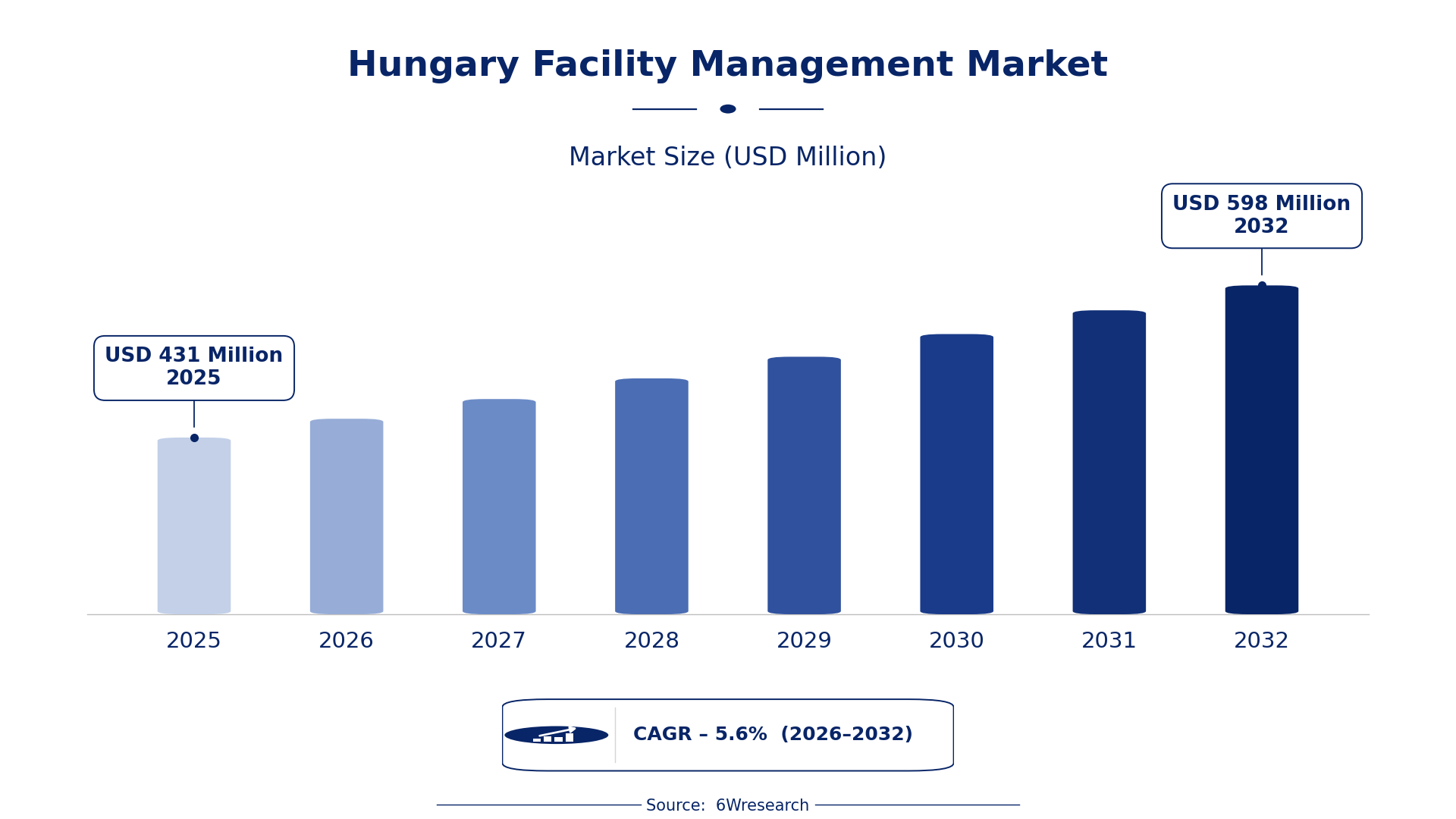
The Hungary Facility Management Market was estimated at USD 431 Million in 2025 and is projected to reach USD 598 Million by 2032, growing at a CAGR of 5.6% from 2026 to 2032.
Hungary Facility Management Market Synopsis
The Hungary Facility Management Market is currently witnessing a positive trajectory, fueled by a robust push for operational efficiency and cost-effectiveness. As businesses increasingly recognize the strategic advantages of outsourcing facility management, this sector is expected to expand significantly in the coming years, aligning with global trends towards integrated services.
Emerging technologies such as IoT and AI are reshaping service delivery, offering innovative solutions that enhance facility management. However, challenges such as regulatory inconsistencies and a shortage of skilled labor may impact growth. Stakeholders should focus on strategic adaptations to harness the full potential of this evolving market.
Hungary Facility Management Market Year-wise Growth Rate and Key Drivers
This graph illustrates the annual growth rates of the Hungary Facility Management Market from 2021 to 2032, highlighting a steady upward trajectory and projected expansion over the forecast period.
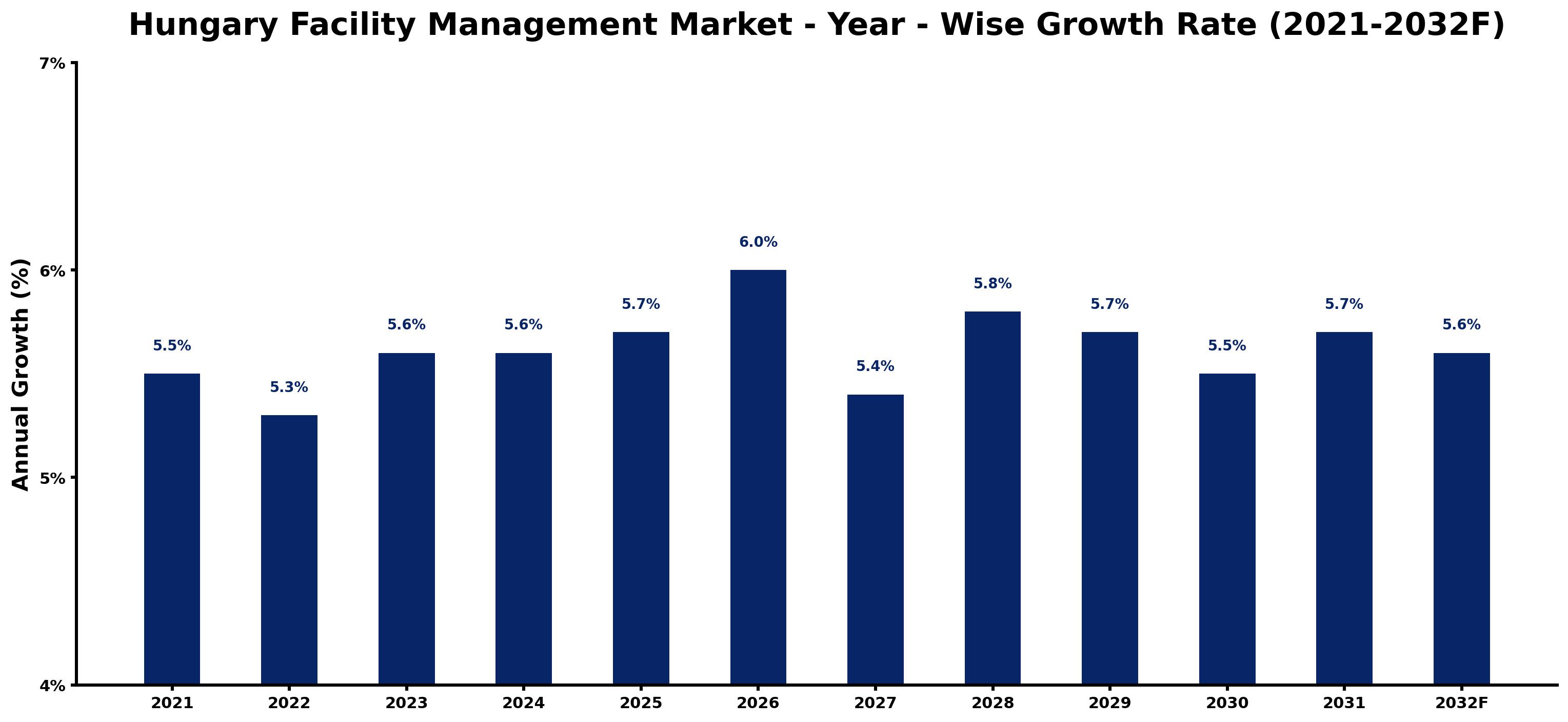
The table below presents the year‑wise growth rates along with the key drivers influencing the market
| Year | Growth Rate | Major Drivers |
| 2021 | 5.5% | Increased EU funding for sustainable building renovations. |
| 2022 | 5.3% | Government incentive for energy-efficient facility upgrades. |
| 2023 | 5.6% | Rise in smart building solutions adoption among businesses. |
| 2024 | 5.6% | Local regulations promoting green building certifications. |
| 2025 | 5.7% | Growing corporate focus on workplace wellness initiatives. |
| 2026 | 6.0% | Emergence of advanced building automation technologies. |
| 2027 | 5.4% | Increased focus on compliance with health regulations. |
| 2028 | 5.8% | Investment in digital twin technology for facilities. |
| 2029 | 5.7% | Trend towards flexible workspace solutions in startups. |
| 2030 | 5.5% | Government support for smart city facility innovations. |
| 2031 | 5.7% | Surge in digital facility management training programs. |
| 2032 | 5.6% | Increased integration of AI in facility operations. |
Note: Market size estimations and growth projections presented in this report are based on 6Wresearch's proprietary forecasting methodology, utilizing the latest available industry data, government publications, and primary research inputs.
Hungary Facility Management Market Key Takeaways
Below are some of the specific key takeaways from the market, including:
- Growing emphasis on integrated facility management services is driving demand across various sectors.
- Smart technologies are gaining traction, leading to enhanced energy management and operational efficiency.
- The shift towards sustainability is prompting service providers to adopt eco-friendly practices.
- Outsourcing is increasingly seen as a strategic move by businesses to streamline operations.
- Government initiatives are aimed at promoting industry standards and sustainable practices.
Evaluation of Restraints in Hungary Facility Management Market
The Hungary Facility Management Market faces several restraints that hinder its growth. A primary concern is the lack of standardized regulations, which results in inconsistent service quality across providers. This inconsistency can undermine client trust and deter investment.
on top of that, many businesses remain unaware of the potential benefits of outsourcing these services, leading to hesitance in making necessary investments. The market is also grappling with a shortage of qualified professionals, which poses a significant barrier to delivering high-quality services consistently.
Hungary Facility Management Market Trends
The ongoing trend towards smart building technologies is fundamentally changing how facility management operates in Hungary. The integration of IoT devices and data analytics is optimizing energy usage and performance monitoring, enabling real-time decision-making. Sustainability has also emerged as a critical focus area, with businesses increasingly adopting green practices in their operations.
Additionally, the demand for integrated facility management solutions is rising, as companies seek comprehensive service offerings that cover maintenance, security, and cleaning under one umbrella. This trend reflects a broader shift towards streamlined operations and efficiency.
Hungary Facility Management Market Opportunities
Opportunities abound in the Hungary Facility Management Market, particularly for providers that can offer innovative and sustainable solutions. The increasing focus on energy efficiency and cost reduction makes it an attractive space for investments in smart technologies.
on top of that, as more sectors like healthcare and retail expand, the demand for specialized facility management services will likely grow. Companies that can adapt to changing client needs and provide tailored solutions are well-positioned to thrive in this evolving market.
Government Initiatives in the Hungary Facility Management Market
Government policies are significantly influencing the Hungary Facility Management Market, particularly in terms of sustainability and regulatory compliance. The Hungarian government has prioritized energy efficiency and waste management, creating a framework that encourages facility management companies to align with these standards. Such initiatives are essential for promoting innovation and ensuring fair competition within the sector.
- A regulatory framework introduced in 2025 mandates energy efficiency standards for facility management services.
- Currently ongoing initiatives focus on incentivizing businesses to adopt environmentally-friendly technologies.
- A planned public-private partnership is expected to enhance sustainability practices within the facility management sector by 2027.
- New legislation aimed at improving procurement transparency is set to roll out in late 2025.
- Subsidies for companies investing in green technologies are currently being offered to encourage compliance with environmental regulations.
Future Insights of the Hungary Facility Management Market
Looking ahead to 2026-2032, the Hungary Facility Management Market is expected to expand steadily as awareness around the benefits of outsourcing continues to rise. Companies will increasingly seek to improve operational efficiency while minimizing costs, leading to a greater demand for integrated solutions.
The ongoing shift towards smart technologies, alongside sustainability initiatives, will likely drive demand for advanced facility management solutions. As businesses embrace digital transformation, the sector will see a movement toward predictive maintenance strategies and enhanced service delivery models.
Hungary Facility Management Market Latest Developments
Recent activity in the Hungary Facility Management Market indicates a strong push towards innovation and efficiency. Over the past year, various developments have emerged that highlight the sector's adaptability and focus on sustainability. Service providers are increasingly aligning their offerings with evolving market demands and technological advancements.
- A major technology vendor launched a new IoT-based facility management platform in early 2025, enhancing real-time monitoring capabilities.
- In mid-2025, a leading regional operator began an initiative to implement energy-efficient systems across its portfolio of managed properties.
- Planned for late 2025, a service provider is set to introduce a comprehensive training program aimed at addressing the skills shortage in the sector.
- Current partnerships between FM companies and tech firms are underway to develop smart building solutions, enhancing operational efficiency.
- An expansion of eco-friendly service offerings is expected to roll out by early 2026, catering to the growing demand for sustainable practices.
Hungary Facility Management Market - Key Attractiveness of the Report
- 10 Years of Market Numbers
- Historical Data Starting from 2022 to 2025
- Base Year: 2025
- Forecast Data until 2032
- Key Performance Indicators Impacting the Market
- Major Upcoming Developments and Projects
Key Highlights of the Report:
- Hungary Facility Management Market Outlook
- Market Size of Hungary Facility Management Market, 2025
- Forecast of Hungary Facility Management Market, 2032
- Historical Data and Forecast of Hungary Facility Management Revenues & Volume for the Period 2022-2032F
- Hungary Facility Management Market Trend Evolution
- Hungary Facility Management Market Drivers and Challenges
- Hungary Facility Management Price Trends
- Hungary Facility Management Porter's Five Forces
- Hungary Facility Management Industry Life Cycle
- Historical Data and Forecast of Hungary Facility Management Market Revenues & Volume By Component for the Period 2022-2032F
- Historical Data and Forecast of Hungary Facility Management Market Revenues & Volume By Solutions for the Period 2022-2032F
- Historical Data and Forecast of Hungary Facility Management Market Revenues & Volume By Services for the Period 2022-2032F
- Historical Data and Forecast of Hungary Facility Management Market Revenues & Volume By Deployment Mode for the Period 2022-2032F
- Historical Data and Forecast of Hungary Facility Management Market Revenues & Volume By Cloud for the Period 2022-2032F
- Historical Data and Forecast of Hungary Facility Management Market Revenues & Volume By On-premises for the Period 2022-2032F
- Historical Data and Forecast of Hungary Facility Management Market Revenues & Volume By Organization Size for the Period 2022-2032F
- Historical Data and Forecast of Hungary Facility Management Market Revenues & Volume By Large enterprises for the Period 2022-2032F
- Historical Data and Forecast of Hungary Facility Management Market Revenues & Volume By Small and medium-sized enterprises (SMEs) for the Period 2022-2032F
- Historical Data and Forecast of Hungary Facility Management Market Revenues & Volume By Vertical for the Period 2022-2032F
- Historical Data and Forecast of Hungary Facility Management Market Revenues & Volume By BFSI for the Period 2022-2032F
- Historical Data and Forecast of Hungary Facility Management Market Revenues & Volume By IT and Telecom for the Period 2022-2032F
- Historical Data and Forecast of Hungary Facility Management Market Revenues & Volume By Government and Public Administration for the Period 2022-2032F
- Historical Data and Forecast of Hungary Facility Management Market Revenues & Volume By Healthcare for the Period 2022-2032F
- Historical Data and Forecast of Hungary Facility Management Market Revenues & Volume By Education for the Period 2022-2032F
- Historical Data and Forecast of Hungary Facility Management Market Revenues & Volume By Retail for the Period 2022-2032F
- Historical Data and Forecast of Hungary Facility Management Market Revenues & Volume By Energy and Utilities for the Period 2022-2032F
- Historical Data and Forecast of Hungary Facility Management Market Revenues & Volume By Manufacturing for the Period 2022-2032F
- Hungary Facility Management Import Export Trade Statistics
- Market Opportunity Assessment By Component
- Market Opportunity Assessment By Deployment Mode
- Market Opportunity Assessment By Organization Size
- Market Opportunity Assessment By Vertical
- Hungary Facility Management Top Companies Market Share
- Hungary Facility Management Competitive Benchmarking By Technical and Operational Parameters
- Hungary Facility Management Company Profiles
- Hungary Facility Management Key Strategic Recommendations






































