Hungary Fluorochemicals Market: Import Trend Analysis
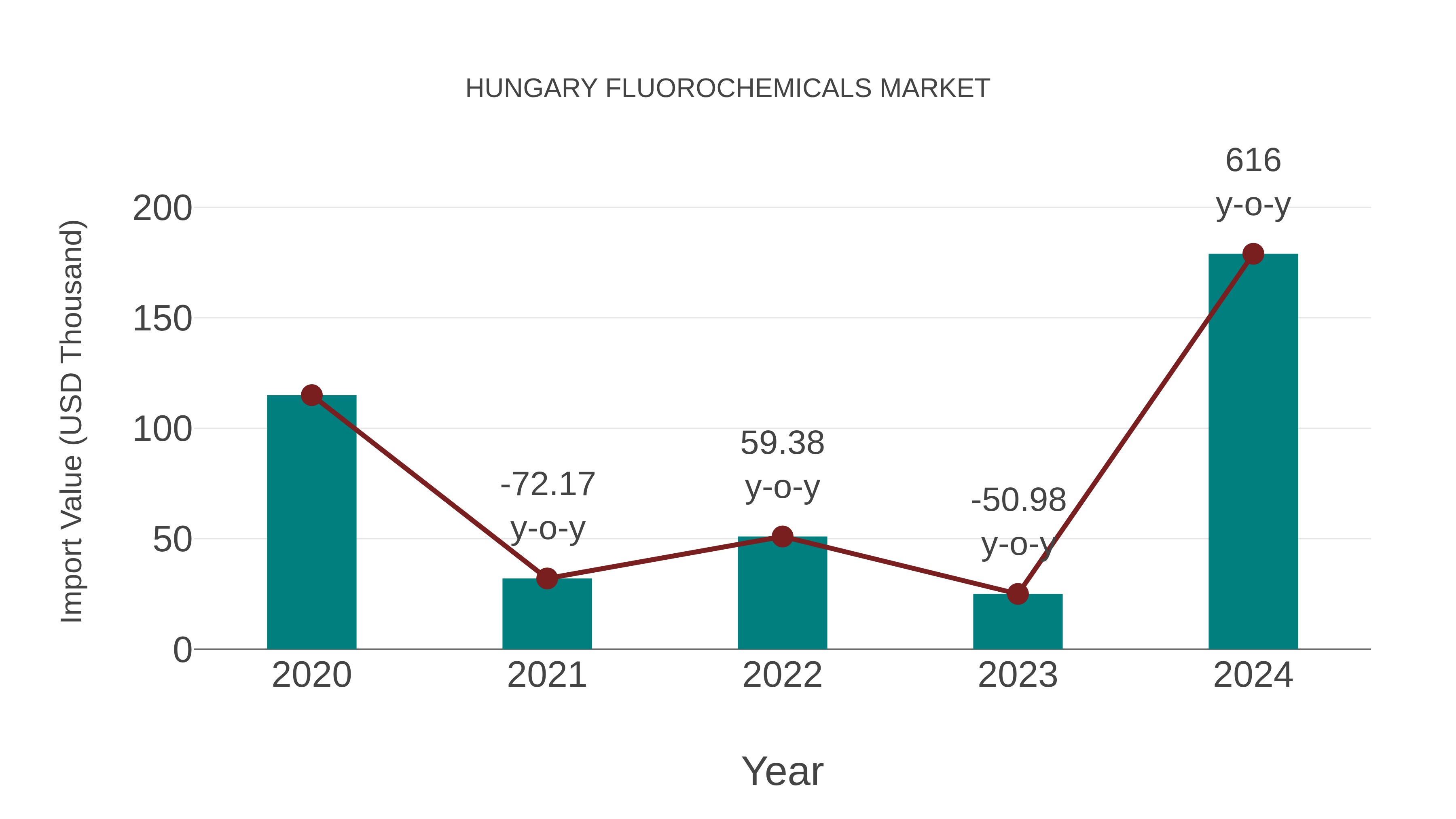
In the Hungary fluorochemicals market, the import trend showed significant growth from 2023 to 2024, with a remarkable rate of 616.0%. The compound annual growth rate (CAGR) for the period 2020-2024 stood at 11.7%. This surge in imports can be attributed to a notable shift in demand for fluorochemicals within the market, indicating a changing landscape in terms of consumer preferences or industrial requirements.
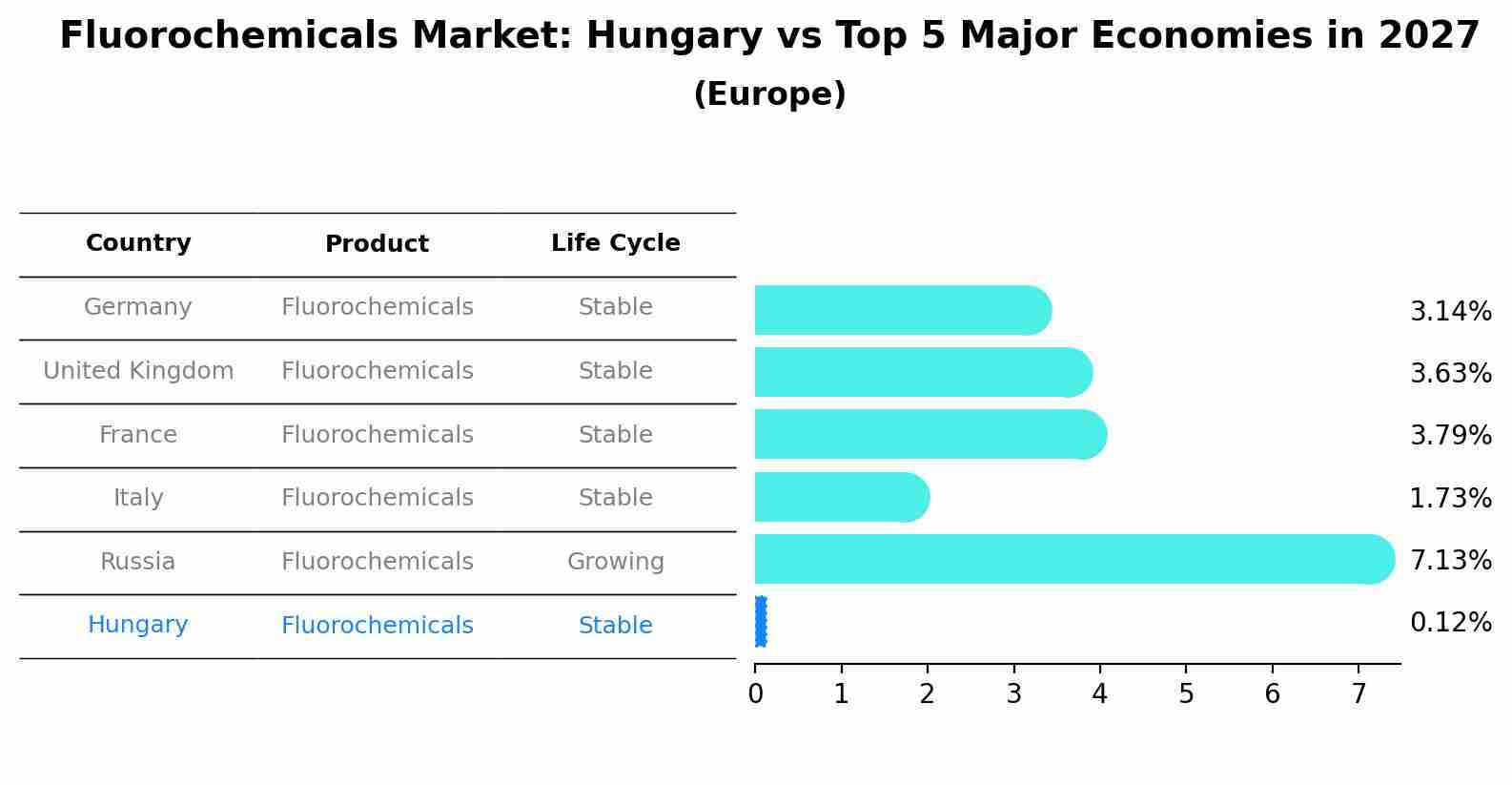
Fluorochemicals Market: Hungary vs Top 5 Major Economies in 2027 (Europe)
In the Europe region, the Fluorochemicals market in Hungary is projected to expand at a stable growth rate of 0.12% by 2027. The largest economy is Germany, followed by United Kingdom, France, Italy and Russia.
Hungary Fluorochemicals Market Overview
Fluorochemicals find extensive applications in refrigeration, air conditioning, and electronics industries in Hungary. The market is driven by the demand for fluoropolymers, fluorocarbons, and fluorinated solvents, owing to their unique properties such as chemical resistance and thermal stability.
Drivers of the market
The Hungary fluorochemicals market is driven by the demand from industries such as refrigeration, air conditioning, electronics, and automotive for fluorinated gases, fluids, and polymers that offer unique properties such as thermal stability, chemical inertness, and low surface tension. Fluorochemicals are used as refrigerants, solvents, lubricants, and surface treatments in various applications where conventional chemicals may not provide adequate performance or environmental compatibility. Moreover, regulatory initiatives to phase out ozone-depleting substances and greenhouse gases further stimulate market growth by driving the adoption of fluorine-based alternatives and eco-friendly technologies.
Challenges of the market
The Hungary fluorochemicals market faces challenges related to environmental regulations and technological advancements. Ensuring compliance with regulations aimed at reducing greenhouse gas emissions and ozone depletion requires innovation in fluorochemical formulations and production processes. Moreover, addressing concerns about the environmental impact of fluorochemicals and exploring sustainable alternatives poses ongoing challenges for market players.
Government Policy of the market
The Hungary government supports the growth of the fluorochemicals market by promoting research and development initiatives, providing financial incentives for investment in production facilities, and fostering collaboration between industry stakeholders and research institutions. Policies aim to enhance the competitiveness of Hungary manufacturers in the global market by encouraging innovation, improving product quality, and expanding the range of applications for fluorochemicals. Additionally, regulations are enforced to ensure compliance with quality standards, safety regulations, and environmental requirements in the production and use of fluorochemicals in Hungary.
Key Highlights of the Report:
- Hungary Fluorochemicals Market Outlook
- Market Size of Hungary Fluorochemicals Market, 2020
- Forecast of Hungary Fluorochemicals Market, 2027
- Historical Data and Forecast of Hungary Fluorochemicals Revenues & Volume for the Period 2018 - 2027
- Hungary Fluorochemicals Market Trend Evolution
- Hungary Fluorochemicals Market Drivers and Challenges
- Hungary Fluorochemicals Price Trends
- Hungary Fluorochemicals Porter's Five Forces
- Hungary Fluorochemicals Industry Life Cycle
- Historical Data and Forecast of Hungary Fluorochemicals Market Revenues & Volume By Product for the Period 2018 - 2027
- Historical Data and Forecast of Hungary Fluorochemicals Market Revenues & Volume By Fuorocarbon for the Period 2018 - 2027
- Historical Data and Forecast of Hungary Fluorochemicals Market Revenues & Volume By Inorganic &Specialities for the Period 2018 - 2027
- Historical Data and Forecast of Hungary Fluorochemicals Market Revenues & Volume By Fluoropolymer for the Period 2018 - 2027
- Historical Data and Forecast of Hungary Fluorochemicals Market Revenues & Volume By Application for the Period 2018 - 2027
- Historical Data and Forecast of Hungary Fluorochemicals Market Revenues & Volume By Refrigerant for the Period 2018 - 2027
- Historical Data and Forecast of Hungary Fluorochemicals Market Revenues & Volume By Aluminium Production for the Period 2018 - 2027
- Historical Data and Forecast of Hungary Fluorochemicals Market Revenues & Volume By Blowing Agent for the Period 2018 - 2027
- Historical Data and Forecast of Hungary Fluorochemicals Market Revenues & Volume By Components & Others for the Period 2018 - 2027
- Hungary Fluorochemicals Import Export Trade Statistics
- Market Opportunity Assessment By Product
- Market Opportunity Assessment By Application
- Hungary Fluorochemicals Top Companies Market Share
- Hungary Fluorochemicals Competitive Benchmarking By Technical and Operational Parameters
- Hungary Fluorochemicals Company Profiles
- Hungary Fluorochemicals Key Strategic Recommendations






































