Hungary Glass Tiles Market Size, Share & Growth Rate
The Hungary Glass Tiles Market was estimated at USD 292 Million in 2025 and is projected to reach USD 414 Million by 2032, growing at a CAGR of 5.1% from 2026 to 2032. This promising trajectory is driven by the booming construction and interior design sectors, which increasingly favor decorative and sustainable tiling solutions. Innovations in manufacturing technology, coupled with an aesthetic shift towards modern and luxurious designs, are further fueling the demand for glass tiles across both residential and commercial spaces.
Hungary Glass Tiles Market Year-wise Growth Rate and Key Drivers
This graph highlights how the Hungary Glass Tiles Market has steadily grown over the years, supported by major growth factors.
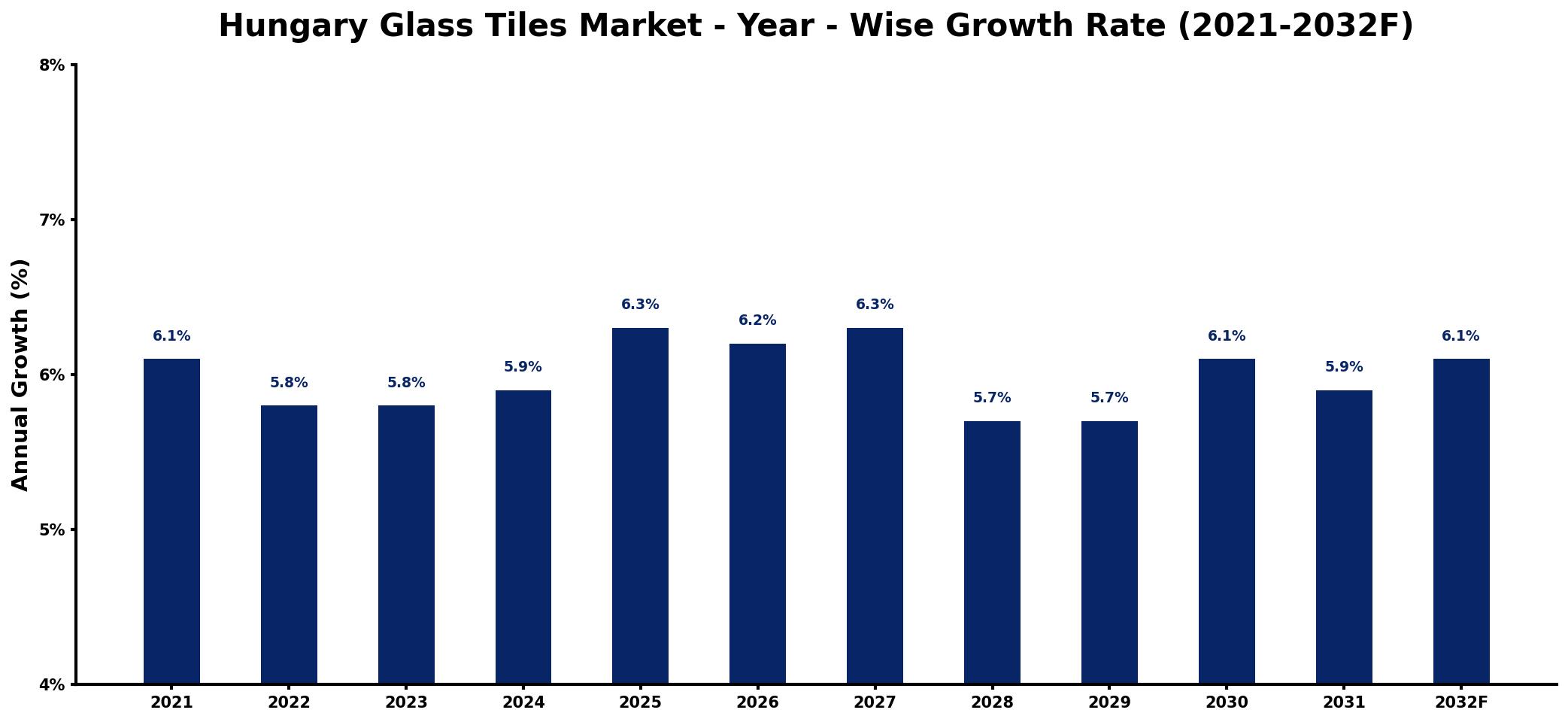
The table below presents the year‑wise growth rates along with the key drivers influencing the market
| Year | Growth Rate | Major Drivers |
| 2021 | 6.1% | Rising demand for sustainable materials |
| 2022 | 5.8% | Increased investment in interior design |
| 2023 | 5.8% | Growing popularity of home renovations |
| 2024 | 5.9% | Expansion of construction projects |
| 2025 | 6.3% | Surge in luxury home features |
| 2026 | 6.2% | Higher consumer disposable income |
| 2027 | 6.3% | Increased focus on aesthetic appeal |
| 2028 | 5.7% | Shift towards eco-friendly alternatives |
| 2029 | 5.7% | Growth in commercial property development |
| 2030 | 6.1% | Rising interest in DIY projects |
| 2031 | 5.9% | increased pharmaceutical industry usage |
| 2032 | 6.1% | Increased urbanization and housing demand |
Note: Market size estimations and growth projections presented in this report are based on 6Wresearch's proprietary forecasting methodology, utilizing the latest available industry data, government publications, and primary research inputs.
Hungary Glass Tiles Market Synopsis
The glass tiles market in Hungary has seen substantial momentum, propelled by a growing preference for stylish and durable materials in various construction applications. This trend reflects a broader cultural shift towards design-driven projects that emphasize sustainability and customization.
Looking ahead, the market is expected to evolve, embracing even more innovative designs and materials. Architects and designers will increasingly seek to incorporate glass tiles in projects, benefiting from advancements in printing techniques and design versatility, which allow for unique aesthetic expressions that resonate with modern sensibilities.
Hungary Glass Tiles Market Key Takeaways
- The market is witnessing robust growth due to rising demand in construction, architecture, and interior design.
- Technological advancements are enhancing product offerings, including design flexibility and customization options.
- Government support and incentives are promoting sustainable building practices, positively impacting market growth.
- Challenges in logistics and manufacturing must be navigated to fully capitalize on market opportunities.
- Market participants are focusing on customer service and innovation to remain competitive and relevant.
Evaluation of Restraints in Hungary Glass Tiles Market
While the Hungary glass tiles market is poised for growth, it faces notable restraints that could impede its trajectory. Key challenges include optimizing tile designs and manufacturing processes to meet consumer demands for aesthetics and durability, which can lead to increased production costs. Additionally, logistical issues surrounding the supply chain for raw materials can disrupt availability, causing delays in project timelines. Compliance with regulatory requirements concerning safety and environmental standards adds another layer of complexity for manufacturers seeking to establish a foothold in the market.
Hungary Glass Tiles Market Trends
Several trends are shaping the Hungary glass tiles market. The push for sustainability is leading to a greater emphasis on eco-friendly materials and production processes, with consumers favoring products that have a lower environmental impact. Additionally, personalization is becoming a key driver, as homeowners and designers seek unique designs and textures that reflect individual styles. Technological advancements, such as digital printing, are allowing for intricate patterns and colors, further enhancing the aesthetic appeal of glass tiles.
Hungary Glass Tiles Market Opportunities
Opportunities for growth within the Hungary glass tiles market are significant, particularly in the realm of residential renovation and commercial construction. As urbanization continues and architectural innovation expands, there is a burgeoning demand for high-quality, visually striking tiles that can elevate interior and exterior spaces. Furthermore, government incentives aimed at promoting modern building practices present avenues for investment, particularly for projects focused on heritage preservation and urban revitalization.
Government Initiatives in the Hungary Glass Tiles Market
The Hungarian government recognizes the critical role of the construction and architectural sectors in enhancing urban aesthetics and driving economic growth. Policies are in place to encourage investment and innovation within the glass tiles market, including financial support programs for architects and designers. These initiatives promote collaboration within the industry and aim to ensure that new developments meet stringent safety, quality, and environmental standards. The government is committed to fostering a market environment conducive to sustainability and aesthetic excellence.
Future Insights of the Hungary Glass Tiles Market
From 2026 to 2032, the Hungary glass tiles market is anticipated to continue its upward trajectory, bolstered by ongoing innovations and shifts in consumer preferences towards stylish and sustainable building materials. The integration of smart technologies in design and manufacturing will likely open new avenues for customization and production efficiency. Moreover, as sustainability becomes increasingly paramount, glass tiles that emphasize eco-friendly practices will likely gain greater market share, positioning the industry well for a future aligned with modern environmental standards and consumer expectations.
Hungary Glass Tiles Market Latest Developments (2025 - 2026)
Recent developments in the Hungary glass tiles market indicate a growing focus on advanced manufacturing processes and sustainable practices. Industry stakeholders are increasingly investing in new technologies that enhance design capabilities while minimizing environmental footprints. Additionally, collaborations among architects and designers are becoming more common, as they seek to push the boundaries of creativity in tile applications. The market is also seeing a rise in awareness of the benefits of glass tiles, leading to increased adoption in both new constructions and renovation projects.
Hungary Glass Tiles Market - Key Attractiveness of the Report
- 10 Years of Market Numbers
- Historical Data Starting from 2022 to 2025
- Base Year: 2025
- Forecast Data until 2032
- Key Performance Indicators Impacting the Market
- Major Upcoming Developments and Projects
Key Highlights of the Report:
- Hungary Glass Tiles Market Outlook
- Market Size of Hungary Glass Tiles Market, 2025
- Forecast of Hungary Glass Tiles Market, 2032
- Historical Data and Forecast of Hungary Glass Tiles Revenues & Volume for the Period 2022-2032F
- Hungary Glass Tiles Market Trend Evolution
- Hungary Glass Tiles Market Drivers and Challenges
- Hungary Glass Tiles Price Trends
- Hungary Glass Tiles Porter's Five Forces
- Hungary Glass Tiles Industry Life Cycle
- Historical Data and Forecast of Hungary Glass Tiles Market Revenues & Volume By Manufacturing Process for the Period 2022-2032F
- Historical Data and Forecast of Hungary Glass Tiles Market Revenues & Volume By Smalti Tiles for the Period 2022-2032F
- Historical Data and Forecast of Hungary Glass Tiles Market Revenues & Volume By Fused Tiles for the Period 2022-2032F
- Historical Data and Forecast of Hungary Glass Tiles Market Revenues & Volume By Sintered Tiles for the Period 2022-2032F
- Historical Data and Forecast of Hungary Glass Tiles Market Revenues & Volume By Cast Tiles for the Period 2022-2032F
- Historical Data and Forecast of Hungary Glass Tiles Market Revenues & Volume By Other for the Period 2022-2032F
- Historical Data and Forecast of Hungary Glass Tiles Market Revenues & Volume By Product Type for the Period 2022-2032F
- Historical Data and Forecast of Hungary Glass Tiles Market Revenues & Volume By Matte-finished Glass Tile for the Period 2022-2032F
- Historical Data and Forecast of Hungary Glass Tiles Market Revenues & Volume By Smooth Glass Tile for the Period 2022-2032F
- Historical Data and Forecast of Hungary Glass Tiles Market Revenues & Volume By End-User Industry for the Period 2022-2032F
- Historical Data and Forecast of Hungary Glass Tiles Market Revenues & Volume By Residential for the Period 2022-2032F
- Historical Data and Forecast of Hungary Glass Tiles Market Revenues & Volume By Commercial for the Period 2022-2032F
- Historical Data and Forecast of Hungary Glass Tiles Market Revenues & Volume By Infrastructure for the Period 2022-2032F
- Hungary Glass Tiles Import Export Trade Statistics
- Market Opportunity Assessment By Manufacturing Process
- Market Opportunity Assessment By Product Type
- Market Opportunity Assessment By End-User Industry
- Hungary Glass Tiles Top Companies Market Share
- Hungary Glass Tiles Competitive Benchmarking By Technical and Operational Parameters
- Hungary Glass Tiles Company Profiles
- Hungary Glass Tiles Key Strategic Recommendations






































