Hungary IoT Connectivity Market Size & Growth Rate (2026-2032)
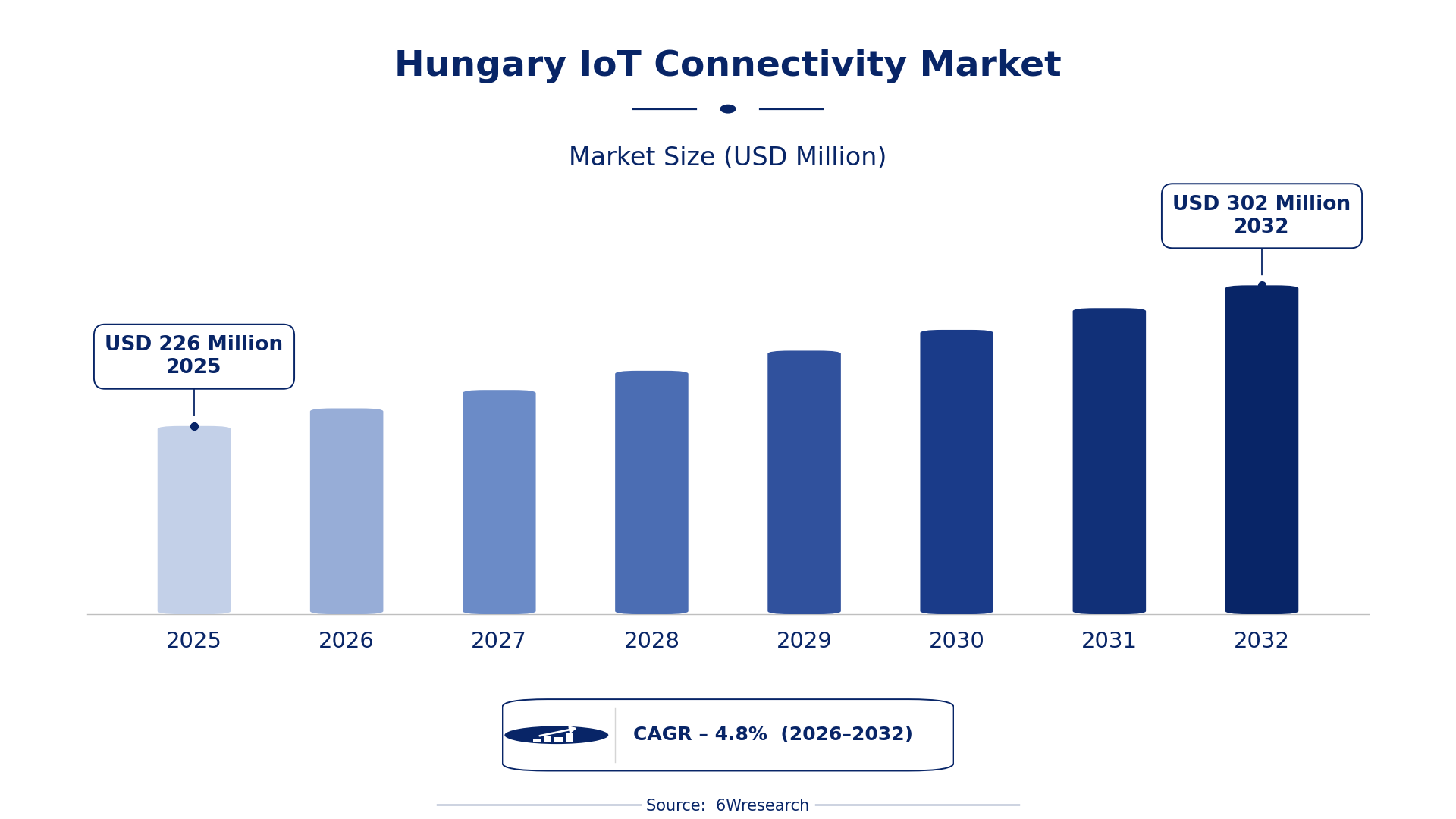
The Hungary IoT Connectivity Market was estimated at USD 226 Million in 2025 and is projected to reach USD 302 Million by 2032, growing at a CAGR of 4.8% from 2026 to 2032.
Hungary IoT Connectivity Market Synopsis
The Hungary IoT Connectivity Market is currently experiencing a dynamic shift, driven by increasing adoption across various sectors such as smart cities and healthcare. This momentum is expected to continue as businesses recognize the critical role of connectivity in enhancing operational efficiency and service delivery.
Looking ahead, the market is set to evolve with advancements in wireless technologies and infrastructure improvements. The ongoing investment in low-power wide-area networks (LPWAN) and satellite communication will be essential for addressing the connectivity needs in rural areas, ensuring that IoT solutions are accessible to all regions.
Hungary IoT Connectivity Market Year-wise Growth Rate and Key Drivers
This graph illustrates the annual growth rates of the Hungary IoT Connectivity Market from 2021 to 2032, highlighting a steady upward trajectory and projected expansion over the forecast period.
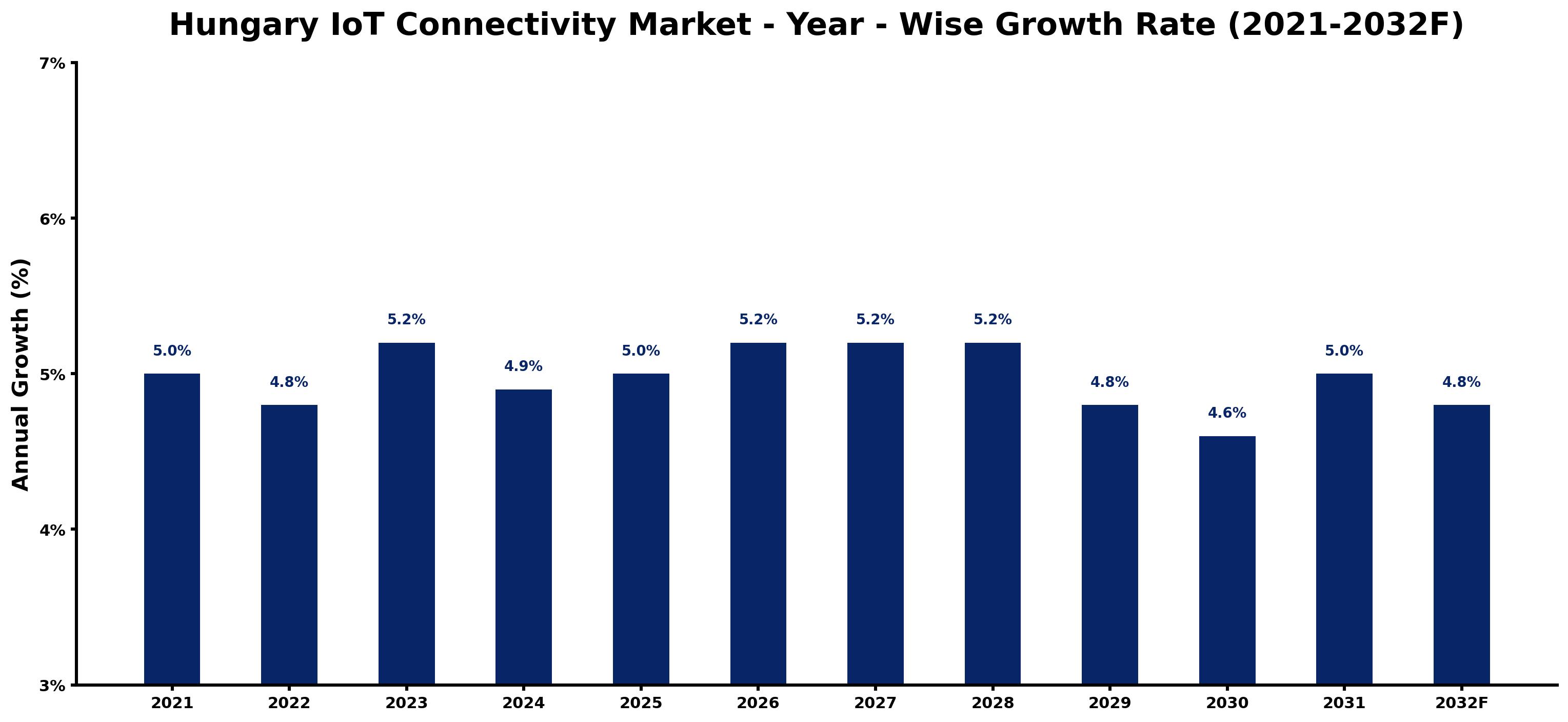
The table below presents the year‑wise growth rates along with the key drivers influencing the market
| Year | Growth Rate | Major Drivers |
| 2021 | 5.0% | Hungarian government funding IoT technology pilot projects. |
| 2022 | 4.8% | Increased adoption of IoT in Hungarian healthcare systems. |
| 2023 | 5.2% | Local manufacturing sector adopting IoT for efficiency gains. |
| 2024 | 4.9% | Growing interest in smart home devices by Hungarian consumers. |
| 2025 | 5.0% | Hungary's participation in EU digitalization initiatives driving growth. |
| 2026 | 5.2% | Support for startups focused on IoT solutions in Budapest. |
| 2027 | 5.2% | Rising consumer awareness of IoT benefits in retail. |
| 2028 | 5.2% | Partnerships between universities and industry boosting IoT education. |
| 2029 | 4.8% | Implementation of IoT in Hungary's transportation management systems. |
| 2030 | 4.6% | Regulatory support for IoT security and privacy standards. |
| 2031 | 5.0% | Increased investment in IoT research by local tech firms. |
| 2032 | 4.8% | Growing urban population boosting demand for connected devices. |
Note: Market size estimations and growth projections presented in this report are based on 6Wresearch's proprietary forecasting methodology, utilizing the latest available industry data, government publications, and primary research inputs.
Hungary IoT Connectivity Market Key Takeaways
Below are some of the specific key takeaways from the market, including:
- Growing demand for IoT connectivity solutions in sectors like industrial automation and healthcare.
- Emerging LPWAN and satellite technologies are addressing coverage gaps in rural areas.
- Government policies are actively supporting infrastructure development and regulatory reforms.
- Advancements in cellular technologies are enabling low-latency, high-bandwidth applications.
- Continued investment in smart city initiatives will drive further adoption of IoT solutions.
Evaluation of Restraints in Hungary IoT Connectivity Market
Despite the promising outlook, the Hungary IoT Connectivity Market faces significant hurdles. Coverage and reliability in remote and rural areas remain a challenge, as urban regions typically enjoy better infrastructure. This disparity can hinder the effective deployment of IoT solutions, limiting their potential benefits. As connectivity requirements grow, innovative approaches must be adopted to bridge these gaps, ensuring that all areas can reap the advantages of IoT technology.
Hungary IoT Connectivity Market Trends
Several key trends are shaping the Hungary IoT Connectivity Market. First, there's a noticeable shift towards LPWAN technologies, which provide energy-efficient and cost-effective solutions for a variety of IoT applications. Additionally, the integration of AI and machine learning in IoT systems is enhancing data analytics capabilities, enabling businesses to make informed decisions.
on top of that, the rise of smart city projects is catalyzing the demand for interconnected devices and sensors, ultimately pushing for comprehensive connectivity solutions that can handle increased data traffic. As industries evolve, the need for high-speed, low-latency connections will become even more critical.
Hungary IoT Connectivity Market Opportunities
Investment opportunities abound in the Hungary IoT Connectivity Market, particularly in the expansion of network infrastructure. Companies can capitalize on the growing demand for smart city technologies by developing innovative solutions that enhance urban living. on top of that, partnerships between public and private sectors are likely to yield new projects aimed at improving connectivity in underserved areas.
As healthcare systems increasingly adopt IoT solutions, there is a chance for businesses to innovate in telemedicine and remote monitoring applications. The ongoing demand for efficiency and safety across industries will create a fertile ground for IoT connectivity investments.
Government Initiatives in the Hungary IoT Connectivity Market
Government initiatives in Hungary are playing a crucial role in shaping the IoT Connectivity Market. With a focus on enhancing infrastructure and regulatory frameworks, the government is paving the way for increased connectivity and innovation. Such policies are vital for attracting investments and facilitating industry collaboration.
- A national digital infrastructure upgrade programme launched in early 2023 aims to improve connectivity across urban and rural areas.
- Currently ongoing initiatives include regulatory reforms focused on spectrum allocation to streamline the deployment of IoT networks.
- A planned public-private initiative is expected to expand telecom infrastructure access by 2028, targeting underserved regions.
- Investment incentives for network infrastructure are being rolled out to encourage faster adoption of IoT technologies.
- Collaboration with industry stakeholders is enhancing the reliability and coverage of IoT services across various sectors.
Future Insights of the Hungary IoT Connectivity Market
From 2026 to 2032, the Hungary IoT Connectivity Market is set to witness transformative growth. The convergence of advanced technologies such as 5G, AI, and cloud computing will create new opportunities for innovation and application development. As industries continue to integrate IoT solutions into their operations, the demand for seamless connectivity will intensify.
The focus on sustainability and energy efficiency will also drive developments in low-power IoT solutions, ensuring that the environmental impact remains minimal. As the market matures, stakeholders must stay agile to adapt to the evolving needs of businesses and consumers alike.
Hungary IoT Connectivity Market Latest Developments
Recent activity in the Hungary IoT Connectivity Market highlights a concerted effort to enhance infrastructure and expand service offerings. As companies respond to growing demand, several initiatives are shaping the future of connectivity.
- A leading regional operator announced the rollout of a new LPWAN network in early 2025, aimed at increasing IoT device connectivity in rural areas.
- In mid-2025, a partnership was formed between technology vendors and local governments to implement smart city solutions in major urban centers.
- Ongoing development of a satellite communication project aims to provide reliable connectivity options for remote communities by late 2026.
- A service upgrade was launched in Q3 2025 to enhance the bandwidth and reliability of existing cellular networks for IoT applications.
- Upcoming initiatives include a planned expansion of IoT service offerings by a prominent telecom operator, set to begin in early 2027.
Hungary IoT Connectivity Market - Key Attractiveness of the Report
- 10 Years of Market Numbers
- Historical Data Starting from 2022 to 2025
- Base Year: 2025
- Forecast Data until 2032
- Key Performance Indicators Impacting the Market
- Major Upcoming Developments and Projects
Key Highlights of the Report:
- Hungary IoT Connectivity Market Outlook
- Market Size of Hungary IoT Connectivity Market, 2025
- Forecast of Hungary IoT Connectivity Market, 2032
- Historical Data and Forecast of Hungary IoT Connectivity Revenues & Volume for the Period 2022-2032F
- Hungary IoT Connectivity Market Trend Evolution
- Hungary IoT Connectivity Market Drivers and Challenges
- Hungary IoT Connectivity Price Trends
- Hungary IoT Connectivity Porter's Five Forces
- Hungary IoT Connectivity Industry Life Cycle
- Historical Data and Forecast of Hungary IoT Connectivity Market Revenues & Volume By Component for the Period 2022-2032F
- Historical Data and Forecast of Hungary IoT Connectivity Market Revenues & Volume By Platform for the Period 2022-2032F
- Historical Data and Forecast of Hungary IoT Connectivity Market Revenues & Volume By Services for the Period 2022-2032F
- Historical Data and Forecast of Hungary IoT Connectivity Market Revenues & Volume By Application Areas for the Period 2022-2032F
- Historical Data and Forecast of Hungary IoT Connectivity Market Revenues & Volume By Building & Home Automation for the Period 2022-2032F
- Historical Data and Forecast of Hungary IoT Connectivity Market Revenues & Volume By Smart Energy & Utility for the Period 2022-2032F
- Historical Data and Forecast of Hungary IoT Connectivity Market Revenues & Volume By Smart Manufacturing for the Period 2022-2032F
- Historical Data and Forecast of Hungary IoT Connectivity Market Revenues & Volume By Connected Health for the Period 2022-2032F
- Historical Data and Forecast of Hungary IoT Connectivity Market Revenues & Volume By Smart Retail for the Period 2022-2032F
- Historical Data and Forecast of Hungary IoT Connectivity Market Revenues & Volume By Smart Transportation for the Period 2022-2032F
- Historical Data and Forecast of Hungary IoT Connectivity Market Revenues & Volume By Others (Education and Agriculture) for the Period 2022-2032F
- Historical Data and Forecast of Hungary IoT Connectivity Market Revenues & Volume By Organization Size for the Period 2022-2032F
- Historical Data and Forecast of Hungary IoT Connectivity Market Revenues & Volume By Large Enterprises for the Period 2022-2032F
- Historical Data and Forecast of Hungary IoT Connectivity Market Revenues & Volume By SMEs for the Period 2022-2032F
- Hungary IoT Connectivity Import Export Trade Statistics
- Market Opportunity Assessment By Component
- Market Opportunity Assessment By Application Areas
- Market Opportunity Assessment By Organization Size
- Hungary IoT Connectivity Top Companies Market Share
- Hungary IoT Connectivity Competitive Benchmarking By Technical and Operational Parameters
- Hungary IoT Connectivity Company Profiles
- Hungary IoT Connectivity Key Strategic Recommendations






































