Hungary LTE IoT Market Size & Growth Rate (2026-2032)
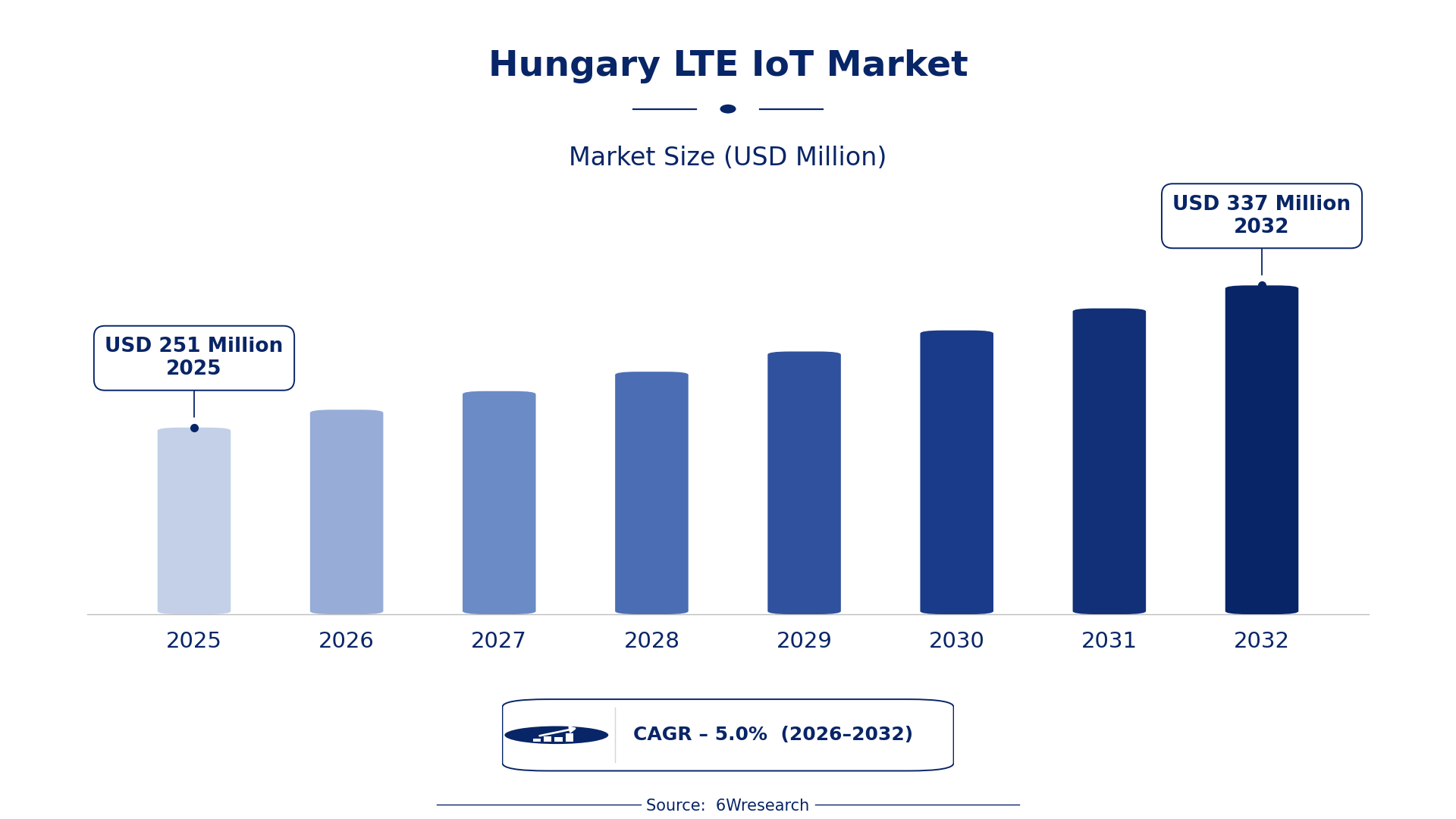
The Hungary LTE IoT Market was estimated at USD 251 Million in 2025 and is projected to reach USD 337 Million by 2032, growing at a CAGR of 5.0% from 2026 to 2032.
Hungary LTE IoT Market Synopsis
The driving force behind the Hungary LTE IoT market is the rapid integration of IoT technologies across diverse sectors such as manufacturing, agriculture, and healthcare. This growing adoption is largely supported by the reliable connectivity enabled by LTE networks, which have become essential for IoT devices seeking to enhance operational efficiencies.
Key players are actively innovating in areas like asset tracking, smart metering, and remote monitoring. With government-backed initiatives promoting digital transformation, the market offers fertile ground for both local and global vendors to expand their reach and capabilities.
Hungary LTE IoT Market Year-wise Growth Rate and Key Drivers
This graph illustrates the annual growth rates of the Hungary LTE IoT Market from 2021 to 2032, highlighting a steady upward trajectory and projected expansion over the forecast period.
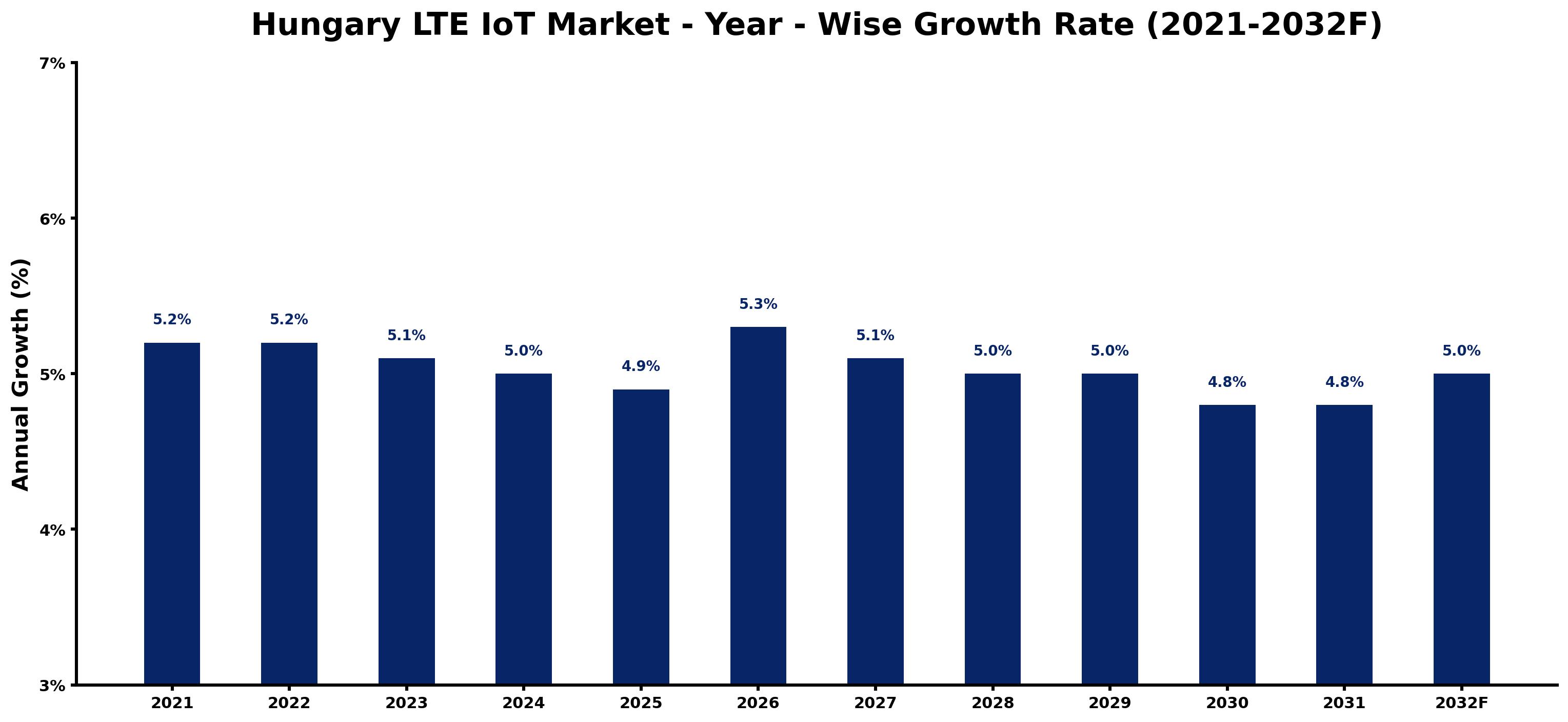
The table below presents the year‑wise growth rates along with the key drivers influencing the market
| Year | Growth Rate | Major Drivers |
| 2021 | 5.2% | Hungarian government supports smart agriculture initiatives. |
| 2022 | 5.2% | Increased urbanization drives smart city IoT solutions. |
| 2023 | 5.1% | Growing interest in industrial IoT for manufacturing efficiency. |
| 2024 | 5.0% | Telecom Hungary launches new IoT connectivity solutions. |
| 2025 | 4.9% | Adoption of smart meters incentivized by regulatory reforms. |
| 2026 | 5.3% | EU funding boosts digital transformation in Hungary. |
| 2027 | 5.1% | Rise in environmental monitoring technology applications. |
| 2028 | 5.0% | Focus on smart logistics for supply chain optimization. |
| 2029 | 5.0% | Increased energy management needs drive IoT innovation. |
| 2030 | 4.8% | Hungary's aging population creates demand for smart healthcare. |
| 2031 | 4.8% | Local startups develop innovative IoT applications for cities. |
| 2032 | 5.0% | Government initiatives promote green IoT technology adoption. |
Note: Market size estimations and growth projections presented in this report are based on 6Wresearch's proprietary forecasting methodology, utilizing the latest available industry data, government publications, and primary research inputs.
Hungary LTE IoT Market Key Takeaways
Below are some of the specific key takeaways from the market, including:
- Steady growth trajectory fueled by increasing demand for IoT solutions.
- Significant government initiatives aimed at enhancing digital infrastructure.
- Rising popularity of low-power technologies like LTE-M and NB-IoT.
- Growing investments in sectors such as smart cities and precision agriculture.
- Heightened focus on partnerships between telecom operators and solution providers.
Evaluation of Restraints in Hungary LTE IoT Market
While the Hungary LTE IoT market is expanding, certain limitations impede faster growth. The financial burden associated with implementing LTE technologies can deter smaller businesses from adopting these solutions. Network coverage and reliability inconsistencies in various regions also hinder the seamless connectivity that is vital for effective IoT operations. Furthermore, the complexities in integrating LTE solutions into existing infrastructures and the requisite technical expertise pose additional hurdles for organizations venturing into this space.
Hungary LTE IoT Market Trends
The current trends in the Hungary LTE IoT market highlight a surge in the adoption of LTE-M and NB-IoT due to their cost-effectiveness and extended coverage. These technologies are particularly relevant in developing smart city frameworks, enhancing agricultural productivity, and improving healthcare services. As organizations increasingly seek real-time data and optimized connectivity, the market is seeing greater deployment of innovative IoT devices and applications.
Hungary LTE IoT Market Opportunities
Investment opportunities in Hungary's LTE IoT sector are abundant, particularly in areas such as smart city initiatives, agricultural advancements, and healthcare solutions. The rising demand for efficient connectivity positions LTE technology as a prime candidate for various IoT applications. Collaborating with local telecom operators and tech firms can facilitate market entry, enabling investors to capitalize on Hungary’s digital transformation trajectory.
Government Initiatives in the Hungary LTE IoT Market
The Hungarian government is actively cultivating an environment conducive to the growth of LTE IoT technologies. Through various strategic initiatives, there is a clear focus on enhancing digital infrastructure, which is critical for supporting the expansive IoT ecosystem. These policies not only aim to foster innovation but also provide essential funding and regulatory frameworks to stimulate market growth.
- A recently completed National Digitalisation Strategy that aims to bolster connectivity and infrastructure development.
- Currently underway projects focusing on enhancing LTE network coverage in rural areas, improving IoT service accessibility.
- A planned public-private initiative expected to provide subsidies for IoT research and development by 2028.
- Upcoming regulatory frameworks aimed at promoting spectrum efficiency and interoperability among IoT devices.
- Ongoing financial support initiatives encouraging local startups to innovate in the IoT space.
Future Insights of the Hungary LTE IoT Market
Looking ahead to 2026-2032, the Hungary LTE IoT market is set for pronounced growth, buoyed by increasing IoT solution adoption across key industries. The LTE networks in Hungary provide an essential backbone for connecting a multitude of devices, enabling swift data transfer and reduced latency. As technology continues to evolve, particularly with advancements in 5G and novel applications emerging, the market is well-positioned for expansion fueled by demands for asset tracking, predictive maintenance, and enhanced operational efficiencies.
Hungary LTE IoT Market Latest Developments
In the past year, the Hungary LTE IoT market has seen dynamic developments, reflecting a shift towards more integrated IoT solutions. Industry players have been active in forming partnerships and rolling out innovative services to meet market demand.
- A leading regional operator launched an enhanced LTE service for agricultural IoT applications in Q1 2023, targeting efficiency improvements in precision farming.
- A major technology vendor is currently undertaking a rollout of smart metering solutions across urban centers, expected to complete by mid-2024.
- In early 2023, several local startups formed a consortium to develop next-generation IoT applications focused on healthcare services, a move gaining momentum.
- An initiative for comprehensive IoT training programs began in late 2022 and remains ongoing, aimed at equipping professionals with necessary skills.
- A planned LTE infrastructure upgrade is set to commence in early 2024, enhancing overall connectivity across metropolitan areas.
Hungary LTE IoT Market - Key Attractiveness of the Report
- 10 Years of Market Numbers
- Historical Data Starting from 2022 to 2025
- Base Year: 2025
- Forecast Data until 2032
- Key Performance Indicators Impacting the Market
- Major Upcoming Developments and Projects
Key Highlights of the Report:
- Hungary LTE IoT Market Outlook
- Market Size of Hungary LTE IoT Market, 2025
- Forecast of Hungary LTE IoT Market, 2032
- Historical Data and Forecast of Hungary LTE IoT Revenues & Volume for the Period 2022-2032F
- Hungary LTE IoT Market Trend Evolution
- Hungary LTE IoT Market Drivers and Challenges
- Hungary LTE IoT Price Trends
- Hungary LTE IoT Porter's Five Forces
- Hungary LTE IoT Industry Life Cycle
- Historical Data and Forecast of Hungary LTE IoT Market Revenues & Volume By Technology for the Period 2022-2032F
- Historical Data and Forecast of Hungary LTE IoT Market Revenues & Volume By NB-IoT for the Period 2022-2032F
- Historical Data and Forecast of Hungary LTE IoT Market Revenues & Volume By LTE-M for the Period 2022-2032F
- Historical Data and Forecast of Hungary LTE IoT Market Revenues & Volume By Service for the Period 2022-2032F
- Historical Data and Forecast of Hungary LTE IoT Market Revenues & Volume By Professional Services for the Period 2022-2032F
- Historical Data and Forecast of Hungary LTE IoT Market Revenues & Volume By Managed Services for the Period 2022-2032F
- Historical Data and Forecast of Hungary LTE IoT Market Revenues & Volume By Industry for the Period 2022-2032F
- Historical Data and Forecast of Hungary LTE IoT Market Revenues & Volume By Manufacturing for the Period 2022-2032F
- Historical Data and Forecast of Hungary LTE IoT Market Revenues & Volume By Energy and utilities for the Period 2022-2032F
- Historical Data and Forecast of Hungary LTE IoT Market Revenues & Volume By Transportation and logistics for the Period 2022-2032F
- Historical Data and Forecast of Hungary LTE IoT Market Revenues & Volume By Healthcare for the Period 2022-2032F
- Historical Data and Forecast of Hungary LTE IoT Market Revenues & Volume By Agriculture for the Period 2022-2032F
- Hungary LTE IoT Import Export Trade Statistics
- Market Opportunity Assessment By Technology
- Market Opportunity Assessment By Service
- Market Opportunity Assessment By Industry
- Hungary LTE IoT Top Companies Market Share
- Hungary LTE IoT Competitive Benchmarking By Technical and Operational Parameters
- Hungary LTE IoT Company Profiles
- Hungary LTE IoT Key Strategic Recommendations






































