Hungary Lumber Market: Import Trend Analysis
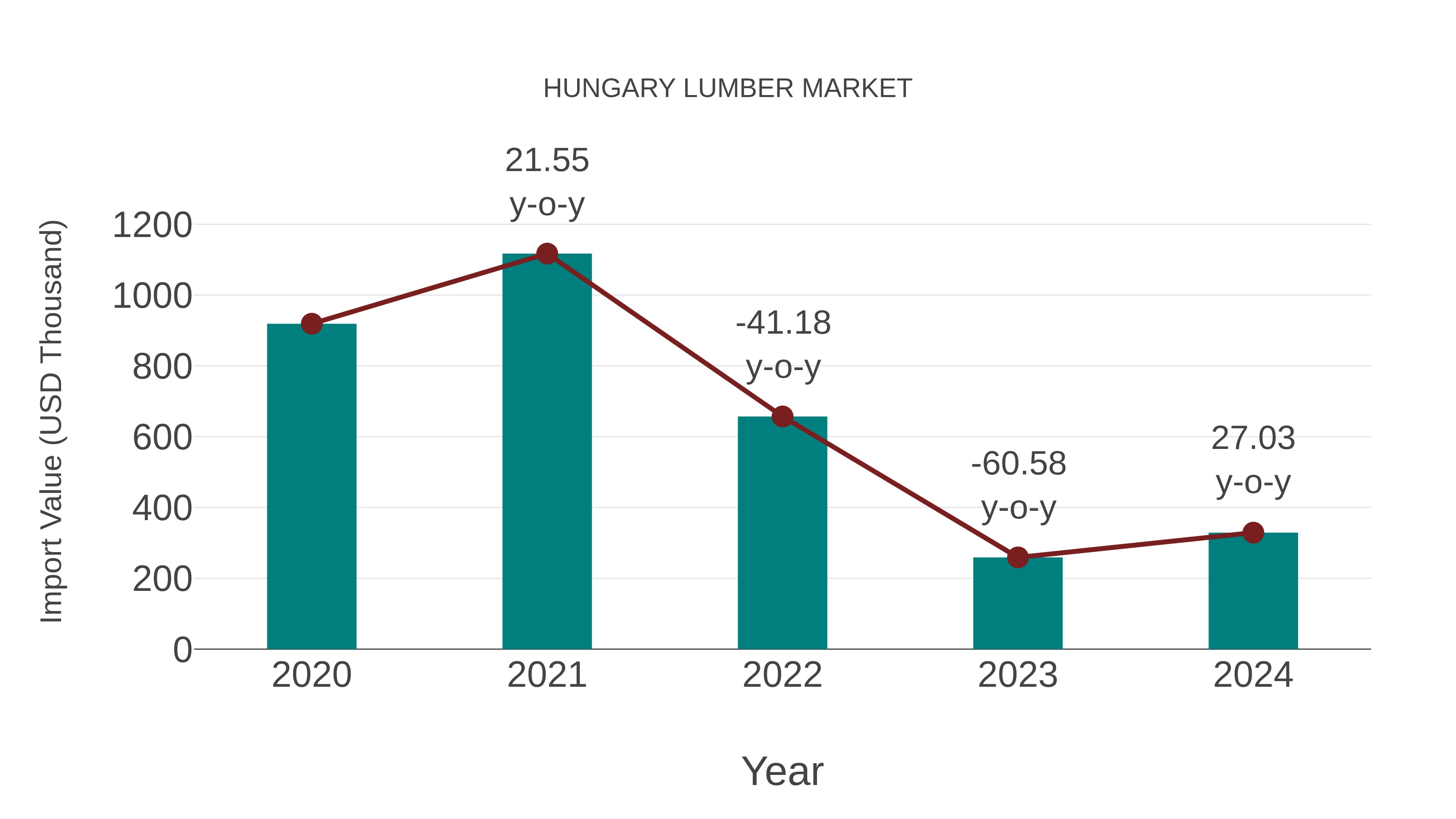
In the Hungary lumber market, the import trend experienced a notable growth rate of 27.03% from 2023 to 2024, contrasting with a compound annual growth rate (CAGR) of -22.65% for the period 2020-2024. This shift could be attributed to evolving demand dynamics or changes in trade policies affecting market stability.
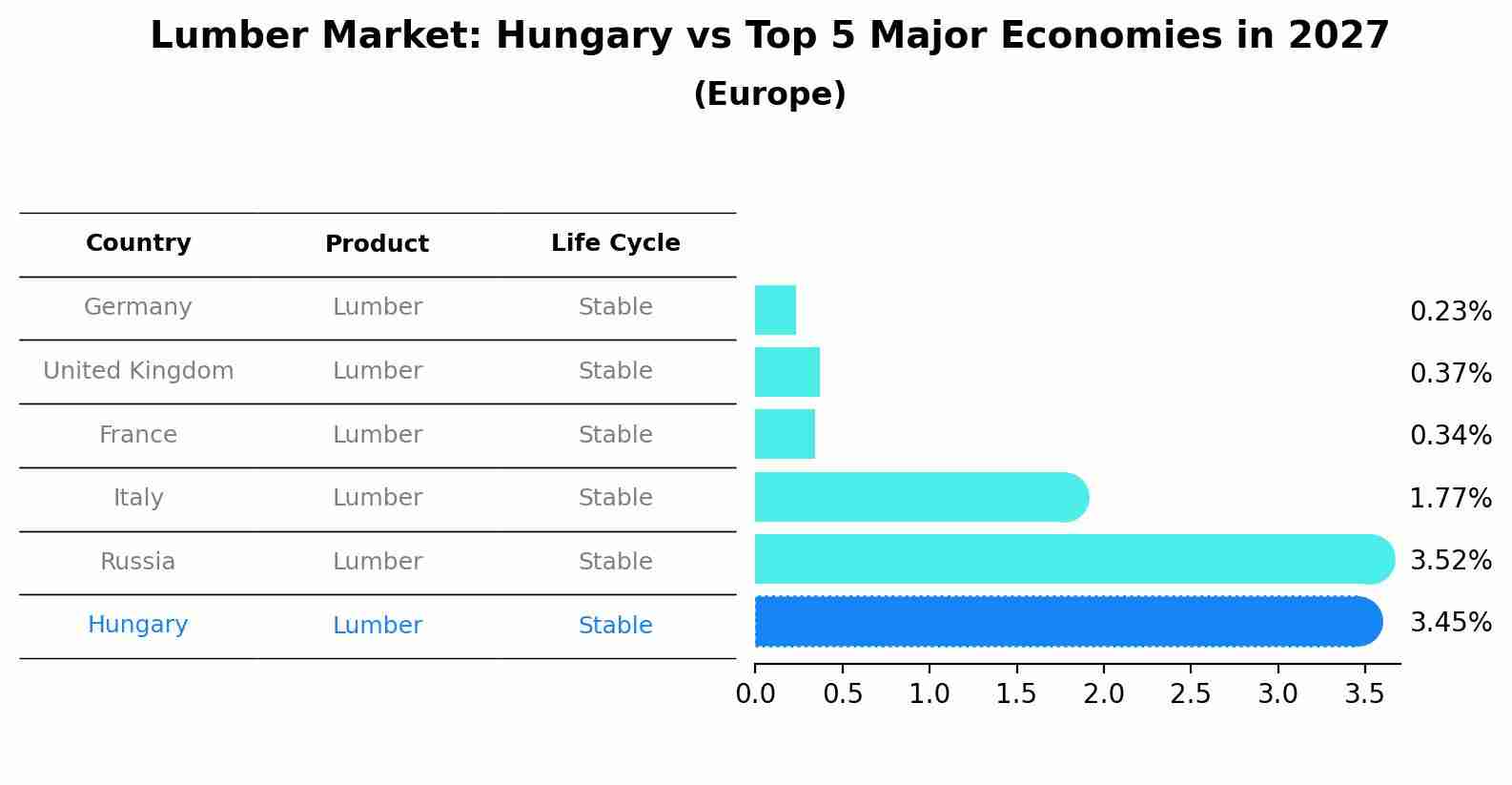
Lumber Market: Hungary vs Top 5 Major Economies in 2027 (Europe)
By 2027, the Lumber market in Hungary is anticipated to reach a growth rate of 3.45%, as part of an increasingly competitive Europe region, where Germany remains at the forefront, supported by United Kingdom, France, Italy and Russia, driving innovations and market adoption across sectors.
Hungary Lumber Market Overview
The lumber market in Hungary is influenced by construction activities, furniture manufacturing, and woodworking industries. Lumber products are essential for building and renovation projects, as well as for producing furniture and other wooden goods. With urbanization and infrastructure development driving demand for construction materials, the lumber market is expected to see steady growth.
Drivers of the market
With the construction industry witnessing steady growth in Hungary, the demand for lumber is on the rise. Lumber is a primary raw material used in construction and woodworking applications, and its demand is closely tied to trends in housing construction, infrastructure development, and furniture manufacturing.
Challenges of the market
In the Hungary Lumber Market, sustainable forest management and responsible sourcing are critical challenges for the industry. Balancing the demand for timber products with the need to preserve forest ecosystems and biodiversity requires collaboration among stakeholders, including forest owners, government agencies, and conservation organizations. Moreover, ensuring transparency and traceability throughout the supply chain is essential to meet the growing consumer demand for ethically sourced lumber products.
Government Policy of the market
Government policies in Hungary concerning the lumber market encompass sustainable forest management, timber harvesting practices, and timber trade regulations. The government promotes responsible forestry practices, regulates logging activities to prevent deforestation and habitat destruction, and implements measures to combat illegal logging and timber trafficking.
Key Highlights of the Report:
- Hungary Lumber Market Outlook
- Market Size of Hungary Lumber Market, 2019
- Forecast of Hungary Lumber Market, 2026
- Historical Data and Forecast of Hungary Lumber Revenues & Volume for the Period 2016 - 2026
- Hungary Lumber Market Trend Evolution
- Hungary Lumber Market Drivers and Challenges
- Hungary Lumber Price Trends
- Hungary Lumber Porter's Five Forces
- Hungary Lumber Industry Life Cycle
- Historical Data and Forecast of Hungary Lumber Market Revenues & Volume By Types for the Period 2016 - 2026
- Historical Data and Forecast of Hungary Lumber Market Revenues & Volume By Hardwood Lumber for the Period 2016 - 2026
- Historical Data and Forecast of Hungary Lumber Market Revenues & Volume By Softwood Lumber for the Period 2016 - 2026
- Historical Data and Forecast of Hungary Lumber Market Revenues & Volume By Application for the Period 2016 - 2026
- Historical Data and Forecast of Hungary Lumber Market Revenues & Volume By Construction for the Period 2016 - 2026
- Historical Data and Forecast of Hungary Lumber Market Revenues & Volume By Furniture for the Period 2016 - 2026
- Historical Data and Forecast of Hungary Lumber Market Revenues & Volume By Flooring for the Period 2016 - 2026
- Historical Data and Forecast of Hungary Lumber Market Revenues & Volume By Moldings for the Period 2016 - 2026
- Historical Data and Forecast of Hungary Lumber Market Revenues & Volume By Others for the Period 2016 - 2026
- Hungary Lumber Import Export Trade Statistics
- Market Opportunity Assessment By Types
- Market Opportunity Assessment By Application
- Hungary Lumber Top Companies Market Share
- Hungary Lumber Competitive Benchmarking By Technical and Operational Parameters
- Hungary Lumber Company Profiles
- Hungary Lumber Key Strategic Recommendations






































