Hungary Magnesium Oxide Market: Import Trend Analysis
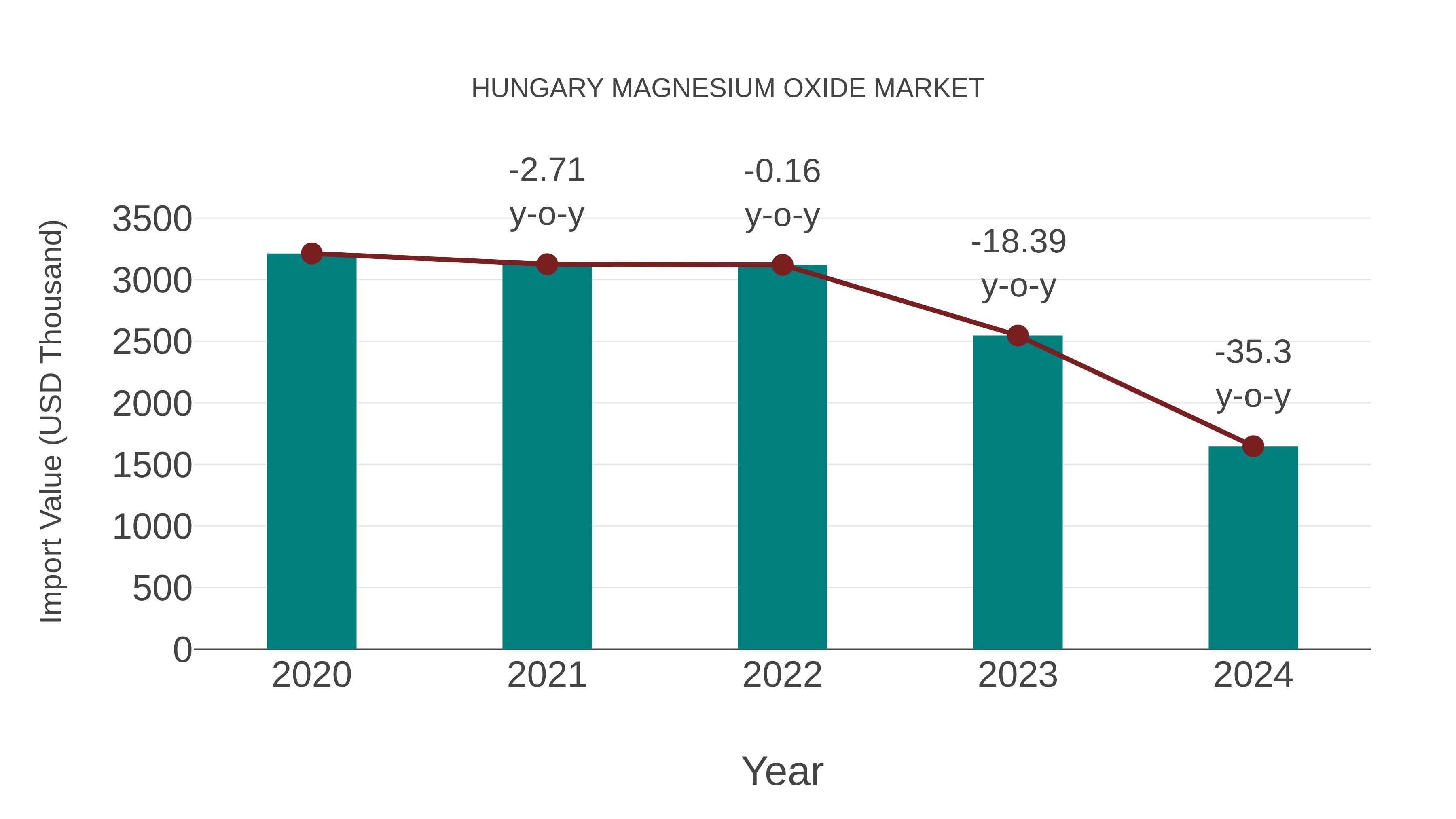
Hungary`s import trend in the magnesium oxide market experienced a notable decline from 2023 to 2024, with a growth rate of -35.3%. The compound annual growth rate (CAGR) for 2020-2024 stood at -15.37%. This sharp decrease in imports can be attributed to shifting market demands or potentially influenced by changes in trade policies impacting the market stability.
Magnesium Oxide Market: Hungary vs Top 5 Major Economies in 2027 (Europe)
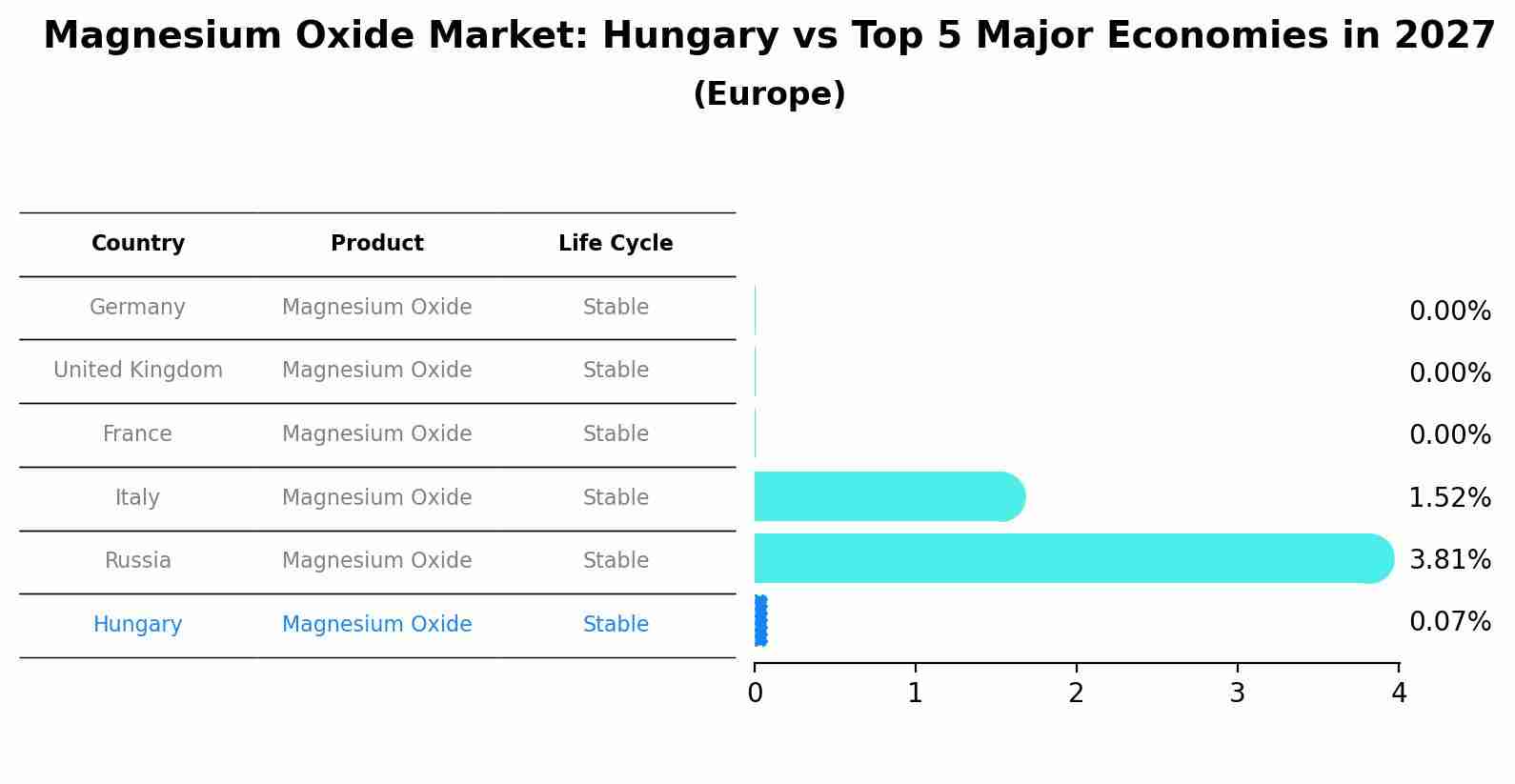
The Magnesium Oxide market in Hungary is projected to grow at a stable growth rate of 0.07% by 2027, highlighting the country's increasing focus on advanced technologies within the Europe region, where Germany holds the dominant position, followed closely by United Kingdom, France, Italy and Russia, shaping overall regional demand.
Hungary Magnesium Oxide Market Overview
The Hungary magnesium oxide market demonstrates robust growth prospects, driven by its versatile applications across industries such as construction, agriculture, and healthcare. Magnesium oxide, also known as magnesia, serves as a key raw material in the production of refractory materials, fertilizers, and pharmaceuticals. In the construction sector, magnesia finds use in various applications including as a flame retardant and in the manufacturing of cement. Furthermore, its role in soil amendment and livestock feed additives underscores its significance in agriculture. With the expansion of these industries and increasing demand for high-quality magnesia products, Hungary magnesium oxide market is expected to exhibit favorable growth trends.
Drivers of the market
The Hungary magnesium oxide market is primarily driven by its diverse applications across industries such as construction, agriculture, and healthcare. The increasing construction activities, coupled with rising demand for refractory materials, are significant drivers for the magnesium oxide market in Hungary.
Challenges of the market
In the Hungary Magnesium Oxide market, challenges include quality control issues throughout the manufacturing process, impacting product consistency and customer satisfaction. Market saturation and limited growth opportunities within traditional applications pose challenges for expansion and revenue generation. Additionally, rising energy costs and environmental concerns regarding emissions management require investments in sustainable practices and technology upgrades, increasing operational costs for businesses.
Government Policy of the market
In Hungary, regulations govern the production, sale, and use of magnesium oxide to ensure product quality and safety standards. The government may provide support for research and development efforts aimed at improving manufacturing processes and product performance.
Key Highlights of the Report:
- Hungary Magnesium Oxide Market Outlook
- Market Size of Hungary Magnesium Oxide Market, 2021
- Forecast of Hungary Magnesium Oxide Market, 2028
- Historical Data and Forecast of Hungary Magnesium Oxide Revenues & Volume for the Period 2018 - 2028
- Hungary Magnesium Oxide Market Trend Evolution
- Hungary Magnesium Oxide Market Drivers and Challenges
- Hungary Magnesium Oxide Price Trends
- Hungary Magnesium Oxide Porter's Five Forces
- Hungary Magnesium Oxide Industry Life Cycle
- Historical Data and Forecast of Hungary Magnesium Oxide Market Revenues & Volume By Product Type for the Period 2018 - 2028
- Historical Data and Forecast of Hungary Magnesium Oxide Market Revenues & Volume By Dead Burned Magnesia for the Period 2018 - 2028
- Historical Data and Forecast of Hungary Magnesium Oxide Market Revenues & Volume By Caustic Calcined Magnesia for the Period 2018 - 2028
- Historical Data and Forecast of Hungary Magnesium Oxide Market Revenues & Volume By Fused Magnesia for the Period 2018 - 2028
- Historical Data and Forecast of Hungary Magnesium Oxide Market Revenues & Volume By Application for the Period 2018 - 2028
- Historical Data and Forecast of Hungary Magnesium Oxide Market Revenues & Volume By Industrial for the Period 2018 - 2028
- Historical Data and Forecast of Hungary Magnesium Oxide Market Revenues & Volume By Refractories for the Period 2018 - 2028
- Historical Data and Forecast of Hungary Magnesium Oxide Market Revenues & Volume By Agricultural for the Period 2018 - 2028
- Historical Data and Forecast of Hungary Magnesium Oxide Market Revenues & Volume By Others for the Period 2018 - 2028
- Hungary Magnesium Oxide Import Export Trade Statistics
- Market Opportunity Assessment By Product Type
- Market Opportunity Assessment By Application
- Hungary Magnesium Oxide Top Companies Market Share
- Hungary Magnesium Oxide Competitive Benchmarking By Technical and Operational Parameters
- Hungary Magnesium Oxide Company Profiles
- Hungary Magnesium Oxide Key Strategic Recommendations






































