Hungary Mega Data Center Market Size & Growth Rate (2026-2032)
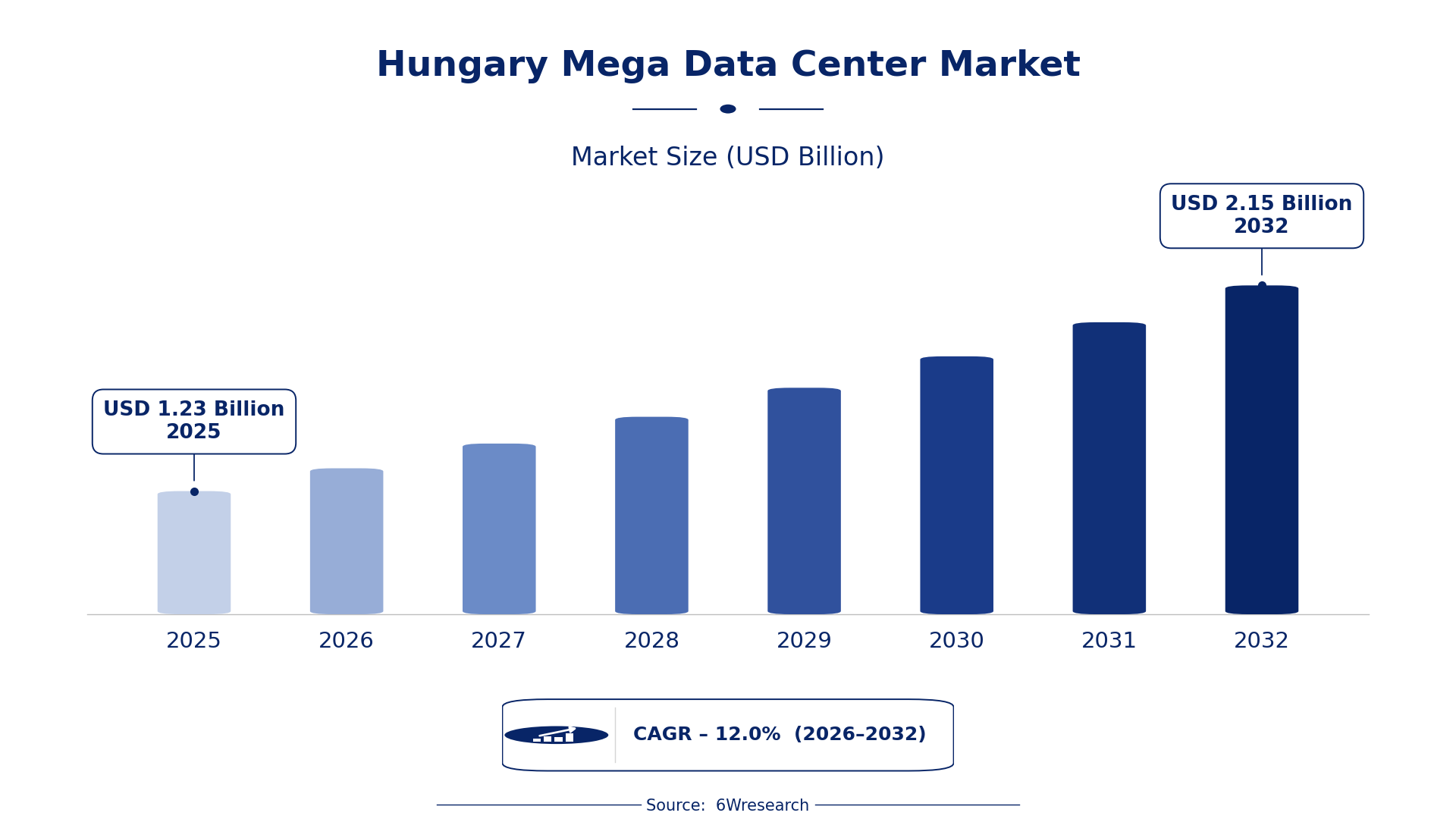
The Hungary Mega Data Center Market was estimated at USD 1228 Million in 2025 and is projected to reach USD 2151 Million by 2032, growing at a CAGR of 12.0% from 2026 to 2032.
Hungary Mega Data Center Market Synopsis
The Hungary Mega Data Center Market is witnessing unprecedented expansion, driven by escalating needs for data management across sectors. The confluence of rising internet connectivity and the explosion of digital services solidifies Hungary’s position as a burgeoning hub for mega data centers.
Key industries are increasingly turning to mega data centers to support their digital transformation efforts, enabling advanced analytics and cloud computing capabilities. Hungary’s unique geographical advantages and government support further enhance its attractiveness for large-scale data infrastructure investments.
Hungary Mega Data Center Market Year-wise Growth Rate and Key Drivers
This graph illustrates the annual growth rates of the Hungary Mega Data Center Market from 2021 to 2032, highlighting a steady upward trajectory and projected expansion over the forecast period.
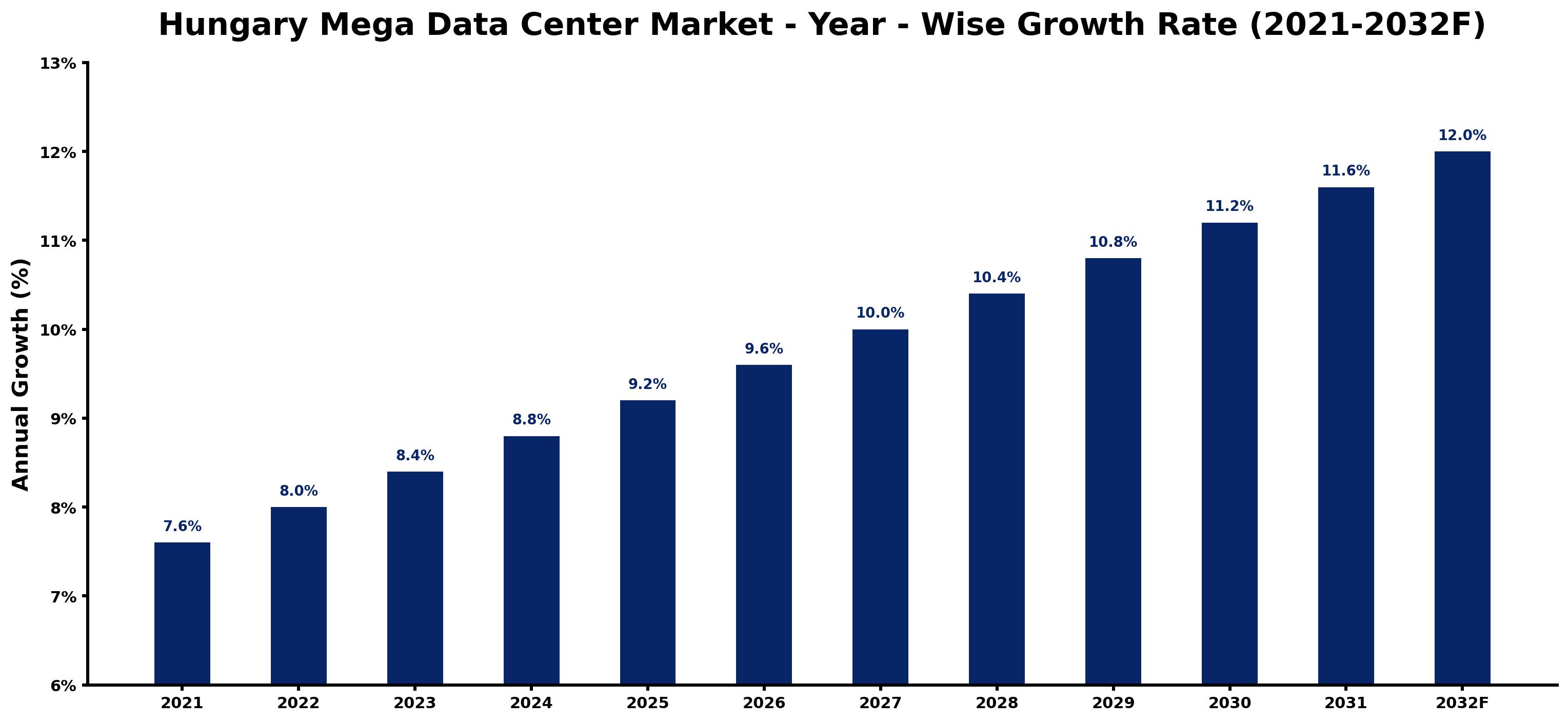
The table below presents the year‑wise growth rates along with the key drivers influencing the market
| Year | Growth Rate | Major Drivers |
| 2021 | 7.6% | Increased cloud adoption among Hungarian SMEs boosting demand. |
| 2022 | 8.0% | Investment in data protection policies enhancing data center needs. |
| 2023 | 8.4% | Partnerships with local tech firms driving innovative data solutions. |
| 2024 | 8.8% | Hungary's tech workforce growth supporting data center expansion. |
| 2025 | 9.2% | Urbanization trends fueling need for localized data services. |
| 2026 | 9.6% | Regional connectivity improvements enabling faster data transmission. |
| 2027 | 10.0% | Rising e-commerce activities driving data storage requirements. |
| 2028 | 10.4% | Increased regulatory focus on data sovereignty enhancing demand. |
| 2029 | 10.8% | Local universities advancing data science skills for industry. |
| 2030 | 11.2% | Government support for AI initiatives increasing data processing needs. |
| 2031 | 11.6% | Strong rise in IoT devices creating extra data traffic. |
| 2032 | 12.0% | Sustainability initiatives incentivizing green data center investments. |
Note: Market size estimations and growth projections presented in this report are based on 6Wresearch's proprietary forecasting methodology, utilizing the latest available industry data, government publications, and primary research inputs.
Hungary Mega Data Center Market Key Takeaways
Below are some of the specific key takeaways from the market, including:
- The market is expected to grow significantly, reaching USD 2151 Million by 2032.
- Cloud computing and big data analytics are primary drivers of market demand.
- Government initiatives are actively promoting investment in data center infrastructure.
- Energy efficiency and environmental sustainability are critical considerations for new developments.
- Security and regulatory compliance remain ongoing challenges for operators in multi-tenant environments.
Evaluation of Restraints in Hungary Mega Data Center Market
Despite its growth potential, the Hungary Mega Data Center Market faces several obstacles. The demand for computing power is surging, yet operators are grappling with the need to minimize energy consumption. Meeting these dual demands requires considerable financial investment and meticulous infrastructure planning. on top of that, ensuring data security while navigating complex regulatory compliance within multi-tenant facilities adds layers of difficulty for operators, making strategic planning essential.
Hungary Mega Data Center Market Trends
A few key trends are reshaping the Hungary Mega Data Center Market. The increasing adoption of artificial intelligence and machine learning applications is driving demand for high-performance computing capabilities. Additionally, the focus on energy-efficient designs is prompting operators to explore renewable energy sources as a means to offset operational costs. The push for enhanced cybersecurity measures is also influencing the development of more secure facilities, reflecting the growing importance of data protection.
Hungary Mega Data Center Market Opportunities
Investors and operators should keep an eye on several promising opportunities in the Hungary Mega Data Center Market. The ongoing expansion of e-commerce and digital services creates a continuous need for data storage and processing capabilities. on top of that, innovations in energy-efficient technologies present opportunities for operators to differentiate themselves. Collaborations with technology firms to enhance services could also yield competitive advantages in this rapidly evolving market.
Government Initiatives in the Hungary Mega Data Center Market
Government policy is shaping the Hungary Mega Data Center Market by fostering an environment conducive to investment and innovation. Recent initiatives focus on data localization and cybersecurity, which are crucial for attracting global players. The government’s commitment to enhancing digital infrastructure underscores its importance in this competitive sector.
- A national digital infrastructure upgrade program launched recently aims to enhance connectivity and support data center operations.
- Current initiatives include tax incentives for investments in energy-efficient data center projects, encouraging sustainability.
- Planned regulations expected in 2026 will mandate higher standards for data center security and energy efficiency.
- The government is promoting public-private partnerships to expand broadband access, facilitating better data center connectivity.
- Ongoing discussions are focused on streamlining the permitting process for new data center constructions to attract foreign investments.
Future Insights of the Hungary Mega Data Center Market
Looking ahead, the Hungary Mega Data Center Market is set for dynamic evolution through 2032. As digital services continue to proliferate, the demand for robust data infrastructure will only intensify. Innovations in technology and energy management will play pivotal roles in shaping the market. Operators who can successfully integrate sustainability with operational efficiency will likely lead in this competitive environment.
Hungary Mega Data Center Market Latest Developments
Recent developments in the Hungary Mega Data Center Market reflect a vigorous push towards modernization and efficiency. Companies are increasingly focusing on integrating cutting-edge technologies to enhance service offerings. This trend towards innovation is evident in various ongoing and planned projects across the sector.
- A leading regional operator began construction of a new data center facility in early 2025, aimed at enhancing cloud service capabilities.
- In late 2025, a major technology vendor announced a partnership to develop AI-driven analytics solutions for data center operations.
- Currently ongoing is a project to upgrade existing data center infrastructure to meet new energy efficiency standards, set to complete by mid-2026.
- Upcoming initiatives include a rollout of advanced cybersecurity measures planned for Q3 2026 to enhance data protection across facilities.
- A regional expansion strategy is underway, with plans to establish additional data centers in secondary cities by 2027.
Hungary Mega Data Center Market - Key Attractiveness of the Report
- 10 Years of Market Numbers
- Historical Data Starting from 2022 to 2025
- Base Year: 2025
- Forecast Data until 2032
- Key Performance Indicators Impacting the Market
- Major Upcoming Developments and Projects
Key Highlights of the Report:
- Hungary Mega Data Center Market Outlook
- Market Size of Hungary Mega Data Center Market, 2025
- Forecast of Hungary Mega Data Center Market, 2032
- Historical Data and Forecast of Hungary Mega Data Center Revenues & Volume for the Period 2022-2032F
- Hungary Mega Data Center Market Trend Evolution
- Hungary Mega Data Center Market Drivers and Challenges
- Hungary Mega Data Center Price Trends
- Hungary Mega Data Center Porter's Five Forces
- Hungary Mega Data Center Industry Life Cycle
- Historical Data and Forecast of Hungary Mega Data Center Market Revenues & Volume By Solutions Infrastructure for the Period 2022-2032F
- Historical Data and Forecast of Hungary Mega Data Center Market Revenues & Volume By IT infrastructure solutions for the Period 2022-2032F
- Historical Data and Forecast of Hungary Mega Data Center Market Revenues & Volume By Support infrastructure solutions for the Period 2022-2032F
- Historical Data and Forecast of Hungary Mega Data Center Market Revenues & Volume By Power solutions for the Period 2022-2032F
- Historical Data and Forecast of Hungary Mega Data Center Market Revenues & Volume By Cooling solutions for the Period 2022-2032F
- Historical Data and Forecast of Hungary Mega Data Center Market Revenues & Volume By Security solutions for the Period 2022-2032F
- Historical Data and Forecast of Hungary Mega Data Center Market Revenues & Volume By Management software for the Period 2022-2032F
- Historical Data and Forecast of Hungary Mega Data Center Market Revenues & Volume By Services for the Period 2022-2032F
- Historical Data and Forecast of Hungary Mega Data Center Market Revenues & Volume By System integration for the Period 2022-2032F
- Historical Data and Forecast of Hungary Mega Data Center Market Revenues & Volume By Monitoring services for the Period 2022-2032F
- Historical Data and Forecast of Hungary Mega Data Center Market Revenues & Volume By Professional services for the Period 2022-2032F
- Historical Data and Forecast of Hungary Mega Data Center Market Revenues & Volume By Support for the Period 2022-2032F
- Historical Data and Forecast of Hungary Mega Data Center Market Revenues & Volume By Power for the Period 2022-2032F
- Historical Data and Forecast of Hungary Mega Data Center Market Revenues & Volume By Cooling for the Period 2022-2032F
- Historical Data and Forecast of Hungary Mega Data Center Market Revenues & Volume By Security for the Period 2022-2032F
- Historical Data and Forecast of Hungary Mega Data Center Market Revenues & Volume By Verticals for the Period 2022-2032F
- Historical Data and Forecast of Hungary Mega Data Center Market Revenues & Volume By Banking, Financial Services and Insurance (BFSI) for the Period 2022-2032F
- Historical Data and Forecast of Hungary Mega Data Center Market Revenues & Volume By Telecom and IT for the Period 2022-2032F
- Historical Data and Forecast of Hungary Mega Data Center Market Revenues & Volume By Media and entertainment for the Period 2022-2032F
- Historical Data and Forecast of Hungary Mega Data Center Market Revenues & Volume By Government and public for the Period 2022-2032F
- Historical Data and Forecast of Hungary Mega Data Center Market Revenues & Volume By Others for the Period 2022-2032F
- Hungary Mega Data Center Import Export Trade Statistics
- Market Opportunity Assessment By Solutions Infrastructure
- Market Opportunity Assessment By Services
- Market Opportunity Assessment By Support
- Market Opportunity Assessment By Verticals
- Hungary Mega Data Center Top Companies Market Share
- Hungary Mega Data Center Competitive Benchmarking By Technical and Operational Parameters
- Hungary Mega Data Center Company Profiles
- Hungary Mega Data Center Key Strategic Recommendations






































