Hungary Microphone Market: Import Trend Analysis
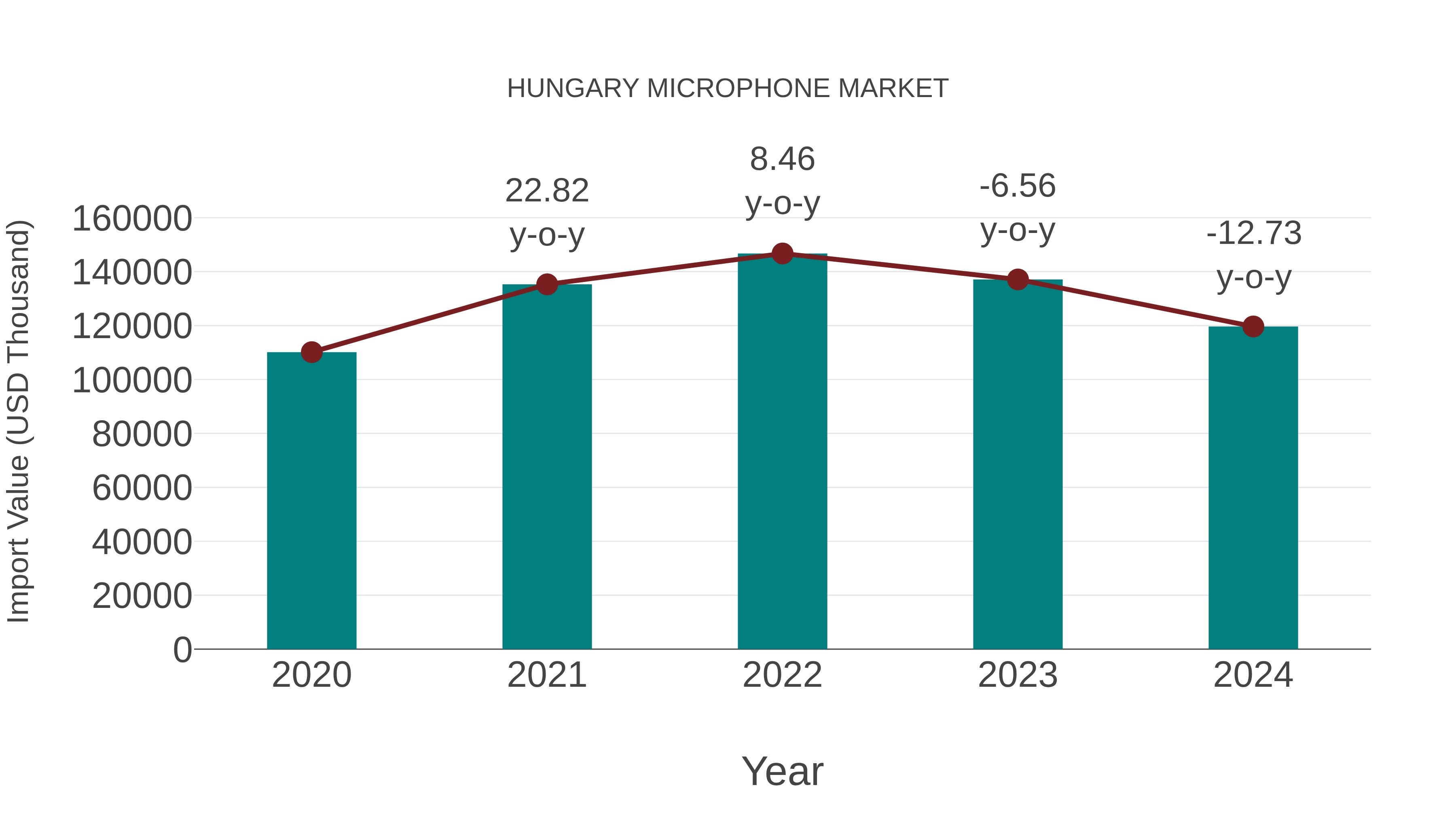
In the Hungary microphone market, the import trend saw a decline in growth from 2023 to 2024, with a rate of -12.73%. However, the compound annual growth rate (CAGR) for the period of 2020-2024 stood at 2.09%. This decrease in import momentum could be attributed to shifts in demand dynamics or changes in trade policies impacting market stability.
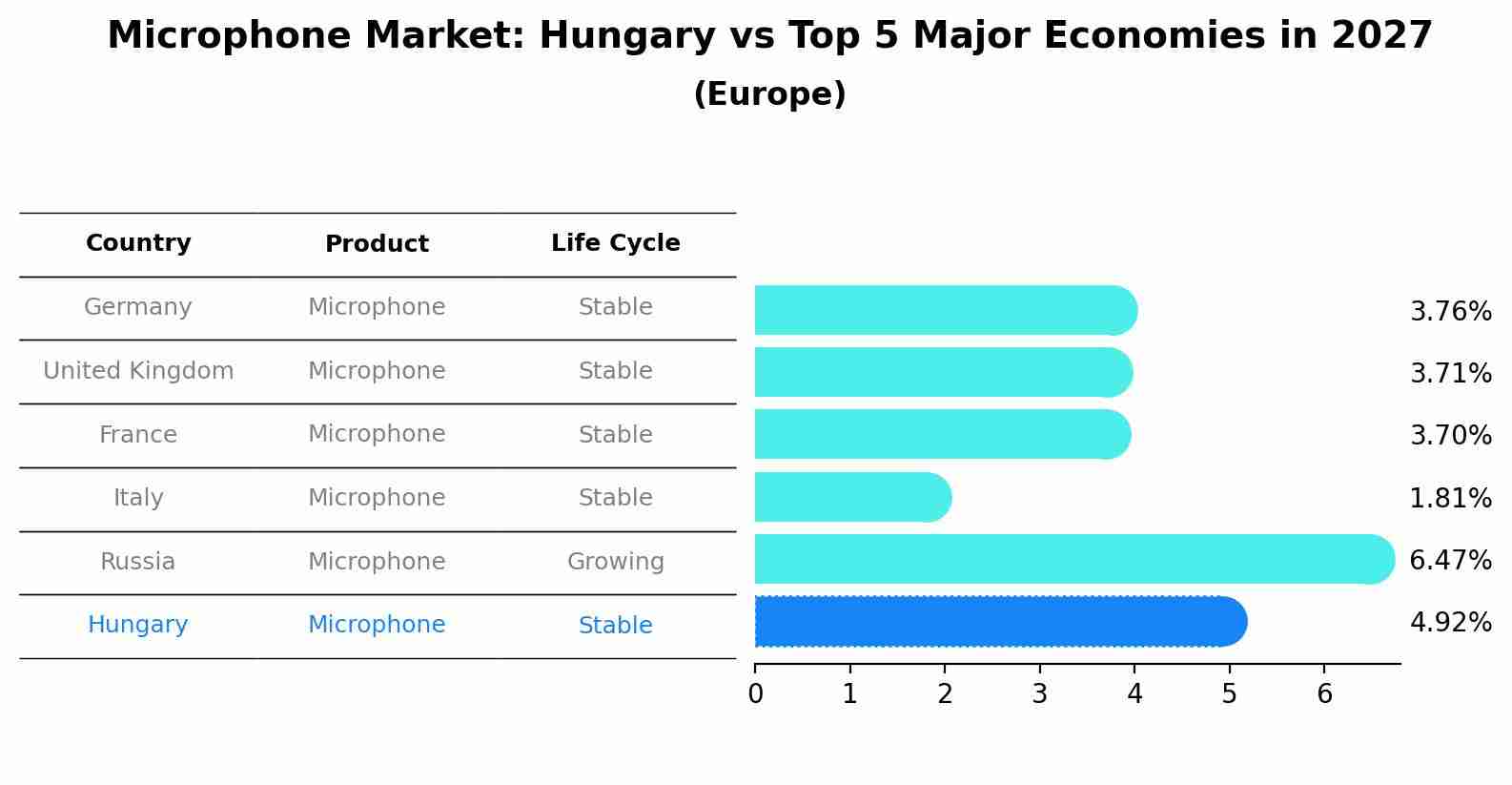
Microphone Market: Hungary vs Top 5 Major Economies in 2027 (Europe)
By 2027, Hungary's Microphone market is forecasted to achieve a stable growth rate of 4.92%, with Germany leading the Europe region, followed by United Kingdom, France, Italy and Russia.
Hungary Microphone Market Overview
The microphone market in Hungary is witnessing steady growth driven by the rising demand for audio recording and communication devices across various sectors including entertainment, telecommunications, automotive, and consumer electronics. Microphones are essential components in devices such as smartphones, tablets, laptops, headphones, and professional audio equipment. With the growing popularity of voice-controlled smart devices, virtual meetings, and online content creation, the demand for high-quality microphones is expected to continue rising in Hungary.
Drivers of the market
The Hungary Microphone Market is influenced by the growing adoption of audio communication and recording solutions across various sectors including entertainment, telecommunications, and automotive. Microphones play a critical role in voice-enabled devices, conferencing systems, and automotive infotainment systems, driving their demand in Hungary. Moreover, technological advancements such as noise cancellation and voice recognition capabilities further propel market growth by enhancing microphone performance and functionality.
Challenges of the market
The Hungary microphone market confronts challenges related to technological obsolescence and evolving user preferences, particularly with the shift towards wireless and noise-canceling technologies. Moreover, ensuring quality control and consistency in microphone performance across different applications require stringent manufacturing standards and testing protocols. Additionally, addressing price pressures and competitive dynamics in the audio equipment market necessitates continuous innovation and cost optimization strategies.
Government Policy of the market
The Hungary government has implemented regulations to ensure the quality and performance of microphones sold in the market. These regulations include product certification requirements and standards for sound quality and sensitivity. Additionally, the government supports research and development in microphone technology to promote innovation and enhance the competitiveness of domestic manufacturers.
Key Highlights of the Report:
- Hungary Microphone Market Outlook
- Market Size of Hungary Microphone Market, 2019
- Forecast of Hungary Microphone Market, 2026
- Historical Data and Forecast of Hungary Microphone Revenues & Volume for the Period 2016 - 2026
- Hungary Microphone Market Trend Evolution
- Hungary Microphone Market Drivers and Challenges
- Hungary Microphone Price Trends
- Hungary Microphone Porter's Five Forces
- Hungary Microphone Industry Life Cycle
- Historical Data and Forecast of Hungary Microphone Market Revenues & Volume By MEMS Type for the Period 2016 - 2026
- Historical Data and Forecast of Hungary Microphone Market Revenues & Volume By Analog for the Period 2016 - 2026
- Historical Data and Forecast of Hungary Microphone Market Revenues & Volume By Digital for the Period 2016 - 2026
- Historical Data and Forecast of Hungary Microphone Market Revenues & Volume By Technology for the Period 2016 - 2026
- Historical Data and Forecast of Hungary Microphone Market Revenues & Volume By Electret for the Period 2016 - 2026
- Historical Data and Forecast of Hungary Microphone Market Revenues & Volume By MEMS for the Period 2016 - 2026
- Historical Data and Forecast of Hungary Microphone Market Revenues & Volume By Others for the Period 2016 - 2026
- Historical Data and Forecast of Hungary Microphone Market Revenues & Volume By Communication Technology for the Period 2016 - 2026
- Historical Data and Forecast of Hungary Microphone Market Revenues & Volume By Wired for the Period 2016 - 2026
- Historical Data and Forecast of Hungary Microphone Market Revenues & Volume By Wireless for the Period 2016 - 2026
- Historical Data and Forecast of Hungary Microphone Market Revenues & Volume By Applications for the Period 2016 - 2026
- Historical Data and Forecast of Hungary Microphone Market Revenues & Volume By Automotive for the Period 2016 - 2026
- Historical Data and Forecast of Hungary Microphone Market Revenues & Volume By Commercial Security & Surveillance for the Period 2016 - 2026
- Historical Data and Forecast of Hungary Microphone Market Revenues & Volume By Consumer Electronics for the Period 2016 - 2026
- Historical Data and Forecast of Hungary Microphone Market Revenues & Volume By Industrial for the Period 2016 - 2026
- Historical Data and Forecast of Hungary Microphone Market Revenues & Volume By Medical for the Period 2016 - 2026
- Historical Data and Forecast of Hungary Microphone Market Revenues & Volume By Noise Monitoring & Sensing for the Period 2016 - 2026
- Hungary Microphone Import Export Trade Statistics
- Market Opportunity Assessment By MEMS Type
- Market Opportunity Assessment By Technology
- Market Opportunity Assessment By Communication Technology
- Market Opportunity Assessment By Applications
- Hungary Microphone Top Companies Market Share
- Hungary Microphone Competitive Benchmarking By Technical and Operational Parameters
- Hungary Microphone Company Profiles
- Hungary Microphone Key Strategic Recommendations






































