Hungary Molded Pulp Packaging Market Size, Share & Growth Rate
The Hungary Molded Pulp Packaging Market was estimated at USD 228 Million in 2025 and is projected to reach USD 315 Million by 2032, growing at a CAGR of 4.7% from 2026 to 2032. This growth trajectory is fueled by an increasing demand for sustainable packaging solutions driven by heightened environmental awareness among consumers and businesses alike. Regulations aimed at reducing plastic waste further enhance the appeal of molded pulp packaging, making it an attractive alternative across various sectors.
Hungary Molded Pulp Packaging Market Year-wise Growth Rate and Key Drivers
This graph highlights how the Hungary Molded Pulp Packaging Market has steadily grown over the years, supported by major growth factors.
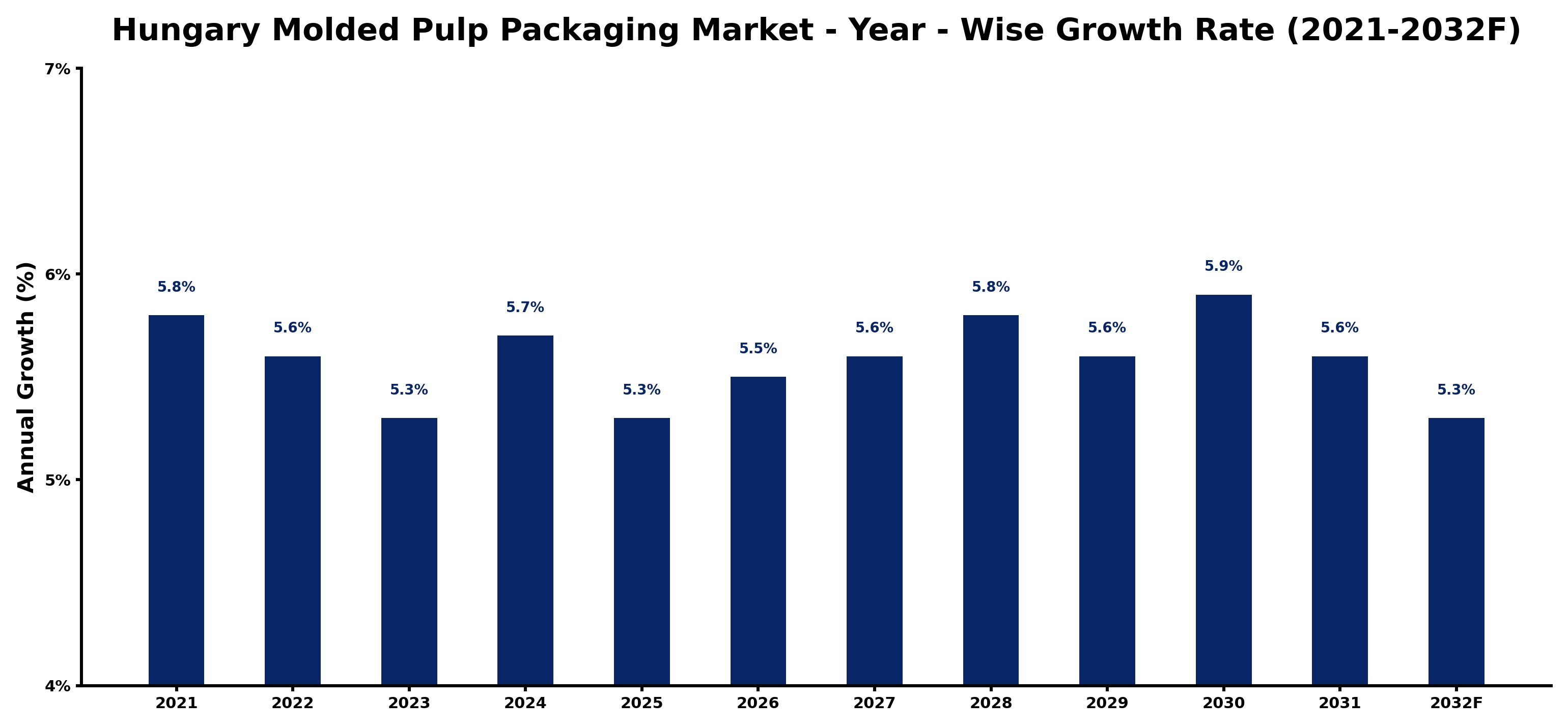
The table below presents the year‑wise growth rates along with the key drivers influencing the market
| Year | Growth Rate | Major Drivers |
| 2021 | 5.8% | Expansion of transportation and logistics networks |
| 2022 | 5.6% | Increasing adoption of advanced technologies |
| 2023 | 5.3% | Government infrastructure modernization initiatives |
| 2024 | 5.7% | Government infrastructure modernization initiatives |
| 2025 | 5.3% | Rapid growth in telecom and data center sectors |
| 2026 | 5.5% | Rising electricity demand across industries |
| 2027 | 5.6% | Expansion of manufacturing activities |
| 2028 | 5.8% | Expansion of transportation and logistics networks |
| 2029 | 5.6% | Increasing adoption of advanced technologies |
| 2030 | 5.9% | Government infrastructure modernization initiatives |
| 2031 | 5.6% | Rapid growth in telecom and data center sectors |
| 2032 | 5.3% | Expansion of commercial construction activities |
Note - Market size estimations and growth projections presented in this report are based on 6Wresearch’s advanced forecasting approach, validated with industry datasets as of June 2026.
Hungary Molded Pulp Packaging Market Synopsis
While the Hungary molded pulp packaging market has gained momentum due to its eco-friendly properties, it is on the cusp of a more significant transformation. The industry is increasingly aligning with global sustainability trends, signaling a robust shift toward more responsible consumption patterns that prioritize biodegradable materials.
Looking ahead, the market is set to experience accelerated growth as technological innovations continue to enhance product capabilities. Companies are not only focusing on meeting regulatory standards but also on exceeding consumer expectations, which positions molded pulp packaging as a crucial component in the broader narrative of sustainability.
Hungary Molded Pulp Packaging Market Key Takeaways
- The market is driven by strong consumer preferences for sustainable and biodegradable packaging solutions.
- Technological advancements are enhancing product performance and design flexibility in molded pulp packaging.
- Regulatory frameworks encourage the adoption of eco-friendly materials to reduce environmental impacts.
- Increasing e-commerce activities are creating new opportunities for molded pulp packaging applications.
- Brands are actively investing in molded pulp solutions to lower their carbon footprints.
Evaluation of Restraints in Hungary Molded Pulp Packaging Market
Despite its promising growth, the Hungary molded pulp packaging market faces several constraints. A key challenge remains the need for constant innovation in developing packaging solutions that effectively protect products while adhering to sustainability norms. Manufacturers must also navigate complexities related to product compatibility, ensuring that molded pulp packaging maintains integrity and extends shelf life. Additionally, it is essential to educate consumers on the environmental benefits of these materials, as this knowledge is critical for widespread market acceptance and adoption.
Hungary Molded Pulp Packaging Market Trends
Current trends indicate a significant shift towards utilizing recycled and renewable materials in the molded pulp packaging sector. Enhanced consumer awareness about environmental issues is spurring demand for packaging that is not only sustainable but also offers customization options. Technological innovations are paving the way for advanced production techniques, enabling manufacturers to create lighter and more robust products that can meet diverse market needs.
Hungary Molded Pulp Packaging Market Opportunities
Opportunities for growth in the Hungary molded pulp packaging market are abundant. The increasing penetration of e-commerce provides a fertile ground for molded pulp applications, particularly in protective packaging. Additionally, businesses looking to improve their sustainability practices present a ripe opportunity for suppliers of molded pulp solutions. Investments in R&D aimed at further improving product functionality could also yield substantial benefits, aligning offerings more closely with consumer and regulatory demands.
Government Initiatives in the Hungary Molded Pulp Packaging Market
The Hungarian government has taken proactive steps to encourage the use of molded pulp packaging as a sustainable alternative to conventional materials. Various policies aim to curb plastic waste and reduce environmental pollution, fostering a circular economy through the promotion of renewable and biodegradable packaging solutions. Additionally, incentives and grants are available to support businesses in adopting these innovative materials, alongside regulations that enforce standards for recyclability, compostability, and food safety in packaging design and production.
Future Insights of the Hungary Molded Pulp Packaging Market
As we look toward 2026 and beyond, the Hungary molded pulp packaging market is anticipated to evolve significantly. Increased regulatory support for sustainable practices will likely encourage more companies to adopt molded pulp solutions. Furthermore, advancements in production technology are expected to enhance the efficiency and versatility of molded pulp products, providing a stronger competitive edge. Ultimately, this market will play a crucial role in advancing environmental sustainability across various industries.
Hungary Molded Pulp Packaging Market Latest Developments (May 2025 - June 2026)
Recent industry developments indicate a robust push towards enhancing the functionality of molded pulp packaging. Companies are focusing on incorporating new design techniques and materials that improve product performance while ensuring adherence to sustainability principles. Collaborative efforts among stakeholders are also emerging, aimed at fostering innovations that not only meet market demands but also align with broader environmental goals.
Hungary Molded Pulp Packaging Market - Key Attractiveness of the Report
- 10 Years of Market Numbers
- Historical Data Starting from 2022 to 2025
- Base Year: 2025
- Forecast Data until 2032
- Key Performance Indicators Impacting the Market
- Major Upcoming Developments and Projects
Key Highlights of the Report:
- Hungary Molded Pulp Packaging Market Outlook
- Market Size of Hungary Molded Pulp Packaging Market, 2025
- Forecast of Hungary Molded Pulp Packaging Market, 2032
- Historical Data and Forecast of Hungary Molded Pulp Packaging Revenues & Volume for the Period 2022-2032F
- Hungary Molded Pulp Packaging Market Trend Evolution
- Hungary Molded Pulp Packaging Market Drivers and Challenges
- Hungary Molded Pulp Packaging Price Trends
- Hungary Molded Pulp Packaging Porter's Five Forces
- Hungary Molded Pulp Packaging Industry Life Cycle
- Historical Data and Forecast of Hungary Molded Pulp Packaging Market Revenues & Volume By Source for the Period 2022-2032F
- Historical Data and Forecast of Hungary Molded Pulp Packaging Market Revenues & Volume By Wood Pulp for the Period 2022-2032F
- Historical Data and Forecast of Hungary Molded Pulp Packaging Market Revenues & Volume By Non-wood Pulp for the Period 2022-2032F
- Historical Data and Forecast of Hungary Molded Pulp Packaging Market Revenues & Volume By Molded Type for the Period 2022-2032F
- Historical Data and Forecast of Hungary Molded Pulp Packaging Market Revenues & Volume By Thick Wall for the Period 2022-2032F
- Historical Data and Forecast of Hungary Molded Pulp Packaging Market Revenues & Volume By Transfer for the Period 2022-2032F
- Historical Data and Forecast of Hungary Molded Pulp Packaging Market Revenues & Volume By Thermoformed for the Period 2022-2032F
- Historical Data and Forecast of Hungary Molded Pulp Packaging Market Revenues & Volume By Processed for the Period 2022-2032F
- Historical Data and Forecast of Hungary Molded Pulp Packaging Market Revenues & Volume By Product for the Period 2022-2032F
- Historical Data and Forecast of Hungary Molded Pulp Packaging Market Revenues & Volume By Trays for the Period 2022-2032F
- Historical Data and Forecast of Hungary Molded Pulp Packaging Market Revenues & Volume By End Caps for the Period 2022-2032F
- Historical Data and Forecast of Hungary Molded Pulp Packaging Market Revenues & Volume By Bowls & Cups for the Period 2022-2032F
- Historical Data and Forecast of Hungary Molded Pulp Packaging Market Revenues & Volume By Clamshells for the Period 2022-2032F
- Historical Data and Forecast of Hungary Molded Pulp Packaging Market Revenues & Volume By Plates for the Period 2022-2032F
- Historical Data and Forecast of Hungary Molded Pulp Packaging Market Revenues & Volume By Others for the Period 2022-2032F
- Hungary Molded Pulp Packaging Import Export Trade Statistics
- Market Opportunity Assessment By Source
- Market Opportunity Assessment By Molded Type
- Market Opportunity Assessment By Product
- Hungary Molded Pulp Packaging Top Companies Market Share
- Hungary Molded Pulp Packaging Competitive Benchmarking By Technical and Operational Parameters
- Hungary Molded Pulp Packaging Company Profiles
- Hungary Molded Pulp Packaging Key Strategic Recommendations






































